

Constant user complaints, inefficient traffic flow, and unauthorised vehicles are often symptoms of a flawed approach to car parking control management. For many developers and property managers, these issues create significant daily challenges that jeopardise safety, user satisfaction, and critical planning application / development application (DA) approvals. The common response is to focus on reactive enforcement, but the most effective solutions are established long before the first vehicle arrives.
This guide moves beyond reactive tactics to focus on the true foundation of a successful car park: strategic design and expert planning. We provide the essential framework for creating a facility that is fully compliant with Australian Standards (AS 2890.1), maximises both space and traffic flow efficiency, and meets complex council requirements from day one. You will learn how to engineer a compliant, high-functioning asset that prevents common issues, reduces long-term management headaches, and supports a smooth planning process.
What is Parking Control Management? (Beyond Just Enforcement)
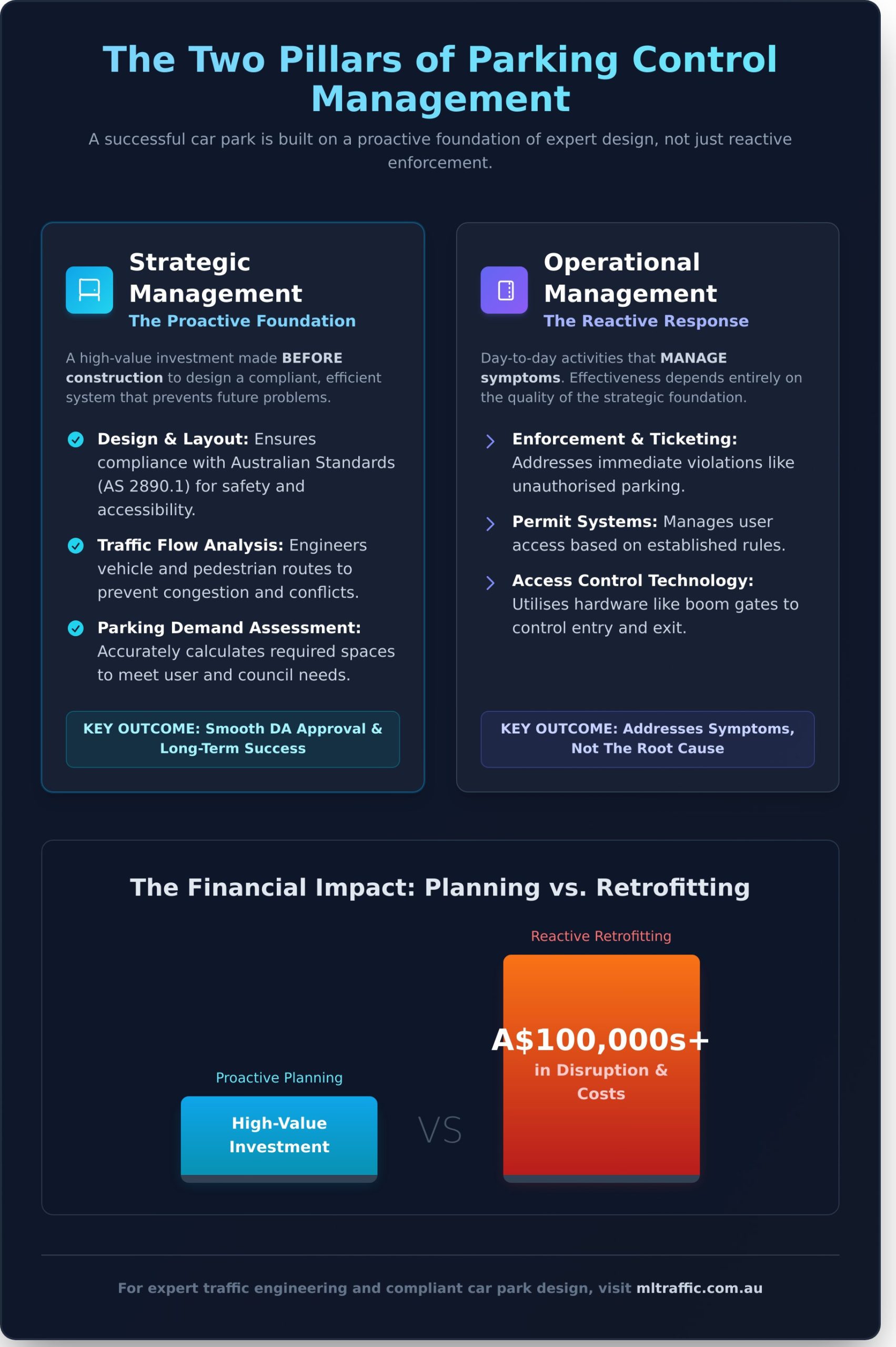
Effective parking control management is a comprehensive system designed to ensure safety, efficiency, and compliance within a car park. It extends far beyond simple enforcement and ticketing. At its core, it is a discipline that integrates proactive design with reactive day-to-day administration. A detailed overview of parking’s role in urban planning helps clarify what parking control management is at a foundational level. The entire practice can be broken down into two distinct but interconnected pillars: Strategic Planning and Operational Management.
For a visual summary of these core concepts, the following video provides a clear overview:
A frequent and costly mistake is to focus solely on operational issues like illegal parking without addressing the underlying strategic flaws. Persistent operational problems are almost always a symptom of poor initial design. Proactive planning is a high-value investment, whereas retrofitting a poorly designed car park to fix issues like congestion or non-compliance can cost hundreds of thousands of Australian Dollars (A$) and cause significant disruption.
Strategic Management: The Foundation of Success
Strategic management is the proactive foundation of any successful car park. This phase occurs before construction or implementation and focuses on designing a system that inherently prevents problems. It is the core service provided by professional traffic engineering consultants. Key activities in this stage include:
-
Design and Layout: Ensuring parking bays, aisles, and ramps meet Australian Standards (AS 2890.1) for safety and accessibility.
-
Traffic Flow Analysis: Engineering vehicle and pedestrian routes to prevent congestion and conflicts.
-
Parking Demand Assessment: Accurately calculating the required number of spaces to meet user demand and council requirements.
Operational Management: The Day-to-Day Activities
Operational management encompasses the day-to-day activities required to maintain order and enforce the rules established during the strategic phase. These services are typically handled by specialised parking enforcement or facilities management companies. This includes enforcement, ticketing, permit systems, and access control technology like boom gates. While essential, these actions address the symptoms, not the root cause, of parking issues. ML Traffic Engineers designs the strategic framework that enables these operational systems to function effectively and efficiently.
The Blueprint for Control: Compliant Design with AS 2890.1
Effective parking control management begins long before the first vehicle enters a car park. It starts with a design blueprint founded on strict compliance with Australian Standard AS 2890.1, the mandatory code for off-street parking facilities. Adherence to this standard is not optional; it is a fundamental requirement for securing Development Application (DA) approval from local councils across Australia.
Compliance is more than a bureaucratic necessity. It is a strategic investment in operational efficiency and safety. A car park designed to AS 2890.1 specifications ensures logical traffic circulation, minimises the risk of accidents, and prevents the common frustrations that lead to disputes and difficult enforcement. By engineering control into the physical layout, you reduce long-term management costs and simplify daily operations. These foundational design principles align with broader Core Strategies for Effective Parking Management, which demonstrate how well-planned infrastructure directly improves urban mobility and user experience.
Key Design Elements Dictated by AS 2890.1
AS 2890.1 provides precise technical specifications for the core components of a car park layout. Getting these details right is critical for functionality and preventing common parking problems like vehicle damage or inaccessible bays. Key requirements include:
-
Parking space dimensions and clearances: Prescribes minimum widths, lengths, and overhead clearances for various parking angles (e.g., 90-degree, 60-degree) to ensure vehicles can park and open doors safely.
-
Aisle widths and circulation roadways: Defines the minimum width of aisles to allow for safe, two-way traffic flow and efficient entry and exit from parking spaces.
-
Ramp grades and transitions: Sets maximum gradients for ramps and specifies the design of transitions to prevent vehicles, particularly those with low ground clearance, from scraping their undercarriage.
-
Sight lines: Mandates clear lines of sight at entrances, exits, and internal intersections to prevent collisions between vehicles and with pedestrians.
Ensuring Accessibility and Safety
A compliant design prioritises the safety of all users, not just drivers. This involves specific measures for pedestrians and individuals with disabilities. AS 2890.6 is the dedicated standard for disabled parking spaces, detailing dimensions, location, and shared area requirements. Furthermore, a safe facility incorporates clearly marked pedestrian walkways, adequate lighting for security, and unambiguous signage to guide drivers and prevent confusion, forming an essential layer of your parking control management strategy.
Vehicle Swept Path Analysis
A swept path analysis is a technical assessment that models the turning path of a design vehicle, from a small car to a large delivery truck. This analysis is critical to verify that vehicles can manoeuvre through the car park-navigating ramps, turning in aisles, and entering bays-without colliding with columns, walls, or other vehicles. It is a proactive tool that identifies and eliminates potential bottlenecks and structural damage risks before construction begins. Ensure your design is compliant with a professional assessment.
Core Strategies for Effective Parking Management
Effective parking control management is not an afterthought; it is a critical component established during the initial design phase of a development. The selection of control strategies is fundamentally tied to the land use of the site. A high-turnover retail centre requires a different approach to a private residential building or a commercial office with dedicated staff parking. An experienced traffic consultant is essential in determining the most suitable mix of strategies to ensure functionality, safety, and compliance with council regulations.
These strategies are planned conceptually but have direct physical implementations that dictate the user experience and operational efficiency of the car park.
Access Control Systems
Physical access control is a primary strategy for managing who enters a car park and when. This is typically achieved through a combination of systems:
-
Boom gates: To regulate the flow of vehicles at entry and exit points.
-
Security card readers or ticket systems: To grant access to authorised users, such as tenants, staff, or paid visitors.
-
Intercoms: To provide assistance for visitors or in case of equipment malfunction.
A critical design consideration is planning for adequate vehicle queueing space (stacking distance) before any boom gate. This prevents vehicles from backing up onto the public street network, a common point of failure in poorly designed systems and a major concern for local councils.
Parking Allocation and Wayfinding
A well-managed car park clearly communicates its layout to drivers. This strategy involves the logical allocation of spaces for different user groups, including designated bays for visitors, tenants, staff, deliveries, and accessible parking (in compliance with AS 2890.6). This allocation is physically implemented through clear, durable line marking and logical signage. Effective wayfinding is a non-negotiable component; it minimises circulation time, reduces driver frustration, and lowers the risk of internal vehicle conflicts, ensuring a safe and efficient facility.
Demand-Responsive Strategies
The foundation of any parking strategy is ensuring the correct supply of spaces. A professional Car Parking Demand Assessment is the formal process used to determine the appropriate number of bays for a development. This assessment analyses site-specific data, council planning schemes, and industry rates to justify the proposed parking supply, preventing costly over-provision or a non-compliant under-supply. Forward-thinking design also incorporates future needs, such as allocating infrastructure for EV charging stations and designated bays for shared mobility. Adapting to emerging trends in Modern Parking Control ensures the development remains functional and valuable for years to come.
Technology’s Role in Modern Parking Control
Effective parking control management is no longer a matter of painted lines and signage alone. Today, it is a technology-driven discipline focused on maximising efficiency, enhancing user experience, and generating revenue. Integrating technology is not an afterthought; the foundational infrastructure for these systems must be incorporated during the initial car park design phase to avoid costly and disruptive retrofitting.
Failure to plan for cabling, power supply, and sensor placement from the outset can render a new facility operationally obsolete before it even opens. An experienced traffic consultant provides the necessary foresight to future-proof the design, ensuring it supports both current and emerging technologies. This strategic approach links a seamless user journey directly to the asset’s commercial performance.
Automated and Digital Systems
Digital systems are the cornerstone of modern parking operations, automating processes to improve traffic flow and user convenience. Key technologies include:
-
Automatic Number Plate Recognition (ANPR): Enables ticketless, frictionless entry and exit, reducing queues and improving vehicle throughput.
-
Parking Guidance Systems (PGS): Use sensors and dynamic signage to direct drivers to available bays, minimising circulation time and driver frustration.
-
App-Based Booking and Payment: Offer visitors the convenience of pre-booking and paying for parking via their smartphones, streamlining the process and guaranteeing a space.
Planning for Electric Vehicle (EV) Charging
The rise of electric vehicles presents a critical planning consideration. Integrating EV charging stations is now a fundamental aspect of future-proofing a car park. The initial design must account for the significant electrical capacity required and include the strategic layout of conduits to designated charging bays. This pre-planning avoids expensive excavation and rewiring later. The allocation of EV bays also impacts the overall management strategy, often requiring different time limits or pricing structures.
Data and Analytics
Modern parking systems provide a wealth of valuable data. This information is crucial for optimising the facility’s performance. By analysing usage patterns, operators can identify peak demand periods, average length of stay, and bay turnover rates. This data enables dynamic pricing strategies, informs the allocation of reserved versus casual bays, and helps refine the overall parking control management strategy for maximum efficiency and revenue. An effective design ensures that sensors and data collection points are positioned to capture this critical information accurately.
How a Traffic Consultant Delivers Effective Parking Control
Effective parking control management is not merely about enforcement; it is a direct result of strategic, compliant design. While a parking operator manages an existing system, a traffic engineering consultant creates the blueprint for success. Engaging an expert at the planning stage is the most crucial step to prevent the chronic issues-congestion, safety hazards, and non-compliance-that plague poorly designed car parks. The consultant’s role is to engineer a solution that is functional, safe, and built to code from the ground up.
This fundamental difference is key: an enforcement company reacts to problems within a fixed layout, whereas a traffic consultant proactively eliminates those problems before they are built.
Navigating the Development Application (DA) Process
A successful development hinges on council approval, and parking is a critical assessment point. A traffic consultant prepares the mandatory Traffic and Parking Impact Assessment report required for your DA submission. This technical document provides council with empirical evidence that the parking supply is appropriate for the land use, access points are safe, and the design complies with all local planning codes and Australian Standards. We act as your technical representative, liaising directly with authorities to resolve queries and justify the design, streamlining the approval process.
Optimising Layout for Efficiency and Safety
A high-performing car park balances capacity, safety, and user experience. Our engineers leverage specialised software like AutoTURN for precise swept path analysis, ensuring every vehicle can manoeuvre without conflict. This data-driven approach allows us to:
-
Maximise the number of fully compliant parking bays within a given footprint.
-
Design safe and efficient access driveways and internal circulation routes.
-
Ensure ramp grades, bay dimensions, and aisle widths meet AS 2890.1 requirements.
-
Eliminate blind spots and improve sight lines for pedestrians and drivers.
Certifying Compliance and Future-Proofing
The final stage of the design process is certification. A traffic engineering consultant provides formal certification confirming that the as-built car park complies with all approved plans and relevant standards. This certification is a non-negotiable requirement for obtaining your final Occupation Certificate. Beyond today’s rules, we also provide strategic advice on future-proofing your asset, such as planning for electric vehicle (EV) charging infrastructure or adapting to changes in vehicle technology. This foresight ensures your investment remains functional and valuable. Get an expert review of your parking plans today.
Finalising Your Parking Control Strategy
Effective parking management is a comprehensive discipline, extending far beyond simple enforcement. Its foundation lies in a compliant design that adheres strictly to Australian Standards like AS 2890.1, combined with a strategic approach that leverages technology for efficiency and user satisfaction. Achieving this synthesis of design, strategy, and compliance is fundamental to successful parking control management and is the key to maximising the value and functionality of your development.
Navigating these technical requirements demands specialist knowledge. With over 15 years of dedicated experience, the team at ML Traffic Engineers provides expert guidance grounded in deep expertise of AS 2890.1. Our proven track record in securing Development Application approvals across Australia ensures your project is not only compliant but optimised for success. Contact our expert traffic engineers for a compliant and efficient car park design assessment. Ensure your project’s compliance and efficiency from the outset.
Frequently Asked Questions
What is the difference between a parking management plan and a parking enforcement service?
A parking management plan is a strategic document developed by a traffic consultant. It outlines the design, layout, allocation of spaces, and operational rules to ensure safety, efficiency, and compliance with Australian Standards. It is the foundational blueprint for how the car park should function.
A parking enforcement service is the operational implementation of that plan. It is typically carried out by a parking operator and involves activities like monitoring, ticketing, and managing access control systems to ensure drivers adhere to the established rules.
How do I determine the right number of car parking spaces for my development?
The correct number of spaces is determined through a professional Car Parking Demand Assessment. This technical analysis considers the specific land use, local council planning controls, and empirical data on peak demand. It is not a guess; it is a calculated figure based on established traffic engineering principles.
The goal is to satisfy regulatory requirements and meet user demand without over-supplying spaces, which is an inefficient use of valuable land. An experienced traffic consultant provides this essential assessment for development applications.
Why is a Vehicle Swept Path Analysis essential for my car park design?
A Vehicle Swept Path Analysis is critical to verify that vehicles can safely and efficiently manoeuvre throughout a car park. The assessment models the turning path of a design vehicle to ensure it can navigate ramps, corners, and parking aisles without colliding with columns, walls, or other structures.
Failing to conduct this analysis can result in an unsafe, non-compliant, and dysfunctional facility that is difficult for drivers to use and may require expensive remedial works post-construction.
Do I need a traffic consultant or a parking operator to solve my issues?
This depends on the nature of the problem. A traffic consultant is required for issues related to design, compliance, and planning approvals. They provide the technical expertise for layout design, swept path analysis, and ensuring adherence to AS 2890.1 for a development application.
Conversely, a parking operator is engaged to solve day-to-day operational issues. This includes managing enforcement, ticketing technology, staffing, and revenue collection. For design and strategy, you need a consultant; for ongoing operations, you need an operator.
How does AS 2890.1 compliance affect the long-term management of my car park?
Adherence to Australian Standard AS 2890.1 is fundamental to successful long-term parking control management. This standard dictates critical design elements like bay dimensions, aisle widths, ramp grades, and sight lines, ensuring the car park is inherently safe and functional for all users.
A compliant design minimises operational issues such as vehicle damage, access conflicts, and potential liability. It prevents costly retrofits and ensures the facility can be managed efficiently and safely throughout its entire operational lifespan.
Can you design car parks to accommodate large trucks and delivery vehicles?
Yes. Accommodating heavy vehicles requires a specialised design approach. It involves a detailed Vehicle Swept Path Analysis using the appropriate design vehicle, such as a Medium Rigid Vehicle (MRV) or a semi-trailer, to ensure adequate geometric design for safe access and egress.
Critical considerations include specifying sufficient vertical clearances, generous turning radii, appropriate ramp grades, and designing robust loading docks. This ensures service vehicles can operate safely without disrupting general traffic or damaging infrastructure.
Which areas do you service?
We are traffic engineers covering Melbourne, Sydney, Brisbane, Gold Coast, Hobart, Perth, Adelaide, Darwin and surrounding areas.
