

Did you know that mandatory minimum parking requirements add up to A$137,000 to the cost of a single two-bedroom apartment? Research from the Grattan Institute in May 2026 reveals that Australia spends over A$1 billion annually on parking spaces that often sit empty. For developers, mastering parking generation rates australia is no longer just about basic compliance; it’s a matter of project viability. You likely deal with the high cost of basement construction and conflicting rates between regulatory bodies. A refusal of your development application due to inadequate parking supply is a risk you can’t afford, yet over-supplying parking destroys your margins.
This guide provides the technical clarity required to optimise your development’s footprint and ensure compliance with AS 2890.1. We’ll examine statutory benchmarks, recent regulatory shifts impacting parking provisions across Australia, and the specific tipping point where an empirical Car Parking Demand Assessment becomes your most valuable tool for achieving development approval. We’ll detail how to align your project with current Australian standards while protecting your bottom line through precise Traffic Impact Assessment (TIA) Reports and Vehicle Swept Path Analysis, leveraging the expertise of ML Traffic Engineers Australia.
Key Takeaways
- Understand the fundamental role of parking rates within a Traffic Impact Assessment (TIA) to accurately predict peak vehicle attraction for specific land uses.
- Identify the primary regulatory benchmarks used by Australian authorities, specifically the RMS Guide to Traffic Generating Developments and Austroads Part 12.
- Learn to identify the ‘tipping point’ when standard parking generation rates australia over-estimate demand, necessitating an empirical Car Parking Demand Assessment.
- Discover strategic methods to justify parking shortfalls or credits by using Vehicle Swept Path Analysis to demonstrate site efficiency and safety.
- Secure DA approvals by leveraging senior-led technical expertise to navigate conflicting requirements between local councils and state road authorities.
Understanding Parking Generation Rates in the Australian Planning Context
Parking generation rates represent the technical prediction of how many vehicles a specific land use will attract during its peak operational period. This metric is the foundation of any professional Traffic Impact Assessment. It dictates the physical space required for a development to function without impacting the surrounding road network. For a broader context on how these spaces are managed as a critical urban resource, Understanding Parking as a land use is essential for developers.
In the Australian context, these rates are usually expressed as a ratio. For residential projects, this is typically spaces per dwelling or bedroom. For commercial and industrial developments, the standard is spaces per 100 square metres of Gross Floor Area (GFA). Getting these numbers right is a high-stakes calculation. Data from the Grattan Institute in May 2026 indicates that mandatory minimums add between A$62,000 and A$137,000 to the cost of a typical two-bedroom apartment. Over-supply erodes project feasibility. Under-supply risks DA refusal due to potential traffic overflow into local streets.
To better understand how these technical requirements translate to the street level, watch this helpful video:
The Statutory Framework for Australian Parking
Australian parking requirements operate within a complex hierarchy. Local government Development Control Plans (DCPs) usually provide the baseline. However, state planning policies can override these local controls to drive specific urban outcomes. For instance, the Victorian car parking requirement changes that took effect on December 18, 2025, introduced a four-category system based on public transport accessibility. This shift demonstrates how state-level reforms can supersede traditional council benchmarks. Effective Car Park Design must account for these shifting statutory frameworks to ensure proposed numbers are both compliant and functional.
Land Use Categories and Their Impact
The parking generation rates australia utilizes vary significantly across land use categories. A high-turnover retail site requires a vastly different assessment than a long-term storage warehouse. Mixed-use developments introduce further complexity through ancillary uses. These are secondary functions, like a small cafe within an office block, which may not require their own dedicated parking if they primarily serve the main site occupants. Location is the final critical variable. Sites classified as Category 4 in Victoria, which have the highest public transport access, now have no mandatory minimums and only maximum rates. This reflects a national trend toward transport-oriented development where proximity to rail or high-frequency bus networks allows for a reduction in the base parking requirement.
Primary Sources for Parking Rate Benchmarks: RMS, Austroads, and Council DCPs
Developers must rely on established technical benchmarks to justify their parking supply. The most significant source is the Transport for NSW (formerly RMS) Guide to Traffic Generating Developments. While NSW centric, it serves as the de facto standard across many Australian jurisdictions. It provides a structured methodology for calculating demand based on land use size and type.
National perspectives are provided by the Austroads Guide to Traffic Management Part 12. This document offers a broader view of parking demand management across the country. However, these benchmarks only address the quantity of spaces. The AS 2890 series (Australian Standards for Parking Facilities) ensures those spaces are functional. It covers critical technical specifications including stall dimensions, aisle widths, and ramp gradients. Compliance with AS 2890.1 is a non-negotiable requirement for DA approval in most councils.
Navigating the RMS Guide to Traffic Generating Developments
The RMS Guide differentiates between Peak Generation and Daily Generation rates. Peak rates are critical for intersection analysis and assessing the impact on the immediate road network during the busiest hours. Daily rates determine the total volume of traffic over a 24 hour period. The guide categorizes sites into geographic zones, acknowledging that a commercial hub in a metropolitan CBD has different demand profiles than a regional centre.
A significant challenge remains the age of the data within these guides. Research published by the Australasian Transport Research Forum highlights that many current benchmarks rely on surveys conducted over 20 years ago. These figures often fail to reflect modern high density living, increased work from home trends, or the rise of ride sharing services. Relying solely on outdated parking generation rates australia can lead to significant over-provision of parking, which erodes project feasibility.
Local Council Requirements vs. State Guidelines
Local Development Control Plans (DCPs) often mandate higher parking generation rates australia than state guidelines. Councils frequently prioritize visitor and staff parking to prevent overflow into residential streets. This creates a tension between state-led densification goals and local amenity protection. While a state policy might encourage reduced parking near rail corridors, a local DCP might still demand a strict ratio per bedroom.
Modern planning is shifting from ‘Minimum’ to ‘Maximum’ parking requirements. As seen in the Victorian Category 4 sites introduced in December 2025, some areas now prohibit excessive parking to encourage public transport use. Developers are also exploring ‘unbundled’ parking, where spaces are sold or leased separately from the dwelling. This approach aligns with the Grattan Institute’s 2026 findings on housing affordability. If you are facing conflicting requirements between a DCP and state policy, a formal Car Parking Demand Assessment is the standard method to resolve the discrepancy and protect your project margins.
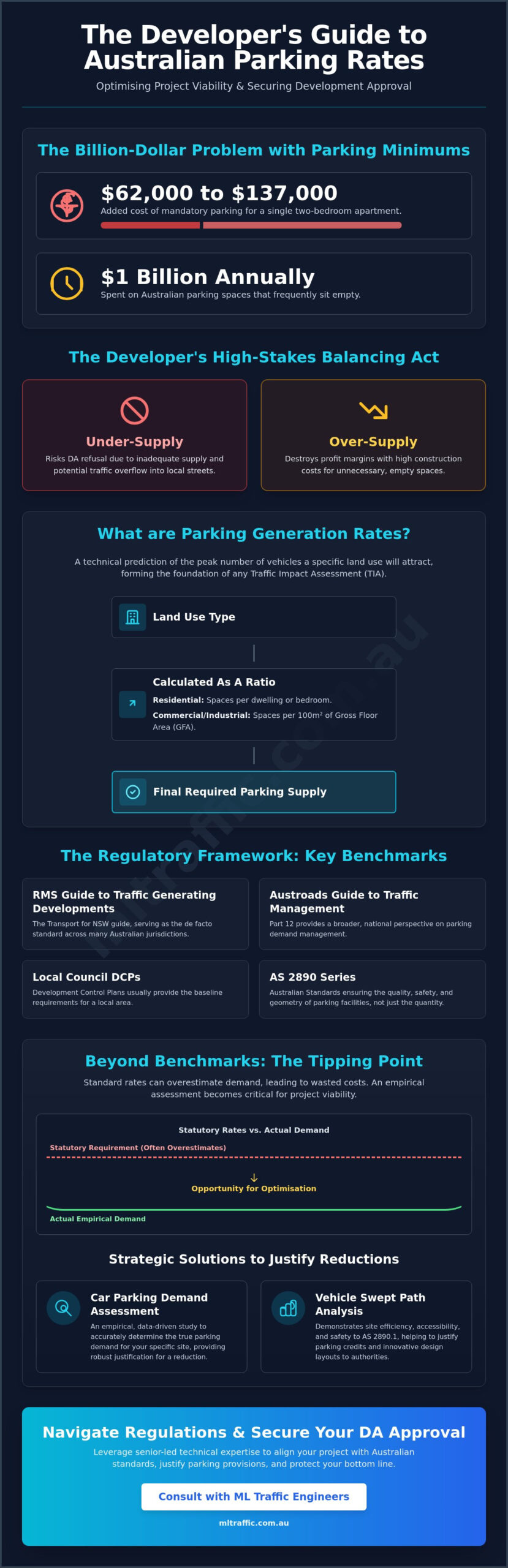
Statutory Requirements vs. Empirical Demand: When Benchmarks Fail
Standard parking generation rates australia councils mandate often fail to reflect actual site behavior in dense urban environments. These benchmarks act as safety nets for planners; they are designed to prevent street congestion, but they frequently over-estimate demand by 20% to 40%. In many apartment buildings, research shows up to 40% of spaces sit empty overnight. This surplus construction is a primary driver of housing unaffordability. It forces developers to build infrastructure that isn’t wanted or used.
The ‘tipping point’ for commissioning a specialized study occurs when the cost of constructing mandated parking threatens project feasibility. If a DCP requires 50 spaces but empirical data suggests 30 are sufficient, the saving on 20 basement spaces can represent millions in capital expenditure. At this stage, a technical justification for a parking reduction becomes a strategic necessity for the developer. It’s the difference between a project that pencils out and one that remains stuck in the planning phase.
Mixed-use developments offer the best opportunity for shared parking arrangements. These sites benefit from non-coincident peak demands. An office peak typically occurs at 11:00 AM on weekdays, while a residential or restaurant peak occurs in the evening or on weekends. By utilizing a shared parking model, developers can significantly reduce the total footprint without compromising the site’s functionality. This approach requires a sophisticated analysis of how different land uses interact over a 24 hour cycle.
Conducting Empirical Parking Surveys
The methodology for a successful survey involves identifying ‘proxy sites’. These are existing developments with similar land-use, size, and demographic profiles within a comparable geographic context. Surveys must capture ‘worst-case’ peak periods to satisfy regulatory scrutiny and prove that the surrounding road network won’t be compromised. This data is then synthesized into a professional Car Parking Demand Assessment report. The report must clearly contrast empirical findings against statutory requirements to provide a robust, evidence-based argument for the DA.
The Role of Multi-Modal Transport and Walkability
Walkability and proximity to high-frequency transport are quantifiable variables that lower parking generation rates australia. Developments in transit-oriented zones see significantly lower car ownership. Census data provides the necessary evidence to prove these lower ownership rates in specific catchments. Integrating car-share schemes within the building design serves as further justification for reduced private parking. These schemes provide residents with vehicle access without the need for individual space ownership, aligning with modern “unbundled” parking trends where spaces are sold or leased separately from the dwelling.
Strategic Approaches to Justifying Parking Reductions for DAs
Securing a parking shortfall requires a technical argument that balances economic feasibility with urban amenity. While parking generation rates australia provide the baseline, they are often negotiable when supported by empirical data and site-specific efficiencies. A key technical requirement is Swept Path Analysis. This ensures that even with a reduced number of spaces, the site remains functional for service vehicles and residents. Proving that a car park design works safely in tight configurations is often the deciding factor for council engineers during the DA process.
Green Travel Plans (GTPs) offer another strategic lever. By committing to non-infrastructure measures like subsidized transit cards or high-quality end-of-trip facilities, developers can justify a lower private car parking ratio. Some councils also accept infrastructure contributions or cash-in-lieu payments. These funds are directed toward public parking or transit improvements in the immediate vicinity. This allows the developer to avoid the excessive costs of deep basement excavation while contributing to broader community transport goals.
Shared Parking and Reciprocal Rights
Shared parking is an effective way to optimize parking generation rates australia for mixed-use sites. This strategy relies on analyzing diurnal patterns. For example, office workers occupy spaces by day, while restaurant patrons or residents use them by night. By calculating a shared parking factor, developers can reduce the total required spaces by 15% to 30% depending on the land-use mix. Legal and operational management is essential for this approach. This often involves registered easements or specific Car Park Management Plans to ensure reciprocal rights are maintained without conflict between different user groups.
Preparing a Professional Parking Justification Report
A parking justification report must be structured to address the specific objectives of the local DCP. It is not enough to state that parking is expensive. You must prove that the reduction will not result in adverse overflow impacts on the surrounding street network. Adherence to national standards is the baseline for credibility. Review our AS 2890.1 explained guide to ensure your layout meets all technical requirements for stall dimensions and ramp grades. A compliant design combined with a robust demand assessment provides the strongest path to approval. If you require expert technical support for your next project, contact our team for a professional Car Parking Demand Assessment today.
Securing Approvals with ML Traffic Engineers Australia
ML Traffic Engineers Australia provides a direct, senior-led approach to solving complex parking and access challenges for developers across the country. With over 15 years of professional experience, we understand the specific technicalities and bureaucratic requirements of local councils and state road authorities. We don’t use gatekeepers; our senior principals are involved in every project to ensure technical accuracy and accountability. This level of expertise is critical when justifying parking generation rates australia that deviate from standard statutory benchmarks.
We promise personnel continuity for every client. The expert who initiates your relationship is the same professional performing the technical work and representing your project during the DA process. We don’t view parking in isolation. Our assessments are integrated into a comprehensive Traffic Engineering strategy. This ensures that parking numbers, intersection analysis, and site access are balanced to protect your project’s feasibility and the surrounding road network’s performance.
Expert Advocacy for Complex Developments
Our team provides expert advocacy across a vast range of project environments, including:
- High-density residential flat buildings and mixed-use towers.
- Commercial office developments and retail shopping centres.
- Industrial warehouses, distribution centres, and business parks.
- Childcare centres, medical clinics, and educational facilities.
- Specialised land uses including service stations and fast-food outlets.
We represent clients in high-stakes negotiations with planning authorities and state agencies. If a project proceeds to the Land and Environment Court, we provide authoritative expert testimony based on rigorous data. Our national project portfolio allows us to leverage reliable proxy data to support parking generation rates australia justifications for non-standard developments where traditional guides fail to reflect modern transport trends.
Start Your Project with a Technical Advantage
Early engagement with a traffic engineer is the most effective way to optimise your site layout. Waiting until the final design phase to address parking often leads to expensive retrofits or lost floor space. We conduct detailed Vehicle Swept Path Analysis and Driveway Ramp Grade Assessments during the initial design stage to ensure your car park is functional and compliant with AS 2890.1. This proactive approach identifies potential opportunities where an empirical survey can save millions in basement construction costs.
Don’t risk a DA refusal or over-building unwanted parking spaces. Contact our senior principals at ML Traffic Engineers Australia directly to discuss a preliminary parking assessment. We provide a no-nonsense, fact-based approach that focuses on demonstrating compliance and achieving results. Our goal is to ensure your development meets all relevant Australian Standards for access and safety while protecting your bottom line.
Secure Your DA Approval with Evidence-Based Parking Strategies
Mastering parking generation rates australia requires a shift from passive compliance to active technical justification. We have explored how standard benchmarks often fail to reflect modern urban realities, potentially burdening projects with excessive infrastructure costs. By leveraging empirical demand data, shared parking models, and functional design through precise swept path analysis, you can align your development’s footprint with actual vehicle attraction while satisfying the most rigorous regulatory scrutiny.
Success in the current planning environment depends on the integration of technical assessments and expert advocacy. ML Traffic Engineers Australia brings over 15 years of national consultancy experience to your project. We provide direct access to senior traffic engineering experts who manage your assessment from inception to final DA approval. Our proven track record is built on meticulous accountability, personnel continuity, and a deep understanding of state and local planning hierarchies.
Don’t let rigid statutory requirements compromise your project’s feasibility or result in a DA refusal. Speak with our Senior Principals about your parking assessment needs today. We look forward to helping you achieve an optimised, compliant, and cost-effective development outcome.
Frequently Asked Questions
What is the difference between a parking rate and a parking demand assessment?
A parking rate is a static, pre-defined benchmark found in planning documents like a DCP, typically expressed as a ratio per dwelling or floor area. A Car Parking Demand Assessment is a site-specific technical study that uses empirical data to justify a deviation from these benchmarks. It accounts for actual usage patterns and local variables rather than relying on generic, often outdated ratios.
Can I use the RMS Guide for developments outside of New South Wales?
The RMS Guide to Traffic Generating Developments is accepted as a primary technical reference across many Australian jurisdictions. While it’s a NSW-specific document, interstate councils and traffic consultants frequently use its data as a reliable baseline when local guides are unavailable. It remains the most comprehensive source for parking generation rates australia for diverse land-use categories.
How much can I reduce my parking requirements if my site is near a train station?
Reductions depend on specific state policies and the proximity to high-frequency transit. For example, under the Victorian regulations effective December 18, 2025, Category 4 sites have no mandatory minimum parking requirements at all. In other regions, developers often secure reductions between 10% and 30% by providing census data that proves lower car ownership rates in transit-oriented catchments.
Does a shared parking arrangement require a formal legal agreement?
Most planning authorities require a formal legal mechanism to ensure shared parking remains functional for the life of the development. This typically involves a Section 88B instrument or a registered easement that grants reciprocal rights between different user groups. A Car Park Management Plan is also required to outline operational procedures and prevent parking conflicts between commercial and residential users.
What data do I need to provide for a parking generation survey?
You must provide peak vehicle accumulation data collected from ‘proxy sites’ with similar land-use and demographic profiles. Surveys must record vehicle movements at 15-minute intervals during ‘worst-case’ peak periods to identify the maximum demand. This empirical data is essential for justifying parking generation rates australia that are lower than the standard rates mandated by local council DCPs.
How do councils verify the accuracy of a traffic engineer’s parking report?
Councils use internal engineers or external consultants to conduct a peer review of the technical methodology and data sources. They verify that the proxy sites used in surveys are genuinely comparable and that the calculations align with established benchmarks. They also check for strict compliance with AS 2890.1 regarding stall dimensions, aisle widths, and ramp gradients to ensure the proposed layout is functional.
Is microsimulation needed for every parking demand assessment?
Microsimulation is not a standard requirement for every project and is typically reserved for large-scale developments with complex internal circulation. Most residential or commercial assessments are resolved through empirical surveys and static accumulation analysis. We identify the specific level of modelling required early in the process to avoid unnecessary costs while ensuring the report meets all regulatory expectations.
What happens if my development cannot meet the minimum parking rates in the DCP?
You must submit a formal justification for a parking shortfall as part of a Traffic Impact Assessment (TIA) Report. This involves proving that actual demand is lower than the DCP rate or proposing mitigation through measures like Green Travel Plans. If the technical argument demonstrates that there’s no adverse overflow impact on the surrounding street network, councils have the discretion to approve the shortfall.

Article by
Michael Lee
Practising traffic engineer with over 35 years experience.
Disclaimer
The content on www.mltraffic.com.au, including all technical articles, guides, and resources, is provided for general informational and educational purposes only. It is not intended to constitute professional advice in traffic engineering, transportation planning, development approvals, or any other technical or legal field.
While ML Traffic Engineers makes every reasonable effort to ensure the accuracy, completeness, and timeliness of the information published, we do not provide any warranties or representations (express or implied) regarding its reliability, suitability, or availability for any particular purpose. Any reliance you place on the content is strictly at your own risk.
In no event shall ML Traffic Engineers, its directors, employees, authors, or affiliates be liable for any direct, indirect, incidental, special, consequential, or punitive damages (including, without limitation, loss of profits, data, or business opportunities) arising out of or in connection with the use of, or inability to use, any information provided on this website.
The articles and guides on this site are not a substitute for engaging a qualified, registered professional traffic engineer (such as an NPER or RPEQ engineer) to assess your specific project requirements. For tailored advice, compliance assessments, or traffic engineering services, please contact a competent professional.
This disclaimer may be updated from time to time without notice. By accessing or using this website, you agree to be bound by the most current version of this disclaimer.
