

What if the standard City of Gold Coast parking rates are actually stifling your project’s commercial viability? Many developers face the frustration of DCP rates that feel too high for their specific site, creating a constant fear of DA rejection due to perceived insufficient parking. You likely understand that meeting every rigid council requirement can eat into your developable area, but you might not know how to technically challenge those figures. Professional parking studies gold coast serve as a strategic tool to bridge the gap between these generic codes and the reality of your development.
We understand the pressure of delivering a compliant report that the council will actually accept. This article will show you how a data-driven parking study provides the technical justification needed to secure approval for lower parking rates. You’ll learn the critical differences between a basic survey and a comprehensive study, how to navigate Gold Coast Transport Code 9.4.13, and the exact steps required to ensure your project meets Australian Standards (AS 2890.1) without over-allocating valuable space.
Key Takeaways
- Understand how a technical assessment of supply and demand serves as a critical component of your Development Application (DA) to secure council approval.
- Learn how professional parking studies gold coast utilize Australian Standards (AS 2890.1 and AS 2890.2) to establish a compliant technical baseline for your site.
- Discover how to use empirical evidence and data-driven assessments to justify lower parking rates than those mandated by conservative council DCP requirements.
- Gain insight into the data collection process, including occupancy and turnover surveys, that provides the technical justification for maximizing your developable area.
- Leverage the benefit of working with senior principals who bring over 15 years of industry experience to perform the technical work on your parking report.
Understanding the Role of Parking Studies in Planning Approvals
A parking study is a technical assessment that quantifies the relationship between anticipated parking supply and projected demand for a specific development site. Within the Australian Development Application (DA) process, these assessments provide the objective evidence required to satisfy local planning authorities that a project won’t adversely impact the surrounding road network. For those seeking a comprehensive overview of parking and its wider implications on urban infrastructure, it’s clear that parking is a primary driver of site layout and commercial feasibility.
To better understand the local context of transport and parking management, watch this helpful video:
Proactive involvement is critical. Waiting until the DA submission to address parking often leads to significant design rework if the council rejects the proposed layout. A preliminary parking studies gold coast assessment identifies potential shortfalls before the building footprint is finalized. This approach allows for adjustments in land use intensity or the inclusion of mechanical parking systems early in the project lifecycle, saving both time and capital.
It’s vital to distinguish between a parking survey and a parking study. A survey involves the raw data collection; this includes occupancy, turnover, and duration-of-stay counts. A study is the comprehensive technical report that interprets this data. It applies engineering principles and local planning codes to determine if the proposed provision is sufficient and defensible under technical scrutiny.
When is a Professional Parking Assessment Required?
Council typically mandates a professional assessment when a development deviates from standard requirements. Common triggers include:
- Non-standard land uses that don’t fit into existing Development Control Plan (DCP) categories.
- Shared-use developments where peak demand for different tenancies occurs at different times.
- Applications for parking reductions below the rates specified in the Council DCP.
- Projects located in high-density areas with limited on-street capacity.
The Objective: Securing Council Concurrence
The primary objective of these assessments is to secure council concurrence by addressing specific technical concerns. Council officers prioritize the prevention of parking overspill into local residential streets; this overspill can lead to safety issues and community complaints. A robust parking studies gold coast report proves the provision is “fit for purpose” for the specific end-user. By aligning the project with broader transport planning objectives, developers can move through the approval process with greater certainty. You can view our full range of technical traffic services to see how these assessments integrate into a complete DA package.
Technical Components of a Compliant Parking Demand Assessment
A Car Parking Demand Assessment serves as the technical backbone of a successful development application. It is a standalone deliverable that provides the empirical proof that a site operates safely and efficiently. While this assessment is frequently housed within a larger Traffic Impact Assessment (TIA) Report, its specific focus is the adequacy and functionality of the parking provision. When conducting parking studies gold coast, we prioritize the technical justification required to satisfy council engineers who scrutinize every bay and aisle.
Compliance begins with a thorough assessment of the internal layout. It isn’t enough to simply provide the correct number of spaces. The physical design must allow for seamless vehicle movement. We evaluate aisle widths, bay dimensions, and blind aisle extensions against rigorous benchmarks. This ensures that the car park design is functional for the end-user and minimizes the risk of on-site congestion. Review our Car Parking Demand Assessment services to ensure your site layout meets these rigorous benchmarks.
Adherence to Australian Standards (AS 2890 Series)
The AS 2890 series provides the non-negotiable baseline for all parking infrastructure in Australia. Our assessments strictly adhere to these national standards to ensure regulatory compliance and safety. The core standards include:
- AS 2890.1: Covers off-street car parking requirements for light vehicles, focusing on geometry and access.
- AS 2890.2: Governs off-street commercial vehicle facilities, including loading docks and service areas.
- AS 2890.6: Specifies the requirements for off-street parking for people with disabilities.
Calculating Parking Demand for Diverse Land Uses
Generic parking rates often fail to account for the nuances of specific developments. For unique land uses such as childcare centres or specialized medical clinics, we employ a first-principles approach. This involves analyzing actual operational data rather than relying solely on broad Council Development Control Plan (DCP) rates. We also utilize industry-recognized data from RMS or TfNSW guide rates to provide a robust technical defense for our findings.
Mixed-use developments require a more sophisticated shared parking analysis. Different tenancies often experience peak demand at different times of the day. By calculating these peak demand shifts, we can often justify a lower overall parking provision. This maximizes the developable area of the site without compromising operational efficiency. Professional parking studies gold coast translate these complex data points into a clear, compliant narrative for council approval.
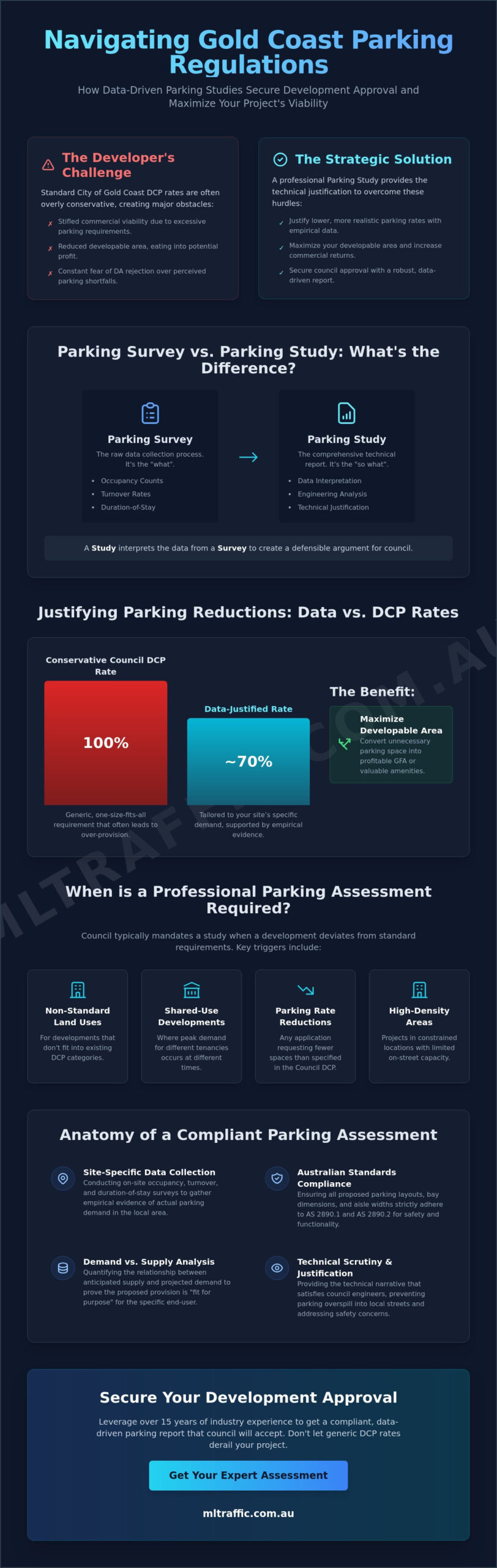
Justifying Parking Reductions: Empirical Evidence vs. DCP Rates
The most frequent objection in the development application process is the mismatch between Council requirements and site constraints. Council Development Control Plans (DCP) often mandate parking rates that are physically impossible to accommodate on-site without sacrificing significant developable area. These standard rates are typically conservative. They’re designed to cover a broad range of scenarios and often rely on outdated data that doesn’t reflect current vehicle ownership trends or site-specific operational realities. Relying solely on these generic codes can lead to unnecessary construction costs and inefficient land use.
Professional parking studies gold coast provide the technical mechanism to challenge these generic figures. By presenting empirical evidence, we move the conversation from theoretical requirements to operational reality. This is particularly effective for mixed-use sites where reciprocal parking can be utilized. Reciprocal parking acknowledges that residential and commercial users have different peak demand times. A space used by an office worker at 10:00 AM is often vacant and available for a resident by 6:00 PM. Analyzing these demand shifts allows for a defensible reduction in the total number of physical bays required without causing overspill into surrounding streets.
The Value of Empirical Site Surveys
Empirical justification is a data-driven alternative to generic codes that uses observed demand from comparable sites to establish a realistic parking rate. We conduct surveys at existing developments with similar land uses, scales, and locations to provide a direct comparison. This data proves that actual demand is frequently lower than what the DCP suggests. Proximity to high-frequency public transport is a major factor in this analysis. Sites near major transit interchanges naturally require fewer car spaces because a verified portion of the population utilizes alternative transit options, effectively lowering the parking burden on the development.
Sustainable Transport Credits and Reductions
Technical reports can also leverage sustainable transport initiatives to justify parking reductions. High-quality end-of-trip facilities, such as secure bike racks, lockers, and showers, encourage active transport and reduce the reliance on private vehicles. The inclusion of car-share schemes within residential developments provides another strong argument for lower parking provisions. We formalize these commitments through Green Travel Plans. These plans outline specific management strategies to reduce car dependency, providing council with the assurance that the development will operate effectively with a reduced parking footprint. Integrating these elements into a Traffic Impact Assessment (TIA) Report ensures a comprehensive approach to site accessibility.
The Methodology: How Professional Parking Studies are Conducted
Executing professional parking studies gold coast requires a systematic, five step approach to ensure every technical requirement is met. This structured process provides the empirical foundation needed to withstand council scrutiny and secure development approval. We follow a rigorous methodology that moves from initial scoping to final certification.
- Step 1: Scoping. We define the study area and identify key council requirements. This includes a detailed review of the Gold Coast City Plan Version 10, specifically Transport Code 9.4.13.
- Step 2: Data Collection. We perform field surveys to capture occupancy, turnover, and duration-of-stay data. This provides a snapshot of actual demand.
- Step 3: Comparative Analysis. We weigh the collected data against relevant planning schemes and Australian Standards. This identifies any gaps between generic codes and site reality.
- Step 4: Parking Strategy. We formulate mitigation measures and management plans. This strategy addresses any identified shortfalls or operational constraints.
- Step 5: Final Report. We produce a comprehensive technical document for DA submission. This report houses all data and expert recommendations.
Data Collection and Peak Demand Identification
Identifying the “design hour” is a critical component of the data collection phase. This represents the period of maximum parking demand for your specific land use. To ensure data accuracy, we conduct surveys during neutral periods. We strictly avoid school holidays or major local events that create statistical outliers. This accuracy is bolstered by integrating Vehicle Swept Path Analysis. This technical step proves the physical feasibility of the layout, ensuring that the proposed bays and aisles are functional for the intended vehicles.
Reporting and Expert Recommendations
The final stage involves translating raw survey data into a clear, authoritative narrative for council planners. We directly address potential impacts on surrounding on-street parking to mitigate concerns regarding overspill. Every parking studies gold coast report requires certification by a qualified Traffic Engineer to provide the necessary regulatory authority. This certification ensures the document is recognized as a professional engineering assessment. You can contact our senior principals directly to initiate the scoping process for your site’s parking assessment.
Expert Parking Assessments by ML Traffic Engineers
ML Traffic Engineers Australia provides professional engineering solutions with over 15 years of experience in traffic engineering and transport planning. We specialize in delivering technical reports that withstand the scrutiny of local government authorities. Our firm maintains a proven track record of successful DA approvals across all Australian states. We bridge the gap between complex site constraints and regulatory requirements through meticulous data analysis and engineering expertise. Every project benefits from our comprehensive service suite, ranging from detailed Vehicle Swept Path Analysis to full Traffic Impact Assessments.
The technical integrity of our parking studies gold coast is guaranteed by our unique operational model. We provide direct access to senior principals who perform the actual technical work. This approach eliminates the communication gaps found in larger firms where projects are often delegated to junior staff. Our clients deal directly with the experts responsible for the engineering outcomes, ensuring accountability and precision in every report we produce. This senior-led involvement ensures that the resulting assessment is a strategic negotiation tool rather than just a collection of raw data.
Why National Developers Choose ML Traffic Engineers Australia
National developers require a consultancy that understands the nuances of diverse project environments. ML Traffic Engineers Australia brings exhaustive experience across multiple sectors, including:
- High-density residential flat buildings and townhouses.
- Commercial office developments and business parks.
- Industrial warehouses and distribution centres.
- Retail shopping centres and bulky goods outlets.
- Specialized land uses such as childcare, medical, and aged care facilities.
Our commitment to AS 2890.1 compliance ensures that every car park design is safe, functional, and legally defensible. We offer a personnel continuity promise; the senior expert who initiates your project will be the one who completes the technical assessment. This consistency is vital for maintaining the narrative of a development application through to approval. It prevents the loss of critical project knowledge during the often lengthy council review and RFI phases.
Contact Our Senior Engineers Today
We understand that timing is critical in the development industry. ML Traffic Engineers Australia provides fast turnaround times for council Request for Information (RFI) responses, keeping your project on schedule. You can reach our senior principals directly for immediate technical advice regarding your site’s specific challenges. We provide clear, fixed-fee proposals based on the specific requirements of your development. Use the link below to start your engagement with a seasoned expert. Contact ML Traffic Engineers Australia for a Parking Study Quote to secure the technical justification your project requires.
Securing Your Development’s Operational Success
Securing council approval requires more than just meeting a generic quota; it requires technical precision and defensible data. Professional parking studies gold coast provide the empirical evidence needed to bridge the gap between rigid planning codes and site-specific commercial reality. By leveraging the data-driven methodologies discussed, you can defend lower parking provisions without compromising site safety or surrounding street capacity. These assessments ensure that your site layout remains compliant with Australian Standards while maximizing your project’s developable area.
ML Traffic Engineers Australia brings over 15 years of consultancy experience to your project. Our senior principals handle every assessment personally to ensure accountability and technical accuracy across all council jurisdictions. This hands-on approach eliminates the risk of design rework and minimizes the likelihood of costly council RFIs. We are ready to provide the technical justification your development requires to move forward with confidence.
Get a Professional Parking Study for Your DA Approval
We look forward to helping you secure a compliant and commercially viable outcome for your next development project.
Frequently Asked Questions
What is the difference between a parking survey and a parking study?
A parking survey is the raw data collection phase involving physical counts of vehicle occupancy, turnover, and duration of stay. A parking study is the comprehensive technical analysis that interprets this data to provide a formal recommendation for a development application. While the survey provides the metric evidence, the study provides the engineering justification required for council approval.
How much does a professional parking study cost for a DA?
The cost of professional parking studies gold coast depends on the project’s scale and the complexity of the required data collection. Factors influencing the fee include the number of survey locations, the duration of the monitoring period, and the specific land use categories involved. ML Traffic Engineers Australia provides fixed fee proposals based on a detailed scoping of your site’s technical requirements.
Can a parking study help me provide fewer parking spaces than council requires?
Yes, a study can justify a reduction by presenting empirical evidence that actual demand is lower than generic DCP rates. This often involves analyzing shared parking opportunities in mixed use developments or demonstrating the impact of high frequency public transport proximity. The objective is to prove the proposed provision is fit for purpose without impacting local street capacity through professional parking studies gold coast.
How long does it take to complete a comprehensive parking assessment?
A typical assessment takes between two and four weeks from the commencement of data collection to the delivery of the final report. This timeline allows for surveying during neutral periods to ensure data integrity and statistical accuracy. ML Traffic Engineers Australia can often prioritize urgent council RFI responses to meet specific planning and submission deadlines.
What Australian Standards govern car park design and parking studies?
The primary regulatory benchmarks are the AS 2890 series. This includes AS 2890.1 for light vehicles, AS 2890.2 for commercial vehicles, and AS 2890.6 for disabled parking. Compliance with these national standards is a mandatory requirement for securing engineering certification and ensuring the physical feasibility of the car park layout.
Will council definitely accept the findings of an independent parking study?
Council officers maintain the discretion to review all technical submissions, but a report certified by a qualified Traffic Engineer carries significant regulatory weight. A well documented study based on first principles analysis and Australian Standards provides the strongest possible defense against DA rejection. It moves the discussion from subjective opinion to technical fact.
Do I need a parking study for a small-scale change of use application?
A study is often required if the proposed land use has a higher parking demand rate than the existing use under the Gold Coast City Plan. Even small scale changes can trigger a requirement for a Car Parking Demand Assessment if the change creates a technical deficit in the site’s historical parking provision compared to the new requirement.
What happens if the parking study shows a deficit in parking supply?
If a deficit is identified, we formulate technical mitigation measures to address the shortfall. This may include implementing a Green Travel Plan, proposing mechanical parking systems like car stackers, or recommending shared use arrangements between different tenancies. These strategies provide council with the technical assurance that the development remains operational and won’t cause overspill into surrounding residential streets.

Disclaimer
The content on www.mltraffic.com.au, including all technical articles, guides, and resources, is provided for general informational and educational purposes only. It is not intended to constitute professional advice in traffic engineering, transportation planning, development approvals, or any other technical or legal field.
While ML Traffic Engineers makes every reasonable effort to ensure the accuracy, completeness, and timeliness of the information published, we do not provide any warranties or representations (express or implied) regarding its reliability, suitability, or availability for any particular purpose. Any reliance you place on the content is strictly at your own risk.
In no event shall ML Traffic Engineers, its directors, employees, authors, or affiliates be liable for any direct, indirect, incidental, special, consequential, or punitive damages (including, without limitation, loss of profits, data, or business opportunities) arising out of or in connection with the use of, or inability to use, any information provided on this website.
The articles and guides on this site are not a substitute for engaging a qualified, registered professional traffic engineer (such as an NPER or RPEQ engineer) to assess your specific project requirements. For tailored advice, compliance assessments, or traffic engineering services, please contact a competent professional.
This disclaimer may be updated from time to time without notice. By accessing or using this website, you agree to be bound by the most current version of this disclaimer.
