

Why should your multi-million dollar development be held hostage by a junior consultant who doesn’t understand the technical nuances of your site? You already know that every week your Development Application sits in a council queue represents thousands of dollars in holding costs. It’s frustrating to receive redesign requests because a traffic report failed to address specific AS 2890.1 requirements or ignored local council parking codes.
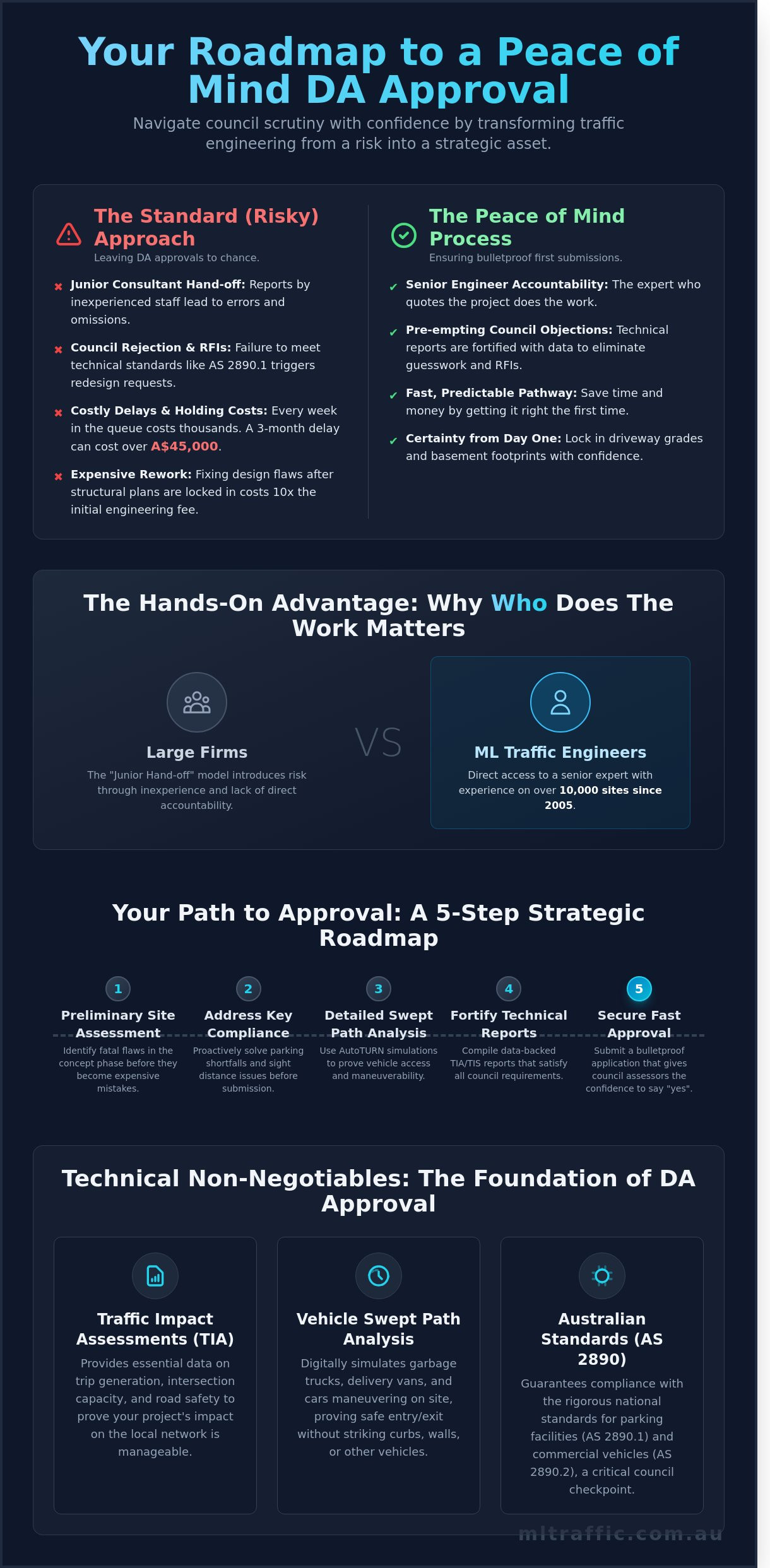
Securing a peace of mind DA approval process starts with technical reports that are bulletproof from the first submission. Since 2005, our principals have managed over 10,000 sites, ensuring that the engineer who quotes your project is the same senior expert who completes the work. This direct accountability eliminates the common errors found in reports produced by inexperienced staff at larger firms.
In this guide, you’ll discover how to navigate council scrutiny with confidence and secure a fast, predictable approval pathway. We’ll detail the exact technical standards required to bypass common delays and explain how direct access to senior expertise keeps your project on schedule.
Key Takeaways
- Learn how prioritizing technical compliance prevents costly council delays and transforms traffic engineering into a strategic asset for your development.
- Secure a peace of mind DA approval process by identifying the specific data points council assessors require within Traffic Impact Assessments (TIA) to issue a “yes.”
- Discover the methodology for pre-empting Requests for Further Information (RFIs) by addressing parking shortfalls and sight distance compliance before submission.
- Understand why direct access to senior engineers eliminates the “junior hand-off” risk, ensuring your technical reports meet rigorous Australian Standards like AS 2890.
- Follow a 5-step strategic roadmap that moves from preliminary site assessment to detailed swept path analysis for a streamlined path to approval.
Table of Contents
- What is the Peace of Mind DA Approval Process?
- Technical Non-Negotiables: The Foundation of DA Approval
- Eliminating RFIs: Pre-empting Council Traffic Objections
- The Hands-On Advantage: Why Who Does the Work Matters
- Your Path to Approval: A 5-Step Strategic Roadmap
What is the Peace of Mind DA Approval Process?
The peace of mind DA approval process is a strategic methodology that treats technical compliance as a prerequisite rather than an afterthought. In Australia, the process of regulating land use is governed by strict local council LEPs and DCPs. A standard submission often relies on a general planner to guess at traffic requirements. A technically fortified application uses precise engineering data to eliminate this guesswork. This approach ensures that when a council officer reviews your plans, they find no grounds for a Request for Further Information (RFI) regarding vehicle access or parking.
To better understand how to de-risk your development during the entitlement phase, watch this helpful video:
Traffic engineering is the make or break element of modern development. If a driveway ramp is too steep or a parking bay is 100mm too narrow, the entire basement design might fail. By involving a traffic consultant during the concept phase, you identify these fatal flaws before they become expensive mistakes. This early involvement transforms the DA from a stressful gamble into a predictable administrative step.
The Cost of Uncertainty in Development
A three-month delay caused by a traffic-related RFI isn’t just a scheduling hiccup. For a mid-sized residential development in an Australian capital city, holding costs can exceed A$15,000 per month in interest and land tax. If your parking layout fails AS 2890.1 compliance after the structural design is locked in, the cost to relocate load-bearing columns is often 10 times higher than the initial engineering fee. The peace of mind DA approval process provides the psychological certainty that your basement footprint and driveway grades are locked in correctly from day one.
The Role of the Expert Traffic Consultant
While a general planner manages the broad application, a specialist traffic engineer focuses on the technical minutiae that trigger council rejections. Australian Standards like AS 2890.1 for parking facilities and AS 2890.2 for commercial vehicles require a specialist’s eye for certification. At ML Traffic Engineers, the consultant who provides your quote is the one who does the work. This direct accountability ensures your swept path assessments and sight-line requirements meet every regulatory hurdle. Learn more about our professional traffic engineering services to see how we secure your project’s technical compliance. Our principals have assessed over 10,000 sites since 2005, providing the authoritative data councils demand.
Technical Non-Negotiables: The Foundation of DA Approval
Council assessors prioritize technical accuracy over aesthetic appeal. Achieving a peace of mind DA approval process requires a foundation of data-backed reports that address traffic safety and flow. If your submission lacks these core documents, the assessment process stops before it truly begins. We focus on providing the exact technical specifications that allow council officers to tick their boxes with confidence.
Traffic Impact Assessments (TIA) and Statements
Councils distinguish between a Traffic Impact Statement (TIS) and a full Traffic Impact Assessment (TIA) based on the scale of your development. Small-scale projects, such as a four-unit residential block or a small boutique office, often only require a TIS. This is a concise document outlining why the traffic changes are negligible. Larger commercial or high-density residential developments demand a full TIA. This report must include specific data points: trip generation rates, intersection capacity analysis, and road safety audits. Council needs to see how your project affects the local road network at peak hours. For a deeper look at these requirements, see The definitive guide to Traffic Impact Assessments.
Vehicle Swept Path Analysis
Site feasibility often hinges on whether the largest expected vehicle can physically enter and exit the property safely. We use industry-standard software like AutoTURN to provide Swept Path Analysis. This digital simulation proves to council that garbage trucks, delivery vans, and passenger vehicles can maneuver without striking curbs, walls, or other cars. It’s an essential requirement for tight urban sites where every millimeter counts. If your plans don’t show these maneuvering diagrams, councils will likely issue a Request for Further Information (RFI), delaying your project by weeks. You can find more details in this complete guide to Swept Path Analysis for Australian developments.
Compliance with AS 2890.1 and AS 2890.2
The Australian Standards for off-street parking (AS 2890.1) and commercial facilities (AS 2890.2) are the benchmarks for every car park design. Non-compliant ramp grades remain the primary reason for DA rejection across Australia. A ramp that’s too steep or lacks the required 2-metre transitions will fail the assessment immediately. We review every design to ensure parking bay dimensions, aisle widths, and headroom clearances meet these rigorous standards. Ensuring your design adheres to these codes from the start is vital for a smooth peace of mind DA approval process. Review this AS 2890.1 guide for compliant design specifics.
Getting these technical details right the first time prevents costly redesigns during the construction certificate phase. If you aren’t sure which reports your specific site needs, you can view our full range of traffic engineering services to see how we address these requirements.
Eliminating RFIs: Pre-empting Council Traffic Objections
A Request for Further Information (RFI) is a formal notice from a local council stating that your Development Application (DA) lacks sufficient detail for a decision. It is a developer’s primary enemy because it resets the statutory assessment clock. This often delays projects by 30 to 90 days, causing holding costs to accumulate. Most traffic-related RFIs focus on three areas: parking shortfalls, inadequate sight distance, and unsafe site access.
Our approach utilizes a defensive engineering strategy to anticipate council questions before they are asked. We analyze the site against Australian Standard AS 2890.1 and local Development Control Plans (DCP) during the design phase. By identifying potential friction points early, we provide the technical evidence required to satisfy council engineers on the first submission. This proactive documentation is a core component of a peace of mind DA approval process.
Sight Distance Assessments are mandatory for proving safety at site access points. We measure the available lines of sight for drivers exiting the property to ensure they meet Austroads and Australian Standards. If a site has restricted visibility due to neighboring buildings or topography, we provide engineered solutions, such as warning devices or driveway realignments, to mitigate risks before the council identifies them as grounds for refusal.
Addressing Parking Demand vs. Council Requirements
A Parking Demand Assessment is a data-driven justification for deviations from standard council rates. When a project cannot meet the specific parking numbers dictated by a DCP, we use empirical data to argue the case. We analyze Australian Bureau of Statistics (ABS) car ownership data, proximity to public transport hubs, and parking surveys from similar land uses. This evidence proves that the actual demand is lower than the theoretical council requirement. We rely on local government planning instruments and verified traffic generation rates to ensure the justification is legally and technically sound.
Managing Access and Intersection Safety
High-traffic developments, such as childcare centers or multi-unit apartments, require formal Intersection Analysis. We use SIDRA software to model traffic flow and demonstrate that your project won’t cause gridlock on the surrounding road network. This analysis shows the Level of Service (LoS) remains acceptable post-development. Providing this data upfront prevents the council from claiming your project will negatively impact local residents. You can contact ML Traffic to discuss your site’s specific access challenges and secure a peace of mind DA approval process through expert technical reporting.
The Hands-On Advantage: Why Who Does the Work Matters
Large engineering firms often rely on a traditional hierarchy that separates the client from the expertise. In these environments, a senior partner might front the initial meeting to secure the contract, only to hand the technical work to a junior graduate. This ‘Junior Hand-off’ creates a disconnect between the project vision and the technical execution. At ML Traffic, we operate on a no-gatekeepers philosophy. We believe that the traffic consultant who provides the quote should be the one performing the work. This direct line of communication is essential for a peace of mind DA approval process, as it ensures that no detail is lost in translation between management levels.
Direct access to principals Michael Lee and Benny Chen means you’re talking to the person who actually calculates the data. This eliminates the bureaucracy that often slows down development timelines. When you have a question about your project, you don’t wait for a message to be passed up a chain of command. You get an immediate, technically sound answer from a professional who understands every nuance of your site. This transparency builds a level of trust and reliability that is often missing in larger, more impersonal consultancies.
Accountability and Technical Precision
Technical precision is the foundation of any successful development application. Errors in Vehicle Swept Path Assessments or driveway ramp grades can lead to immediate rejection by council. Senior involvement reduces these risks significantly. Because our principals are hands-on, they ensure every calculation adheres to Australian Standards AS 2890.1. A senior engineer has the authority and the experience to defend a report directly to council planners. This direct accountability from the senior engineers at ML Traffic means that technical justifications are robust and defensible from the start. We don’t just provide data; we provide a professional opinion that stands up to scrutiny.
Efficiency through Experience
Experience isn’t just a number; it’s a tool for efficiency. Having worked on over 10,000 sites since 2005, our principals have encountered almost every conceivable traffic challenge. This deep history allows us to identify ‘deal-breaker’ issues during the pre-DA stage. We spot problems with sight-lines or parking layouts before they become expensive council objections. This foresight is a critical component of the peace of mind DA approval process. With over 15 years of experience per principal, we navigate council negotiations faster because we understand the specific requirements of different local government areas across Australia. Speed in the reporting process comes from knowing exactly what the authorities need to see to grant an approval.
Eliminate the uncertainty of junior staff and gatekeepers. If you want the person who quotes your job to be the expert who delivers the results, contact our senior traffic engineers for a direct consultation.
Your Path to Approval: A 5-Step Strategic Roadmap
Securing a peace of mind DA approval process depends on technical accuracy and proactive management. At ML Traffic Engineers, we’ve refined a 5-step roadmap based on over 10,000 successful site assessments since 2005. This structured approach eliminates guesswork and ensures your project meets all regulatory benchmarks from the outset.
- Step 1: Preliminary Site Assessment and Feasibility Check. We evaluate the site against local Council Development Control Plans (DCP) and Local Environmental Plans (LEP) to identify immediate constraints.
- Step 2: Detailed Technical Reporting. Preparation of Traffic Impact Assessments (TIA), Swept Path Analysis, and AS 2890 compliance certification.
- Step 3: Pre-DA Liaison with Council. We consult with council engineers for complex developments to resolve potential objections before they’re officially lodged.
- Step 4: DA Lodgement and Technical Support. Providing the necessary documentation and technical backing for your formal application.
- Step 5: Post-Lodgement RFI Management and Final Approval. Managing Requests for Information (RFI) with data-driven responses to secure the final sign-off.
Getting the Foundation Right
The first 10% of your project’s timeline typically determines 90% of the DA outcome. Identifying site constraints early prevents expensive redesigns during the later stages of the peace of mind DA approval process. Our preliminary assessments establish a hierarchy of required reports, ensuring you don’t over-invest in unnecessary studies or miss critical compliance triggers. It’s about finding the balance between what council requires and what the site can physically accommodate.
Early coordination with your architect is vital. We review driveway ramp grades and parking bay dimensions against AS 2890.1 standards before the architectural design is locked in. This integration ensures the building footprint maximizes yield without violating safety or accessibility requirements. If the driveway grade is too steep for a standard B85 vehicle, we find out in step one, not step five.
Managing the Council Relationship
Professional traffic engineering reports build immediate credibility with council assessors. When a report is signed by a qualified RPEQ or a senior engineer with over 30 years of experience, it signals that the data is reliable. This trust is essential when we need to negotiate specific design elements without compromising your project’s commercial viability. We focus on facts and standards to move the application forward.
If council issues an RFI, we respond with technical evidence rather than opinion. Our final checklist for every submission includes:
- Verification of all vehicle swept paths using latest industry-standard software.
- Compliance checks against AS 2890.1 (Off-street car parking) and AS 2890.2 (Commercial vehicle facilities).
- Direct oversight from the principal consultant who quoted the work.
For expert assistance and technical reliability for your next development, contact our senior engineers to discuss your requirements.
Secure Your Development Approval with Technical Precision
Achieving a successful development application requires more than just submitting paperwork. It demands strict adherence to Australian Standards like AS 2890.1 and AS 2890.2. By pre-empting council objections through rigorous technical assessments, you remove the risk of costly Requests for Information (RFIs) that stall project timelines. Our approach ensures you don’t get passed off to junior staff. At ML Traffic Engineers, the traffic consultant who provides the quote is the same expert who does the technical work.
With over 10,000 sites assessed across Australia, we provide the technical foundation needed for a smooth transition from planning to construction. Our principals bring between 30 and 40 years of experience to every project; they ensure your site layout is compliant and efficient from day one. This hands-on expertise is the core of our peace of mind DA approval process. We focus on getting the technical details right so your project stays on track. Don’t leave your project’s timeline to chance when you can rely on proven engineering authority.
Get a quote from the traffic engineer who will actually do the work
Frequently Asked Questions
What is the most common reason for a DA being rejected due to traffic?
The most common reason for DA rejection is non-compliance with Australian Standard AS 2890.1, specifically regarding sight distance and driveway gradients. Over 35 percent of initial applications fail because the proposed driveway design doesn’t provide adequate visibility for exiting vehicles. Our peace of mind DA approval process ensures every design meets these safety requirements before submission. This technical precision prevents costly delays and avoids the need for total site redesigns later.
How much does a Traffic Impact Assessment (TIA) cost for a standard DA?
Traffic Impact Assessment costs vary based on project scale and Council requirements. A basic assessment for a small commercial site typically starts around A$2,000, while complex multi-unit developments can exceed A$12,000. These figures reflect the technical depth required for data collection and intersection modelling. We provide fixed quotes for every project. The consultant who quotes your job is the same senior engineer who completes the technical work.
Do I need a traffic report for a small residential development?
You need a traffic report for small residential developments if the site sits on a State Road or involves a multi-dwelling layout like a dual occupancy. Most Councils require a Traffic Impact Statement for any project increasing vehicle movements by 10 percent or more. Even for small sites, a Swept Path Analysis proves a B85 vehicle can enter and exit in a forward direction. This is a mandatory safety requirement for most Australian local government areas.
Can a traffic engineer help if council has already issued an RFI?
A traffic engineer can resolve a Request for Further Information (RFI) by providing technical justifications or design amendments. We regularly step in after Council identifies deficiencies in parking layouts or traffic flow. Our team has handled over 10,000 sites, allowing us to address specific Council concerns with data-backed responses. We focus on achieving compliance through technical evidence and engineering principles rather than subjective arguments or guesswork.
What is the difference between AS 2890.1 and AS 2890.2?
AS 2890.1 covers off-street car parking for light vehicles, while AS 2890.2 sets the standards for commercial vehicle facilities. Developers must use AS 2890.1 for residential garages and visitor bays. AS 2890.2 applies to loading docks and service areas for trucks. Ensuring your site accommodates the specific turning circles of an 8.8-metre Medium Rigid Vehicle is critical for industrial or retail developments to pass Council inspection.
How long does it take to prepare a standard traffic report for council?
A standard traffic report typically takes 5 to 10 business days to complete once we receive your final architectural plans. This timeframe includes site inspection, data analysis, and drafting the formal report. Complex projects requiring intersection modelling or extensive traffic counts may take 15 days or longer. We prioritise direct communication to ensure the peace of mind DA approval process moves forward without unnecessary technical bottlenecks or administrative delays.
Is a Swept Path Analysis required for every development application?
Swept Path Analysis is required for almost every development application that introduces new parking or access points. Council planners use these diagrams to verify that vehicles don’t clip kerbs or require multi-point turns. We use specialized software to simulate vehicle movements for B85 and B99 cars. This analysis is also mandatory for proving that waste collection vehicles can safely access and exit your site in a forward gear.
Can a traffic engineer help justify a reduction in required parking spaces?
A traffic engineer can justify a reduction in parking spaces by conducting a Car Parking Demand Assessment. We compare your project against the RMS Guide to Traffic Generating Developments and local Council rates. If the site is within 400 metres of a high-frequency transport hub, we use empirical data to prove lower demand. This evidence-based approach often allows developers to reduce construction costs while remaining fully compliant with Council expectations.
Which areas do you cover?
We are traffic engineers servicing Melbourne, Sydney, Brisbane, Gold Coast, Hobart, Perth, Adelaide, Darwin, Canberra and surrounding areas.
Disclaimer
The content on www.mltraffic.com.au, including all technical articles, guides, and resources, is provided for general informational and educational purposes only. It is not intended to constitute professional advice in traffic engineering, transportation planning, development approvals, or any other technical or legal field.
While ML Traffic Engineers makes every reasonable effort to ensure the accuracy, completeness, and timeliness of the information published, we do not provide any warranties or representations (express or implied) regarding its reliability, suitability, or availability for any particular purpose. Any reliance you place on the content is strictly at your own risk.
In no event shall ML Traffic Engineers, its directors, employees, authors, or affiliates be liable for any direct, indirect, incidental, special, consequential, or punitive damages (including, without limitation, loss of profits, data, or business opportunities) arising out of or in connection with the use of, or inability to use, any information provided on this website.
The articles and guides on this site are not a substitute for engaging a qualified, registered professional traffic engineer (such as an NPER or RPEQ engineer) to assess your specific project requirements. For tailored advice, compliance assessments, or traffic engineering services, please contact a competent professional.
This disclaimer may be updated from time to time without notice. By accessing or using this website, you agree to be bound by the most current version of this disclaimer.
