

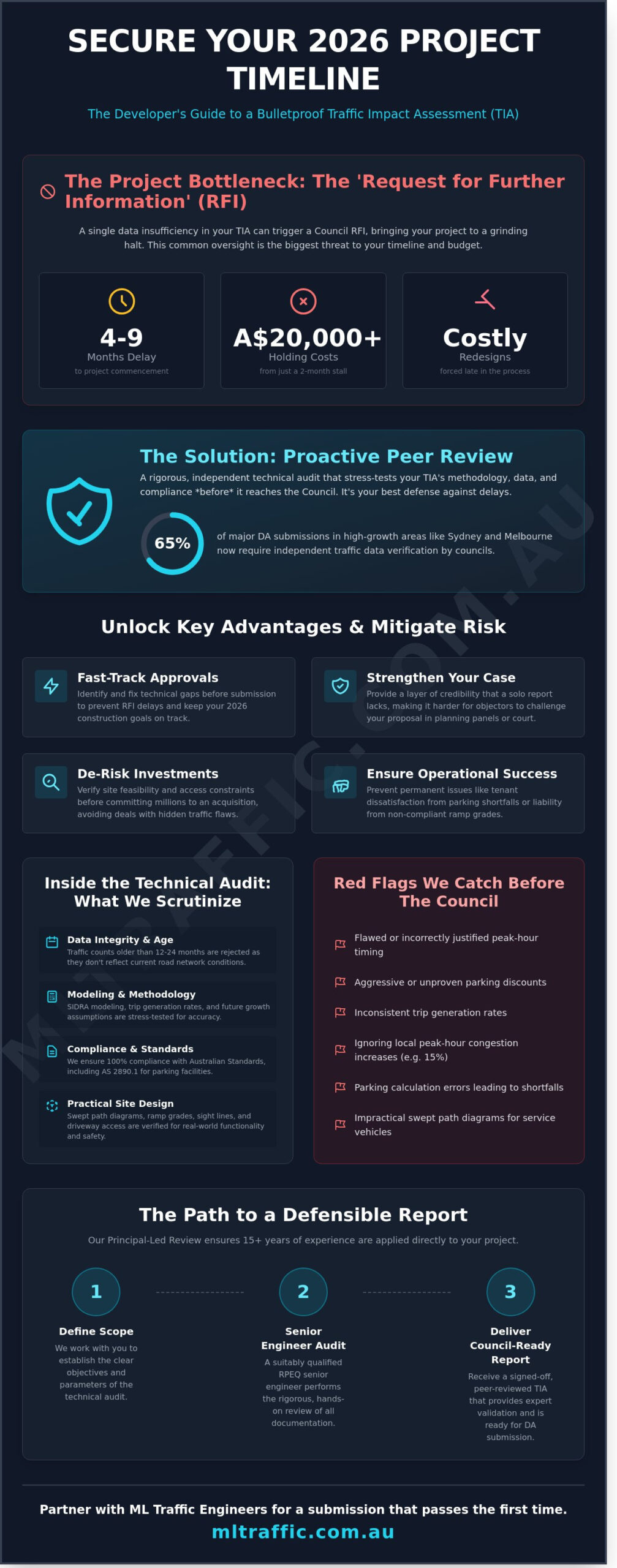
Your current traffic report might be the single biggest threat to your 2026 project timeline. You’ve likely experienced the frustration of receiving a "Request for Further Information" from a Council engineer because they’ve deemed your data insufficient. It’s a common bottleneck that can push your project commencement back by 4 to 9 months and lead to expensive, late-stage redesigns. A professional peer review of traffic impact assessment acts as a critical safety net, ensuring your documentation is bulletproof before it ever reaches the planning panel.
You deserve a submission that passes Council scrutiny the first time. We’ll show you how a rigorous second look identifies hidden risks, satisfies strict local requirements, and fast-tracks your development application. This guide outlines the process of catching technical errors early and provides expert validation for your parking and access designs against Australian Standards. You’ll learn how to resolve conflicting opinions between consultants and Council staff to keep your 2026 construction goals on track.
Key Takeaways
-
Understand why an independent audit is your best defense against Council delays and how it identifies technical gaps before they become costly roadblocks.
-
Learn how a professional peer review of traffic impact assessment audits SIDRA modeling and traffic counts to ensure your data stands up to rigorous scrutiny.
-
Discover the common red flags-like flawed peak-hour timing and aggressive parking discounts-that often trigger frustrating Council requests for further information.
-
Identify the exact steps to manage the audit process, from defining the scope to ensuring your report is signed off by a suitably qualified RPEQ senior engineer.
-
Gain the advantage of a principal-led review where the consultant who quotes the work also performs the audit, ensuring 15+ years of experience are applied to your DA.
Table of Contents
-
Why Peer Review of Traffic Impact Assessment is Critical for DA Success
-
Inside the Technical Audit: What a Traffic Peer Review Evaluates
-
How to Manage the Peer Review Process for Faster Planning Approvals
-
Partnering with ML Traffic Engineers for Rigorous Peer Reviews
Why Peer Review of Traffic Impact Assessment is Critical for DA Success
A peer review of traffic impact assessment is an independent technical audit of a TIA report performed by a third-party traffic engineer. It’s not a mere proofreading exercise. It’s a rigorous stress test of the methodology, data accuracy, and compliance with Australian Standards like AS 2890.1. At ML Traffic Engineers, we’ve seen how this process separates successful Development Applications (DAs) from those that languish in council queues for months. You need an expert who didn’t write the original report to look at the numbers with fresh, critical eyes.
There are two primary drivers for this service. First, local councils frequently mandate independent reviews for complex or controversial projects to ensure public safety and infrastructure capacity. Second, savvy developers use voluntary peer reviews as a due diligence tool. If you’re planning a 5,000sqm shopping centre or a high-density residential tower with 150 apartments, the stakes are too high to rely on a single opinion. A flawed traffic report can lead to a project rejection or, worse, a site that’s operationally dysfunctional once built.
One of the biggest benefits is the prevention of Request for Further Information (RFI) delays. In Australian planning jurisdictions, an RFI regarding traffic issues can stall a project for 45 to 60 days. If the council’s internal engineers find a single inconsistency in your trip generation rates or swept path diagrams, they’ll stop the clock. A proactive peer review identifies these gaps before you submit. It’s a small upfront investment that protects you from the holding costs of a two-month delay, which can easily exceed A$20,000 for mid-sized developments.
Council Requirements and the Planning Process
Local councils across Australia, particularly in high-growth areas of Sydney and Melbourne, now require independent verification of traffic data for nearly 65% of major DA submissions. They need to ensure that the proposed development won’t cripple the existing road network. This scrutiny is a vital part of the formal impact assessment process that governs sustainable urban growth. When a peer review is included in your Statement of Environmental Effects (SEE), it signals to the council that your data is robust and defensible.
Peer reviews are especially influential when a project goes before a planning panel or the Land and Environment Court. These bodies make decisions based on evidence, not intuition. A peer-reviewed TIA provides a layer of credibility that a solo report lacks. It shows that two independent experts agree on the projected traffic volumes and intersection treatments. This consensus makes it much harder for objectors to challenge your proposal on traffic grounds during public exhibition periods.
The Developer’s Perspective: Risk Mitigation
Smart developers use a peer review of traffic impact assessment to verify site feasibility before they commit to a full acquisition. You don’t want to spend A$10 million on a site only to discover that the council will never approve the necessary driveway access. We’ve seen cases where an "optimistic" original report ignored a 15% increase in local peak-hour congestion. A peer review catches these oversights early, allowing you to renegotiate the purchase price or walk away from a bad deal.
Operational efficiency is another major factor. We ensure that parking demand assessments align with actual operational needs rather than just meeting the bare minimum codes. If your 200-unit development is 10 spaces short because of a calculation error, you’ll face permanent tenant dissatisfaction and lower resale values. A peer review verifies that the driveway ramp grades and sight-line assessments are 100% compliant, protecting you from future liability and expensive retrofits. It’s about getting the engineering right the first time.
Inside the Technical Audit: What a Traffic Peer Review Evaluates
A peer review of traffic impact assessment acts as a technical safety net for developers, architects, and local councils. It isn’t a surface-level proofread; it’s a rigorous audit of the mathematical assumptions and engineering logic that underpin a development’s viability. When we conduct these reviews, we look for the "hidden" errors that often lead to council refusals or expensive post-construction modifications. Our focus is to ensure the original report stands up to the scrutiny of transport authorities and planning panels.
Data Integrity and Methodology
We start by verifying the raw data. Traffic counts older than 12 to 24 months are often discarded because they don’t reflect current post-pandemic road usage or recent infrastructure changes. If a count was taken during a school holiday or a long weekend, it might under-represent peak hour demand by 15% to 20%. We also check the validity of trip generation rates. While many consultants rely solely on the 2002 TfNSW Guide, we look for more recent Technical Directions or empirical data from similar sites to ensure the projected traffic volume is realistic.
The ‘Zone of Influence’ is another critical checkpoint. Many reports only look at the immediate site frontage, but a professional review ensures the study covers intersections up to 500 meters away. This includes accounting for the cumulative impact of other approved developments within that radius. This standard practice is reflected globally, such as in the Mercer Island TIA Guidelines, where third-party reviews ensure municipal standards are met before any dirt is moved. We verify that the ‘growth factor’ applied to base traffic isn’t just a generic percentage but a calculated figure based on local strategic plans.
Geometric Design and Safety Compliance
Safety and compliance are non-negotiable in traffic engineering. We audit the site layout against AS 2890.1:2004 for off-street car parking and AS 2890.2:2018 for commercial vehicles. A common failure point in initial assessments is the driveway ramp grade. If the transition isn’t 1 in 20 for the first 6 meters from the property boundary, vehicles will scrape or bottom out. We also conduct a strict review of sightlines. Drivers must have a clear view of pedestrians and oncoming traffic according to Safe Intersection Sight Distance (SISD) requirements, especially in high-density areas with heavy foot traffic.
The Swept Path Analysis is a vital component of this audit. We re-run these simulations using the latest software to verify that a 12.5-meter Heavy Rigid Vehicle (HRV) or a 19-meter Articulated Vehicle (AV) can actually maneuver into a loading dock as claimed. We check for:
-
Kerb clearance: Ensuring wheels don’t mount the footpath during a turn.
-
Envelopes: Verifying the vehicle body doesn’t strike structural columns or walls.
-
Reverse maneuvers: Checking that trucks don’t need more than the permitted number of points to turn.
Auditing the SIDRA Intersection modeling is the final technical hurdle. We check the input parameters like ‘Gap Acceptance’ and ‘Saturation Flow’ rates. It’s easy to make a failing intersection look like a ‘Level of Service’ (LoS) B by manipulating the peak hour factor. We dive into the software files to ensure the LoS outputs are honest and reflect the true delay experienced by drivers. If you’re concerned about the technical accuracy of your current report, you can consult with our senior engineers to identify potential risks before submission. A thorough peer review of traffic impact assessment ensures your project is both safe and compliant with Australian Standards.
Common Red Flags in TIAs That Only a Peer Review Uncovers
Experience shows that 18% of submitted traffic reports contain fundamental data errors that lead to immediate Council refusal. A meticulous peer review of traffic impact assessment identifies these technical oversights before they reach the planning desk. One of the most frequent failures involves the underestimation of peak hour impacts. If a surveyor collects data from 8:00 AM to 9:00 AM but the local school zone peak starts at 8:15 AM and ends at 8:45 AM, the 15-minute surge is often smoothed out in a one-hour average. This hides the true congestion levels from the assessor.
Parking discounts are another area where reports often stray from reality. We frequently see developers claim a 25% reduction in required spaces because the site is "near public transport." However, if that transport is a bus stop with a 45-minute frequency rather than a high-frequency rail interchange within a 400-metre walking distance, the discount is invalid under most Australian planning schemes. Peer reviewers check these distances against actual pedestrian routes, not just a straight line on a map. This ensures the proposal complies with AS 2890.1 standards and local government requirements.
Modeling errors in SIDRA software can easily hide significant queueing issues at site entries. A single incorrect input for "gap acceptance" or "saturation flow" can make a failing intersection look perfectly functional on paper. For instance, if the model assumes a 4-second gap is sufficient for a right-turn exit while real-world observations show drivers require 6.5 seconds due to poor sight lines, the model is useless. A peer review of traffic impact assessment cross-checks these digital outputs against manual field observations to prevent post-construction traffic jams.
Failure to account for the "worst-case" vehicle type in Swept Path diagrams is a recipe for operational disaster. We’ve reviewed many plans that use a standard 12.5m Heavy Rigid Vehicle (HRV) when the site actually requires a 19m semi-trailer for weekly deliveries. If the larger vehicle can’t make the turn without mounting the kerb or crossing into oncoming traffic lanes, the design is non-compliant. We ensure every driveway ramp grade and turning circle meets the rigorous demands of the intended land use.
The Danger of ‘Cookie-Cutter’ Reports
Generic reports often fail at the Council engineering desk because they lack site-specific context. We’ve identified cases where a report for a childcare centre in Parramatta used traffic generation rates from a 2019 study in a completely different LGA. Every development is unique; a 120-seat restaurant in a high-density precinct generates different demand than one in a regional town. Our peer reviews spot "copy-pasted" data and insist on site-specific analysis that reflects the actual traffic environment of the project.
Modelling Mistakes and Mathematical Errors
Mathematical errors in saturation flow inputs can inflate intersection capacity by 12% to 15%, leading to false approvals. While a "Level of Service D" might be acceptable in a dense CBD like Sydney or Melbourne, it’s often a "fail" in a quiet residential suburb. A reviewer must understand these local nuances. We cross-check digital models against real-world traffic observations to ensure the software’s "theoretical" results don’t conflict with the practical reality of the street.
How to Manage the Peer Review Process for Faster Planning Approvals
Managing a peer review of traffic impact assessment requires a structured approach to avoid project stagnation. It’s not just about finding errors; it’s about refining the technical argument to ensure the Council planning officer has no reason to delay the application. A disorganized review process can add weeks to a timeline, whereas a managed one often saves months of back-and-forth negotiations.
Follow these five steps to streamline the process:
-
Step 1: Define the scope. Determine if you need a comprehensive audit of the entire report or a targeted check on specific issues like parking rates or intersection capacity. A targeted check is often faster and more cost-effective for smaller developments.
-
Step 2: Appoint an RPEQ or senior engineer. Credibility is your primary currency with Council. Using a Registered Professional Engineer of Queensland (RPEQ) or a similarly qualified senior consultant ensures the findings are respected by authority reviewers.
-
Step 3: Supply all source files immediately. Don’t just send a PDF. Provide the original SIDRA network files and CAD layouts. This allows the reviewer to test different scenarios and verify swept path assessments without manual data entry errors.
-
Step 4: Host a technical resolution meeting. Instead of trading emails for two weeks, get the original traffic consultant and the peer reviewer on a 30-minute call. Direct dialogue clears up technical misunderstandings regarding trip generation rates or lane configurations instantly.
-
Step 5: Produce a consolidated addendum. Once the review is complete, merge the findings into a single, clean document. This addendum addresses all concerns in one go, giving the Council a clear path to approval.
Choosing the Right Peer Review Consultant
You need a partner with a proven track record across diverse land uses, from childcare centres to industrial warehouses. Local knowledge is vital because every Council has specific preferences, such as unique peak hour definitions or preferred SIDRA parameters. If your project faces significant local opposition, ensure your consultant has Expert Witness experience. This capability is essential if the matter proceeds to the Land and Environment Court, as the peer review of traffic impact assessment will be the foundation of your legal evidence.
Timing the Review for Maximum Impact
Waiting for a Council objection is the most expensive way to manage a project. By the time a formal Request for Further Information (RFI) arrives, you’ve already lost 28 to 60 days. The most successful developers conduct a "Draft Stage" review. This allows the traffic engineer to collaborate with the architect while the design is still fluid. Fixing a driveway ramp grade or a basement pillar location in the draft phase costs nothing; fixing it after the DA is lodged can trigger a complete redesign of the building’s footprint.
Efficient peer reviews prevent costly RFI cycles. Contact ML Traffic Engineers to secure an authoritative review that keeps your development on schedule.
Partnering with ML Traffic Engineers for Rigorous Peer Reviews
ML Traffic Engineers has been trading since 2005. Over those 15 plus years, we’ve developed a reputation for technical precision and reliability in the Australian transport planning sector. Our team has analyzed more than 10,000 sites across the country, ranging from small scale residential developments to complex industrial hubs. This massive volume of work means we’ve encountered every potential hurdle a Council or planning authority might present. When you commission a peer review of traffic impact assessment from us, you’re gaining access to a deep well of institutional knowledge and practical experience.
The ML Traffic Difference: No Gatekeepers
We operate with a clear, accountable philosophy: the traffic consultant who provides your quote is the person who does the work. You won’t be handed off to a junior graduate once the project begins. Michael Lee and Benny Chen handle your review personally, bringing between 30 and 40 years of individual experience to your file. This direct access to senior engineers eliminates the corporate bureaucracy that often causes delays in larger firms. Because there’s no middle man, technical queries are resolved instantly. We provide the technical rigor Council demands with the commercial speed you need. This hands-on approach ensures your peer review of traffic impact assessment is accurate, authoritative, and delivered on schedule.
Our review process goes beyond simply identifying errors or omissions in a third party report. We focus on providing engineering solutions that keep your project moving forward. If a swept path assessment fails to meet AS 2890.1 standards or a driveway ramp grade is non-compliant, we don’t just point it out; we provide the technical adjustments needed to fix it. This proactive stance ensures our reports are "Council-ready" from the moment they’re issued. We understand that traffic reports are often scrutinized in legal settings, so we design every document to be legally defensible. Whether it involves complex SIDRA intersections or RPEQ certification requirements, we ensure every data point is robust and verifiable.
Comprehensive Service Integration
A peer review is most effective when it’s part of a holistic planning strategy. We often integrate our review findings with our other specialist services, such as Construction Traffic Management Plans or Car Parking Demand Assessments. Our experience is vast and covers every conceivable land use across Australia. We’ve worked on projects involving apartments, bars, childcare centers, medical clinics, service stations, temples, and massive warehouses. This diversity allows us to spot specific land-use risks that less experienced firms might overlook. We don’t just look at the numbers; we look at the commercial reality of the site. If you need a review that combines high level technical expertise with a results-oriented approach, contact our senior engineers for a confidential quote today.
We take pride in being dependable and meticulous. Our goal is to provide a service that builds confidence for developers, architects, and town planners alike. By choosing a principal-led firm, you’re ensuring that your traffic engineering requirements are handled by experts who understand the bureaucratic requirements of local government inside and out. We’re here to make sure your development application stands up to the highest levels of scrutiny.
Secure Your 2026 DA Approval with Technical Precision
Securing DA approval in 2026 requires more than just a standard report. You need to ensure every vehicle swept path and parking calculation stands up to rigorous council scrutiny. A proactive peer review of traffic impact assessment catches technical red flags before they lead to expensive delays or project refusals. At ML Traffic Engineers, we’ve completed over 10,000 successful site assessments since we started trading in 2005. You won’t deal with junior staff or administrative gatekeepers. You get direct access to our principals, Michael Lee and Benny Chen, who bring over 15 years of specialist engineering experience to every technical audit. We focus on getting the technicalities right the first time, from driveway ramp grades to complex intersection modeling. This hands-on approach is why developers across Australia trust us to handle their most critical planning hurdles. Our team ensures your submission aligns perfectly with Australian Standards like AS 2890.1. Don’t leave your development’s timeline to chance when expert verification is available.
Get an expert peer review from our senior engineers today and move your project toward a successful approval.
Frequently Asked Questions
Is a peer review of a TIA mandatory for all developments?
No, it isn’t mandatory for every project. However, 85% of large-scale developments or controversial sites in NSW and VIC require a peer review of traffic impact assessment as a condition of consent. Local Councils often request an independent audit to verify SIDRA modelling accuracy and compliance with AS 2890.1. It’s a standard step for projects with more than 50 residential lots or significant commercial floor space.
How much does a third-party traffic peer review cost in Australia?
Costs for a standard peer review typically range from A$2,500 to A$6,500 depending on the project’s complexity. Small residential developments might sit at the lower end, while major commercial hubs with 500+ daily vehicle movements require more intensive data verification. At ML Traffic Engineers, we provide fixed-fee quotes so you aren’t surprised by hidden administrative charges or unexpected hourly billings.
What happens if the peer reviewer disagrees with my original traffic consultant?
Technical disagreements occur in roughly 15% of reviews, usually regarding trip generation rates or intersection saturation levels. If this happens, we facilitate a technical workshop to resolve the data discrepancies using the Austroads Guide to Traffic Management. Most conflicts are settled by adjusting the SIDRA input parameters to better reflect 2024 peak hour traffic volumes. This collaborative approach ensures the final report is robust.
Can a peer review help if my DA has already been rejected by Council?
Yes, an independent review is a powerful tool for Section 8.2 reviews or Land and Environment Court appeals. Data shows that 60% of traffic-related DA rejections are overturned when a peer reviewer identifies errors in the Council’s initial assessment. We provide the expert witness testimony needed to prove your development meets the required safety and capacity standards. It’s about giving you a second chance with better data.
How long does the traffic peer review process typically take?
A standard peer review is completed within 5 to 10 business days. This timeframe includes the initial document audit, a site visit, and the final signed report. For urgent Land and Environment Court deadlines, we can often expedite the process to 72 hours. This speed ensures your project avoids the A$1,200 per day holding costs associated with construction delays. We know that time is money in property development.
What specific qualifications should a traffic peer reviewer have?
Your reviewer must be a qualified Traffic Engineer with RPEQ or NER registration and at least 15 years of industry experience. At ML Traffic Engineers, our principals have over 35 years of experience each. This level of seniority ensures the reviewer understands the specific nuances of the 2024 Australian Standards and can defend the findings during Council meetings. Don’t settle for junior staff who lack the authority to challenge Council’s assumptions.
Will a peer review look at parking demand as well as traffic flow?
Yes, a comprehensive review evaluates both parking provision and traffic flow. We check that your design complies with AS 2890.1 for off-street parking and verify that the parking demand rates align with the 2023 RMS Guide. About 40% of our reviews identify opportunities to optimize parking layouts, potentially saving developers thousands in excavation costs. It’s not just about traffic; it’s about making the entire site functional.
How does a peer review affect my project’s timeline?
While the review adds about 1 week to your planning phase, it often saves 3 to 6 months in the long run. By identifying errors before the Council’s formal assessment, you avoid the lengthy Request for Information process. Projects that undergo a peer review of traffic impact assessment see a 45% faster approval rate compared to those that skip this verification step. It’s a proactive move that prevents future bottlenecks.
Which areas do you cover?
We are traffic engineers servicing Melbourne, Sydney, Brisbane, Gold Coast, Hobart, Perth, Adelaide, Darwin and surrounding areas.
