
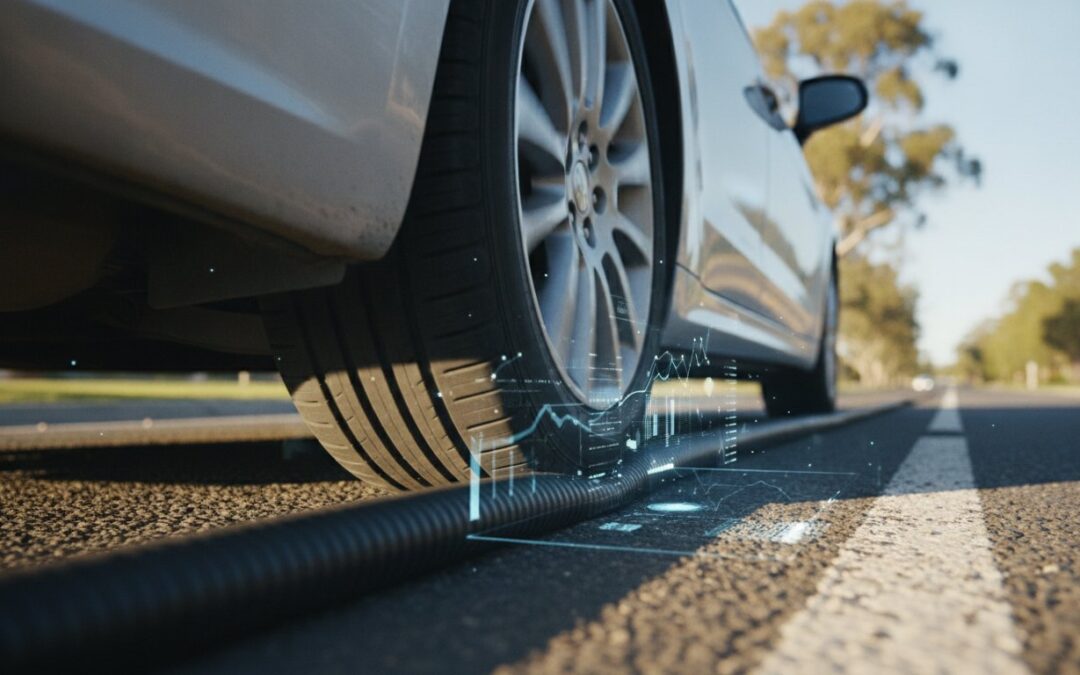
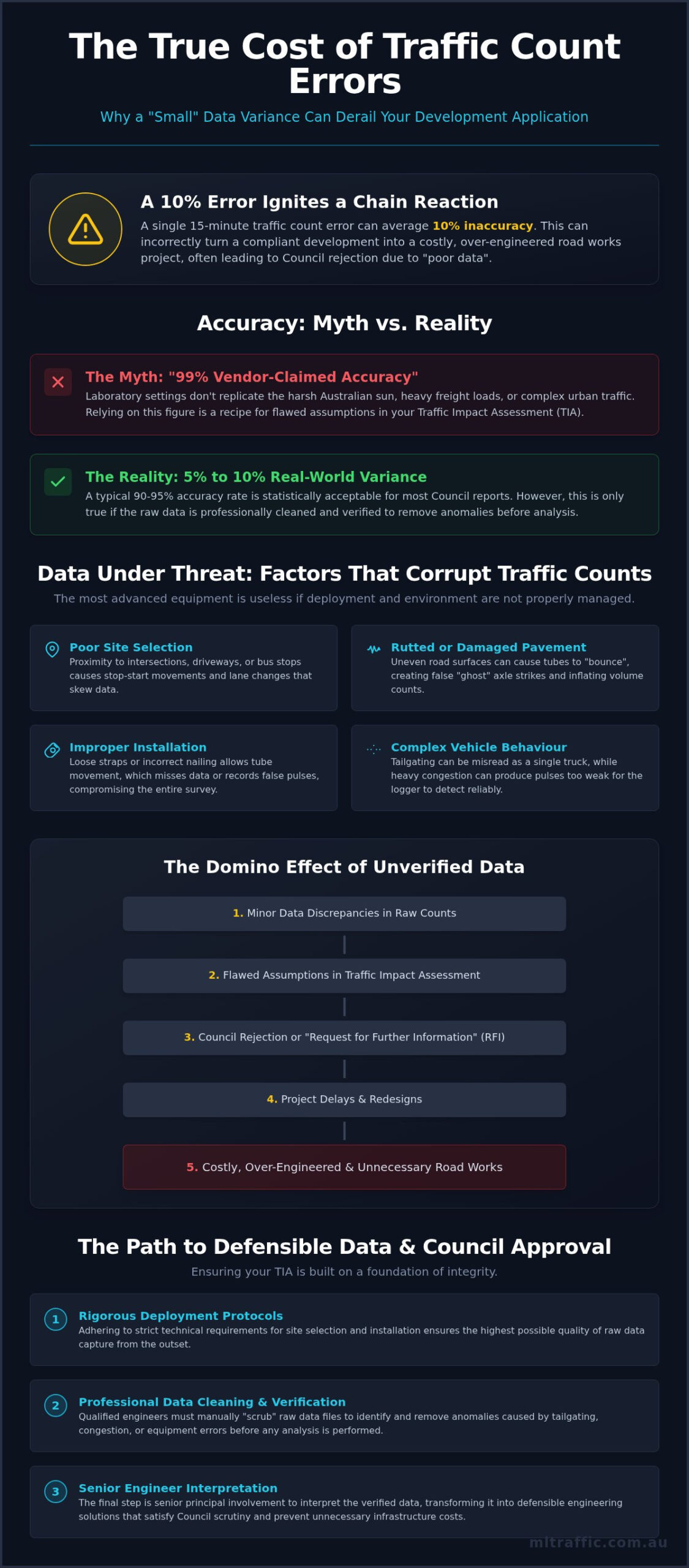
A single 15-minute traffic count error can average 10 per cent, often turning a compliant development application into a costly, over-engineered road works project. You likely rely on road tubes because they’re the primary method for cost-effective data collection, yet many developers face the frustration of an Australian Council rejecting a Traffic Impact Assessment due to “poor data.” Understanding the variables affecting pneumatic tube traffic counter accuracy is the difference between a seamless approval and a stalled project.
It’s a common industry belief that daily totals cancel out minor errors, but real-world performance often contradicts vendor claims. With the ASTM E2300-09 standard withdrawn as of May 2024, the responsibility for data verification now rests heavily on the expertise of the consultant. This guide explores the technical realities of road tube data and how to ensure your traffic counts meet rigorous standards. We’ll examine the limitations of the “10 per cent rule,” the impact of improper installation, and the specific verification protocols required to satisfy Council scrutiny and avoid unnecessary infrastructure costs.
Key Takeaways
- Understand why vendor-claimed “99 per cent accuracy” rarely translates to Australian road environments and how to manage the standard 5 per cent to 10 per cent variance.
- Learn how pneumatic tube traffic counter accuracy is compromised by poor site selection; specifically proximity to intersections, driveways, or rutted pavement.
- Identify how minor data discrepancies in peak hour volumes can trigger a “Request for Further Information” (RFI) and lead to costly, over-engineered road works.
- Discover the technical requirements for road tube deployment that ensure your data meets rigorous Council standards for Traffic Impact Assessment (TIA) reports.
- Recognise why senior principal involvement is essential for interpreting raw traffic data into defensible engineering solutions that pass Council scrutiny.
What is Pneumatic Tube Traffic Counting?
Pneumatic tube counting is a foundational method for collecting temporary road data. It relies on hollow, air-filled rubber hoses stretched across a carriageway to detect vehicle movements. This technology is the primary choice for short-term traffic surveys in Australia, typically spanning seven days, to support development applications and Council planning. For a broader perspective on the various methodologies used in the industry, one might ask What is Pneumatic Tube Traffic Counting? in the context of global infrastructure monitoring.
The system operates through mechanical pressure. Every time a vehicle’s axle strikes the tube, it sends a burst of air down the hose to a connected data logger. This logger acts as the system’s brain, recording the exact time of each pulse. By analysing the timing between pulses across a pair of tubes, the software can determine vehicle speed, direction, and wheelbase length. This mechanical simplicity is why the method remains the industry standard. It offers a level of portability and cost-efficiency that permanent inductive loops cannot match for temporary site assessments.
The Components of a Road Tube Setup
A standard deployment consists of three critical elements. The pneumatic tubes themselves are manufactured from heavy-duty rubber to withstand thousands of axle strikes. These connect to digital data loggers, which are secured in weather-proof housings off the shoulder of the road. To maintain pneumatic tube traffic counter accuracy, the tubes must be fixed firmly to the bitumen using specialised road nails and heavy-duty nylon straps. Any movement or “bouncing” of the tube during a vehicle strike will result in ghost pulses or missed data, compromising the entire survey.
Data Captured by Tube Counters
Modern tube systems provide a comprehensive dataset far beyond simple volume counts. They are essential for generating the evidence required in a Traffic Impact Assessment (TIA). The data captured includes:
- Vehicle volume and flow directionality across multiple lanes.
- Vehicle classification, categorising traffic into passenger cars, light commercials, or heavy vehicles such as B-doubles and semis based on axle spacing.
- Speed data, specifically the 85th percentile speeds used to determine safe sight distances and intersection design.
Precision in this initial data collection phase is vital. While these devices are robust, pneumatic tube traffic counter accuracy is highly dependent on the quality of the hardware and the professional rigour of the installation. Inaccurate raw data at this stage inevitably leads to flawed engineering conclusions during the planning phase.
The Reality of Pneumatic Tube Traffic Counter Accuracy
Laboratory settings for equipment testing don’t account for the intense heat of an Australian summer or the heavy freight loads on local arterial roads. While manufacturers often claim near-perfection, real-world pneumatic tube traffic counter accuracy typically settles between 90 and 95 per cent. For the majority of Council-mandated TIA reports, this 5 to 10 per cent margin of error is considered statistically acceptable and won’t invalidate the final engineering conclusions. The focus isn’t on absolute perfection but on capturing a representative sample of road usage.
Raw data can be deceptive due to a phenomenon known as “masking.” This occurs when the logger misses several vehicles but over-counts others, leading to a daily total that appears correct on the surface. However, the granularity required for peak hour flow or specific speed profiles is often lost in these instances. This is why professional data cleaning is vital. Qualified engineers must scrub the raw files to remove these anomalies before the data is used for complex traffic modelling. Without this intervention, a report relies on flawed assumptions that Council officers will likely identify.
Common Sources of Discrepancy
Discrepancies often stem from vehicle behaviour rather than hardware failure. Tailgating is a frequent issue; when two cars follow too closely, the logger may interpret the sequence as a single multi-axle truck. Conversely, in stop-start urban congestion, the air pulse generated by slow-moving tyres may be too weak to trigger the sensor reliably. Lane-changing manoeuvres also create “ghost” strikes if a vehicle crosses the tubes at an oblique angle, which confuses the classification logic and inflates the volume count.
Accuracy vs. Precision in Traffic Engineering
In civil design, precision-the consistency of data over time-is often more valuable than a single “perfect” count. Consistent data allows for reliable trend analysis over the standard seven-day survey period. To bolster pneumatic tube traffic counter accuracy, ML Traffic Engineers Australia cross-checks tube results against manual turning counts at key intersections during peak periods. This verification ensures the baseline data is defensible during the planning assessment. As defined by the Austroads Guide to Traffic Management, accuracy represents the degree to which a measured value aligns with the true traffic parameter being observed.
If you’re preparing a Traffic Impact Assessment, ensuring the underlying data is interpreted by qualified experts is the only way to satisfy rigorous Council requirements and avoid costly project delays.
Critical Factors Influencing Data Integrity
The mechanical nature of road tubes makes them susceptible to environmental interference. While the hardware might be calibrated, pneumatic tube traffic counter accuracy is heavily dictated by the physical placement and the condition of the road surface. Poor site selection is the most frequent cause of data corruption. Placing tubes too close to intersections or driveways introduces variable vehicle speeds and turning movements that classification algorithms cannot interpret correctly. Vehicles braking or accelerating over the tubes distort the air pulse timing, leading to erroneous speed and classification results.
Pavement condition is another significant variable. Bitumen that exhibits heavy rutting or deep cracking prevents the tube from laying flush against the surface. When a vehicle passes over a tube suspended over a rut, the tube “bounces,” often generating multiple pulses for a single axle strike. Australia’s weather extremes also play a role. Intense sun exposure increases the elasticity of the rubber hoses. This thermal expansion can delay pulse transmission to the logger, slightly altering speed calculations during peak afternoon heat.
Installation tension remains a critical technical requirement. Technicians must secure tubes with enough tension to eliminate road slap but not so much that the internal diameter is constricted. A loose tube is a primary driver of equipment failure and “double counting,” where the logger records the initial strike and the subsequent vibration of the hose against the road.
Optimal Site Conditions for Tube Counters
To maximise pneumatic tube traffic counter accuracy, technicians prioritise specific road characteristics. These include:
- Straight road sections with free-flowing traffic, ideally at least 50 metres from traffic lights or major junctions.
- Smooth, well-maintained bitumen surfaces that allow the tube to remain in constant contact with the pavement.
- Clear sightlines and adequate shoulder width to ensure technicians can safely install and maintain the equipment without obstructing traffic.
The Human Element: Professional Installation
Developers often attempt to save costs by using uncertified contractors or “DIY” counting solutions. This almost inevitably leads to Council rejection. Data collection is not a “set and forget” task. The role of a Traffic Engineer involves supervising the deployment to ensure it meets rigorous Australian Standards for temporary traffic control and data validity. Professional oversight ensures that the raw data is not only accurate but also defensible during the planning assessment phase. Compliance with Austroads guidelines during setup is the only way to avoid a Request for Further Information (RFI) regarding data integrity.
Why Data Precision Is Non-Negotiable for Council Approvals
Council planning departments view raw data with high levels of scepticism. If a Traffic Impact Assessment (TIA) relies on questionable baseline figures, the likely outcome is a “Request for Further Information” (RFI). This stops the assessment clock and adds weeks or months to your project timeline. The pneumatic tube traffic counter accuracy directly influences the modelling used to determine if a simple priority-controlled junction is sufficient or if a signalised intersection is required. A 10 per cent error in peak flow volumes can fundamentally change the scope of required road works, potentially adding hundreds of thousands of dollars to your infrastructure budget.
Accurate vehicle classification data also informs the Swept Path Analysis. If road tubes misidentify a heavy vehicle as a light commercial due to poor pulse timing, the “design vehicle” used for your loading dock assessment will be incorrect. This leads to designs that fail in practice, creating operational hazards once the development is built. During the public exhibition phase, high-quality data serves as a technical shield. It allows you to counter emotive community objections regarding traffic congestion with verifiable, empirical evidence that stands up under legal cross-examination.
Meeting Australian Regulatory Standards
All data collection must align with local Council transport codes and national standards like AS 2890.1. Professional Traffic Impact Assessments depend on this verified baseline to project future demand accurately. Flawed entry and exit counts often result in over-calculating car parking demand. This forces developers to provide more parking spaces than necessary, consuming valuable floor area and increasing construction costs. Ensuring pneumatic tube traffic counter accuracy at the start of the process prevents these downstream design errors.
The Cost of Poor Data
Inaccurate data is a financial liability. Beyond DA delays, inflated traffic projections can lead to excessive Section 7.11 or 7.12 infrastructure contributions. Councils use these counts to determine your share of local road upgrades. If your data overstates the traffic impact, you may end up funding infrastructure that your development does not actually require. ML Traffic Engineers Australia minimises these risks through meticulous data verification and senior principal oversight of every logger file. This rigorous approach ensures your contributions are proportional to your actual impact and protects your project’s bottom line.
To ensure your project is supported by defensible data that passes Council scrutiny, contact ML Traffic Engineers Australia for a compliant assessment.
Partnering with ML Traffic Engineers Australia for Compliant Traffic Engineering
ML Traffic Engineers Australia provides the technical bridge between raw field data and successful development outcomes. We recognise that pneumatic tube traffic counter accuracy is only the first step in a complex regulatory process. Our firm doesn’t just deliver a spreadsheet of axle strikes; we provide defensible engineering solutions that address the specific requirements of Australian Councils. This expertise transforms raw numbers into the evidence needed to support a development application.
Clients gain direct access to senior principals who oversee every stage of the project. This “no-gatekeepers” approach ensures that the data collected in the field is interpreted correctly from day one. Whether your project requires a Swept Path Analysis for a constrained loading dock or a comprehensive TIA report for a multi-stage subdivision, our 15 years of experience ensures compliance with Austroads and local transport codes. We understand the nuances of different LGAs across Australia, from bustling urban centres to diverse regional areas.
Our Traffic Engineering Process
We follow a structured methodology to ensure data integrity. This begins with an initial site assessment and survey design to determine the optimal placement for road tubes. Simply dropping equipment on the road is insufficient. We evaluate pavement condition and traffic flow patterns to maintain pneumatic tube traffic counter accuracy throughout the seven-day survey period. Once collected, our engineers perform rigorous data cleaning. We manually review logger files to remove anomalies and “noise” before integrating the results into a robust, Council-ready report.
Secure Your Planning Approval
Developers trust ML Traffic Engineers Australia for complex and contentious sites where data is likely to be challenged. We provide personnel continuity, meaning the expert who initiates your project is the same senior principal who performs the technical work and defends it during the assessment process. This accountability is a core brand signature that distinguishes us from larger, more impersonal firms. We take responsibility for the data, ensuring it meets the high standards required by transport authorities and planning panels.
Don’t let poor data collection stall your development application or lead to unnecessary infrastructure costs. Contact ML Traffic Engineers Australia to discuss your next project’s traffic survey requirements and ensure your submission is backed by professional engineering rigour.
Ensuring Your Traffic Data Passes Council Scrutiny
Relying on raw data from unverified sources is a project risk that often results in assessment delays and inflated infrastructure contributions. Achieving high pneumatic tube traffic counter accuracy requires more than just laying rubber hoses; it demands professional site selection and rigorous engineering analysis. The 5 per cent to 10 per cent variance inherent in road tube technology must be managed through expert data cleaning to ensure your Traffic Impact Assessment remains defensible.
ML Traffic Engineers Australia brings over 15 years of Australian experience to your development application, ensuring full compliance with AS 2890.1 and local transport codes. Our senior principals maintain direct involvement in every project, providing the technical rigour required for complex planning approvals. This meticulous approach protects your project from unnecessary over-engineering and provides a solid foundation for your design vehicle and parking requirements.
Contact ML Traffic Engineers Australia for a Compliant Traffic Report to secure your planning approval with data you can trust. We look forward to helping you move your project forward with confidence.
Frequently Asked Questions
How long do pneumatic tube counters usually stay on the road?
Pneumatic tube counters typically remain on the road for a seven-day period. This duration is necessary to capture a full cycle of traffic behaviour, including weekday commuter patterns and weekend recreational flows. Most Australian Councils specify this one-week minimum to ensure the data is representative of typical conditions. Shorter durations often fail to provide the statistical average required for a compliant Traffic Impact Assessment.
Can pneumatic tubes distinguish between a car and a motorbike?
Modern data loggers distinguish between cars and motorbikes by analysing axle spacing and the timing of air pulses. While motorbikes generate a lighter pressure pulse, the system’s sensitivity can be calibrated to record these smaller vehicles. This classification is essential for accurate reports where the vehicle mix influences road safety and intersection design. Engineers review this data to ensure the vehicle fleet matches local expectations.
Do weather conditions like heavy rain affect tube counter accuracy?
Heavy rain generally does not compromise pneumatic tube traffic counter accuracy because the system relies on physical pressure rather than optical sensors. However, extreme heat can increase tube elasticity, which may slightly alter pulse timing during peak afternoon temperatures. Technicians must ensure tubes are properly tensioned to withstand varied Australian weather conditions without losing data integrity or causing the tubes to “slap” against the bitumen.
Why does Council require a 7-day traffic count instead of just one day?
A seven-day count is required to account for daily fluctuations in traffic volume and peak hour timing. A single-day snapshot is often an outlier and fails to provide the 85th percentile speed data or the average weekday traffic (AWT) figures required by Council. This longitudinal data ensures the proposed development’s impact is assessed against a reliable baseline rather than a potentially unrepresentative single day.
What happens if a tube is damaged or pulled up during the survey?
If a tube is damaged or displaced by heavy braking, street sweeping, or vandalism, the data for that specific period becomes invalid. Technicians monitor the loggers to identify these gaps early in the survey cycle. In most cases, the equipment must be reset and the survey restarted to ensure a continuous seven-day dataset that meets the evidentiary standards for a formal planning submission.
Can tube counters be used on multi-lane motorways with high speeds?
Tube counters are suitable for high-speed roads, but their effectiveness decreases on multi-lane motorways where vehicles strike tubes simultaneously across different lanes. In these environments, isolating data for a specific lane becomes technically difficult. For high-volume, multi-lane infrastructure, alternative methods like side-fire radar or video AI may be more appropriate to maintain the necessary data precision and technician safety.
How much does it cost to get a professional traffic count for a DA?
The cost of a professional traffic survey depends on the number of lanes being monitored, the duration of the count, and the complexity of the site’s location. Factors such as the requirement for specialised traffic control during installation and the proximity to major intersections also influence the project fee. Developers should request a site-specific quote to ensure the survey design meets all specific Council requirements.
Is pneumatic tube data more accurate than video AI counting?
Pneumatic tubes are highly effective for speed and classification data on mid-block sections of road. While video AI counting excels at complex intersection turning movements, it can struggle with depth perception for precise speed calculations. Maintaining pneumatic tube traffic counter accuracy is often more cost-effective for simple volume and speed surveys on standard carriageways where axle-based classification is the primary requirement.

Disclaimer
The content on www.mltraffic.com.au, including all technical articles, guides, and resources, is provided for general informational and educational purposes only. It is not intended to constitute professional advice in traffic engineering, transportation planning, development approvals, or any other technical or legal field.
While ML Traffic Engineers makes every reasonable effort to ensure the accuracy, completeness, and timeliness of the information published, we do not provide any warranties or representations (express or implied) regarding its reliability, suitability, or availability for any particular purpose. Any reliance you place on the content is strictly at your own risk.
In no event shall ML Traffic Engineers, its directors, employees, authors, or affiliates be liable for any direct, indirect, incidental, special, consequential, or punitive damages (including, without limitation, loss of profits, data, or business opportunities) arising out of or in connection with the use of, or inability to use, any information provided on this website.
The articles and guides on this site are not a substitute for engaging a qualified, registered professional traffic engineer (such as an NPER or RPEQ engineer) to assess your specific project requirements. For tailored advice, compliance assessments, or traffic engineering services, please contact a competent professional.
This disclaimer may be updated from time to time without notice. By accessing or using this website, you agree to be bound by the most current version of this disclaimer.
