
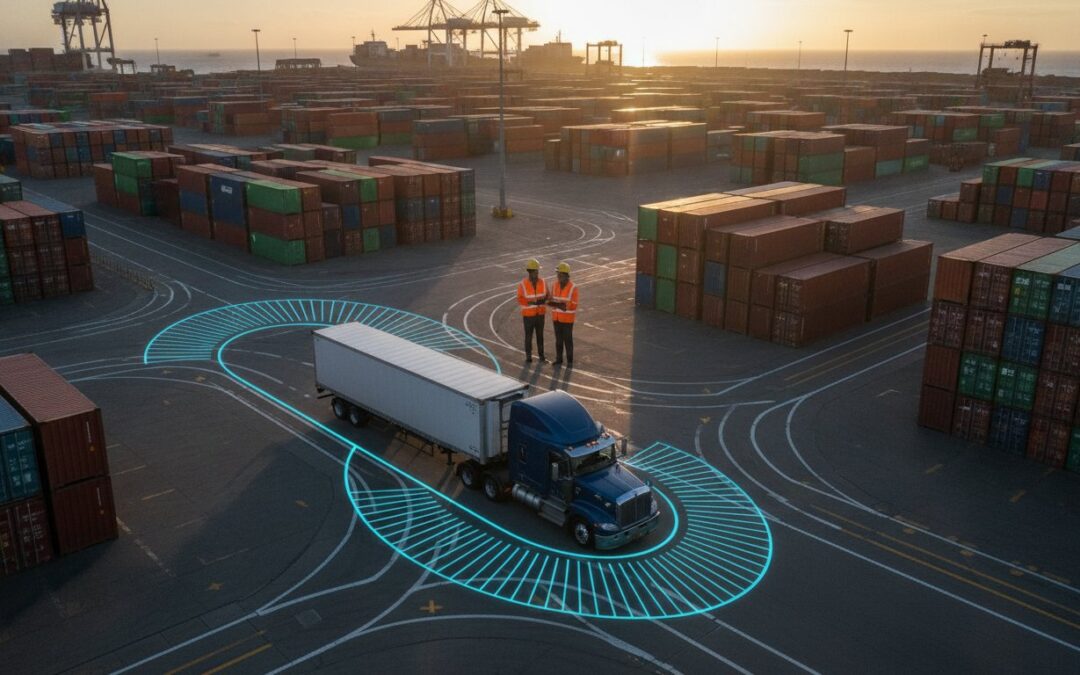
Australian domestic freight volumes reached 786 billion tonne-kilometres in the 2024–25 period, yet the bottleneck for this massive economic engine often comes down to a few square metres of poorly planned asphalt at the terminal gate. Effective traffic management for port and freight terminals is not just a logistical preference; it’s a technical necessity for safety and throughput. You deal with the daily reality of gate congestion and the high-stakes risks inherent in heavy vehicle interactions. Navigating the layers of port authority and council approvals adds a complexity that can stall even the most critical infrastructure upgrades.
Mastering these movements is a matter of geometric precision and strict regulatory adherence. This guide provides the technical roadmap required to manage heavy vehicles, ensuring your facility remains safe, compliant, and ready for DA approval. You’ll learn how to achieve full AS 2890.2:2018 compliance while significantly reducing vehicle turnaround times. We will examine the critical role of meticulous swept path analysis, the necessity of expert traffic impact assessments, and the specific design strategies that satisfy council requirements for complex Australian freight hubs.
Key Takeaways
- Utilise AutoTURN software for precise Swept Path Analysis to ensure B-doubles and A-doubles can safely navigate loading docks and container stacks without incident.
- Ensure your traffic management for port and freight terminals adheres to AS 2890.2:2018 standards to meet national regulatory requirements for off-street commercial facilities.
- Identify why a comprehensive Traffic Impact Assessment (TIA) is a mandatory component for successful Development Application (DA) approvals during terminal expansions.
- Implement rigorous segregation strategies between heavy vehicles, light vehicles, and pedestrians to mitigate safety risks and reduce vehicle turnaround times.
- Recognise the importance of direct principal involvement in traffic engineering to navigate the complex approval processes of council and port authorities.
The Fundamentals of Traffic Management for Port and Freight Terminals
Traffic management for port and freight terminals involves the technical coordination of heavy vehicle movements within high-density infrastructure. While Port management focuses on the broad logistics of cargo handling and vessel traffic, the physical efficiency of a terminal is dictated by its geometric design and adherence to civil engineering standards. The scope of work includes everything from gate queuing capacity to internal circulation paths. Terminal gate efficiency is the heartbeat of the facility; if the entry process fails, the resulting congestion impacts the entire surrounding road network.
A primary requirement in these environments is the absolute segregation of heavy vehicles from light vehicles and pedestrians. High-volume terminals cannot rely on drivers simply seeing each other. Meticulous design must physically prevent interactions that lead to safety incidents. This requires a shift from general logistics planning to rigorous traffic engineering to ensure that every square metre of the site is utilised safely and effectively.
Key Drivers of Terminal Congestion
Congestion often begins at the terminal boundary. Inadequate queuing space at entry gates causes heavy vehicles to spill over onto the public road network, creating safety risks and operational delays. Internal bottlenecks frequently arise from poorly designed circulation paths that fail to accommodate the turning requirements of multi-combination vehicles. Conflicts between active loading dock operations and internal through-traffic further degrade throughput, leading to increased vehicle turnaround times.
The Role of the Traffic Engineer
A qualified professional identifies these bottlenecks using established traffic engineering principles. This involves more than just layout advice; it requires the production of technical documentation that satisfies both Port Authority and Council requirements for a Development Application (DA). The engineer provides the data-driven assurance needed for high-stakes infrastructure projects.
Key technical assessments provided by a consultant include:
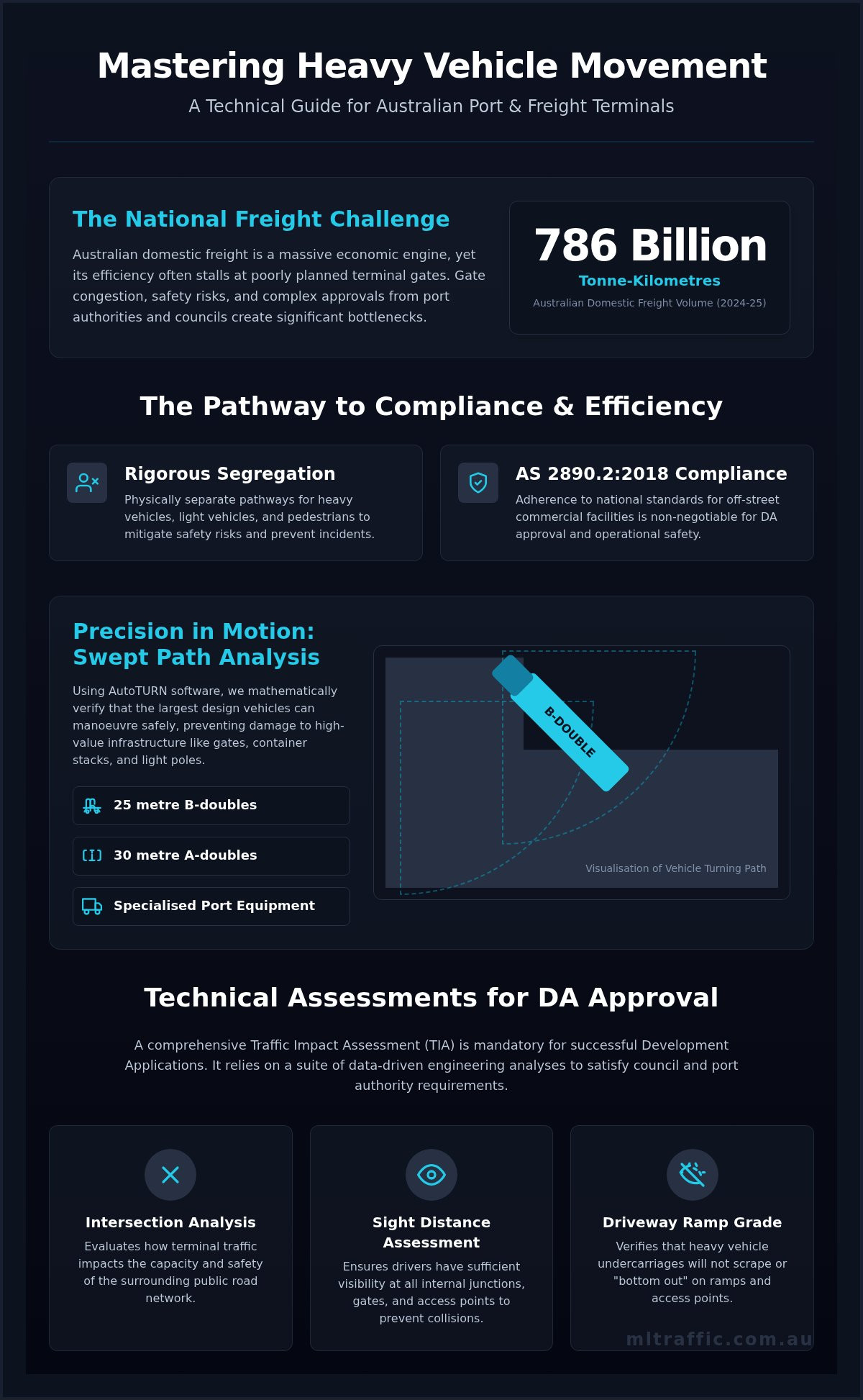
- Intersection Analysis: Evaluating how terminal traffic affects the capacity and safety of surrounding roads.
- Sight Distance Assessment: Ensuring drivers have sufficient visibility at all internal junctions and entry points.
- Driveway Ramp Grade Assessment: Verifying that heavy vehicle undercarriages will not scrape or bottom out on site access points.
These assessments ensure that the site remains functional under peak loads. By integrating these technical requirements early in the design phase, terminal managers can avoid costly retrofits and ensure full compliance with AS 2890.2:2018 standards.
Swept Path Analysis: Designing for Heavy Vehicle Manoeuvrability
Effective traffic management for port and freight terminals relies on the physical ability of the largest vehicles to circulate without conflict. We utilise AutoTURN software to model the dynamic movement of B-doubles and A-doubles, ensuring that every turn is mathematically verified. This technical precision is essential for preventing infrastructure damage to gate portals, container stacks, and light poles. While Port Gate Management Strategies often focus on digital appointment systems, the physical geometry of the site determines whether those trucks can actually reach the gate without incident.
Designing for freight hubs requires accounting for more than just road-going trucks. Specialized port equipment, such as reach stackers and straddle carriers, often possess wider turning circles and unique steering characteristics that differ from standard articulated vehicles. Failure to model these specific envelopes during the design phase leads to operational bottlenecks and increased risk of collisions. Meticulous geometric design ensures that high-value infrastructure remains protected while maintaining maximum throughput.
Modelling Multi-Combination Vehicles
Technical requirements for modelling 25m B-doubles and 30m A-doubles are stringent. Engineers must verify that these combinations have sufficient clearance in tight terminal corners to avoid mounting kerbs or striking barriers. Incorporating swept path analysis into the early master-planning phase allows for the optimisation of road widths and junction radii. This proactive approach prevents the need for expensive pavement widening once the facility is operational. It’s essential to model the “worst-case” vehicle for each specific route to ensure the site remains functional for all authorized freight combinations.
Optimising Loading Dock and Hardstand Areas
Loading docks must be designed to facilitate efficient reversing manoeuvres that comply with AS 2890.2:2018 standards. We ensure that hardstand areas provide enough depth for articulated vehicles to align with dock levellers without obstructing internal through-traffic. Beyond freight movements, the design must also verify access for refuse vehicles and emergency services, which often have different manoeuvring requirements than standard cargo trucks. Swept Path Analysis is the critical tool for preventing operational gridlock in freight hubs by mathematically verifying that vehicle envelopes do not overlap with permanent infrastructure. If your current site layout is causing operational delays, engaging an expert for a detailed vehicle path review can identify the geometric causes of your congestion.
Traffic Impact Assessment (TIA) for Terminal Expansions
A comprehensive TIA is a mandatory requirement for any Development Application (DA) involving terminal expansions. When a facility increases its capacity, the surrounding road network must be technically verified to handle the additional load. We analyse the impact of increased TEU (Twenty-foot Equivalent Unit) throughput on critical intersections to ensure that local infrastructure remains functional. This process integrates directly with the broader Statement of Environmental Effects (SEE), providing the technical evidence needed to support a project’s viability. Effective traffic management for port and freight terminals starts with this predictive modelling, ensuring that future growth does not result in local gridlock.
Developing mitigation strategies for peak-hour freight movements is essential for maintaining community support and regulatory compliance. These strategies often involve staggered gate arrivals or dedicated heavy vehicle turning lanes. By addressing these factors during the planning phase, terminal operators can avoid the operational restrictions that often follow poorly planned expansions. Our approach focuses on technical accuracy to ensure that every proposed movement is sustainable within the existing road hierarchy.
Data Collection and Traffic Modelling
Accurate data collection forms the foundation of a reliable assessment. We conduct precise heavy vehicle counts and develop growth projections based on anticipated cargo volumes. Using SIDRA intersection analysis, we predict how future traffic will perform under various load scenarios. This includes assessing the adequacy of existing pavement and infrastructure to handle higher axle loads, which is a critical concern for road authorities. Global standards in Freight Management and Operations emphasise the need for these data-driven models to maintain supply chain resilience. With Australian domestic freight volumes reaching 786 billion tonne-kilometres in the 2024–25 period, modelling the transition between rail and road interfaces has become a vital part of terminal traffic engineering.
Securing Planning Approvals
Securing a DA requires addressing common Council concerns regarding freight noise, vibration, and traffic volume. A professional traffic impact assessment is essential for reducing Request for Information (RFI) delays that can stall a project for months. We ensure the TIA reflects the 24/7 operational nature of modern freight hubs, providing a realistic view of night-time movements and their impact on local amenity. By providing clear, authoritative documentation, we bridge the gap between complex terminal logistics and the bureaucratic requirements of planning authorities. Our reports are designed to be meticulous and results-oriented, ensuring that senior decision-makers have the data they need to approve a development with confidence.
Compliance with AS 2890.2: Off-Street Commercial Parking
Compliance with AS 2890.2:2018 serves as the technical benchmark for all commercial vehicle facilities. This standard, published on 21 December 2018, supersedes older editions and introduces more rigorous requirements for modern freight hubs. Traffic management for port and freight terminals must align with these specifics to ensure the safe movement of Heavy Rigid Vehicles (HRV) and articulated combinations. Meticulous planning is required to determine the precise parking demand for terminal staff and visitors. Over-provisioning wastes valuable hardstand space while under-provisioning leads to illegal parking in heavy vehicle lanes, creating significant safety hazards.
Geometric Design Requirements
The standard sets strict parameters for minimum bay dimensions and aisle widths based on the specific design vehicle. For instance, an articulated vehicle requires a swept path that accounts for its unique hinge points. We apply AS 2890.1 for staff car parks, but these light vehicle zones must be physically segregated from heavy vehicle circulation paths. This segregation prevents high-risk interactions in high-density freight environments.
Key geometric considerations include:
- Commercial Bay Dimensions: Sizing bays correctly for HRVs and articulated vehicles to prevent dangerous overhangs.
- Aisle Widths: Ensuring sufficient space for vehicles to exit bays in a single, fluid manoeuvre.
- Clearance Heights: Verifying that overhead obstructions do not interfere with high-cube containers or specialized port equipment.
Full AS 2890.2 compliance reduces the risk of onsite accidents and operational delays by ensuring every vehicle has adequate room to manoeuvre.
Access and Manoeuvring Standards
Designing compliant terminal entries and exits is a core requirement for DA approval. All commercial vehicles must be able to enter and leave the site in a forward direction to maintain safety on the public road network. We assess sight distances at every terminal crossover point to ensure drivers have sufficient visibility of oncoming traffic and pedestrians. This is particularly critical in terminals where 24/7 operations mean visibility conditions vary significantly throughout the day and night.
Driveway ramp grades are another critical consideration for freight hubs. Many facilities utilize specialized, low-clearance equipment that is susceptible to bottoming out on steep transitions. We perform a Driveway Ramp Grade Assessment to verify that the vertical geometry of site access points is compatible with the intended fleet. Integrating car park design with the overall terminal traffic flow prevents bottlenecks during shift changes and ensures consistent throughput. If you need to verify your site’s adherence to these standards, engage us for a comprehensive Car Park Design and compliance review.
Strategic Traffic Engineering for National Freight Infrastructure
Managing the intersection of high-volume logistics and public road safety requires more than generic planning. Strategic traffic management for port and freight terminals demands a hands-on approach where technical theory meets operational reality. National freight infrastructure is under constant pressure to increase capacity, making the role of the traffic engineer central to long-term viability. We provide the technical bridge between initial feasibility studies and the final traffic management plan certification required for operational launch.
Terminal managers face a high-stakes environment where a single design flaw results in millions of dollars in lost productivity or regulatory fines. Direct access to senior traffic engineers is vital in these scenarios. It ensures that complex queries regarding intersection capacity or heavy vehicle manoeuvrability are answered with authority and technical precision. ML Traffic Engineers Australia brings over 15 years of consultancy experience to these projects, supporting Australian freight developments through rigorous assessment and meticulous documentation.
The ML Traffic Advantage for Freight
Our methodology prioritises both safety and throughput without compromise. We provide meticulous attention to detail in every TIA and swept path report, ensuring that no technical requirement is overlooked. This results-oriented approach is backed by our extensive experience across a vast range of industrial and logistics land-use categories, including container parks, intermodal hubs, and bulk liquid terminals. We understand that effective traffic management for port and freight terminals is the product of senior-level involvement at every project stage.
Unlike larger firms where work is often delegated to junior staff, our senior principals remain involved in every assessment at ML Traffic Engineers Australia. This ensures that the professional who understands your operational constraints is the same one performing the technical work. This accountability is a unique signature of our consultancy, providing terminal operators with a reliable partner for complex infrastructure design. Our personnel continuity promise distinguishes our brand from impersonal firms; the expertise you hire is the expertise that delivers the work.
Next Steps for Your Terminal Project
Engaging a traffic consultant during the concept phase is the most effective way to avoid costly design revisions later. Early involvement allows us to optimise site layouts for heavy vehicle flow before architectural plans are finalised. This proactive strategy reduces the likelihood of Council or Port Authority RFIs that stall progress. We offer a “no-gatekeepers” approach, providing you with direct lines to our leadership for immediate accountability. Contact ML Traffic Engineers Australia today to discuss your specific terminal requirements with a senior principal and ensure your next freight development meets every regulatory and operational standard.
Securing Your Terminal’s Operational Future
Achieving peak efficiency within a high-volume freight hub requires a shift from general logistics to rigorous technical engineering. This guide has detailed how meticulous swept path analysis and strict adherence to AS 2890.2:2018 standards prevent operational gridlock and infrastructure damage. Integrating these civil engineering principles early in your master-planning phase ensures your facility is prepared for the demands of 24/7 heavy vehicle movements. Effective traffic management for port and freight terminals is the only way to reduce vehicle turnaround times while maintaining full regulatory compliance.
ML Traffic Engineers Australia offers 15+ years of Australian traffic engineering experience to support your next development. We provide direct principal involvement in every freight project, ensuring you have a “no-gatekeepers” line to the experts performing your technical work. As specialists in AS 2890.2 compliance, we deliver the authoritative documentation required for successful DA and Port Authority approvals. Get a Professional Traffic Assessment for Your Terminal to ensure your facility operates at its maximum potential. Your terminal’s success depends on the precision of its design, and we provide that technical certainty.
Frequently Asked Questions
What is the difference between a Traffic Management Plan (TMP) and a TIA for ports?
A Traffic Impact Assessment (TIA) is a predictive technical report required during the planning phase to evaluate how a development affects the surrounding road network. In contrast, a Traffic Management Plan (TMP) is an operational document detailing the specific procedures for managing vehicle and pedestrian movements on-site. For ports, the TIA is the primary document needed for DA approval, while the TMP focuses on day-to-day safety and logistics coordination.
Does my freight terminal expansion require a Swept Path Analysis?
Yes, almost every freight terminal expansion requires a Swept Path Analysis to satisfy Council and Port Authority requirements. We use AutoTURN software to model the movement of design vehicles, such as 25m B-doubles, through your proposed layout. This analysis proves that heavy vehicles can navigate the site without striking infrastructure or mounting kerbs, which is a mandatory requirement for securing planning approval for high-volume logistics hubs.
What are the specific parking requirements for heavy vehicles under AS 2890.2?
AS 2890.2:2018 specifies the minimum bay dimensions, aisle widths, and vertical clearances for off-street commercial facilities. The requirements vary based on the specific vehicle class, ranging from Heavy Rigid Vehicles (HRV) to large articulated combinations. Compliance ensures that vehicles can enter and exit parking bays in a single manoeuvre. Our Car Park Design services ensure your facility meets these exact standards while maintaining safe segregation from staff and visitor parking areas.
How can traffic engineering improve terminal gate turnaround times?
Traffic engineering improves turnaround times by identifying and removing geometric bottlenecks that cause congestion. By analysing gate queuing capacity and optimising internal circulation paths, we reduce the time vehicles spend idling or manoeuvring. Effective traffic management for port and freight terminals relies on these data-driven design improvements to ensure that peak-hour throughput remains consistent. Meticulous planning at the entry and exit points prevents spillover onto the public road network.
Is a Road Safety Audit necessary for internal terminal roads?
While authorities may request a Road Safety Audit for complex sites, we focus on providing the foundational traffic engineering assessments that ensure internal safety. We perform rigorous Sight Distance Assessments and Intersection Analysis to identify and mitigate high-risk conflict points during the design phase. These technical reports provide the empirical evidence needed to satisfy regulatory safety requirements and ensure that your internal road hierarchy is compliant with national standards.
How do you model the movement of B-doubles for Council approval?
We model B-double movements using CAD-based AutoTURN software to simulate the vehicle’s swept path across your site plan. This involves testing critical turns, gate entries, and loading dock access points against the dimensions of a standard 25m or 26m B-double combination. The resulting diagrams provide Council with visual and mathematical proof that the proposed development can safely accommodate these large vehicles without impacting the safety of the public road interface.
What data is required to prepare a Traffic Impact Assessment for a new terminal?
Preparing a TIA requires detailed data on projected TEU throughput, peak hour vehicle volumes, and the anticipated vehicle mix. We also require a functional site plan to assess internal circulation and access points. Our engineers use this data to perform intersection analysis and road capacity modelling. This technical approach ensures that the traffic management for port and freight terminals is based on realistic growth projections rather than generic industry assumptions.
Can traffic engineers help with the layout of loading docks and hardstand areas?
Yes, we provide expert input on the layout of loading docks and hardstand areas through our Car Park Design and Swept Path Analysis services. We verify that reversing manoeuvres for articulated vehicles comply with AS 2890.2 standards and ensure hardstand depths are sufficient for operational requirements. This technical verification prevents costly design errors and ensures that your terminal’s physical layout can handle its projected cargo volumes safely and efficiently.

Disclaimer
The content on www.mltraffic.com.au, including all technical articles, guides, and resources, is provided for general informational and educational purposes only. It is not intended to constitute professional advice in traffic engineering, transportation planning, development approvals, or any other technical or legal field.
While ML Traffic Engineers makes every reasonable effort to ensure the accuracy, completeness, and timeliness of the information published, we do not provide any warranties or representations (express or implied) regarding its reliability, suitability, or availability for any particular purpose. Any reliance you place on the content is strictly at your own risk.
In no event shall ML Traffic Engineers, its directors, employees, authors, or affiliates be liable for any direct, indirect, incidental, special, consequential, or punitive damages (including, without limitation, loss of profits, data, or business opportunities) arising out of or in connection with the use of, or inability to use, any information provided on this website.
The articles and guides on this site are not a substitute for engaging a qualified, registered professional traffic engineer (such as an NPER or RPEQ engineer) to assess your specific project requirements. For tailored advice, compliance assessments, or traffic engineering services, please contact a competent professional.
This disclaimer may be updated from time to time without notice. By accessing or using this website, you agree to be bound by the most current version of this disclaimer.
