

A single technical oversight in your swept path analysis or a non-compliant driveway grade can freeze a multi-million dollar development just as it reaches the finish line. For Australian developers, the period following a Notice of Determination is often the most volatile, where holding costs mount while you’re trapped in a cycle of RFIs. Achieving post-approval traffic condition compliance isn’t about ticking boxes; it’s a precise engineering sequence that requires aligning your site’s physical constraints with the rigid expectations of both local councils and state road authorities.
You’ve likely experienced the frustration of conflicting requirements where Council standards clash with state-level mandates, leaving your project in a bureaucratic stalemate. This technical framework outlines the exact steps needed to satisfy complex traffic conditions and ensure full adherence to AS 2890.1:2021. We’ll examine how to translate technical jargon into actionable design and provide a clear roadmap to bypass the RFI process entirely, ensuring your path to Construction Certificate (CC) or Occupation Certificate (OC) sign-off remains clear and predictable.
Key Takeaways
- Understand that post-approval traffic condition compliance is a mandatory technical process designed to satisfy specific ‘Conditions of Consent’ before a Construction Certificate (CC) or Occupation Certificate (OC) can be issued.
- Differentiate between construction-phase obligations and long-term operational requirements to ensure resident safety and adherence to evolving regulatory standards throughout the development lifecycle.
- Master the technical nuances of AS 2890.1:2021 and the 2026 Austroads updates to avoid the substantial financial penalties and remediation orders associated with non-compliant infrastructure.
- Implement a proactive 5-step framework to organise engineering evidence and technical assessments, effectively eliminating project-stalling Requests for Information (RFIs) from local councils.
- Leverage direct access to senior principals with over 15 years of experience to navigate conflicting mandates between Council and state road authorities with professional precision.
What is Post-Approval Traffic Condition Compliance?
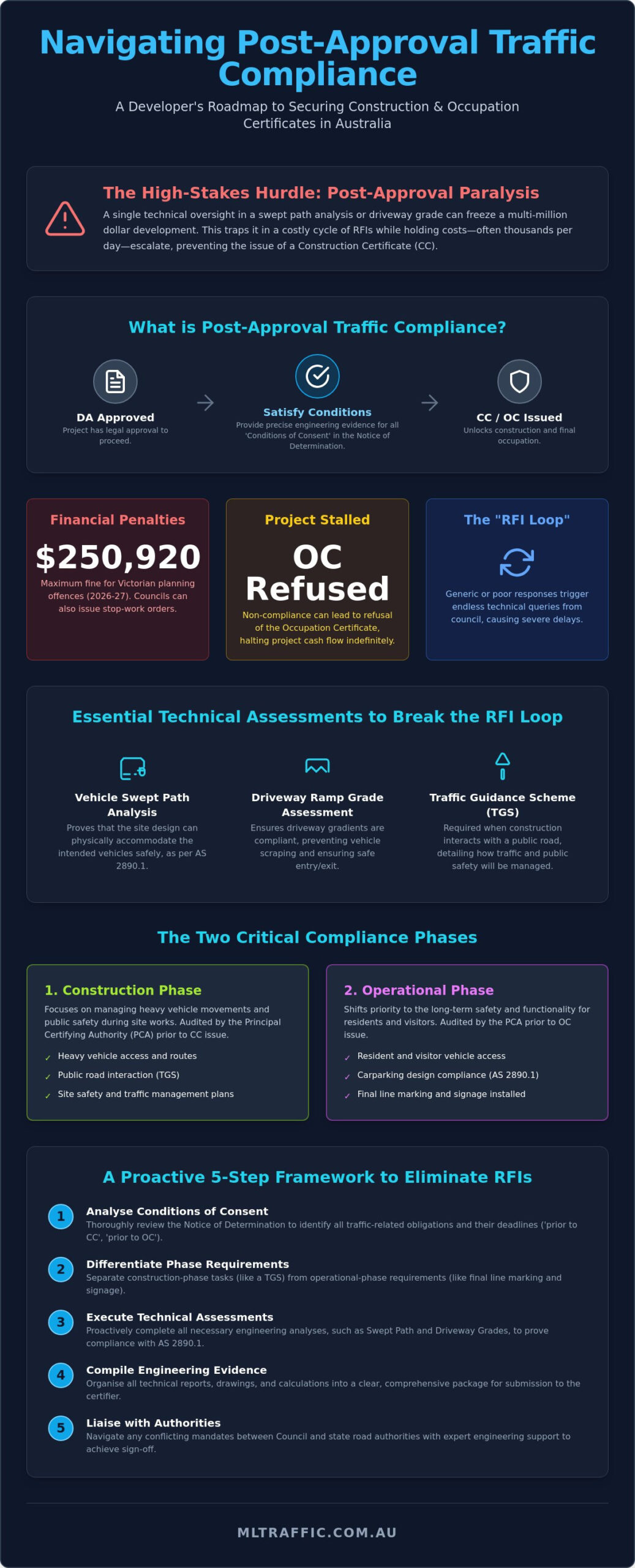
Post-approval traffic condition compliance is the technical process of satisfying the specific ‘Conditions of Consent’ mandated by a planning authority after a Development Application (DA) has been approved. This phase is the most volatile period in the development lifecycle. While the project has legal approval, it remains physically stalled until every traffic-related condition is discharged. Failure to provide precise engineering evidence at this stage prevents the issuance of a Construction Certificate (CC), effectively locking the project in an administrative stalemate.
For mid-scale Australian developments in 2026, holding costs and interest repayments can accumulate at rates exceeding several thousand dollars per day. These financial pressures make the post-approval phase a high-stakes environment where any delay is costly. Developers must distinguish between “deferred commencement” conditions, which prevent the consent from becoming active, and “prior to construction” conditions, which must be satisfied before any site works begin. Both require detailed technical documentation to satisfy Council engineers.
To better understand the technical nuances of managing these requirements, watch this helpful video:
The Notice of Determination: Your Compliance Roadmap
The Notice of Determination (NoD) serves as the definitive roadmap for your project’s technical obligations. Traffic conditions are typically found under sections titled “Conditions to be satisfied prior to the issue of a Construction Certificate” or “General Conditions.” These requirements often use specific terminology, such as “prior to the commencement of works,” to signal when evidence must be submitted. While some conditions may appear to be “standard” templates, they frequently demand bespoke engineering solutions. A requirement to adhere to Road traffic control principles might necessitate a site-specific Traffic Guidance Scheme (TGS) if the construction footprint interacts with the public road reserve. You can view the full range of required technical assessments on our services page.
The Consequences of Non-Compliance
The risks of non-compliance are both legal and financial. In Victoria, for the 2026-2027 financial year, planning offences can attract maximum penalties of up to $250,920. Beyond fines, Council has the authority to issue stop-work orders or refuse an Occupation Certificate (OC), halting project cash flow indefinitely. Many developers fall into the “RFI Loop,” where a generic or poorly prepared response to a condition triggers three or four additional technical queries from Council. This cycle is usually caused by a lack of specific data, such as a Vehicle Swept Path Analysis or a Driveway Ramp Grade Assessment, which are essential for proving that the proposed design functions safely in a real-world environment.
Construction vs. Operational Stage Traffic Compliance
Securing a Notice of Determination is only the first step in a multi-stage technical obligation. Compliance is not a static event but an ongoing requirement that evolves as a project moves from a vacant lot to a finished building. Developers must recognise that the technical evidence required to satisfy a Principal Certifying Authority (PCA) changes significantly between the construction and operational phases. While the construction phase focuses on managing heavy vehicle movements and public safety, the operational phase shifts priority toward long-term resident and visitor safety. In both instances, a detailed Swept Path Analysis is essential to prove that the site can physically accommodate the vehicles intended to use it.
The PCA acts as the primary auditor for these stages. They will not issue a Construction Certificate (CC) until temporary traffic measures are approved, nor will they grant an Occupation Certificate (OC) until the final built form matches the approved traffic designs. This dual-gatekeeper system makes post-approval traffic condition compliance a critical path item for project delivery. If you are facing complex requirements from a PCA, you can contact our senior principals for direct technical assistance.
Construction Stage: Managing Temporary Impacts
The construction phase requires the development of a Traffic Guidance Scheme (TGS) and a comprehensive Traffic Management Plan (TMP). These documents must outline heavy vehicle haulage routes that avoid sensitive residential areas and adhere to Council-approved peak hour restrictions. Compliance at this stage is about mitigating the impact of the build on the existing road network. It involves managing work zones, ensuring pedestrian protection, and verifying that site access points can handle the turning circles of concrete agitators and delivery trucks without breaching DA conditions. Failure to manage these temporary impacts often leads to immediate stop-work orders from Council rangers.
Operational Stage: Long-Term Site Functionality
Once construction concludes, the focus shifts to the permanent functionality of the site. This requires final certification of car park designs and driveway ramp grades to ensure they meet the rigorous requirements of AS 2890.1. Every parking space, aisle width, and overhead clearance must be verified against the Australian Standards. Operational compliance also extends to waste management; you must demonstrate that waste collection vehicles can enter, circulate, and exit the site in a forward direction. Without this technical verification, the project remains a legal liability, and the OC will be withheld, preventing any commercial or residential occupation.
Regulatory Standards: AS 2890 and Austroads 2026 Updates
Technical standards are the primary benchmarks used by planning authorities to verify the safety and functionality of a development. To achieve post-approval traffic condition compliance, your project must satisfy the rigorous criteria set out in the Australian Standards and the latest Austroads guidelines. Council engineers don’t view these documents as flexible suggestions. They’re binary checklists. If a design deviates from the prescribed dimensions, it’ll be rejected, regardless of how minor the discrepancy seems. Precision is the only way to avoid costly redesigns.
The “near enough” approach is the most frequent cause of project delays. A driveway ramp that exceeds the maximum gradient by a fraction of a percent or a loading dock that lacks the required vertical clearance will trigger a refusal. Courts have recently reinforced this strict adherence. A 2026 decision in Queensland (1770 Nominees Pty Ltd & Anor v Gladstone Regional Council) demonstrated that failure to complete required car park and driveway works can lead to the immediate cessation of commercial operations. This highlights that compliance is a legal necessity, not a bureaucratic preference.
Navigating AS 2890.1:2021 Requirements
Compliance with AS 2890.1:2021 requires precise design for both B85 and B99 vehicle classes. This involves more than just marking out bays on a plan. A Driveway Ramp Grade Assessment is essential to prevent vehicle scraping, particularly for low-clearance vehicles. You must also verify Sight Distance Assessment requirements at the property boundary to ensure exiting drivers can see pedestrians and oncoming traffic. These dimensions are non-negotiable and must be proven through technical drawings and engineering reports. You can view our full range of technical capabilities on our services page.
The Impact of 2026 Austroads Technical Updates
The regulatory environment became more complex in May 2026 with the release of updated Austroads Guides to Temporary Traffic Management. These updates, alongside the January 2026 revision of the Guide to Traffic Management Part 2, have introduced stricter requirements for Intersection Analysis. Developers are now frequently required to provide detailed SIDRA modelling to prove intersection capacity and performance. There is also an increased focus on active transport. This requires specific provisions for bicycle parking and end-of-trip facilities that align with new national consistency standards. These national updates filter down quickly to local council assessments, making up-to-date technical knowledge a prerequisite for successful post-approval traffic condition compliance.
A 5-Step Framework for Managing Post-Approval Compliance
Managing post-approval traffic condition compliance requires a systematic approach to technical evidence. It is not merely an administrative exercise. It is a defensive engineering strategy designed to protect your project from the “RFI Loop” and mounting holding costs. Professional Traffic Engineering oversight ensures that every response to Council is backed by robust data and compliant design. This framework allows developers to pre-empt objections and handle onerous conditions with technical authority.
Step 1: Condition Deconstruction
Condition Deconstruction is the foundation of project risk management. This process involves isolating every traffic-related clause within the Notice of Determination and mapping them to specific project milestones. You must identify which conditions are required for the Construction Certificate (CC), the Occupation Certificate (OC), or Section 73 compliance. Missing a single “prior to commencement” requirement can halt site works for weeks while holding costs accumulate.
Step 2: Technical Evidence Collection
You must commission site-specific assessments, including a Swept Path Analysis and parking demand studies, based on the most recent architectural revisions. It is vital that all CAD drawings align with the latest site survey data, including existing road levels and sightlines. Inaccurate survey data is a primary cause of technical RFIs during the CC phase. Robust data collection at this stage prevents design conflicts later in the build.
Step 3: Internal Compliance Audit
Conduct a rigorous internal audit before any documents are submitted to the planning authority. This involves cross-referencing engineering reports against the specific wording of the DA conditions. You should identify “grey areas” where Council interpretation may vary and address them proactively. Self-correcting design flaws before they reach the Council desk maintains your project’s momentum and builds professional credibility with the reviewing engineers.
Step 4: Submission and Negotiation
Presenting data in a format that satisfies Council traffic engineers is essential for a quick turnaround. When “Deemed-to-Satisfy” standards cannot be met due to physical site constraints, we implement “Performance-Based Solutions” to prove safety and functionality. This technical negotiation is often the only way to manage unreasonable or onerous conditions that would otherwise compromise the project’s feasibility. Direct dialogue with Council helps to expedite the review process.
Step 5: Final Certification and Sign-off
The final step involves obtaining the necessary compliance certificates to satisfy the Principal Certifying Authority (PCA). You must ensure that all long-term operational plans, such as waste collection and loading dock management, are handed over to the site management team. Properly closing out the compliance file is the only way to secure the Occupation Certificate and transition the project to its operational phase. If you need to organise technical evidence for your next submission, our senior principals provide direct oversight on every assessment.
Partnering with ML Traffic Engineers Australia for Post-Approval Success
ML Traffic Engineers Australia delivers the technical precision required to navigate the final stages of the Australian planning process. With over 15 years of national consultancy experience, we understand the specific requirements of local councils and state road authorities. Our focus remains on achieving post-approval traffic condition compliance through meticulous data and engineering expertise. We do not delegate critical assessments to junior staff; our senior principals remain hands-on throughout the project lifecycle to ensure every submission is RFI-proof and meets the rigorous expectations of planning auditors.
The comprehensive range of technical services provided by ML Traffic Engineers Australia is designed to satisfy every possible ‘Condition of Consent’. We provide the engineering evidence needed to discharge conditions across diverse project environments. Our core capabilities include:
- Traffic Impact Assessment (TIA) Report
- Vehicle Swept Path Analysis
- Car Parking Demand Assessment
- Traffic Guidance Scheme (TGS)
- Driveway Ramp Grade Assessment
- Intersection Analysis
- Sight Distance Assessment
- Car Park Design
- Waste Management Plan
Our Senior-Led Approach to Compliance
Junior-level reporting is a primary cause of the technical RFIs that stall multi-million dollar developments. When an assessment lacks the necessary technical depth or fails to reference the correct version of the Australian Standards, Council engineers will inevitably issue a request for further information. The ML Traffic Engineers Australia senior-led approach eliminates this risk. We provide direct access to experts who understand the nuances of urban planning and infrastructure design. A core pillar of our consultancy is the Personnel Continuity Promise. The senior expert who initiates your project is the same professional who performs the technical work and defends the design before Council.
Securing Your Development Timeline
Time is the most expensive variable in any Australian development. Our No-Gatekeepers approach ensures you have a direct line to senior leadership, which is essential for fast-tracked developments. ML Traffic Engineers Australia has successfully intervened in numerous stalled projects where non-compliant designs had halted progress. By providing accurate post-approval traffic condition compliance documentation, we clear the path for both Construction Certificates and Occupation Certificates on complex sites. We ensure your project remains on schedule by delivering engineering reports that satisfy regulatory bodies on the first submission. Contact ML Traffic Engineers Australia to discuss your post-approval conditions today.
Securing Your Final Approvals with Technical Precision
Achieving post-approval traffic condition compliance is the final technical hurdle in the development lifecycle. As established, this process requires a transition from managing temporary construction impacts to ensuring long-term operational safety under AS 2890.1:2021. By implementing a structured 5-step framework and staying ahead of the 2026 Austroads updates, you can eliminate the RFI delays that threaten project feasibility and increase holding costs.
ML Traffic Engineers Australia provides the professional certainty needed to discharge complex conditions of consent. With over 15 years of national consultancy experience, we ensure your project benefits from direct access to senior principals who manage every technical assessment personally. This level of accountability is vital for satisfying the Principal Certifying Authority and securing both your Construction and Occupation Certificates without administrative friction.
Speak with a Senior Traffic Engineer about your compliance conditions to discuss how ML Traffic Engineers Australia can support your project. We provide the meticulous oversight required to turn complex approval documents into a clear path for project completion. Our expert team remains committed to delivering results that meet the highest regulatory standards across Australia.
Frequently Asked Questions
What is the most common reason for a traffic-related RFI?
The most frequent cause of a Request for Information (RFI) is the submission of engineering data that does not match the final architectural plans. Many developers provide generic assessments that lack site-specific detail, such as a Vehicle Swept Path Analysis or a Driveway Ramp Grade Assessment based on the exact construction dimensions. Council engineers require precise technical evidence to discharge conditions, and any discrepancy between the traffic report and the architectural set will trigger a delay.
Can I start construction before all traffic conditions are met?
You cannot legally commence construction until all “Prior to the Issue of a Construction Certificate” conditions are satisfied and the certificate is issued. Starting site works before achieving post-approval traffic condition compliance is a breach of the Development Consent. This often leads to immediate stop-work orders from Council rangers and can result in significant financial penalties under state planning legislation.
How long does it typically take for a Council to assess a compliance application?
Assessment timelines vary between Local Government Areas (LGAs), but most councils take between four and eight weeks to review technical submissions. This period can extend significantly if the initial documentation is incomplete or non-compliant. Because the clock often resets when an RFI is issued, providing a robust engineering report on the first submission is the only way to protect your project timeline from administrative bottlenecks.
What happens if my site cannot physically meet AS 2890.1 standards?
If physical site constraints prevent a “Deemed-to-Satisfy” solution, you must propose a “Performance-Based Solution.” A qualified traffic engineer must demonstrate through technical modelling that the alternative design achieves the same safety and functional outcomes as the Australian Standard. This approach requires detailed justification and is often the only path to compliance for constrained urban infill developments.
Do I need a new Swept Path Analysis if my architect changes the driveway slightly?
Yes, any modification to the driveway width, alignment, or internal gradients requires a revised analysis. Even a minor change can alter the turning circle requirements for heavy vehicles or waste collection trucks. To ensure post-approval traffic condition compliance, the technical evidence submitted to the PCA must mirror the exact dimensions of the plans intended for construction.
What is the difference between a TGS and a TMP in the compliance phase?
A Traffic Management Plan (TMP) is a high-level strategic document that outlines how traffic impacts will be managed throughout the project. In contrast, a Traffic Guidance Scheme (TGS) is a technical diagram that shows the specific placement of signs, barriers, and line markings for temporary road interactions. Both are typically required to satisfy construction-stage conditions involving the public road reserve.
Who is responsible for verifying that traffic conditions have been satisfied?
The Principal Certifying Authority (PCA) is responsible for the final verification that all conditions of consent have been met. However, the PCA is not a traffic expert and relies on compliance certificates and technical reports from qualified engineers. We provide the necessary engineering sign-offs that allow the PCA to issue the Construction Certificate or Occupation Certificate with professional certainty.
How much do post-approval traffic engineering services cost?
The cost of technical services depends entirely on the complexity of the project and the number of conditions listed in the Notice of Determination. A simple residential driveway grade assessment will require less resources than a full intersection analysis for a commercial precinct. Developers should provide their specific approval documents to receive a detailed fee proposal tailored to their project’s technical requirements.

Disclaimer
The content on www.mltraffic.com.au, including all technical articles, guides, and resources, is provided for general informational and educational purposes only. It is not intended to constitute professional advice in traffic engineering, transport planning, development approvals, or any other technical or legal field.While ML Traffic Engineers makes every reasonable effort to ensure the accuracy, completeness, and timeliness of the information published, we do not provide any warranties or representations (express or implied) regarding its reliability, suitability, or availability for any particular purpose. Any reliance you place on the content is strictly at your own risk.In no event shall ML Traffic Engineers, its directors, employees, authors, or affiliates be liable for any direct, indirect, incidental, special, consequential, or punitive damages (including, without limitation, loss of profits, data, or business opportunities) arising out of or in connection with the use of, or inability to use, any information provided on this website.The articles and guides on this site are not a substitute for engaging a qualified, registered professional traffic engineer (such as an NPER or RPEQ engineer) to assess your specific project requirements. For tailored advice, compliance assessments, or traffic engineering services, please contact a competent professional.This disclaimer may be updated from time to time without notice. By accessing or using this website, you agree to be bound by the most current version of this disclaimer.
