

A post-construction traffic monitoring plan is often the final, most critical hurdle standing between a completed development and the successful discharge of council conditions. You’ve likely spent years navigating complex planning approvals, only to find that operational reality doesn’t always mirror the initial Traffic Impact Assessment. Dealing with unexpected congestion at site entries or pedestrian safety concerns post-opening is a significant burden that can delay project finalisation.
We understand that satisfying these requirements demands more than a cursory glance at vehicle counts. It requires a meticulous, engineering-led approach to verify that site access and parking flow function as intended. This guide outlines how to develop a professional post-construction traffic monitoring plan that meets national regulatory standards and ensures the safety of all road users.
You’ll learn the essential components of a Stage 5 road safety audit, how to use ground-truth data to address council concerns, and the steps required to secure an expert engineering sign-off. We provide the technical clarity needed to move from construction to a fully compliant, operational site.
Key Takeaways
- Understand why local councils mandate a post-construction traffic monitoring plan as a Condition of Consent to assess the real-world impact of your development on the road network.
- Identify the critical role of Stage 5 Road Safety Audits in detecting operational hazards and verifying site safety within the first few months of opening.
- Learn about the technical data collection methods, including automated counters and manual observations, required to produce authoritative reports for project finalisation.
- Determine the standard reporting intervals and engineering requirements necessary to successfully discharge council conditions and clear your DA obligations.
- Recognise how professional engineering oversight ensures site access and parking flow are optimised while avoiding unnecessary bureaucratic delays.
What is a Post-Construction Traffic Monitoring Plan?
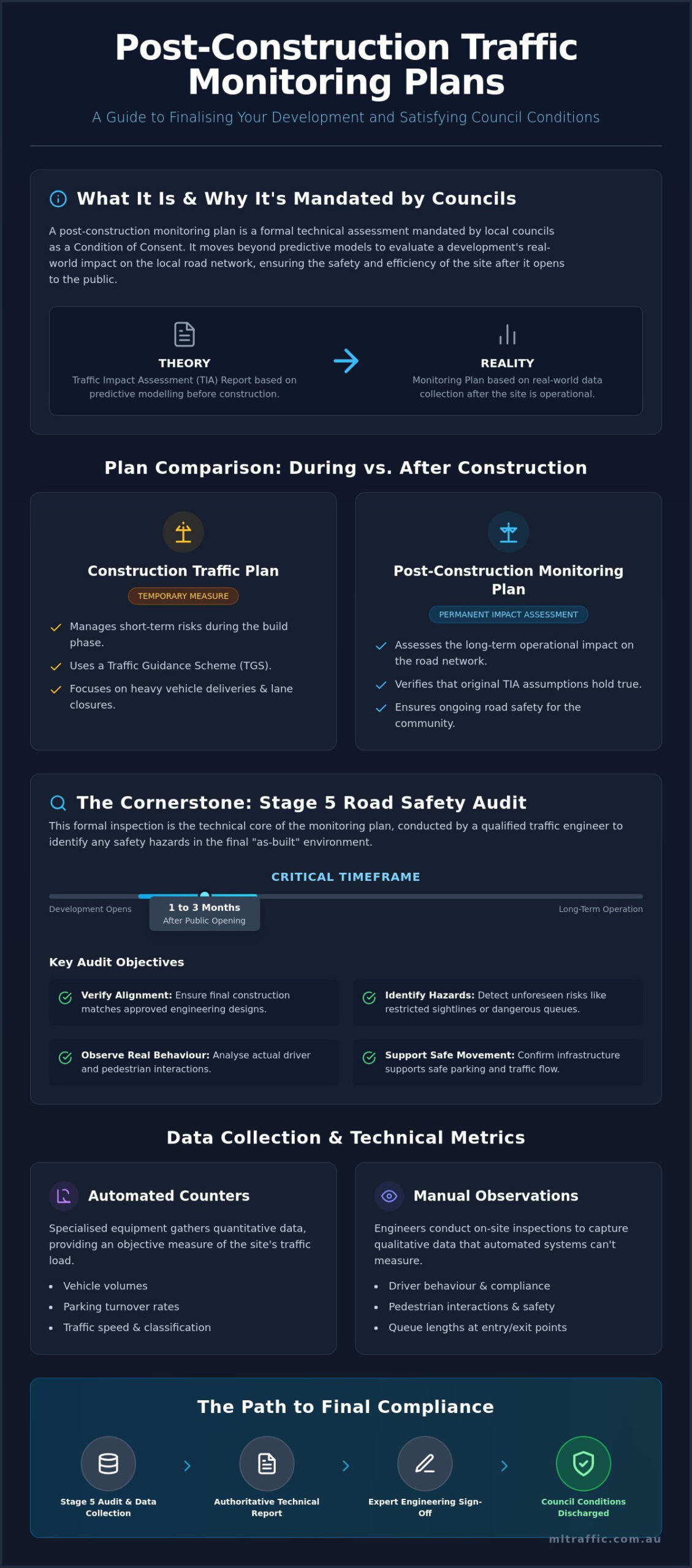
A post-construction traffic monitoring plan is a formalised technical document designed to evaluate the operational performance of a completed development. While the initial planning phase relies on predictive modelling, this plan captures real-world data to ensure the site functions safely and efficiently. Local councils frequently mandate these assessments as a Condition of Consent within a Development Application (DA) to protect the integrity of the surrounding road network.
The discipline of traffic engineering provides the framework for these plans. They move beyond theory to verify that vehicle movements, parking turnover, and pedestrian interactions align with the assumptions made in the original Traffic Impact Assessment (TIA) Report. If actual traffic volumes exceed forecasts or if dangerous queueing occurs at site entries, the monitoring plan identifies these failures so they can be rectified before they become permanent liabilities. ML Traffic Engineers brings over 15 years of experience to this process, ensuring that unforeseen issues like blind spots or intersection bottlenecks are documented with professional precision.
To better understand this concept, watch this helpful video:
The Difference Between Construction and Post-Construction Plans
It’s vital to distinguish between management during the build and monitoring after completion. Construction traffic plans are temporary measures. They use a Traffic Guidance Scheme (TGS) to manage short-term risks like heavy vehicle deliveries and lane closures. In contrast, a post-construction traffic monitoring plan focuses on the permanent operational impact once the site is occupied. Councils prioritising high-density residential or large-scale commercial projects often require this data. It ensures the local infrastructure can handle the increased load without degrading road safety for the community over the long term.
When is Monitoring Legally Required?
Legal requirements for monitoring typically trigger for developments that significantly alter local traffic patterns. This includes major shopping centres, schools, or high-rise residential towers where vehicle and pedestrian volumes are high. In many cases, a council will explicitly request a Stage 5 Road Safety Audit. This is a post-opening verification of the site’s safety performance. Successfully completing this monitoring is often a prerequisite for discharging final occupancy certificates. Developers who ignore these conditions risk delays in project finalisation and potential legal complications regarding site access compliance.
The Stage 5 Road Safety Audit: Post-Opening Verification
A Stage 5 Road Safety Audit is the technical cornerstone of a comprehensive post-construction traffic monitoring plan. Unlike earlier design-stage audits, the Stage 5 assessment occurs after the development has opened to the public, typically within one to three months of operation. This timeframe is critical. It provides the first opportunity to observe real-world driver behaviour and pedestrian interactions within the completed “as-built” environment. A qualified traffic engineer conducts this formalised inspection to identify safety hazards that predictive modelling might have missed.
The primary objective is to verify that the physical infrastructure supports safe movements. We scrutinise the site to ensure that the final construction aligns with the approved engineering designs. Discrepancies between the plan and the reality of the road can lead to dangerous outcomes, such as restricted sightlines or inadequate merging lanes. Identifying these issues early allows for corrective action before a serious incident occurs. If you require assistance with these formalised inspections, our team provides expert traffic engineering consultancy to ensure full compliance.
Key Steps in a Stage 5 Audit
The audit process begins with a detailed desktop review of the original traffic impact assessment and all approved civil plans. This provides the baseline for performance expectations. Following this, the engineer performs on-site observations during both peak and off-peak periods to capture a full spectrum of traffic conditions. We use technical standards similar to those found in the Federal Highway Administration’s Traffic Monitoring Guide to ensure data accuracy. The resulting formal report prioritises safety recommendations based on the level of risk identified during the inspection.
- On-site observations: Monitoring vehicle speeds, queue lengths, and illegal manoeuvres.
- Signage and line marking: Verifying that all regulatory and advisory signs are visible and correctly placed.
- Pedestrian safety: Assessing the adequacy of crossings, footpaths, and refuge islands.
Night-Time vs. Day-Time Observations
Comprehensive monitoring requires assessments across varying lighting conditions. Visibility issues that are non-existent at midday often become critical hazards at dusk or dawn. We evaluate the effectiveness of street lighting and the retro-reflectivity of signage to ensure they meet Australian Standards. This dual-period approach identifies blind spots created by shadows or poor illumination at site entries. It ensures the development remains safe for all users, regardless of the time of day.
Data Collection and Technical Metrics
Quantitative data provides the objective evidence required for the final discharge of council conditions. A professional post-construction traffic monitoring plan uses a combination of manual observations and automated traffic counters to capture precise movement patterns over a defined period. While simple pedestrian counts might suffice for minor projects, complex developments require high-fidelity data to prove that the operational impact matches the original forecasts. We focus on the “Level of Service” (LoS) at surrounding intersections to ensure the new development hasn’t caused unacceptable degradation to the local road network.
Verification extends to internal site metrics, specifically parking demand and bay dimensions. We compare the real-world usage of the car park against the AS 2890.1 standards that informed the initial design. This ensures that the allocated parking is sufficient and that vehicle turnover doesn’t lead to dangerous spillover onto public streets. For broader context on monitoring strategies, Caltrans’ Transportation Management Plan Guidelines offer a benchmark for how post-construction data informs long-term infrastructure adjustments. Our senior principals oversee this data collection to ensure the methodology is beyond reproach during council reviews.
Queue Length and Delay Analysis
Measuring queue lengths at site exits during peak hours is a critical technical requirement. We record the maximum back-up of vehicles to determine if they interfere with through-traffic on main arterial roads. These real-world delays are then compared against the SIDRA modelling performed during the TIA. If the observed delays significantly exceed the predicted values, we identify the specific bottlenecks causing the friction. This allows for data-driven adjustments to signal timings or lane configurations. Accurate queue analysis prevents the “gridlock” scenarios that often lead to community complaints and council intervention.
Swept Path Verification in the Real World
Desktop modelling is an essential starting point, but real-world verification is where safety is confirmed. We observe heavy vehicles as they navigate loading docks and tight turns within the car park. This process identifies issues like “kerb-climbing” or conflict points where large vehicles might encroach on pedestrian zones or scrape structural elements. This field verification builds on our extensive swept path analysis expertise. It provides the final assurance that the site’s geometric design accommodates the actual vehicles using the space. If a heavy vehicle cannot safely clear a turn, we provide the engineering recommendations needed to modify the layout for compliance.
Satisfying Council and Clearing Conditions of Consent
Successfully discharging a Condition of Consent requires more than just submitting raw data. It involves presenting a professional post-construction traffic monitoring plan that directly addresses the specific requirements set out in your Development Application (DA). Local councils across Australia often mandate these reports at specific intervals, such as 6, 12, or 24 months after the site becomes operational. These milestones are critical legal requirements. Failing to meet them can stall the finalisation of your project and lead to ongoing compliance issues with local authorities.
A compliant report must be concise, evidence-based, and signed off by a qualified traffic engineer. This professional endorsement provides the assurance council needs to verify that the development is not adversely affecting the public road network. Proactive monitoring identifies potential friction points before they escalate into community complaints or costly legal disputes. By addressing these issues early, you prevent the risk of forced site modifications later in the project lifecycle. If you need to clear your remaining consent conditions, contact our senior principals for a compliant monitoring report.
Our approach ensures that the same expert who initiates your project is the one performing the technical monitoring work. This personnel continuity is a core promise of our consultancy. It ensures that no technical detail is lost between the planning and operational phases. We provide direct access to our senior leadership, allowing for immediate accountability and expert advice when dealing with complex council negotiations. This “no-gatekeepers” philosophy distinguishes our service from larger, more impersonal firms.
Discharging Your DA Conditions
Discharging DA conditions effectively requires a report that council officers can process without requesting further information. We structure our monitoring reports to align with the exact wording of the council’s requirements. This includes addressing every specific concern raised by the community or the council during the initial planning and public exhibition phases. Each design criterion, such as intersection Level of Service or driveway safety, receives a clear Pass/Fail assessment. This straightforward approach provides the technical clarity required to secure final engineering sign-off and move toward a full discharge of conditions.
Dealing with Negative Results
In some instances, real-world data may indicate that traffic impacts are higher than the initial modelling suggested. When this occurs, the monitoring plan must include practical mitigation measures to satisfy the authority. Developing targeted engineering solutions, such as adjusted traffic signal timings, improved line marking, or enhanced regulatory signage, can often resolve these issues. We actively negotiate with council officers to implement these non-structural changes, avoiding the need for expensive alterations to the site’s physical layout. This results-oriented approach ensures your development remains safe and compliant while minimising further capital expenditure.
Why Expert Traffic Engineering is Essential
Executing a post-construction traffic monitoring plan is a sophisticated technical undertaking that extends far beyond simple vehicle counts. It requires the use of specialised equipment, such as pneumatic tube counters and high-definition video analysis, alongside advanced software for intersection modelling. Relying on non-specialist staff to gather this data often leads to inaccuracies that local councils will quickly identify and reject. Professional engineering oversight ensures that the data collected is both robust and defensible during the final stages of project approval.
ML Traffic Engineers brings over 15 years of experience to every post-construction assessment. Our firm specialises in “closing the loop” between the initial design assumptions and the final operational reality. This continuity is vital for total compliance. By verifying that the site performs as predicted in the original Traffic Impact Assessment, we provide the technical certainty required by both developers and authorities. Our senior principals are directly involved in every project, ensuring that your report carries the necessary weight to satisfy even the most onerous council conditions.
The ML Traffic Advantage
We provide national consultancy services with a deep, practical understanding of Australian Standards, including the AS 2890 series and Austroads guidelines. Our brand is built on a hands-on approach where the same expert who initiates the client relationship performs the technical work. This personnel continuity promise distinguishes us from larger, impersonal firms where projects are often handed off to junior staff. We understand the bureaucratic requirements of local government and have a proven track record in clearing complex conditions for diverse project environments, from high-rise residential towers to major commercial centres.
- Direct Access: You deal directly with senior principals who have the authority to make critical engineering decisions.
- Accountability: Our “no-gatekeepers” approach means you have a direct line to the experts responsible for your project’s success.
- Results-Oriented: We focus on the successful discharge of council conditions and the optimisation of site safety.
Contact Our Senior Engineers Today
If your development requires a post-construction traffic monitoring plan or a formal Stage 5 Road Safety Audit, expert guidance is essential to avoid project delays. Our team provides the technical clarity and professional sign-off needed to ensure your site is safe and fully compliant with all regulatory requirements. We invite you to discuss your specific site needs with our senior leadership team to ensure a seamless transition from construction to operation.
Organise your traffic monitoring with ML Traffic Engineers to secure an authoritative engineering assessment for your next project.
Secure Your Site’s Operational Compliance
A professional post-construction traffic monitoring plan is the final step in validating your development’s safety and efficiency. By verifying “as-built” conditions against predictive models, you ensure that site access and parking flow meet the rigorous requirements of local authorities. This process is essential for discharging DA conditions and mitigating long-term liability risks. Expert oversight identifies hazards like dangerous queueing or visibility issues before they lead to community complaints or site modifications.
ML Traffic Engineers brings 15+ years of Australian traffic engineering experience to guide you through this complex regulatory phase. Our senior principals provide direct involvement in every project, ensuring all assessments adhere to AS 2890 and Austroads standards. We help you move from construction to a fully operational, compliant site with technical precision and authoritative sign-off. Don’t let onerous council conditions delay your project finalisation.
Get Expert Traffic Monitoring Advice from ML Traffic Engineers
Your development is now ready for a safe and successful future.
Frequently Asked Questions
What is the purpose of a post-construction traffic monitoring plan?
The primary purpose is to verify that the real-world traffic impact of a development aligns with the predictions made during the planning phase. It acts as a formal check to ensure the site operates safely and does not cause unacceptable congestion on the surrounding road network. Councils use these plans to confirm that all operational “Conditions of Consent” have been satisfied before finalising project approvals.
How long does traffic monitoring typically need to last?
Monitoring duration is determined by the specific conditions set out in your Development Application. Most councils require data collection at set intervals, typically 6, 12, or 24 months after the development has opened to the public. These periods allow engineers to capture traffic patterns once the site has reached its normal operational capacity and any initial “opening phase” fluctuations have stabilised.
Is a Stage 5 Road Safety Audit the same as a monitoring plan?
No, they are distinct but related components of project finalisation. A Stage 5 Road Safety Audit is a specific inspection focused on identifying physical safety hazards in the “as-built” environment. A post-construction traffic monitoring plan is broader in scope, incorporating quantitative data such as traffic volumes, intersection delays, and parking occupancy rates to assess overall network performance.
What happens if the traffic monitoring shows more congestion than expected?
If congestion exceeds the initial TIA predictions, the traffic engineer must develop and propose mitigation measures to the council. These solutions often involve non-structural changes, such as modifying traffic signal timings, improving line markings, or installing additional regulatory signage. The goal is to resolve operational bottlenecks and satisfy the authority’s requirements without needing to alter the site’s physical footprint.
Do I need a traffic engineer to conduct the monitoring?
Yes, councils require a qualified traffic engineer to perform the assessment and sign off on the final report. Professional involvement ensures that the data collection methodology complies with Australian Standards and that the analysis is technically sound. At ML Traffic Engineers, our senior principals oversee this process to ensure the report carries the necessary authority for council approval.
Can I use automated cameras for traffic monitoring?
Automated cameras and sensors are standard tools used to collect high-quality, objective data for these reports. They are highly effective for measuring vehicle counts, average speeds, and maximum queue lengths at intersections. Using these technologies provides a more accurate and cost-effective dataset compared to manual observations alone, which helps in creating a robust post-construction traffic monitoring plan.
How much does a post-construction traffic report cost for a standard DA?
The cost of a report depends entirely on the scale of the development and the specific metrics required by the council. Factors such as the number of intersections to be monitored, the duration of data collection, and whether a Stage 5 Road Safety Audit is also required will influence the final fee. Complex commercial sites generally require more extensive monitoring than smaller residential projects.
What metrics are councils most interested in during post-opening reviews?
Councils primarily focus on the intersection Level of Service (LoS), maximum queue lengths, and parking demand. They look for evidence that the development has not degraded the performance of the local road network or created safety risks for pedestrians. Demonstrating that vehicle turnover in the car park stays within predicted limits is also a key metric for project finalisation.

Disclaimer
The content on www.mltraffic.com.au, including all technical articles, guides, and resources, is provided for general informational and educational purposes only. It is not intended to constitute professional advice in traffic engineering, transportation planning, development approvals, or any other technical or legal field.While ML Traffic Engineers makes every reasonable effort to ensure the accuracy, completeness, and timeliness of the information published, we do not provide any warranties or representations (express or implied) regarding its reliability, suitability, or availability for any particular purpose. Any reliance you place on the content is strictly at your own risk.In no event shall ML Traffic Engineers, its directors, employees, authors, or affiliates be liable for any direct, indirect, incidental, special, consequential, or punitive damages (including, without limitation, loss of profits, data, or business opportunities) arising out of or in connection with the use of, or inability to use, any information provided on this website.The articles and guides on this site are not a substitute for engaging a qualified, registered professional traffic engineer (such as an NPER or RPEQ engineer) to assess your specific project requirements. For tailored advice, compliance assessments, or traffic engineering services, please contact a competent professional.This disclaimer may be updated from time to time without notice. By accessing or using this website, you agree to be bound by the most current version of this disclaimer.
