

Receiving your Development Application approval feels like the finish line, but for many developers, the real technical battle begins with the conditions of consent. It’s frustrating to see your construction timeline stall because of a complex requirement for a swept path analysis or a dispute over driveway grades. You’ve secured the approval, yet the technical red tape involved in resolving traffic conditions of consent post-DA often feels insurmountable. This stage demands a level of engineering precision that goes beyond basic design plans.
We’ll provide the exact technical and procedural steps you need to satisfy these requirements without compromising your development yield or blowing your budget. This guide examines the nuances of AS 2890.1:2004 compliance, the role of senior-led engineering assessments, and how to negotiate effectively with Council to ensure a smooth transition to the construction phase. You’ll gain a clear roadmap to navigate these bureaucratic hurdles with confidence and technical authority, ensuring your project moves from paper to pavement without unnecessary delay.
Key Takeaways
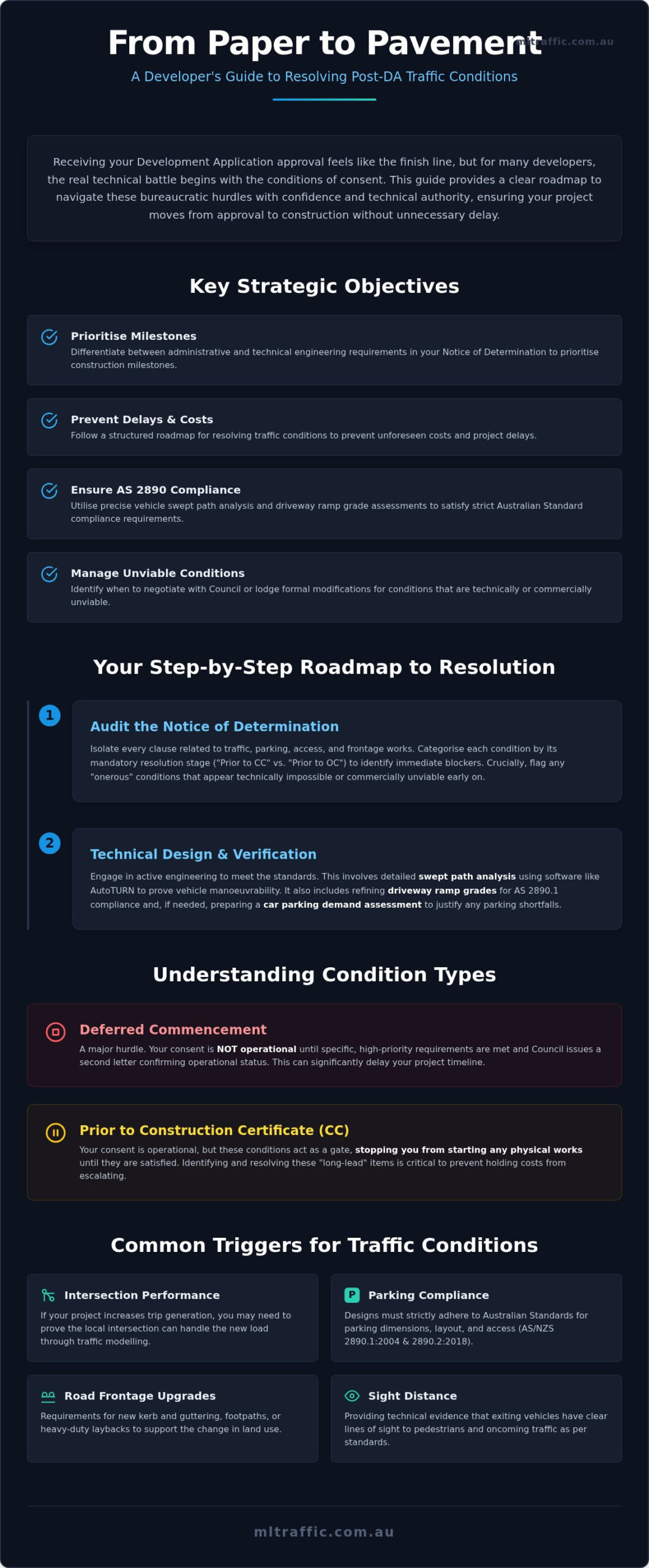
- Differentiate between administrative and technical engineering requirements in your Notice of Determination to prioritise construction milestones.
- Follow a structured roadmap for resolving traffic conditions of consent post-DA to prevent unforeseen costs and project delays.
- Utilise precise vehicle swept path analysis and driveway ramp grade assessments to satisfy strict AS 2890 compliance requirements.
- Identify when to negotiate with Council or lodge formal modifications for conditions that are technically or commercially unviable.
- Access senior-level technical evidence to streamline the transition between DA approval and the final Occupation Certificate.
Understanding Your Notice of Determination and Traffic Conditions
The Notice of Determination is your project’s legal blueprint. It’s more than a simple approval; it’s a conditional contract between you and the Consent Authority. Within this document, traffic conditions are frequently the most technically demanding. They impact public safety, asset management, and civil liability. Traffic engineering principles govern these requirements, ensuring that your development doesn’t compromise the existing road network or safety standards.
Resolving traffic conditions of consent post-DA requires distinguishing between administrative and technical tasks. Administrative items might include paying the $47 NSW Planning Portal service fee for modifications or submitting a finalised management plan. Technical requirements are far more rigorous. They often require a certified Traffic Impact Assessment (TIA) or detailed swept path analysis to prove that vehicles can safely enter and exit the site. Understanding the hierarchy of these requirements is the first step in resolving traffic conditions of consent post-DA without stalling your project’s momentum.
Deferred Commencement vs. Prior to Construction Certificate (CC)
A Deferred Commencement condition is a significant hurdle. It means your consent isn’t operational until you satisfy specific requirements. You can’t act on the approval until Council provides a second letter confirming the operational status. Conversely, “Prior to CC” conditions allow the consent to operate but stop you from starting physical works. Identifying “long-lead” items early is critical. Complex intersection analysis or frontage road designs can take months to negotiate with Council engineers, potentially delaying your construction start date and increasing holding costs.
Common Triggers for Traffic-Related Conditions
Councils impose traffic conditions when a development alters the status quo of local infrastructure. These triggers often relate to safety and capacity. Common requirements include:
- Intersection Performance: If your project increases trip generation, you may need to prove the local intersection can handle the load through modelling.
- Parking Compliance: Designs must strictly adhere to AS/NZS 2890.1:2004 for off-street parking and AS/NZS 2890.2:2018 for commercial vehicles.
- Road Frontage Upgrades: Requirements for new kerb and guttering, footpaths, or heavy-duty laybacks to support the new land use.
- Sight Distance: Providing technical evidence that exiting vehicles have clear lines of sight to pedestrians and oncoming traffic.
Step-by-Step: How to Resolve Traffic Conditions of Consent
Moving from a Notice of Determination to on-site construction requires a methodical technical response. It isn’t enough to simply acknowledge the conditions. You must provide engineering evidence that satisfies the Council’s traffic department. The process of resolving traffic conditions of consent post-DA is often iterative. It requires precise documentation to clear the path for your Construction Certificate (CC) and prevent project stagnation.
Step 1: Audit the Notice of Determination
Isolate every clause mentioning traffic, parking, access, or frontage works. Categorise these conditions by their mandatory resolution stage. “Prior to CC” conditions are your immediate blockers. “Prior to Occupation Certificate” (OC) conditions are final hurdles. During this audit, identify any “onerous” conditions that are technically impossible or commercially unviable. These may require a Section 4.55 modification to amend the consent before you can proceed with the technical design. Early identification of these issues prevents expensive redesigns once construction has already commenced.
Step 2: Technical Design and Verification
This phase involves active engineering to meet the standards set in your conditions. You will likely need to perform a detailed swept path analysis using AutoTURN software. This proves that the design vehicle, whether a B99 car or a heavy rigid waste truck, can safely navigate the site. If your development has a parking shortfall, a car parking demand assessment is necessary to justify the yield. We also focus on refining driveway ramp grades to ensure strict compliance with AS 2890.1. This level of detail is essential for resolving traffic conditions of consent post-DA and gaining the trust of the Consent Authority.
Step 3: Preparation of Compliance Reports
Documentation is the only currency the Consent Authority accepts. You must draft a formal compliance report that addresses each traffic condition individually. These reports should incorporate certified engineering plans and align with the Guide to Traffic Impact Assessment framework. By providing a comprehensive suite of services, including intersection analysis and sight distance assessments, you provide the Council engineer with the data they need to grant a sign-off. If you are unsure which technical reports are required for your specific project, you can contact our senior principals for a direct review of your conditions.
Technical Requirements: Resolving Swept Paths and AS 2890 Compliance
Technical roadblocks usually emerge during the transition from conceptual DA plans to detailed construction drawings. When resolving traffic conditions of consent post-DA, the Consent Authority focuses on whether your site can physically accommodate the vehicle movements it claims to. Australian Standards, specifically AS/NZS 2890.1:2004, serve as the legally binding benchmark for all off-street car parking. While a draft revision was circulated in 2023, the 2004 version remains the enforceable standard for development compliance as of mid-2026. Failing to meet these specific dimensions often results in a refusal of the Construction Certificate.
We use advanced simulation software like AutoTURN to prove that a design is functional and safe. This technology removes the guesswork from Council negotiations by providing visual evidence of vehicle clearance. Beyond the internal site layout, you must also address “Works in Kind” and frontage infrastructure requirements. These often involve upgrades to the public road reserve, such as new kerb and guttering or heavy-duty laybacks. These works are frequently tied to developer contribution plans, such as Section 7.11 in NSW, and require precise engineering designs for approval. In many instances, these civil works also require arboricultural assessments from Arbor Australis Consulting to ensure that street trees and local vegetation are protected during construction.
Swept path analysis is the digital simulation of a vehicle’s turning envelope. It is the primary tool used to prove that Small Rigid Vehicles (SRVs) and Medium Rigid Vehicles (MRVs) can manoeuvre safely within the site boundaries. Resolving conditions related to loading dock functionality often requires demonstrating that these vehicles can enter and exit in a forward direction. If your Notice of Determination specifies that “all waste collection must occur on-site,” you must provide a certified swept path diagram showing the vehicle’s path from the street to the loading bay and back again without impacting parked cars or structural columns.
Car Park Design and Driveway Ramp Compliance
Ensuring your car park design meets AS 2890.1 Explained standards is a frequent requirement for resolving traffic conditions of consent post-DA. Council engineers scrutinise head clearance, aisle widths, and the presence of “blind aisles.” A blind aisle occurs when a driver reaches the end of a parking row with no turnaround area, creating a safety hazard. Driveway ramp grades are equally critical. We conduct detailed driveway ramp grade assessments to ensure transitions don’t lead to vehicle scraping, a common issue when trying to maximise basement yields on steep sites. Correcting these technical errors at the CC stage prevents costly remedial works during the construction phase.
Managing Onerous Conditions: Modifications and Negotiations
Not all conditions of consent are reasonable or technically achievable. When a requirement for significant road upgrades or restrictive on-site manoeuvring threatens the commercial viability of your project, you need a strategy for resolving traffic conditions of consent post-DA through negotiation or formal modification. This isn’t about asking for leniency. It’s about providing technical evidence that an alternative solution meets the same safety and performance outcomes. Conditions must be for a proper planning purpose and reasonably relate to the development; if they don’t, they can be challenged.
Council engineers often apply standard conditions that may not account for the specific physical constraints of your site. Expert evidence is the only way to challenge these requirements effectively. By presenting data-driven arguments, such as updated intersection analysis or refined swept paths, you can demonstrate that the proposed condition is unnecessary or can be satisfied through a less invasive engineering approach. Resolving traffic conditions of consent post-DA in this manner requires a proactive approach before the Construction Certificate is issued.
Negotiating with Council Traffic Engineers
Effective negotiation begins with a technical counter-proposal. Instead of simply stating a condition is too expensive, provide an alternative engineering solution that achieves the intended safety outcome. A face-to-face meeting or an on-site visit with the authority is often the most efficient way to resolve disputes. These meetings allow our senior principals to walk the Council engineer through the technical constraints and the validity of our AutoTURN simulations. Building a case on empirical data rather than opinion reduces the likelihood of a flat refusal and keeps the project moving.
Section 4.55 Modifications (and National Equivalents)
If a design change is the only way to satisfy a condition, or if the condition itself must be deleted, a formal modification of the development consent is required. This is typically a Section 4.55 application or its equivalent in other states. The primary legal test is that the modified development must remain “substantially the same” as the original approval. A revised traffic impact assessment is essential here. It provides the technical justification the Consent Authority needs to approve the change without reopening the entire DA for reassessment.
While the administrative service fee for a modification on the planning portal is $47 as of July 2026, the real value lies in the engineering work that justifies the change. We ensure that every modification application is supported by robust technical documentation that addresses Council’s concerns head-on. If you’re facing a condition that seems impossible to clear, contact our team today to discuss a technical negotiation strategy.
Streamlining Your Path to Construction with Expert Traffic Engineering
The transition from a planning approval to an active construction site is often the most vulnerable period for a development’s timeline. Professional traffic consultants are essential during this phase because they bridge the gap between theoretical planning and physical reality. Resolving traffic conditions of consent post-DA involves a deep understanding of how civil works impact the final site yield. Without senior-level oversight, developers risk having their Construction Certificate delayed by minor technical non-compliances that could have been resolved through early engineering intervention. We focus on providing a seamless path to construction by addressing these technicalities with precision and authority.
Ensuring long-term compliance is the only way to avoid complications during the Occupation Certificate (OC) stage. It is common for developers to focus solely on the Construction Certificate, only to find that the physical build does not match the approved swept path diagrams or parking dimensions. This oversight can lead to a refusal of the OC, preventing the final handover or sale of the property. By maintaining a meticulous approach to condition resolution, we ensure that every technical requirement is satisfied and documented, providing a clear audit trail for the Principal Certifying Authority.
The Value of Senior Expertise
We provide a personnel continuity promise that distinguishes our consultancy from larger, more impersonal firms. The same expert who initiates your project is the one who performs the technical work and negotiates with the Council. This ensures that the technical reasoning established during the DA stage remains consistent through to the resolution of your conditions. Navigating complex site constraints requires a level of meticulous attention that junior staff often overlook. In the field of traffic engineering, accountability is the foundation of a successful sign-off. Our “no-gatekeepers” approach provides you with direct access to senior principals, ensuring that technical challenges are addressed without unnecessary administrative delays.
Final Checklist for Condition Sign-Off
Compliance does not end when the CC is issued. You must verify that every physical element of the build matches the certified plans exactly. This includes checking driveway ramp grades, aisle widths, and the placement of signage and line marking. A final technical audit ensures that all certificates of compliance are in order and that any required works within the road reserve meet the Consent Authority’s standards. You can contact ML Traffic Engineers to finalise your technical documentation and ensure your project reaches the finish line without technical friction. We provide the expert evidence and certified reports required to clear your final conditions and secure your Occupation Certificate.
Securing Your Construction Certificate with Technical Precision
Clearing the path for construction requires more than just a cursory review of your approval documents. Success depends on a methodical audit of your Notice of Determination and the provision of rigorous engineering evidence. By prioritising long-lead technical requirements and ensuring strict adherence to AS 2890 standards, you can avoid the common pitfalls that lead to project stagnation. The process of resolving traffic conditions of consent post-DA is often a technical negotiation where data-driven AutoTURN simulations and expert reports carry the most weight with the Consent Authority.
With over 15 years of Australian consultancy experience, we specialise in Vehicle Swept Path Analysis and car park design compliance. We provide direct access to senior principals for every project, ensuring that the expert who starts your technical work is the one who sees it through to final sign-off. This personnel continuity promise ensures your project maintains technical authority during every interaction with Council. Don’t let technical red tape delay your site start. Contact ML Traffic Engineers to resolve your post-DA conditions today. We’ll provide the engineering solutions you need to move from approval to construction with complete confidence.
Frequently Asked Questions
What happens if I cannot satisfy a traffic condition of consent?
You must lodge a formal modification application, such as a Section 4.55 in NSW, to amend or delete the condition. This process requires technical justification to prove the requirement is either unviable or that an alternative engineering solution achieves the same safety outcome. Council won’t issue a Construction Certificate until the condition is either met or legally amended through this formal planning process.
Can I start construction before all traffic conditions are resolved?
Generally, you cannot start physical works until the relevant conditions are cleared. Most traffic requirements are “Prior to Construction Certificate” (CC) blockers. This means your Principal Certifier is legally prohibited from issuing the CC until Council provides written sign-off on your technical submissions. Commencing works without a valid CC is a breach of planning legislation and can result in significant fines or stop-work orders.
How long does it take to get a traffic condition signed off by Council?
Standard review periods typically range from four to eight weeks depending on the complexity of the submission. Simple swept path verifications move faster than detailed intersection modelling or frontage road designs. Early engagement with a consultant is essential for resolving traffic conditions of consent post-DA to allow for potential Request for Information (RFI) cycles without delaying your scheduled construction start date.
What is the difference between a TIA and a compliance report for a condition?
A Traffic Impact Assessment (TIA) is a broad document used for the initial DA stage to assess network capacity. A compliance report is a targeted technical response to a specific condition of consent. It focuses on granular details like driveway ramp grades, sight distance certification, and car park design compliance with AS 2890.1:2004. While a TIA secures the approval, the compliance report secures the CC.
Do I need a new swept path analysis if the driveway design changes slightly?
Yes, because even a minor shift in driveway width or angle can invalidate previous AutoTURN simulations. Council engineers require precise diagrams that match the final construction drawings exactly. A slight change in the layback position or internal basement ramp can lead to vehicle scraping or inadequate clearance for heavy vehicles. We ensure that every swept path analysis reflects the most recent architectural and civil revisions.
What is a “Works in Kind” agreement in a traffic context?
A “Works in Kind” (WIK) agreement allows a developer to perform physical infrastructure works, such as road widening, instead of paying a monetary developer contribution. This is common under Section 7.11 plans in NSW. It requires a formal legal agreement with Council and detailed engineering plans that meet the authority’s technical standards. This approach can often be more cost-effective than paying the full developer levy.
How much does it cost to resolve traffic conditions post-DA?
Costs depend on the technical complexity of the conditions. Administrative fees, such as the NSW Planning Portal modification fee of $47, are relatively low. The primary investment is in senior engineering expertise for swept path analysis or intersection modelling. While simple residential compliance reports are straightforward, complex commercial developments requiring extensive data collection and modelling involve a higher level of technical work and documentation.
Can a traffic engineer help negotiate down an onerous condition?
Yes, we act as technical advocates who negotiate directly with Council traffic engineers. By providing empirical data and alternative engineering solutions, we can often demonstrate that a condition is redundant or can be satisfied through a more cost-effective design. This technical advocacy is a vital part of resolving traffic conditions of consent post-DA when standard conditions are applied to a site with unique physical constraints.

Disclaimer
The content on www.mltraffic.com.au, including all technical articles, guides, and resources, is provided for general informational and educational purposes only. It is not intended to constitute professional advice in traffic engineering, transportation planning, development approvals, or any other technical or legal field.
While ML Traffic Engineers makes every reasonable effort to ensure the accuracy, completeness, and timeliness of the information published, we do not provide any warranties or representations (express or implied) regarding its reliability, suitability, or availability for any particular purpose. Any reliance you place on the content is strictly at your own risk.
In no event shall ML Traffic Engineers, its directors, employees, authors, or affiliates be liable for any direct, indirect, incidental, special, consequential, or punitive damages (including, without limitation, loss of profits, data, or business opportunities) arising out of or in connection with the use of, or inability to use, any information provided on this website.
The articles and guides on this site are not a substitute for engaging a qualified, registered professional traffic engineer (such as an NPER or RPEQ engineer) to assess your specific project requirements. For tailored advice, compliance assessments, or traffic engineering services, please contact a competent professional.
This disclaimer may be updated from time to time without notice. By accessing or using this website, you agree to be bound by the most current version of this disclaimer.
