

Anticipated regulatory shifts and the Australian Labor Party’s 2026 policy initiatives are poised to reshape the financial landscape for residential and mixed-use developments. Securing a professional traffic impact assessment for mixed-use developments now requires a technical understanding of these evolving policies, including potential impacts on infrastructure contributions and the government’s approach to public transport. You’re likely concerned about the uncertainty of cumulative traffic impact requirements and the risk of expensive delays from state agency objections. Conflicting standards between local councils and state government bodies often create unnecessary friction during the planning process.
ML Traffic Engineers Australia provides the expert traffic engineering insights necessary to overcome these hurdles and establish a clear pathway to DA approval. This article explains how to align your project with the 2026 policy shifts, demonstrating how to optimise site access and car park design to minimise infrastructure contribution costs. We’ll examine the specific impacts of these policy changes on traffic flow, project viability, and discuss practical strategies to maintain site compliance and achieve successful outcomes.
Key Takeaways
- Identify specific multi-agency requirements for sites near major road and rail hubs to avoid costly objections during the planning process.
- Secure a technical traffic impact assessment for mixed-use developments that accounts for cumulative precinct growth and 2026 policy shifts.
- Conduct preliminary assessments to detect site access fatal flaws early, ensuring your architectural design remains viable and compliant.
- Use SIDRA modelling for intersection analysis to provide verifiable data on traffic flow and infrastructure capacity.
- Participate in pre-lodgement meetings with both Council and state transport authorities to confirm the required assessment scope and streamline approvals.
Understanding Traffic Impact Assessments Near Major Infrastructure
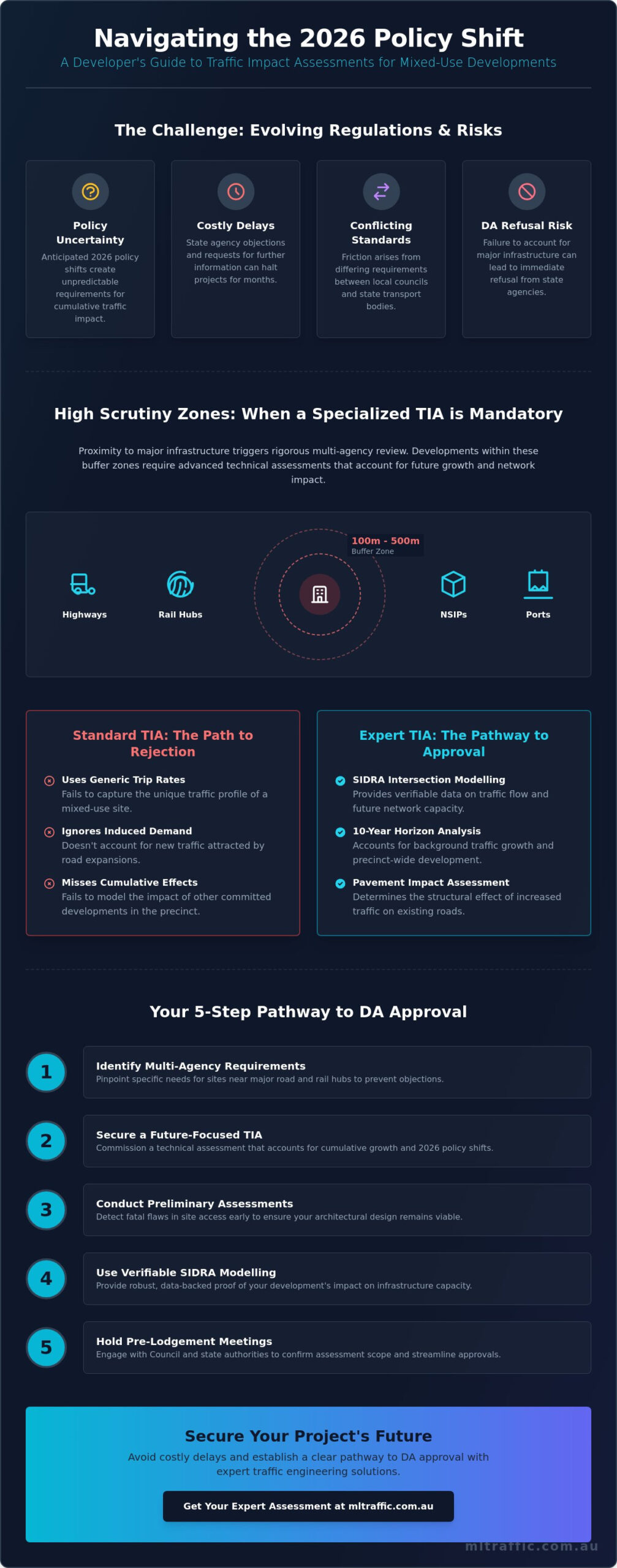
A Traffic Impact Assessment (TIA) is a technical evaluation of the transport implications of a proposed development. It’s a mandatory requirement for sites that generate significant vehicle movements or impact sensitive transport nodes. This report functions as a specialised subset of an Environmental Impact Assessment. Proximity to major infrastructure like highways, rail hubs, and ports triggers rigorous multi-agency scrutiny. The assessment identifies potential congestion, safety risks, and infrastructure wear on the surrounding network. In 2026, assessments must account for future-planned infrastructure initiatives and tax-funded projects. This includes schemes supported by the A$3.4 billion Building Safety Levy and the increased Energy Profits Levy.
To better understand these technical requirements, watch this helpful video:
The Definition of Major Infrastructure Proximity
Scoping an assessment begins with identifying the road network hierarchy. State-controlled roads carry different regulatory requirements than local council streets. Buffer zones play a critical role in this process. Sites located within 100m to 500m of major transport projects require specialised reporting that addresses the specific operational needs of that infrastructure. The 2026 funding shifts mean the government is accelerating certain Nationally Significant Infrastructure Projects (NSIPs). Your traffic impact assessment for mixed-use developments must reflect these updated timelines. Failure to account for a nearby rail expansion or highway upgrade can lead to immediate DA refusal from state agencies.
Why Standard TIAs Fall Short Near Significant Projects
Basic reports often use generic trip generation rates that don’t fit high-density environments. Simple models fail to account for the complex interaction between residential, commercial, and retail traffic at a single site. There’s also the risk of ignoring induced demand. When a major road expands, it often attracts more traffic than initially predicted. A standard report might miss this cumulative effect entirely. This is why councils refer traffic impact assessments to state agencies for a higher level of technical review. These agencies look for intersection analysis that proves the development won’t degrade the level of service on the broader network. Professional traffic engineering services ensure these technicalities are addressed before submission to avoid costly delays.
Technical Requirements for High-Impact Mixed-Use Development Sites
High-impact mixed-use sites demand a rigorous technical approach that extends beyond simple trip generation. A robust traffic impact assessment for mixed-use developments must integrate intersection performance modelling using SIDRA software to evaluate current and future network capacity. We also conduct pavement impact assessments to determine the structural effect of increased loading on existing road surfaces. These technical layers are essential for securing approvals near major infrastructure where state agencies require high-fidelity data. A well-executed assessment provides the technical evidence needed to justify site access and parking provisions to sceptical authorities.
Cumulative Traffic Impact and Network Capacity
Developers often face rejection because they ignore the cumulative effect of surrounding growth. Effective modelling requires a 10-year horizon that accounts for both background traffic increases and committed development traffic within the precinct. This precinct-wide view aligns with the Traffic Impact Assessment Guidelines used by various regulatory bodies to ensure long-term network stability. If the model shows the development will push an intersection beyond its capacity, you will need to propose specific mitigation strategies. This often involves funding intersection upgrades or modifying site access to maintain acceptable levels of service. We focus on these cumulative factors because they represent the primary reason for TIA rejection near major infrastructure projects.
Heavy Vehicle Manoeuvrability and Swept Path Analysis
Mixed-use sites present unique challenges for heavy vehicle access. Loading docks and service areas must accommodate refuse trucks and delivery vans without obstructing public thoroughfares or creating safety hazards. We use specialized software to perform swept path analysis to demonstrate safe entry and exit manoeuvres. A precise traffic impact assessment for mixed-use developments must include these visual proofs to prevent operational failures after construction. We design for worst-case vehicle sizes to ensure your site remains viable as tenant requirements change. This includes verifying driveway ramp grades and sight distance assessments to meet Australian Standards. Our goal is to ensure that your heavy vehicle movements are seamless and don’t trigger objections from local or state transport authorities.
Securing these approvals requires a meticulous attention to detail that only seasoned experts provide. You should consider professional intersection analysis to verify your site’s access strategy before finalising architectural plans. Our senior principals handle these technical assessments directly to ensure accountability and precision on every project. This hands-on approach eliminates the bureaucratic friction often found in larger firms and provides a dependable pathway to DA approval. We prioritize results-oriented solutions that minimize infrastructure contribution costs while maximizing site efficiency.
Strategic vs. Preliminary Traffic Impact Assessments
Early traffic engineering involvement prevents expensive redesign fees. A preliminary TIA identifies fatal flaws in site access before you commit to a full architectural design. This is critical for rezoning applications or large-scale master planning where the road network’s capacity to handle proposed density is unproven. By establishing a Statement of Intent early, you can gauge specific requirements from authorities before formal DA submission. This proactive approach allows you to negotiate infrastructure contributions with planning bodies using data-backed evidence. It’s a strategic move that protects your project’s viability in the face of the A$3.4 billion Building Safety Levy and other 2026 fiscal changes.
When to Conduct a Preliminary TIA
Feasibility studies should always include a preliminary traffic review. This assessment determines if the existing network can support your traffic impact assessment for mixed-use developments. Engaging with state and local authorities at this stage helps you understand the technical expectations. Documents such as the Pinal County Traffic Impact Assessment Guidelines offer a useful framework for understanding local government procedures and procedural rigor. You can use this preliminary data to adjust site density or access points before you spend significant capital on detailed drawings.
Transitioning to a Final Traffic Impact Statement
Once you lock the building footprint and parking layouts, you must refine your traffic model. The final Traffic Impact Statement addresses specific feedback from initial agency referrals or pre-DA meetings. It moves from general precinct assumptions to site-specific calculations. This stage involves finalising the traffic management plan for the construction phase. Our senior leadership ensures technical continuity during this transition. The expert who conducts your preliminary feasibility study’ll be the one performing the technical work for the final submission. This accountability ensures that the final traffic impact assessment for mixed-use developments remains consistent with your initial site strategies.
Navigating the Approval Process with State and Local Authorities
Securing DA approval for mixed-use sites requires a structured approach to multi-agency negotiation. The process begins with identifying all relevant stakeholders, including local Council planning teams and state transport authorities. You must conduct a pre-lodgement meeting to confirm the required scope of assessment before beginning technical work. This prevents the submission of inadequate data that triggers costly delays. A comprehensive traffic impact assessment for mixed-use developments must explicitly address the unique concerns of each agency. Managing the referral process involves responding to Requests for Further Information (RFI) with technical precision. Finally, you must negotiate conditions of consent related to traffic and parking infrastructure to ensure project viability.
Managing the referral process requires more than just submitting a report. State agencies often issue an RFI that demands additional intersection analysis or modifications to site access. Responding to these requests with industry-standard modelling provides the technical weight necessary to move the application forward. During the final stage, you must negotiate the specific conditions of consent. This includes the timing of infrastructure upgrades and the exact value of developer contributions. Meticulous data in your TIA allows you to push back against unreasonable demands for off-site upgrades that aren’t proportional to your project’s impact.
Coordinating Between Multiple Stakeholders
Conflicting requirements between local council and state road authorities often create significant friction. Council may prioritize local amenity, while state agencies focus on arterial network flow. The traffic engineer acts as your technical advocate in these discussions. We resolve these discrepancies by providing evidence-based solutions that satisfy both parties’ safety and operational standards. Documentation must meet the specific formatting and technical standards of each agency to ensure a seamless review process. Our direct access to senior principals ensures that high-level technical accountability is maintained throughout these complex negotiations.
Step-by-Step Compliance Checklist for Developers
Technical compliance is the only way to bypass bureaucratic roadblocks. Use this checklist to verify your site’s readiness for submission:
- Site Access Verification: All access points must comply with road safety and visibility standards to prevent state agency objections.
- Parking Supply Assessment: Evaluate on-site parking versus both statutory requirements and actual projected demand to justify any variations.
- Active Transport Infrastructure: Confirm the adequacy of pedestrian and cyclist facilities to meet modern multimodal transport goals.
- Driveway and Ramp Grades: Verify compliance with Australian Standards to ensure heavy vehicle and passenger car safety within the site.
Expert negotiation can significantly reduce your infrastructure contribution costs while speeding up your timeline. You should contact our senior traffic engineers to discuss your project’s specific stakeholder requirements and streamline your approval pathway.
Expert Traffic Engineering Solutions for Complex Developments
ML Traffic Engineers Australia provides over 15 years of national experience in complex TIA preparation. We specialize in delivering technical reports that survive the scrutiny of both local councils and state transport agencies. Our results-oriented approach focuses on achieving project approval with minimal friction. A high-quality traffic impact assessment for mixed-use developments must be backed by rigorous data and a deep understanding of current regulatory shifts. We provide comprehensive services including car park design and Vehicle Swept Path Analysis to ensure your site functions efficiently from day one. Our team has managed thousands of projects across diverse land-use categories, providing us with the practical knowledge to solve even the most challenging access issues.
Ensuring Compliance with Australian Standards (AS 2890)
Technical compliance is non-negotiable for securing planning approval. We provide formal certification of car park layouts to meet AS 2890.1 for off-street parking. This includes a meticulous review of bay dimensions, aisle widths, and column placements. For sites requiring commercial deliveries, we design loading areas and service vehicle access to strict AS 2890.2 standards. We pay particular attention to:
- Driveway Ramp Grades: Ensuring transitions prevent vehicle scraping and meet safety requirements.
- Height Clearances: Verifying that basement entries and loading docks accommodate the necessary design vehicles.
- Sight Distance Assessments: Confirming that exit points provide clear visibility to pedestrians and oncoming traffic.
Addressing these factors during the design phase prevents costly post-build rectifications and ensures your traffic impact assessment for mixed-use developments is technically sound.
The ML Traffic Engineers Australia Difference: Senior-Led Technical Precision
We operate with a philosophy of total accountability. The expert who starts your project is the same professional who performs the technical work and represents you in agency negotiations. This personnel continuity distinguishes ML Traffic Engineers Australia from larger firms where senior staff often hand off critical tasks to junior employees. Our senior principals bring a meticulous, no-nonsense approach to navigating bureaucratic planning requirements. We understand the financial pressures of the 2026 tax changes and work to minimize your infrastructure contribution costs through precise modelling and expert advocacy.
Direct access to leadership means you get immediate answers to complex technical questions. There are no gatekeepers. This streamlined communication flow allows us to respond rapidly to council RFIs and maintain your project timeline. Our deep-seated expertise in civil engineering and urban planning ensures that every TIA we produce is dependable and meticulously detailed. You can contact our senior principals today to discuss your specific development needs near major road or rail infrastructure. We’re ready to provide the professional assurance and reliable results your project demands.
Securing DA Approval in a Shifting Regulatory Environment
The 2026 fiscal landscape, marked by the A$3.4 billion Building Safety Levy and infrastructure overhauls, demands a higher standard of technical reporting. A comprehensive traffic impact assessment for mixed-use developments must now account for cumulative precinct growth and multi-agency standards to bypass bureaucratic delays. Early technical involvement remains the most effective strategy for identifying site access flaws before they necessitate expensive redesigns. Meticulous adherence to AS 2890 standards ensures that your site remains compliant and operationally viable as regulations evolve.
ML Traffic Engineers Australia provides the technical precision required to navigate these complexities. We are council approval specialists with over 15 years of national experience. Our firm ensures direct principal involvement on every project, providing a level of accountability that larger consultancies cannot match. We focus on results and data-driven modelling to minimize your infrastructure contribution costs. Contact our Senior Principals for a TIA Quote today to secure your development’s approval pathway. Your project’s success is our primary objective and we look forward to assisting with your next application.
Frequently Asked Questions
When is a Traffic Impact Assessment (TIA) required for a mixed-use development?
A traffic impact assessment for mixed-use developments is mandatory when a project meets specific trip generation thresholds defined by local or state authorities. These thresholds vary by jurisdiction but typically apply to developments that include significant retail floor space or high-density residential components. We check the specific council requirements to determine if your site triggers a formal assessment early in the planning stage.
What is the difference between a Traffic Impact Statement and a full TIA?
A Traffic Impact Statement is a simplified report used for projects with low traffic generation or minor network impacts. In contrast, a full TIA provides an exhaustive technical analysis including intersection modelling and long-term network capacity reviews. High-impact mixed-use sites almost always require the full TIA format to satisfy multi-agency referral requirements and state transport standards.
How do major infrastructure projects affect my development application?
Proximity to major projects triggers mandatory referrals to state transport bodies. Your application must account for the 2026 infrastructure initiatives and potential changes in network flow caused by state-funded works. Failure to align your site access with these planned projects results in immediate objections and costly redesigns that can stall your project for months.
What is a cumulative traffic impact assessment?
A cumulative traffic impact assessment evaluates the combined transport effect of your proposal alongside other approved or planned developments in the same precinct. This is a critical requirement for high-growth areas where the road network’s capacity is under pressure. We model these impacts over a 10-year horizon to ensure your traffic impact assessment for mixed-use developments remains technically robust and defensible.
Do I need a traffic engineer for a small residential development near a highway?
You definitely need a traffic engineer for any development adjacent to a highway. State agencies require professional certification of sight distances and driveway safety to ensure the arterial road’s level of service isn’t compromised. We provide the technical evidence needed to prove your site doesn’t create a safety hazard for high-speed traffic, which is essential for securing state-level concurrence.
How long does it take to prepare a Traffic Impact Assessment report?
The timeline for a TIA depends on project complexity and the level of agency coordination required. A preliminary assessment can often be completed within 10 to 14 business days. Comprehensive reports involving complex intersection modelling or multi-agency negotiations typically require four to six weeks to finalize for submission to the relevant planning authority.
What software is used for intersection and traffic modelling in Australia?
SIDRA Intersection is the primary software used for intersection and traffic modelling across Australia. We use this industry-standard tool to provide verifiable data on delay, queue lengths, and level of service. For complex site access, we also employ specialized software to perform Vehicle Swept Path Analysis for heavy vehicles and service trucks to ensure operational compliance.
What happens if my development exceeds the capacity of the local road network?
If your development exceeds road capacity, you’ll be required to provide mitigation strategies to maintain network performance. This often involves funding specific intersection upgrades or implementing a Traffic Guidance Scheme for construction. We negotiate these conditions to ensure that infrastructure contributions remain proportional to your project’s actual impact and don’t compromise your project’s financial viability.

Disclaimer
The content on www.mltraffic.com.au, including all technical articles, guides, and resources, is provided for general informational and educational purposes only. It is not intended to constitute professional advice in traffic engineering, transportation planning, development approvals, or any other technical or legal field.
While ML Traffic Engineers makes every reasonable effort to ensure the accuracy, completeness, and timeliness of the information published, we do not provide any warranties or representations (express or implied) regarding its reliability, suitability, or availability for any particular purpose. Any reliance you place on the content is strictly at your own risk.
In no event shall ML Traffic Engineers, its directors, employees, authors, or affiliates be liable for any direct, indirect, incidental, special, consequential, or punitive damages (including, without limitation, loss of profits, data, or business opportunities) arising out of or in connection with the use of, or inability to use, any information provided on this website.
The articles and guides on this site are not a substitute for engaging a qualified, registered professional traffic engineer (such as an NPER or RPEQ engineer) to assess your specific project requirements. For tailored advice, compliance assessments, or traffic engineering services, please contact a competent professional.
This disclaimer may be updated from time to time without notice. By accessing or using this website, you agree to be bound by the most current version of this disclaimer.
