

A poorly prepared traffic plan is the most common reason for a construction certificate rejection, yet many developers treat it as a secondary administrative task. This oversight often leads to weeks of avoidable delays and unexpected costs during the critical project commencement phase. You likely recognize the frustration of having a project stalled because a council officer flagged a technical non-compliance with the updated Australian Standard AS 1742.3:2019 or the latest Austroads Guide to Temporary Traffic Management. Securing a pre-construction certificate traffic management plan requires more than a simple diagram; it demands a strategic engineering approach that satisfies both safety and regulatory scrutiny.
It’s understandable to feel overwhelmed by the complexity of state-specific requirements and the technical differences between a Traffic Guidance Scheme (TGS) and a full Traffic Management Plan (TMP). This guide will teach you how to secure your certificate by meeting these complex traffic management requirements with expert engineering documentation. We provide a clear breakdown of the approval process, the essential components of a compliant site, and how professional assessments can fast-track your project commencement while minimizing disruption to the public road network.
Key Takeaways
- Differentiate between DA-stage traffic reports and the specific requirements of a construction-stage management plan to avoid common submission errors.
- Identify the essential engineering components required for a pre-construction certificate traffic management plan, including detailed vehicle access and egress strategies.
- Ensure strict compliance with AS 1742.3 and AS 2890.1 to prevent project delays caused by council technical rejections.
- Follow a structured approval process that moves from an initial site audit to final certification through rigorous traffic volume and capacity analysis.
- Leverage senior engineering expertise to produce accurate, compliant documentation that meets the high standards of local authorities and road managers.
What is a Pre-Construction Certificate Traffic Management Plan?
A pre-construction certificate traffic management plan is a specialized engineering submission required before any physical works begin on a development site. It serves as the bridge between the theoretical traffic volumes discussed during the planning phase and the practical safety measures needed during active construction. Unlike general reports, this plan provides specific methodology for managing site-related vehicles, ensuring they don’t compromise the existing capacity or safety of the surrounding infrastructure. It’s a mandatory requirement for obtaining a Construction Certificate (CC) or Complying Development Certificate (CDC).
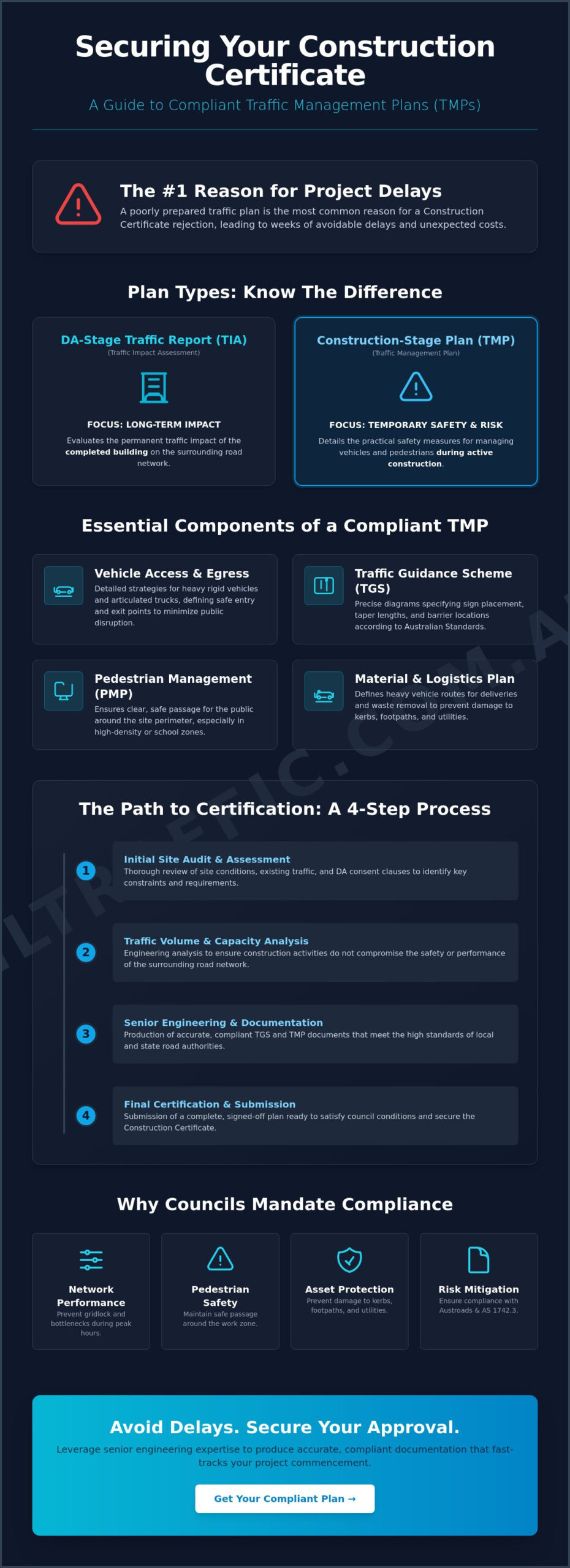
Developers often confuse the initial Traffic Impact Assessment (TIA) with this specific stage. While a TIA evaluates the permanent impact of a completed building, the pre-construction plan focuses on temporary risks. It must adhere to the strict legal framework established by AS 1742.3:2019, which governs Road traffic control for works on roads. This document ensures that every contractor, from excavation teams to fit-out crews, follows a unified safety protocol.
To better understand how these plans function on-site, watch this technical overview:
A traffic management plan is a dynamic document that evolves with the construction phases to reflect changing site conditions.
The Role of Traffic Planning in the Construction Certificate (CC) Phase
The construction certificate phase is where conditions of consent become actionable requirements. Council planners review the TMP to ensure the developer has addressed every traffic-related clause in the DA approval. This transition involves moving from high-level site access concepts to detailed Traffic Guidance Schemes (TGS) that specify sign placement, taper lengths, and barrier locations. Submitting these documents early is essential. Technical rejections at this stage can stall a project for weeks, delaying the commencement of excavation or demolition. A compliant plan demonstrates that the builder has considered the practicalities of site egress for heavy rigid vehicles and articulated trucks.
Why Councils and Road Authorities Mandate These Plans
Regulatory bodies prioritize the safety of the public and the integrity of existing infrastructure. Mandated plans ensure that heavy vehicle movements don’t cause gridlock on residential streets or damage public assets. Councils specifically look for:
- Network Performance: Measures to prevent construction-related bottlenecks during peak traffic hours.
- Pedestrian Safety: Strategies to maintain clear, safe passage around the site perimeter, particularly near schools or high-density zones.
- Asset Protection: Defined heavy vehicle routes that prevent the destruction of kerbs, footpaths, and underground utilities.
- Risk Mitigation: Documentation that proves the site complies with the latest Austroads Guide to Temporary Traffic Management.
Without an approved plan, you cannot legally occupy the road or footpath, and councils will withhold the necessary permits to start work.
Essential Components of a Compliant Pre-Construction Traffic Plan
A compliant pre-construction certificate traffic management plan requires precise technical documentation and senior engineering oversight. It isn’t enough to simply mark where trucks will enter the site. You must demonstrate exactly how these movements interact with the existing road network and public space. A high-quality plan includes detailed site access and egress points, a Traffic Guidance Scheme (TGS), a Pedestrian Management Plan (PMP), and specific logistics for material delivery. These elements work together to form a comprehensive safety strategy that satisfies council requirements and ensures site viability.
Traffic Guidance Schemes (TGS) and Site Access
A TGS provides the visual blueprint for site safety. It details the exact placement of signs, cone tapers, and flagman positions in accordance with AS 1742.3. You must differentiate between short-term work zones, such as a single-day concrete pour, and long-term construction access that remains for the project duration. This scheme integrates directly into the broader management plan to ensure all site personnel understand the traffic flow. If you require assistance with these technical layouts, our team provides professional traffic engineering services to ensure your submission meets regulatory standards.
Vehicle Swept Path Analysis for Construction Machinery
Council rejection often stems from inadequate maneuvering space for heavy vehicles. We use AutoTURN software to perform a Vehicle Swept Path Analysis. This simulation proves that heavy machinery can enter and exit the site in a forward direction without mounting kerbs or striking public infrastructure. Swept paths are mandatory for any site involving trucks over 8.8 metres. Addressing these ‘blind spots’ in your site design early prevents costly delays during the certificate approval stage. A plan that fails to account for the physical dimensions of a standard heavy rigid vehicle will not pass a council audit.
Pedestrian Management Plans (PMP) are equally critical for the construction certificate. They provide the strategy for maintaining safe passage around hoardings and scaffolding. In dense urban areas, councils prioritize the safety of vulnerable road users above all else. Your plan must detail how footpaths remain accessible or provide compliant diversions. Additionally, the plan must address the logistics of construction worker parking and designated material delivery zones. If workers park illegally or deliveries block active lanes, the council may rescind your permits. Meticulous planning in these areas ensures your site remains safe, compliant, and operational.
Navigating Regulatory Standards: AS 1742.3 and AS 2890
Regulatory compliance is the foundation of any successful pre-construction certificate traffic management plan. The primary framework for temporary traffic control in Australia is AS 1742.3:2019. This standard dictates the technical requirements for every sign, barrier, and line marking used near a work site. However, developers must also reconcile these temporary measures with permanent infrastructure standards. A failure to align these two areas often leads to technical non-compliance during the council review process.
Integrating AS 2890.1 into your construction logistics is a standard requirement for urban developments. While often associated with permanent parking, these standards govern the geometry of loading zones and temporary access points. You must prove that your temporary loading areas can accommodate the physical dimensions of the intended vehicles. Many councils also enforce specific ‘Technical Specifications’ that exceed national standards. These local requirements often focus on the Statement of Environmental Effects (SEE), particularly regarding traffic noise and vibration during sensitive hours.
Alignment with National Engineering Standards
High-risk sites require certification from an accredited traffic engineer to confirm that all proposed measures are technically sound. This involves a detailed review of site geometry and vehicle dynamics. For instance, you must ensure that temporary driveway grades and ramp designs meet the strict criteria found in AS 2890.1 Explained: The Ultimate Guide to Compliant Car Park Design. If a ramp is too steep or a transition is too abrupt, heavy vehicles risk bottoming out or losing traction. This creates significant safety hazards and potential damage to public road assets.
Public Asset Protection and Pedestrian Safety
Your plan must account for the physical footprint of hoardings and scaffolding. These structures cannot impede sight distances for motorists or create blind spots for pedestrians. Securing a ‘Works Zone’ permit from the Road Manager is a standard part of this process. This permit allows for the temporary occupation of the road reserve for essential loading and unloading activities. If your project affects public transport infrastructure, such as bus stops or light rail corridors, you must liaise directly with the relevant transport authorities. Coordinating these multi-agency approvals requires a meticulous approach to documentation and a deep understanding of local government requirements. Protecting public assets like kerbs and footpaths is not just a safety issue; it’s a financial necessity to avoid high restoration bonds.
The Approval Process: From Site Assessment to Certification
Securing a pre-construction certificate traffic management plan follows a rigorous five-step engineering workflow. This process ensures that every site-specific risk is identified and mitigated before the first vehicle arrives on-site. It begins with an initial site audit and a comprehensive review of the Development Application (DA) conditions of consent. This audit identifies physical constraints that aren’t always visible on architectural plans. Step two involves the analysis of existing traffic volumes and road capacity to determine the impact of construction movements. Once the data is verified, step three involves drafting the necessary Traffic Guidance Schemes (TGS), Pedestrian Management Plans (PMP), and Vehicle Swept Path diagrams. Step four is the formal submission to the Council or relevant Road Authority for feedback. Finally, step five involves making any required technical adjustments to secure final certification and issuance of the plan for the construction certificate.
Successful certification depends on the accuracy of the underlying data. If the initial site audit misses a critical piece of infrastructure or a restricted parking zone, the entire plan may be deemed non-compliant. This is why we prioritize a hands-on approach to data collection. Our senior engineers personally review the site geometry to ensure every proposed movement is physically possible and legally compliant. This meticulous preparation reduces the likelihood of multiple revision rounds, which are a primary cause of project commencement delays.
Initial Site Audits and Traffic Volume Data
Engineers must obtain accurate ground-truth data before drafting any documentation. We assess the Level of Service (LoS) for surrounding intersections to ensure construction vehicles don’t cause unacceptable delays to the public. This assessment identifies potential conflicts with nearby school zones, major transport hubs, or emergency service routes. If a site is located on a high-volume corridor, the timing of deliveries becomes a critical factor in the plan’s approval. We also identify physical obstructions like power poles, street furniture, or existing signage that could interfere with the proposed vehicle swept paths.
Liaison with Local Councils and Road Managers
The local Traffic Committee often plays a decisive role in the approval of construction work zones. They review the technical merit of the submission and its impact on the local community. Councils frequently send plans back for revision if the documentation lacks technical depth or ignores specific local traffic patterns. Professional representation at this stage is vital. It speeds up the Request for Information (RFI) process by providing clear, engineering-backed answers to authority concerns. Our senior principals handle these negotiations personally to ensure your project stays on schedule. If you’re ready to begin this process, you can contact our senior traffic engineers to arrange an initial site assessment.
Securing Your Pre-Construction Approval with ML Traffic Engineers
Securing a pre-construction certificate traffic management plan requires a partner with deep technical expertise and a proven history of authority approvals. ML Traffic Engineers brings over 15 years of experience in preparing compliant documentation for Australian developers. We provide a comprehensive one-stop service that integrates Vehicle Swept Path Analysis, Traffic Guidance Schemes, and Car Park Design into a single, cohesive submission. This technical synergy ensures that all elements of your traffic strategy align with national standards and local council requirements. Our firm maintains a results-oriented track record with local councils and state road authorities nationwide, ensuring your project meets every regulatory benchmark.
Our approach eliminates the friction often found in larger consultancy firms. We focus on delivering meticulous, engineering-backed reports that withstand the scrutiny of traffic committees and road managers. By addressing potential bottlenecks during the design phase, we prevent the technical rejections that stall project commencement. We understand that for developers, time is a critical variable. Our workflows are designed to produce high-quality documentation that facilitates fast-tracked approval for your construction certificate.
Direct Access to Senior Traffic Engineering Principals
We operate with a direct, no-gatekeepers approach to project management. When you engage our services, you speak directly to the senior principal who is performing the technical work and signing your plan. This direct line of communication ensures that your specific project constraints are understood and addressed without administrative dilution. Personnel continuity is a core pillar of our philosophy; the expert who initiates your relationship remains your point of contact throughout the project life cycle. This is particularly vital for complex, multi-stage construction projects where site conditions and traffic requirements may evolve. To learn more about our senior leadership team and professional qualifications, you can read About ML Traffic Engineers.
Comprehensive Documentation for Seamless Certificate Issuance
A successful submission must explicitly address every condition of consent listed in your Development Application. We specialize in translating these theoretical conditions into practical, compliant on-site traffic control strategies. Our documentation is detailed, transparent, and designed for easy digestion by council officers. To assist with project budgeting, we offer fixed-fee structures that provide cost certainty from the outset. This transparency removes the uncertainty of escalating consultancy costs during the approval phase. If you’re ready to secure your site’s future, contact us today to discuss your pre-construction traffic requirements. ML Traffic Engineers ensures your project moves from planning to construction without delay.
Fast-Track Your Site Commencement with Professional Engineering
Securing a compliant pre-construction certificate traffic management plan is the final technical hurdle before your development moves from paper to physical reality. Success depends on the precise integration of AS 1742.3 safety standards and AS 2890.1 geometry. When you prioritize accurate vehicle swept paths and detailed traffic guidance schemes, you eliminate the technical ambiguities that lead to council RFIs and project delays. High-quality engineering documentation isn’t just a regulatory requirement; it’s a safeguard for your project’s timeline and budget.
ML Traffic Engineers provides the technical certainty needed for national coverage across Australia. With over 15 years of experience, we offer direct senior principal involvement on every project to ensure your documentation meets the highest professional standards. Our hands-on approach guarantees that the expert who designs your plan is the one who understands your site’s unique constraints. Don’t let administrative rejections stall your project’s progress. Get a Compliant Traffic Management Plan for Your Construction Certificate and move your development forward with confidence.
Frequently Asked Questions
What is the difference between a TMP and a TGS?
A Traffic Management Plan (TMP) is a comprehensive strategic document that outlines the overall traffic management approach for a project. In contrast, a Traffic Guidance Scheme (TGS), formerly known as a Traffic Control Plan (TCP), is a technical diagram that shows the exact placement of signs, barriers, and traffic control devices. The TGS functions as a tactical subset of the broader TMP to guide on-site implementation.
How long does it take to get a Traffic Management Plan approved by Council?
Council approval times typically range from 7 to 15 business days depending on the local government area. If the project requires a Road Occupancy Licence (ROL) from a state authority, such as Transport for NSW, the process can take between 10 and 20 business days. Submitting high-quality, compliant documentation at the outset is the most effective way to avoid delays caused by technical revisions.
Do I need a traffic engineer to sign off on my pre-construction certificate?
Most local councils require a qualified traffic engineer to prepare and certify your pre-construction certificate traffic management plan. This requirement ensures that the proposed strategies meet AS 1742.3 standards and specifically address the conditions of consent in your Development Application. Professional sign-off provides the technical accountability councils demand for high-risk site activities.
What happens if my site access doesn’t meet Australian Standards for swept paths?
If a Vehicle Swept Path Analysis indicates that a truck cannot enter or exit the site safely, you must modify the site access design or the proposed vehicle type. Councils will reject any plan that shows vehicles mounting kerbs or crossing into opposing traffic lanes. Engineers can often resolve these conflicts by adjusting driveway geometry or proposing alternative loading methodologies that fit the site’s physical constraints.
Can I use a generic Traffic Management Plan template for my construction certificate?
Councils will not accept generic templates for a pre-construction certificate traffic management plan because they lack site-specific engineering data. Every plan must be tailored to the unique geometry of the site, existing traffic volumes, and the specific safety risks of the surrounding road network. A generic document fails to address the mandatory technical requirements of AS 1742.3 and will lead to an immediate rejection.
Is a Traffic Management Plan required for small-scale residential developments?
A traffic plan is mandatory for any residential project that impacts the normal operation of a road, footpath, or cycleway. This includes activities such as operating a concrete pump, placing a skip bin on the street, or establishing a temporary works zone. Even for smaller builds, developers must prove they have a strategy to maintain pedestrian safety and minimize local traffic disruption.
How much does a professional Traffic Management Plan cost for a commercial project?
Professional fees depend on the complexity of the project, the number of construction stages, and the volume of Traffic Guidance Schemes required. Complex commercial developments with high-traffic interfaces demand more intensive analysis and documentation. Developers should prioritize firms that offer clear, fixed-price engineering documentation to maintain transparent project budgeting throughout the approval phase.
What is the role of AS 1742.3 in my pre-construction traffic plan?
AS 1742.3:2019 is the primary Australian Standard for traffic control devices used at works on roads. It dictates the technical specifications for sign sizes, placement distances, and the design of traffic tapers. Every compliant traffic plan must adhere to this standard to ensure the safety of both construction personnel and the general public. Failure to follow these national guidelines is a common cause for council rejection.

Disclaimer
The content on www.mltraffic.com.au, including all technical articles, guides, and resources, is provided for general informational and educational purposes only. It is not intended to constitute professional advice in traffic engineering, transportation planning, development approvals, or any other technical or legal field.
While ML Traffic Engineers makes every reasonable effort to ensure the accuracy, completeness, and timeliness of the information published, we do not provide any warranties or representations (express or implied) regarding its reliability, suitability, or availability for any particular purpose. Any reliance you place on the content is strictly at your own risk.
In no event shall ML Traffic Engineers, its directors, employees, authors, or affiliates be liable for any direct, indirect, incidental, special, consequential, or punitive damages (including, without limitation, loss of profits, data, or business opportunities) arising out of or in connection with the use of, or inability to use, any information provided on this website.
The articles and guides on this site are not a substitute for engaging a qualified, registered professional traffic engineer (such as an NPER or RPEQ engineer) to assess your specific project requirements. For tailored advice, compliance assessments, or traffic engineering services, please contact a competent professional.
This disclaimer may be updated from time to time without notice. By accessing or using this website, you agree to be bound by the most current version of this disclaimer.
