

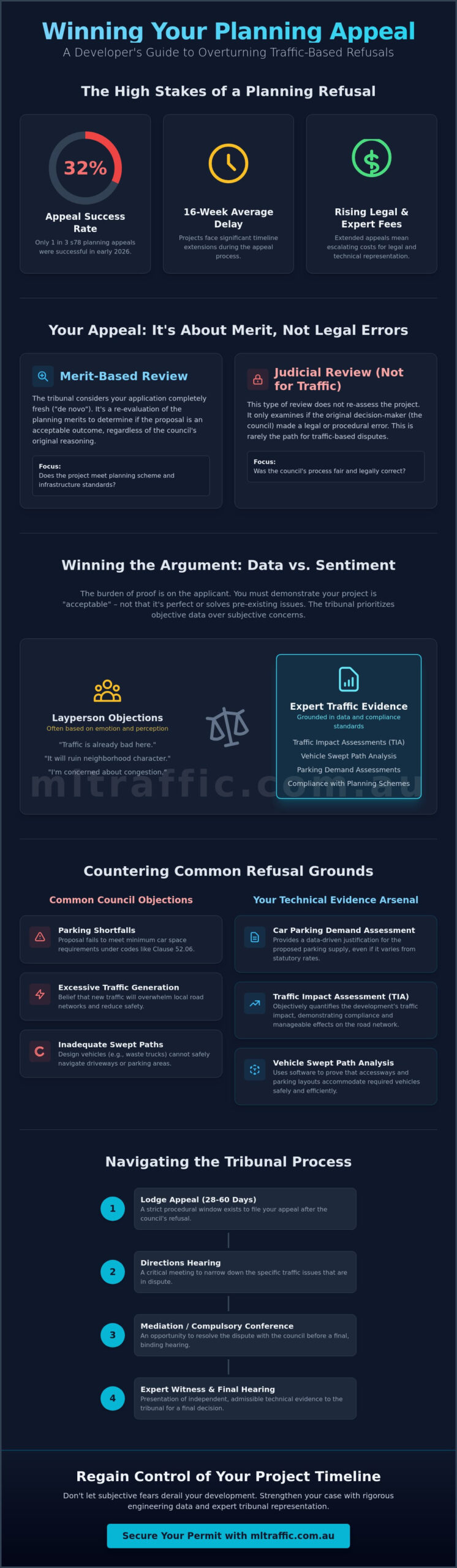
With the overall success rate for s78 planning appeals sitting at just 32% in early 2026, the margin for error during a merit-based review is non-existent. For developers, a refusal based on traffic impact or parking shortfalls often feels like a subjective roadblock that ignores the technical reality of the site. Effectively preparing for a planning tribunal on traffic grounds requires a shift from defensive arguments to a strategy built on rigorous, objective engineering data and expert testimony. Under the current “submit once, submit right” regulatory environment, your technical evidence must be indisputable from the outset.
It’s frustrating to face project delays that now average 16 weeks while legal and expert costs continue to mount. You deserve a process that relies on facts rather than council sentiment. This guide will show you how to counter traffic-based refusals using proven expert witness strategies and compliant data. You’ll gain a clear roadmap for preparing technical evidence, understand the specific role of a traffic engineer in the tribunal, and learn how to secure your planning permit through a successful merit-based review. By replacing subjective fears with standards-compliant data, you can regain control of your project timeline.
Key Takeaways
- Identify the distinction between legal errors and planning merit to ensure your appeal focuses on objective technical data rather than procedural arguments.
- Discover how technical evidence such as a Traffic Impact Assessment (TIA) and Vehicle Swept Path Analysis can effectively counter subjective council objections.
- Understand the critical role of an expert witness when preparing for a planning tribunal on traffic grounds, including the necessity of independent and admissible technical statements.
- Learn how senior personnel continuity and extensive tribunal experience provide a strategic advantage during a merit-based review.
Navigating Planning Tribunal Reviews for Traffic and Parking Matters
A merit-based review in an Australian planning tribunal is a “de novo” process. This means the tribunal considers the application completely fresh. It’s not limited to reviewing the council’s specific reasons for refusal. Instead, the tribunal exercises the same powers as the original decision-maker to determine if the proposal achieves an acceptable planning outcome. This differs significantly from a judicial review, which only examines legal errors or procedural fairness. In traffic disputes, the focus remains on the Planning Merits test. We assess whether the proposed parking provision and access arrangements comply with the relevant planning scheme and state-based infrastructure standards.
Traffic and parking grounds are among the most frequent reasons for development refusal. This is often due to the high visibility of traffic issues to local residents and the perceived impact on neighborhood character. Effectively preparing for a planning tribunal on traffic grounds involves moving past community sentiment to address the technical requirements of the planning scheme. The tribunal environment typically involves several stages, including mediation or compulsory conferences, which aim to resolve disputes before reaching a final hearing.
To better understand this process, watch this helpful overview of the planning appeals system:
The Burden of Proof in Traffic Appeals
In the tribunal, the applicant bears the burden of proving that the development is “acceptable”. It’s a common misconception that a proposal must be perfect or solve existing traffic problems in the area. The tribunal weighs expert traffic evidence, such as a Traffic Impact Assessment (TIA), against layperson objections. While residents may express concerns about congestion, the tribunal prioritizes evidence-based conclusions from qualified engineers. This is similar to the structured approach used by the Planning Inspectorate in the UK, where technical compliance often overrides subjective fears.
Procedural Timelines and National Variations
Effective preparation for a planning tribunal on traffic grounds starts with understanding the strict procedural windows. Most states require appeals to be lodged within 28 to 60 days of the council’s decision. Once lodged, a Directions Hearing is held to narrow the Statement of Grounds. This is a critical point where we identify which traffic issues are truly in dispute. Managing the transition from a council refusal to a tribunal file requires immediate coordination between your legal team and your traffic consultant. We ensure all technical assessments, from Vehicle Swept Path Analysis to Car Parking Demand Assessments, are updated to address the specific grounds of refusal. You can view our full range of technical capabilities on our services page.
Identifying Common Traffic Grounds for Development Refusal
Refusal notices typically cite specific failures to comply with local planning schemes or state-based engineering standards. When preparing for a planning tribunal on traffic grounds, developers must isolate these objections to build a targeted technical defense. Most councils rely on a standard set of concerns to justify a refusal, often driven by resident objections or conservative internal assessments. A robust framework for traffic case tribunals ensures that decisions are based on measurable standards rather than community sentiment.
Common technical grounds for refusal include:
- Parking shortfalls: The proposed development fails to provide the minimum number of car spaces required by statutory rates, such as those found in Clause 52.06 of the Victorian Planning Provisions or similar interstate codes.
- Traffic generation: The anticipated increase in vehicle movements is deemed beyond the capacity of the existing road network or local intersections.
- Safety and access: Issues involving insufficient sight distances at entry points or driveway grades that do not comply with AS/NZS 2890.1 standards.
- Waste and delivery management: Inadequate provision for waste collection vehicles or poor loading dock efficiency that could lead to on-street obstructions.
Parking Demand vs. Statutory Requirements
Councils frequently rely on prescriptive parking rates that don’t always reflect the actual requirements of a modern development. A merit-based demand assessment allows for a reduction in these rates by using empirical data. We conduct parking surveys at similar sites to demonstrate that actual demand is lower than the statutory minimum. This evidence is critical when the council misapplies outdated planning data to high-density or mixed-use projects. Proving a lower demand through a Car Parking Demand Assessment is often the most direct path to overturning a refusal.
Operational Safety and Amenity Concerns
Objections often blur the line between technical safety and residential amenity. Issues like traffic noise and congestion are frequently presented as subjective complaints by objectors. However, tribunal success depends on converting these into objective data. We use technical access data to prove that a development won’t result in an unreasonable loss of on-street parking or negatively impact neighborhood character. The tribunal prioritizes facts over fears. Proving that a driveway meets sight distance requirements or that a heavy vehicle can safely maneuver through a site using Vehicle Swept Path Analysis effectively nullifies subjective safety concerns. If you are facing these specific objections, you can review our technical solutions on our services page to see how we address complex site constraints. For expert assistance in building your technical case, consult with the team at mltraffic.com.au.
Strengthening Your Case with Technical Traffic Evidence
Success in a merit-based review depends entirely on the quality of technical evidence presented. When preparing for a planning tribunal on traffic grounds, developers must move beyond general responses to council objections. You need a comprehensive Traffic Impact Assessment (TIA) that serves as the cornerstone of your evidence. This report quantifies real-world impacts using empirical data rather than speculation. We employ advanced intersection modelling tools like SIDRA to prove that the surrounding road network maintains sufficient capacity for the proposed development. These models provide the tribunal with a mathematical baseline for decision-making. This technical foundation is essential for overturning refusals based on perceived congestion.
The Power of Swept Path Analysis in Access Disputes
Visual evidence often carries more weight than written descriptions in a tribunal setting. We use AutoTURN software to perform detailed Vehicle Swept Path Analysis. This proves that specific vehicles, such as a B99 car or a Small Rigid Vehicle (SRV), can maneuver through the site without encroaching on curbs or blocking through-traffic. These visual diagrams are essential for resolving disputes regarding driveway widths and ramp grades. For a deeper look at how this data facilitates approvals, refer to our guide on Swept Path Analysis: A Developer’s Guide to Council Approval. This technical clarity removes the subjective fear element from the council’s refusal and demonstrates that the site is operationally viable.
Leveraging Australian Standards as the Final Word
The tribunal relies heavily on established engineering benchmarks. Compliance with Australian Standards is non-negotiable for a successful appeal. A development that strictly adheres to AS 2890.1 for off-street car parking and AS 2890.2 for commercial vehicles is difficult for a tribunal to refuse on technical grounds. We conduct rigorous Sight Distance Assessments to override safety concerns at site entrances. By demonstrating that the site access meets or exceeds the required safety offsets, we provide the tribunal with a clear path to approval. This data-driven approach ensures that your Traffic Impact Assessment stands up to cross-examination during the hearing. Utilizing these non-negotiable standards effectively counters arguments about neighborhood character or localized safety risks. When preparing for a planning tribunal on traffic grounds, these certifications provide the objective proof required to secure a permit.
The Role of the Expert Witness at the Tribunal Hearing
The expert witness serves a unique function during the hearing process. Unlike legal counsel, a traffic engineer’s primary duty is to provide independent and unbiased technical evidence to the Tribunal. This is not a role of advocacy. If an expert is perceived as simply “hired help” for the developer, their credibility and your case will likely fail. Preparing for a planning tribunal on traffic grounds requires an Expert Witness Statement that strictly adheres to the Tribunal’s practice notes. This document must be admissible. It must contain all facts, data, and assumptions used to reach a technical conclusion. It is the definitive record that the member will use to weigh your proposal against the planning scheme.
Joint Expert Meetings often occur before the formal hearing. These sessions allow traffic engineers from both sides to discuss the technical merits in a professional setting. The goal is to identify “common ground” and isolate the specific points of disagreement. This process ensures that the hearing focuses only on the issues that remain in dispute.
Joint Statements of Experts
The result of these meetings is a Joint Statement of Experts. This document narrows the traffic issues down to the most critical points. It explicitly lists what the engineers agree on, such as existing traffic volumes or the accuracy of a Vehicle Swept Path Analysis. A well-negotiated joint statement can save days of hearing time and thousands in legal costs. It prevents the Tribunal from wasting time on uncontested data. Having a seasoned Traffic Engineer who can collaborate professionally with council counterparts is a strategic necessity. We focus on technical accuracy to ensure the Joint Statement protects your project’s core requirements.
Responding to Cross-Examination on Traffic Grounds
Giving evidence in the “witness box” is the final and most high-pressure stage. You must be prepared for cross-examination by council lawyers or objector representatives. They often target the methodology of parking surveys or the validity of traffic counts. Maintaining the integrity of the data under pressure is vital. An expert must be able to explain complex concepts, like Intersection Analysis or Sight Distance Assessments, in clear and decisive terms. We provide direct access to senior principals who personally handle the technical work and defend it at the hearing. This personnel continuity means your expert knows every detail of the site and won’t be caught off guard by aggressive questioning.
To ensure your technical evidence is defended by the same senior experts who prepared your reports, contact the team at mltraffic.com.au for professional tribunal representation.
Expert Traffic Engineering Representation for Tribunal Success
ML Traffic Engineers Australia provides a strategic advantage through more than 15 years of tribunal experience across Australia. We understand the technicalities of merit-based reviews and the specific requirements of state planning tribunals. Success in these settings isn’t about flashy narratives; it’s about meticulous adherence to regulatory standards and providing dependable, results-oriented evidence. Our no-nonsense approach focuses on technical compliance and firm negotiations with council engineers. We prioritize engineering facts that support your development’s viability. Effective preparation for a planning tribunal on traffic grounds begins with a comprehensive site review. We analyze the council’s refusal grounds against objective data to identify the strongest path forward. This proactive strategy ensures your case is built on a solid foundation of evidence from the start.
Direct Principal Involvement in Every Appeal
A core signature of our firm is the personnel continuity promise. The senior expert who initiates your project and writes your technical report is the same expert who defends it in the witness box. This “no-gatekeepers” approach ensures deep-seated knowledge of your site’s specific constraints. Direct principal involvement means your Traffic Engineering strategy is robust and authoritative from day one. Our reporting is clear and declarative, designed to withstand the scrutiny of both the tribunal member and opposing counsel. You won’t have to worry about junior staff handling critical testimony. ML Traffic Engineers Australia takes full accountability for the technical work we produce and defend.
Next Steps: Securing Your Expert Evidence
Securing a planning permit through a tribunal review requires immediate action following a council refusal. We recommend providing your refusal documents for an initial technical review as soon as possible. This allows us to establish timelines for preparing tribunal-ready Traffic Impact Assessments or Vehicle Swept Path Analysis. We offer a confidential discussion to review your planning appeal and determine the most effective strategy for your specific site. Preparing for a planning tribunal on traffic grounds demands a meticulous approach to data. We ensure your evidence is admissible and technically sound before the hearing begins.
- Provide your council refusal and Statement of Grounds for expert analysis.
- Establish a timeline for updated technical reporting and expert witness statements.
- Engage directly with senior leadership for all tribunal-related correspondence.
Ready to move forward with your appeal? Contact ML Traffic Engineers Australia for Expert Tribunal Support and ensure your project is represented by seasoned technical experts who prioritize compliance and results.
Securing Your Development Through Technical Excellence
Overcoming a council refusal requires transitioning from defensive arguments to a rigorous, data-driven strategy. Successful outcomes rely on replacing subjective neighborhood concerns with indisputable technical facts. Utilizing objective reports such as a Traffic Impact Assessment and Vehicle Swept Path Analysis provides the tribunal with the mathematical baseline needed for approval. Effectively preparing for a planning tribunal on traffic grounds means ensuring your evidence is admissible, compliant with Australian Standards, and defended by a seasoned expert.
ML Traffic Engineers Australia offers a strategic advantage built on over 15 years of specialist experience. We provide direct access to senior principals for all tribunal matters. This ensures the engineer who designs your project is the one who defends it in the witness box. Our commitment to personnel continuity has resulted in a proven track record of securing development approvals across Australia. You can regain control of your project timeline with expert technical support.
Secure Expert Traffic Testimony for Your Tribunal Appeal. We look forward to supporting your next merit-based review and helping you achieve a successful permit outcome.
Frequently Asked Questions
What is the role of a traffic engineer as an expert witness?
The primary role of a traffic engineer is to provide independent, unbiased technical evidence to the Tribunal. They owe their duty to the court rather than the client who engaged them. This involves preparing a formal Expert Witness Statement and defending technical data, such as sight distances or intersection modelling, during cross-examination in the witness box.
Can I win a tribunal appeal if my development has a parking shortfall?
Yes, approvals are frequently secured despite parking shortfalls by providing a Car Parking Demand Assessment based on empirical data. Tribunals often favor merit-based assessments over statutory planning scheme rates. Success depends on proving that actual demand is lower than prescriptive requirements or that sufficient on-street capacity exists to manage the overflow without impacting amenity.
How much does it cost to hire a traffic expert for a planning tribunal?
Costs for expert representation vary based on the complexity of the site and the duration of the hearing. Primary factors include the preparation of technical reports, participation in joint expert meetings, and the time required for oral testimony. Developers should request a project-specific fee proposal that covers both the reporting phase and the formal tribunal appearance.
What is a Joint Statement of Experts in a traffic matter?
A Joint Statement of Experts is a document co-authored by traffic engineers from opposing sides to identify points of agreement and disagreement. It streamlines the hearing by narrowing the technical issues in dispute. This process occurs after a formal meeting between experts and ensures the Tribunal focuses only on the most critical engineering conflicts.
How long does a planning tribunal appeal usually take on traffic grounds?
In 2026, the median time for planning cases was approximately 16 weeks from the initial lodgment to the final decision. However, complex matters involving multiple experts or lengthy hearings can extend this timeline. The total duration depends on the tribunal’s current backlog and the specific procedural requirements of the state jurisdiction.
Will the tribunal listen to local residents who are worried about traffic congestion?
The Tribunal considers resident concerns but prioritizes objective engineering evidence over subjective fears. While layperson testimony is heard, it rarely overrides a compliant Traffic Impact Assessment or Intersection Analysis. Preparing for a planning tribunal on traffic grounds involves converting community concerns into technical data that the member can evaluate against established planning standards.
What technical reports do I need to prepare for a tribunal hearing?
Essential documentation typically includes a Traffic Impact Assessment (TIA), Vehicle Swept Path Analysis, and a Car Parking Demand Assessment. Depending on the specific grounds of refusal, you may also require a Sight Distance Assessment or detailed Intersection Analysis. These reports must be updated to address the council’s Statement of Grounds directly.
Is a Traffic Impact Assessment (TIA) different for a tribunal than for a standard DA?
A TIA for a tribunal must be “appeal-ready,” adhering strictly to expert witness code of conduct requirements and tribunal practice notes. Unlike a standard DA report, it must explicitly address the specific grounds of refusal and provide a definitive technical conclusion. The data must be rigorous enough to withstand intense cross-examination by council lawyers.

Disclaimer
The content on www.mltraffic.com.au, including all technical articles, guides, and resources, is provided for general informational and educational purposes only. It is not intended to constitute professional advice in traffic engineering, transportation planning, development approvals, or any other technical or legal field.
While ML Traffic Engineers makes every reasonable effort to ensure the accuracy, completeness, and timeliness of the information published, we do not provide any warranties or representations (express or implied) regarding its reliability, suitability, or availability for any particular purpose. Any reliance you place on the content is strictly at your own risk.
In no event shall ML Traffic Engineers, its directors, employees, authors, or affiliates be liable for any direct, indirect, incidental, special, consequential, or punitive damages (including, without limitation, loss of profits, data, or business opportunities) arising out of or in connection with the use of, or inability to use, any information provided on this website.
The articles and guides on this site are not a substitute for engaging a qualified, registered professional traffic engineer (such as an NPER or RPEQ engineer) to assess your specific project requirements. For tailored advice, compliance assessments, or traffic engineering services, please contact a competent professional.
This disclaimer may be updated from time to time without notice. By accessing or using this website, you agree to be bound by the most current version of this disclaimer.
