

Could a single technical oversight in your car parking demand assessment be the reason your multi-million dollar development is refused at the final hurdle? Many permit applicants find that even the most sophisticated projects stall when they cannot effectively counter expert traffic objections. Successfully preparing for a VCAT hearing on traffic grounds requires more than just a basic site plan; it demands a meticulous approach to technical evidence and a deep familiarity with the Tribunal’s rigorous procedural standards.
It’s natural to feel concerned about the uncertainty of VCAT requirements or the high costs of project delays. You need the assurance that your expert testimony will withstand intense scrutiny. This guide provides a clear roadmap for your hearing preparation, focusing on how to leverage robust technical evidence and expert witness statements to secure your planning permit. We’ll examine the critical importance of Practice Note PNVCAT2, the implications of the July 2026 fee regulations, and how to present a Traffic Impact Assessment (TIA) Report that directly addresses the Tribunal’s safety and amenity concerns. By the end of this professional guide, you’ll understand how to translate complex engineering data into authoritative evidence that wins approvals.
Key Takeaways
- Identify the common triggers for traffic-based appeals and learn the precise steps for preparing for a VCAT hearing on traffic grounds to address Council refusals.
- Understand the evidentiary requirements for a Traffic Impact Assessment (TIA) and how Vehicle Swept Path Analysis confirms site accessibility for waste and delivery vehicles.
- Recognize the professional duty of a traffic expert witness and the legal distinction between a standard report and a formal Expert Witness Statement.
- Learn how to structure a technical submission that directly counters specific traffic and parking objections raised in a Statement of Grounds.
- Discover why specialized traffic engineering consultancy is vital for navigating the procedural complexities of the 2026 VCAT fee and hearing regulations.
Understanding VCAT Planning Disputes on Traffic and Parking Grounds
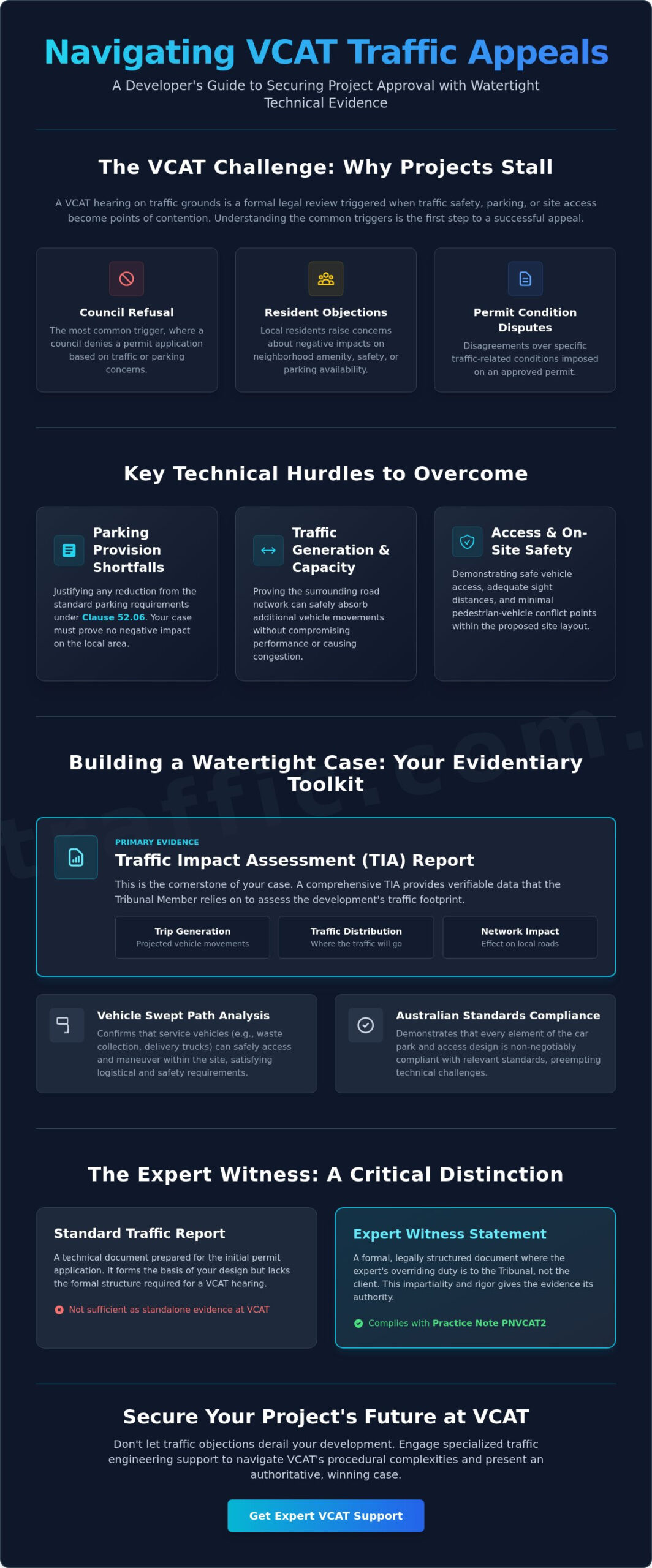
A VCAT hearing on traffic grounds is a formal legal review conducted by the Victorian Civil and Administrative Tribunal (VCAT). It occurs when traffic safety, parking provision, or site access become the central points of contention in a planning dispute. These hearings are often triggered by a Council refusal of a permit application, objections from local residents regarding amenity, or disputes over specific traffic-related permit conditions. For high-density residential or commercial developments, these grounds are frequently the primary factor determining whether a project proceeds or fails. The Tribunal provides an independent forum to resolve technical disagreements through a fresh review of the facts.
The VCAT Member acts as the decision-maker, tasked with weighing technical engineering data against the requirements of the Victoria Planning Provisions. They don’t just look at the aesthetic or social merit of a project; they evaluate how the proposed vehicle movements interact with existing infrastructure. Preparing for a VCAT hearing on traffic grounds requires a clear understanding that the Member relies heavily on expert evidence to resolve technical conflicts. This evidence must be presented in a format that complies with VCAT Practice Notes, ensuring all data is verifiable and scientifically sound.
To better understand the procedural environment of these hearings, watch this overview of the VCAT process:
Common Traffic Issues Raised at VCAT
Disputes typically center on three technical areas. First, parking provision shortfalls under Clause 52.06 are a major hurdle. Applicants must justify why a reduction in the standard parking requirement won’t negatively impact the local area. Second, traffic generation is scrutinized. The Tribunal examines whether the surrounding road network can absorb additional vehicle movements without compromising capacity. Safety is also paramount. This includes assessing sight distances at access points and minimizing pedestrian-vehicle conflict points within the site layout. Successfully preparing for a VCAT hearing on traffic grounds involves identifying these triggers early and building a case that addresses them directly through specialized traffic engineering services.
The Importance of Early Preparation
Waiting until a hearing date is set to review your traffic data is a critical error. Successful outcomes depend on using the Council’s Request for Further Information (RFI) as a baseline for your case. This early phase allows developers to identify potential fatal flaws in the initial design. By addressing these issues before reaching the Tribunal, you can often resolve disputes through mediation or by presenting a more robust proposal. Developers should scrutinize their driveway ramp grade assessment and car park design long before the hearing. It’s much easier to modify a plan during the application stage than to defend a non-compliant design under cross-examination at the Tribunal.
Strengthening Your Case with Technical Traffic Evidence
Technical evidence is the foundation of any successful appeal. When preparing for a VCAT hearing on traffic grounds, you must present a case built on verifiable data rather than subjective opinion. Your primary evidentiary document is a Traffic Impact Assessment (TIA). This document serves as a comprehensive technical record, detailing projected trip generation, distribution, and the resulting impact on the local road network. It’s the document the Tribunal Member will scrutinize to determine if the development’s traffic footprint is acceptable for the surrounding area.
Compliance with Australian Standards is non-negotiable. Every element of your car park design and access points must align with AS 2890.1 (off-street car parking) and AS 2890.2 (commercial vehicle facilities). These standards govern everything from the gradient of a driveway ramp to the clearance heights in a basement. If your proposal fails these technical benchmarks, the Tribunal is likely to uphold a Council refusal. Using robust car parking demand assessments and design reviews ensures these technicalities are resolved before you step into the hearing room.
The Role of Swept Path Analysis in VCAT Appeals
Swept Path Analysis is a critical tool for resolving disputes about vehicle maneuverability. Using AutoTURN software, we generate diagrams that simulate the movement of specific vehicles through your site. This is particularly important for proving that waste collection vehicles or delivery vans can navigate ‘tight’ basement ramps or loading docks without striking infrastructure or requiring excessive maneuvers. We focus on proving compliance for B99 and B85 vehicles as defined by Australian Standards. These simulations remove the guesswork for the Tribunal Member by providing mathematical proof of access. You can find more technical details in our Swept Path Analysis Guide.
Parking Demand vs. Statutory Requirements
Clause 52.06 of the planning scheme sets out standard parking rates, but these don’t always reflect the reality of a specific site. When preparing for a VCAT hearing on traffic grounds, you might argue for a parking reduction based on local site characteristics. This requires empirical data to support your position. We move beyond “one-size-fits-all” statutory rates by providing site-specific analysis:
- Conducting parking surveys of similar land uses in the local area to establish actual demand.
- Performing peak demand analysis to show that the proposed provision covers the busiest periods.
- Evaluating the availability of on-street parking to demonstrate that any minor overflow won’t saturate the local network.
- Documenting the proximity to high-frequency public transport and sustainable transport alternatives.
The goal is to prove that the proposed provision is sufficient for the specific use. This ensures local amenity remains protected while allowing for sensible development outcomes.
The Critical Role of the Traffic Expert Witness
A standard traffic report supports a permit application, but an Expert Witness Statement is a legal document prepared specifically for the Tribunal. When you’re preparing for a VCAT hearing on traffic grounds, you must understand that the expert’s primary duty isn’t to the client, but to the Tribunal. This distinction is vital. An expert provides an unbiased, professional opinion on the technical merits of the case. If a witness appears to be ‘advocating’ for the developer rather than providing objective analysis, the Tribunal Member may give their evidence less weight or disregard it entirely.
Compliance with VCAT Practice Note PNVCAT2 is mandatory for 2026. This note sets out the stringent requirements for expert evidence, ensuring all testimony is transparent and scientifically grounded. A key part of this process is ‘expert conferencing.’ Before the hearing, opposing traffic experts often meet to discuss their findings. They identify areas of agreement and narrow the disputed issues into a joint statement. This process streamlines the hearing and ensures the Member focuses only on the most critical technical disagreements.
What Makes an Effective Expert Witness?
Success at the Tribunal requires an expert with deep technical knowledge and a command of traffic engineering principles. They must be able to remain composed and authoritative during cross-examination by Council solicitors or objectors. An effective witness doesn’t just present data; they explain the ‘why’ behind their conclusions. A track record of providing reliable, well-reasoned evidence is essential for building credibility with the Tribunal Member. This professional standing often determines the outcome of complex disputes involving parking shortfalls or intersection capacity.
Preparing the Expert Witness Statement
The Expert Witness Statement must be comprehensive and meticulous. It must include the expert’s qualifications, the specific facts they relied upon, and every technical assumption made during their analysis. We believe a fresh site inspection is necessary for every VCAT matter. Conditions on the ground can change between the initial application and the hearing date. You must adhere to the strict timeline for filing and serving this evidence. Typically, expert statements must be served to all parties at least 10 business days before the hearing. Missing this deadline can lead to your evidence being excluded, which is a risk no project can afford.
Preparing for a VCAT hearing on traffic grounds involves coordinating these technical inputs to ensure your case is robust and compliant. By engaging an expert who understands the procedural nuances of the 2026 regulations, you position your development for a successful planning outcome.
Addressing Objector Concerns Effectively
Objector concerns often stem from a perceived loss of amenity rather than documented engineering failures. You must separate these ‘perceived’ impacts from ‘actual’ impacts based on engineering data. If residents fear increased ‘rat-running’ or congestion in residential streets, you should provide intersection analysis results to show that the local network capacity remains within safe limits. Proposing mitigating permit conditions can often resolve these disputes. This might include implementing a green travel plan or installing specific directional signage to manage vehicle flow. Using objective data replaces emotional arguments with verifiable engineering facts.
Drafting Permit Conditions
You should never leave the drafting of traffic-related permit conditions solely to the Council. It is a professional necessity to prepare your own preferred version of these conditions. This ensures they are ‘vagueness-free’ and technically achievable for the builder. Conditions must be precise; for example, specifying exact driveway ramp grades or clear sight distance requirements as per AS 2890.1. It is also important to engage in ‘without prejudice’ discussions regarding these conditions with other parties before the hearing concludes. This collaborative approach ensures that if a permit is granted, the conditions are practical and do not create construction hurdles. For expert assistance in drafting compliant technical evidence, contact ML Traffic Engineers today.
Engaging Professional Traffic Engineering Support for VCAT
Choosing a consultant for tribunal representation is a critical commercial decision. While town planners manage the broad planning context, a specialized traffic engineer is essential for technical hearings. Generalists often lack the specific depth required to defend a Car Parking Demand Assessment or a complex Intersection Analysis under cross-examination. We provide a level of technical precision that general practitioners cannot match. Engaging a specialist early in the process of preparing for a VCAT hearing on traffic grounds significantly reduces the risk of project failure and the high costs associated with mandatory redesigns.
ML Traffic Engineers Australia operates on a personnel continuity promise. The engineer who initiates the client relationship and performs the technical site analysis is the same expert who stands in the witness box. This eliminates information gaps and ensures the witness has first-hand knowledge of every technical detail. In the high-stakes environment of a tribunal, this accountability is a decisive advantage. We provide specialized expert services that translate complex data into authoritative testimony.
Our National Tribunal Experience
ML Traffic Engineers Australia has provided robust traffic evidence for over 15 years. We represent clients across Australia, navigating diverse regulatory frameworks and local planning schemes. Our portfolio includes high-stakes developments where traffic issues were the primary point of contention. We have successfully managed matters involving:
- Multi-deck car park facilities with complex internal circulation and ramp gradients.
- Large-scale industrial loading facilities requiring advanced Vehicle Swept Path Analysis for heavy vehicles.
- High-density residential towers in constrained inner-city locations with parking provision shortfalls.
- Commercial precincts involving significant intersection modifications and Sight Distance Assessments.
We offer direct access to senior principals. You won’t be handed off to junior staff; our leadership is involved in every VCAT and tribunal matter to ensure the highest standards of regulatory compliance. This hands-on approach ensures that the technical work is performed by the same expert who defends it.
Next Steps for Your VCAT Matter
The timeline for preparing for a VCAT hearing on traffic grounds is strict, particularly with the 2026 fee and procedural regulations. We recommend a structured approach to your appeal to ensure no deadlines are missed. Our process begins with an initial technical review where we analyze the Council’s refusal or objector claims to identify technical strengths and weaknesses. We then move to evidence preparation, creating a comprehensive Expert Witness Statement that adheres to the latest VCAT Practice Notes. Finally, we finalize the hearing strategy with our senior engineering team. Contact us today to secure professional representation for your upcoming hearing.
Securing Your Project’s Future at VCAT
The 2026 regulatory landscape for Victorian planning appeals leaves no room for technical ambiguity. Project success depends on the transition from broad planning arguments to specific, data-driven engineering evidence. By prioritizing the development of a compliant Traffic Impact Assessment (TIA) and ensuring all access designs meet AS 2890 standards, you mitigate the risks associated with Council refusals and objector appeals.
Successfully preparing for a VCAT hearing on traffic grounds requires a proactive strategy that integrates expert testimony with meticulously drafted permit conditions. This technical rigor ensures that your development is positioned as a safe, functional, and policy-compliant addition to the urban fabric.
ML Traffic Engineers Australia brings over 15 years of specialized tribunal experience to your matter. We offer direct access to senior principal engineers who maintain personal accountability for every technical assessment and witness appearance. Secure Expert Traffic Engineering Support for Your VCAT Hearing and ensure your project is backed by seasoned expertise. With a robust technical case, you can move toward a successful permit outcome with total confidence.
Frequently Asked Questions
Do I really need a traffic engineer for a VCAT hearing?
Yes, professional engineering support is essential when traffic safety or parking provision are points of contention. The Tribunal relies on expert evidence to resolve technical disputes that fall outside the expertise of general town planners. A specialized engineer provides the necessary defense for a Traffic Impact Assessment (TIA) or Vehicle Swept Path Analysis during cross-examination.
What is a Statement of Grounds in a VCAT planning case?
A Statement of Grounds is a formal document where a party outlines their specific reasons for supporting or opposing a permit application. It defines the legal and technical scope of the dispute. When preparing for a VCAT hearing on traffic grounds, you must ensure your expert evidence directly addresses every traffic-related objection raised in this document.
How much does it cost to have an expert witness at VCAT?
Costs for expert witnesses depend on the complexity of the site and the duration of the hearing. Fees typically cover the preparation of an Expert Witness Statement, site inspections, and attendance at the Tribunal. You should also account for the new Victorian Civil and Administrative Tribunal (Fees) Regulations 2026, which introduce a revised fee structure starting 1 July 2026.
Can VCAT override a Council’s decision on parking grounds?
VCAT has the authority to make a fresh decision that overrides a Council refusal. This is known as a “de novo” review. If your technical evidence proves that a parking reduction is justified under Clause 52.06 and won’t impact local amenity, the Tribunal can grant the permit despite Council’s initial opposition.
How long does a VCAT hearing on traffic grounds usually last?
Most planning disputes are scheduled for one to three days. The exact length depends on the volume of expert evidence and the number of objectors. Complex cases involving intersection analysis or large-scale commercial loading facilities may require additional time for detailed technical cross-examination.
What happens if my traffic report is found to be non-compliant with AS 2890?
Non-compliance with AS 2890.1 or AS 2890.2 often results in the Tribunal upholding a permit refusal. VCAT prioritizes adherence to these national standards for safety and vehicle maneuverability. A report that fails to prove compliant driveway ramp grades or sight distances creates a significant legal vulnerability for your project.
Can I represent myself at VCAT for a traffic dispute?
Self-representation is permitted, but it’s risky in technical disputes. VCAT members place heavy weight on evidence that complies with Practice Note PNVCAT2. Without a professional engineer, you’ll likely struggle to counter the technical arguments of a Council solicitor or an opposing expert witness.
What is the deadline for submitting traffic evidence to VCAT?
Expert Witness Statements must be filed with the Tribunal and served to all parties at least 10 business days before the hearing. This is a mandatory requirement under VCAT procedural rules. Missing this deadline when preparing for a VCAT hearing on traffic grounds can lead to your evidence being excluded from the case.

Article by
Michael Lee
Practising traffic engineer with over 35 years experience.
Disclaimer
The content on www.mltraffic.com.au, including all technical articles, guides, and resources, is provided for general informational and educational purposes only. It is not intended to constitute professional advice in traffic engineering, transportation planning, development approvals, or any other technical or legal field.
While ML Traffic Engineers makes every reasonable effort to ensure the accuracy, completeness, and timeliness of the information published, we do not provide any warranties or representations (express or implied) regarding its reliability, suitability, or availability for any particular purpose. Any reliance you place on the content is strictly at your own risk.
In no event shall ML Traffic Engineers, its directors, employees, authors, or affiliates be liable for any direct, indirect, incidental, special, consequential, or punitive damages (including, without limitation, loss of profits, data, or business opportunities) arising out of or in connection with the use of, or inability to use, any information provided on this website.
The articles and guides on this site are not a substitute for engaging a qualified, registered professional traffic engineer (such as an NPER or RPEQ engineer) to assess your specific project requirements. For tailored advice, compliance assessments, or traffic engineering services, please contact a competent professional.
This disclaimer may be updated from time to time without notice. By accessing or using this website, you agree to be bound by the most current version of this disclaimer.
