

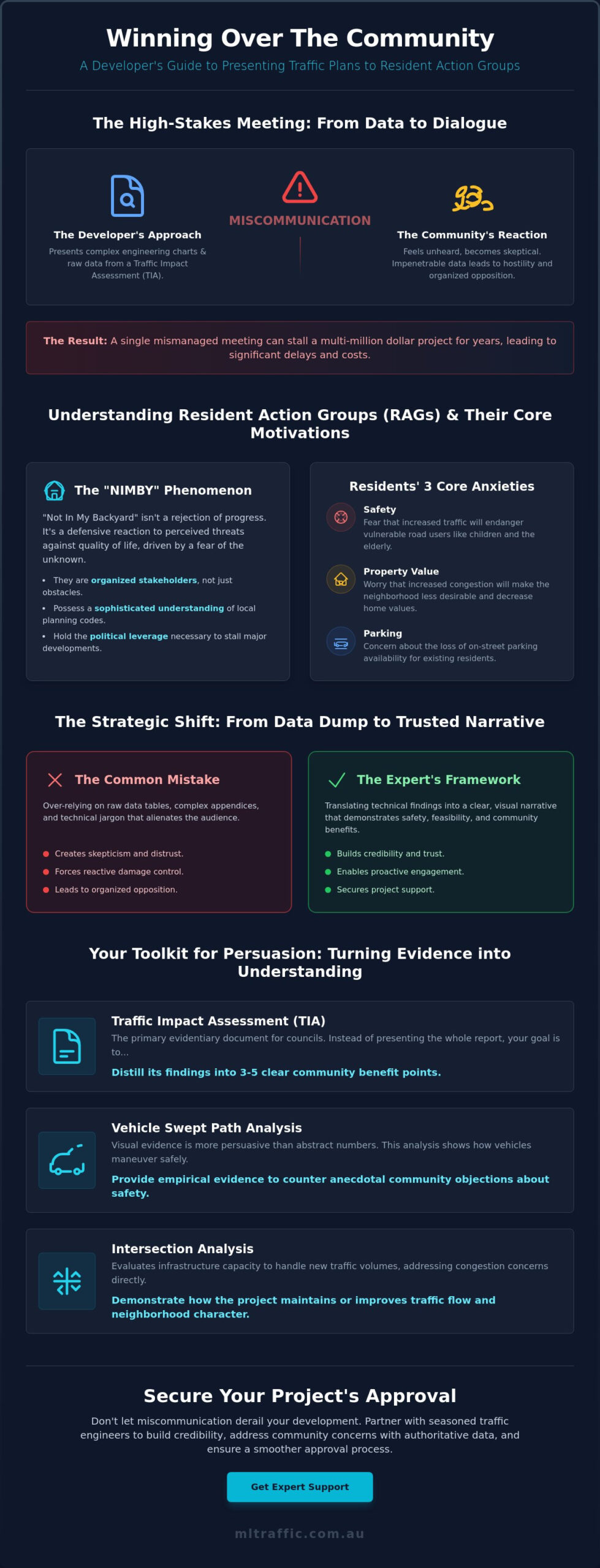
A single mismanaged public meeting can stall a multi-million dollar development for years. When you’re presenting a traffic plan to resident action groups, the objective isn’t just to demonstrate technical compliance; it’s to dismantle the fear of the unknown through authoritative data. Most developers enter these high-stakes environments with complex engineering charts that laypeople find impenetrable, which often leads to immediate hostility and avoidable project delays. You’ve likely experienced how quickly a room turns when residents feel their local safety is being ignored in favor of a Traffic Impact Assessment (TIA) they don’t understand.
This guide provides a professional framework for communicating complex traffic data to community stakeholders to secure project support and minimize friction. You’ll learn how to translate technical outcomes from Intersection Analysis and Vehicle Swept Path Analysis into a narrative of safety and regulatory adherence. We’ll examine how to leverage Australian Standards and precise AutoTURN 2026 simulations to build credibility. By the end of this article, you’ll have a seasoned expert’s strategy for managing hostile environments, clarifying project benefits, and ensuring a smoother approval process through transparent, fact-based communication.
Key Takeaways
- Understand the structural dynamics of Resident Action Groups and the “NIMBY” phenomenon to proactively mitigate potential project delays.
- Learn how to translate technical Traffic Impact Assessment (TIA) reports and complex data tables into accessible, safety-oriented narratives for lay audiences.
- Master the strategy of presenting a traffic plan to resident action groups by distilling engineering data into 3-5 clear community benefit points.
- Utilize high-quality visuals, such as Vehicle Swept Path Analysis and Intersection Analysis, to provide empirical evidence against anecdotal community objections.
- Establish project credibility by partnering with seasoned traffic engineers who provide authoritative support throughout the development application process.
Understanding the Dynamics of Resident Action Groups (RAGs)
Resident Action Groups (RAGs) are organized stakeholders who unite to influence local land-use decisions. These collectives often possess a sophisticated understanding of local planning codes and the political leverage necessary to stall major developments. Successfully presenting a traffic plan to resident action groups requires recognizing that these organizations are not merely obstacles. They are critical participants in the dynamics of resident action groups and the broader public participation process that councils mandate for approval.
The ‘Not In My Backyard’ (NIMBY) phenomenon is a primary driver of community resistance. It isn’t typically a rejection of progress, but a defensive reaction to perceived threats to local quality of life. When residents view technical traffic reports, they often see them as biased documents funded by the developer to justify a specific outcome. This skepticism creates a barrier that raw data alone cannot bridge. Proactive engagement is a strategic necessity. Waiting until a formal public meeting to address community concerns is reactive damage control, which rarely results in project support.
To better understand this concept, watch this helpful video:
The Role of Community Sentiment in Council Approvals
Local council approvals rely heavily on public sentiment. Planning committees and councillors are elected officials who respond to organized pressure. A project that faces hundreds of formal objections will be scrutinized far more heavily than one with minimal opposition. Organized community appeals can add months or even years to a development timeline, resulting in significant holding costs. Identifying key influencers within these groups early allows for targeted communication. By addressing the concerns of the most vocal residents before the official hearing, you can reduce the likelihood of expensive legal appeals.
Identifying the Core Motivations of Local Residents
Residents are generally motivated by three core anxieties: safety, property value, and parking. They worry that increased traffic volume will endanger vulnerable road users, particularly children and the elderly. There’s also a persistent fear that increased congestion will make the neighborhood less desirable, leading to decreased property values. Finally, residents are often protective of on-street parking. When presenting a traffic plan to resident action groups, it’s essential to address these emotional concerns with empirical evidence. Demonstrating how a project maintains neighborhood character while improving infrastructure is vital for securing community buy-in.
Translating Technical Evidence: TIA and Swept Path Analysis
A Traffic Impact Assessment (TIA) serves as the primary evidentiary document for any development application. It provides the empirical data required by councils to evaluate infrastructure capacity. However, a common error when presenting a traffic plan to resident action groups is the over-reliance on raw data tables and complex appendices. Laypeople often find dense spreadsheets and technical jargon impenetrable. When residents cannot understand the data, they default to skepticism. Effective communication requires the conversion of these technical findings into clear, visual evidence that demonstrates safety and feasibility.
Visual evidence is more persuasive than abstract numbers. Utilizing Vehicle Swept Path Analysis allows developers to show exactly how a heavy rigid vehicle or a standard passenger car maneuvers through a proposed site. This is particularly effective for addressing fears about narrow driveways or tight intersections. Reference the City of San Mateo’s Traffic Action Plan Process as an example of how structured visual data can bridge the gap between technical planning and community understanding.
Visualizing Data: From Spreadsheets to Site Diagrams
Static traffic count data should be converted into intuitive heat maps or infographics. These visuals allow residents to see traffic distribution patterns at a glance. Using AutoCAD 2026 and AutoTURN 2026 software, developers can produce 3D swept path simulations that prove access safety in real time. Presenting “before and after” scenarios is also vital. This approach illustrates how proposed mitigation measures, such as new turning lanes or signal adjustments, will actually improve current conditions rather than merely adding to existing congestion.
Communicating Compliance with Australian Standards
Adherence to national standards is the ultimate benchmark for safety. You must explain AS 2890.1 in layman’s terms, positioning it as a non-negotiable safety requirement that dictates everything from ramp grades to bay widths. Adhering to these standards ensures that the design isn’t just a developer’s preference, but a regulated engineering outcome. A robust TIA protects both the developer and the community by ensuring that all infrastructure meets these rigorous safety benchmarks. If your project requires this level of technical precision to satisfy community concerns, consider engaging professional traffic engineering services to prepare your evidentiary documents.
Addressing Common Objections: Safety, Parking, and Congestion
Safety is the primary concern for both developers and the community. While residents often rely on emotional or anecdotal evidence, professional engineers use empirical data to validate safety measures. When presenting a traffic plan to resident action groups, it’s essential to acknowledge these concerns immediately. You must demonstrate that the project design prioritizes human life and local accessibility above mere throughput. Successfully managing these objections requires a shift from defensive posturing to collaborative validation based on engineering facts.
Anecdotal claims regarding speeding or existing congestion are best addressed with recent traffic count data and speed surveys. For example, if residents claim a street is dangerous, show the 85th percentile speeds and how they compare to the posted limits. Integrating traffic calming measures into the project plan, such as raised thresholds or curb extensions, can often turn opposition into support. Research indicates that streets with an Average Daily Traffic (ADT) of less than 4,000 are frequently eligible for such measures, providing a tangible benefit to the existing community.
The ‘Safety for Our Children’ Argument
Addressing the safety of vulnerable road users is non-negotiable. Developers should present a detailed Sight Distance Assessment to prove that visibility at all proposed access points meets or exceeds regulatory requirements. This technical validation proves that drivers have sufficient time to react to pedestrians or other vehicles. Referencing A Resident’s Guide for Creating Safe and Walkable Communities can help bridge the gap between engineering standards and community expectations for walkability. Utilizing expert traffic engineering ensures that every claim about pedestrian crossing upgrades or Traffic Guidance Schemes (TGS) is backed by professional liability and rigorous analysis.
Managing the ‘Loss of Parking’ Narrative
The fear of losing on-street parking is a major driver of community pushback in Australian developments. To counter this, developers must provide a comprehensive Car Parking Demand Assessment. This document proves that the proposed development provides sufficient off-street parking to accommodate its own needs without overflowing into the surrounding streets. When presenting a traffic plan to resident action groups, you should highlight the following data points:
- Present data-backed occupancy studies of the surrounding 200-meter radius to show current capacity.
- Demonstrate how the project meets or exceeds local Council parking rates for both residents and visitors.
- Detail the internal Car Park Design to ensure ease of use, which prevents residents from choosing on-street alternatives.
By providing empirical evidence that the development is self-sufficient, you remove the ‘overflow’ fear from the discussion. This transition from perceived threat to documented reality is vital for securing community buy-in and reducing the risk of organized appeals. For assistance with these specialized assessments, you can contact our senior engineering team directly to discuss your project requirements.
Best Practices for Presentation Delivery and Stakeholder Engagement
Successful community engagement is a structured process that requires more than technical accuracy. When presenting a traffic plan to resident action groups, your delivery must be as meticulous as your engineering data. Residents often feel overwhelmed by technical jargon, which can lead to defensive posturing and project delays. To maintain control of the narrative and secure project support, follow a disciplined five step approach:
- Step 1: Distill the TIA report. Extract 3 to 5 key “Community Benefit” points, such as improved sight distances or reduced neighborhood cut-through traffic.
- Step 2: Prepare large format visuals. Use high quality, physical or digital displays of Intersection Analysis and site access points that are legible from the back of a room.
- Step 3: Anticipate objections. Prepare concise, factual answers for common concerns regarding speed, noise, and safety to avoid appearing unprepared.
- Step 4: Lead with an expert. Ensure a professional traffic engineer manages the technical portion of the meeting to provide authoritative weight to the findings.
- Step 5: Document and follow up. Provide a summary of the meeting and demonstrate how specific resident feedback was considered in the final design.
The Role of the Expert Witness in Community Meetings
Neutrality is a developer’s greatest asset in a hostile environment. A third party traffic engineer carries significantly more weight than the developer because their reputation relies on professional integrity and regulatory compliance. It is vital to maintain an authoritative and calm demeanor, even when faced with aggressive questioning. Personnel continuity is equally important. Having the actual author of the TIA present at the meeting builds trust. It proves that the expert who performed the technical work is personally accountable for the results. Our team provides this level of professional traffic consultancy services to ensure your project remains on track during the public exhibition phase.
Effective Visual Aids and Leave-Behind Materials
Transparency reduces community anxiety. Designing a clear FAQ sheet that addresses local concerns provides residents with a reference point they can review after the meeting. You should provide QR codes that link directly to the full Swept Path Analysis or the complete TIA report. This level of openness demonstrates that the project has nothing to hide. Ensure all diagrams are to scale and clearly labeled. When presenting a traffic plan to resident action groups, a single misleading or poorly labeled diagram can undermine the credibility of the entire project.
Leveraging Professional Traffic Engineering for Project Credibility
Credibility is the most valuable currency in the development application process. When presenting a traffic plan to resident action groups, the technical authority of your engineering partner often determines the project’s trajectory. ML Traffic Engineers Australia operates as a seasoned partner with over 15 years of experience navigating the specific political and social dynamics of local resident groups. We provide more than just documentation; we offer a defensible strategy rooted in meticulous compliance with Australian Standards. This commitment to regulatory rigor serves as a powerful tool for building trust with both Council planners and community stakeholders.
Our firm is built on a “No-Gatekeepers” approach. This means you have direct access to senior principals who are personally involved in every project. We don’t delegate critical technical work to junior staff. The expert who initiates the client relationship is the same person who performs the assessment and represents the findings in public forums. ML Traffic Engineers Australia ensures that presenting a traffic plan to resident action groups becomes a process of validation rather than conflict. This personnel continuity promise ensures accountability and provides a consistent, authoritative voice during high-stakes consultations.
How ML Traffic Engineers Australia Supports Your Community Strategy
A community engagement strategy requires an evidentiary foundation that can withstand intense scrutiny. We support your project through the following technical services:
- Preparation of defensible, data-driven TIA reports that address both local and state planning requirements.
- Expert attendance at public meetings and Council hearings to provide real-time technical rebuttals to community concerns.
- Development of custom Vehicle Swept Path Analysis simulations to demonstrate safe maneuverability for specific site constraints.
- Detailed Intersection Analysis to prove that proposed developments won’t adversely impact existing road network performance.
Securing Planning Approval with Authority
Technical excellence is the most effective way to shorten the DA approval timeline. By delivering clear, compliant, and authoritative reports from the outset, we reduce the frequency of Council requests for further information and minimize the grounds for community appeals. Our hands-on philosophy ensures that your project is represented accurately at every stage of the planning process. We focus on results and the removal of bureaucratic friction. Contact our principals directly to discuss your traffic engineering needs and secure the seasoned expertise required to move your project forward.
Securing Development Approval Through Technical Authority
Mastering the strategy of presenting a traffic plan to resident action groups requires a balance of engineering precision and clear communication. You’ve seen how converting complex Traffic Impact Assessments into community benefit narratives can dismantle opposition. Utilizing visual evidence like Vehicle Swept Path Analysis and Intersection Analysis provides the empirical data needed to counter anecdotal fears about safety and parking. When you lead with technical excellence, you shift the discussion from emotional pushback to regulatory compliance.
Success in the DA process depends on the credibility of your evidentiary documents. ML Traffic Engineers brings over 15 years of Australian engineering expertise to every project. We provide direct access to senior principals and ensure meticulous adherence to AS 2890.1 and AS 2890.2. This seasoned approach minimizes delays and builds the trust required for a smoother approval timeline. Ensure your traffic plan is community-ready—Consult with our Senior Principals today. Your project deserves a foundation built on reliable data and expert representation.
Frequently Asked Questions
How do I handle a hostile resident group during a traffic plan presentation?
Lead with a calm, data-driven approach that prioritizes engineering facts over emotional responses. You should acknowledge community concerns immediately but steer the dialogue back to regulatory compliance and safety benchmarks. Having a neutral, third-party expert witness present the technical findings reduces the perception of developer bias. Maintaining professional composure prevents the meeting from devolving into unproductive arguments, ensuring the focus remains on the empirical evidence provided in the report.
What is the most effective visual aid for showing traffic impact?
Heat maps and 3D simulations are the most effective tools for translating complex datasets into digestible formats for laypeople. While raw data tables are necessary for Council review, resident groups respond better to visual representations of traffic distribution and flow. High-quality, large-format diagrams that illustrate “before and after” scenarios help stakeholders visualize the actual impact of proposed mitigation measures on their local road network rather than guessing from spreadsheets.
Can a resident action group actually stop a development based on traffic concerns?
Yes, organized resident groups can significantly delay or stop a project if they provide evidence of non-compliance with planning codes. While Council makes the final decision, a high volume of formal objections triggers intense scrutiny. If presenting a traffic plan to resident action groups lacks technical rigor or fails to address safety benchmarks, the resulting political pressure can lead to a project refusal or costly, multi-year appeals in planning tribunals.
Why is Swept Path Analysis so important for community consultation?
Vehicle Swept Path Analysis provides visual proof that heavy vehicles and passenger cars can navigate the site without endangering pedestrians or blocking traffic. Residents often fear that new developments will lead to gridlock or unsafe maneuvers at narrow access points. By demonstrating the physical path of a vehicle using AutoTURN software, you provide empirical reassurance that the design accommodates all necessary vehicle types according to Australian Standards, effectively neutralizing safety-based objections.
How do I explain ‘Traffic Volume’ to people who aren’t engineers?
Explain traffic volume by comparing proposed project trips to the existing capacity of the local road network. Instead of using abstract numbers like “1,200 peak hour trips,” describe the impact in terms of additional vehicles per minute or the percentage increase in total daily traffic. This context makes the data relatable for residents. It’s also helpful to reference the Level of Service (LOS) to show that the road continues to operate efficiently after project completion.
Should I present the full Traffic Impact Assessment or a summary?
You should provide a high-level summary during the presentation while making the full TIA report available via a link or QR code. A summary focused on 3 to 5 key community benefits keeps the meeting on track and prevents information overload. However, full transparency is critical for credibility. Providing access to the complete technical document proves that the developer isn’t hiding unfavorable data or non-compliant design elements from the public.
What if the residents’ traffic data contradicts my engineer’s report?
Address contradictory data by highlighting the standardized methodology used in your professional report. Residents often use anecdotal observations or short-term counts that lack the longitudinal accuracy of a formal Traffic Impact Assessment. When presenting a traffic plan to resident action groups, explain that your data follows rigorous Council-mandated collection protocols and Australian Standards. This ensures a more reliable and defensible representation of actual traffic conditions than informal community surveys.
How much weight does Council give to resident objections regarding parking?
Councils give significant weight to parking objections if they demonstrate a clear breach of local planning schemes. However, anecdotal complaints about a perceived lack of street parking are often overruled if the developer provides a Car Parking Demand Assessment. This document proves that the project meets or exceeds the required parking rates. If the data shows the development is self-sufficient, Council is less likely to uphold resident objections during the approval process.

Disclaimer
The content on www.mltraffic.com.au, including all technical articles, guides, and resources, is provided for general informational and educational purposes only. It is not intended to constitute professional advice in traffic engineering, transportation planning, development approvals, or any other technical or legal field.
While ML Traffic Engineers makes every reasonable effort to ensure the accuracy, completeness, and timeliness of the information published, we do not provide any warranties or representations (express or implied) regarding its reliability, suitability, or availability for any particular purpose. Any reliance you place on the content is strictly at your own risk.
In no event shall ML Traffic Engineers, its directors, employees, authors, or affiliates be liable for any direct, indirect, incidental, special, consequential, or punitive damages (including, without limitation, loss of profits, data, or business opportunities) arising out of or in connection with the use of, or inability to use, any information provided on this website.
The articles and guides on this site are not a substitute for engaging a qualified, registered professional traffic engineer (such as an NPER or RPEQ engineer) to assess your specific project requirements. For tailored advice, compliance assessments, or traffic engineering services, please contact a competent professional.
This disclaimer may be updated from time to time without notice. By accessing or using this website, you agree to be bound by the most current version of this disclaimer.
