

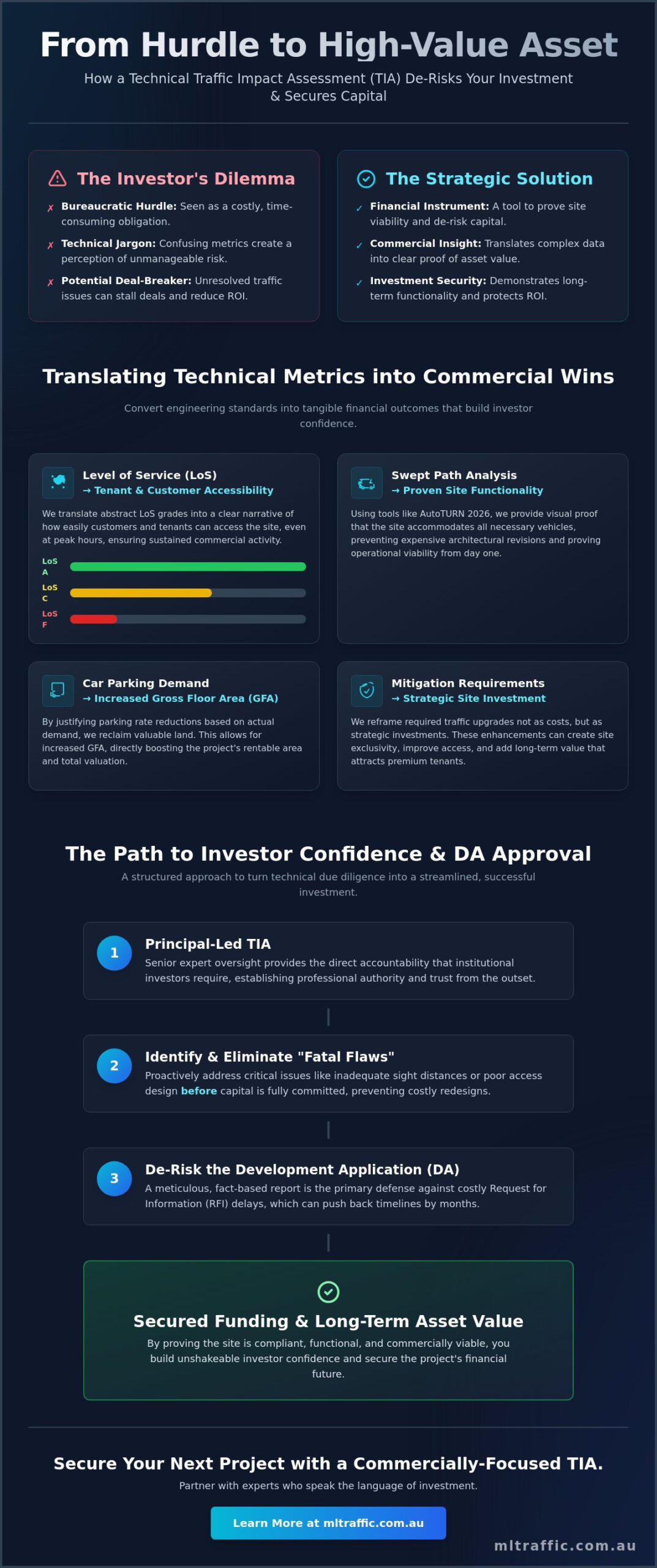
A technical Traffic Impact Assessment (TIA) is not a bureaucratic hurdle; it’s a financial instrument used to de-risk your capital. When presenting traffic assessment findings to investors, your objective is to shift the narrative from potential constraints to proven site feasibility. You likely recognize that technical jargon often causes investor confusion, leading to perceived risks that can stall a deal or impact ROI. It’s common for traffic constraints to be viewed as deal-breakers rather than manageable variables in a project’s commercial success.
This guide provides a professional framework for translating complex engineering metrics into clear, commercial insights. You’ll learn how to leverage 2026 regulatory standards, including the latest City of Tulsa TIA requirements and the Highway Capacity Manual (HCM) for intersection analysis, to build investor confidence. We’ll outline how to use tools like AutoTURN 2026 for vehicle swept path analysis to prove site functionality and compliance. This approach ensures a streamlined path to DA approval by demonstrating a meticulous, fact-based understanding of modern infrastructure requirements.
Key Takeaways
- Position the Traffic Impact Assessment (TIA) as a commercial feasibility document that proves site viability and long-term asset value to stakeholders.
- Master the skill of presenting traffic assessment findings to investors by converting technical Level of Service (LoS) data into clear insights regarding customer and tenant accessibility.
- Utilize Vehicle Swept Path Analysis and professional Car Park Design to provide visual evidence of site maneuverability, preventing expensive architectural revisions later in the project.
- Learn to reframe traffic mitigation requirements as strategic investments in site exclusivity while leveraging Green Travel Plans to optimize car parking demand assessments.
- Understand the importance of principal-led accountability and multi-decade expertise in securing buy-in from institutional investors for complex developments.
Table of Contents
-
The Strategic Role of Traffic Assessment in Investor Relations
-
Visualising Site Feasibility: Swept Paths and Car Park Design
-
Overcoming Investor Objections through Mitigation Strategies
The Strategic Role of Traffic Assessment in Investor Relations
A Traffic Impact Assessment (TIA) report functions as a technical foundation for commercial feasibility. It’s a critical document in the due diligence process. Investors prioritize these findings because they dictate site access, operational safety, and long-term project valuation. A site with unresolved traffic issues is a liability that savvy investors will avoid. When presenting traffic assessment findings to investors, the focus must stay on how the data supports a risk-free exit or stable yield. High-quality reports rely on established traffic engineering principles to validate site capacity and infrastructure needs.
Professional authority is established through principal-led engineering. Presenting traffic assessment findings to investors requires more than just raw data; it requires a narrative of compliance and safety. At ML Traffic Engineers, we ensure every report is handled by a senior expert. This provides the direct line of accountability that institutional investors require before committing capital. You can review our senior leadership’s approach to technical accuracy to see how we maintain these standards.
To better understand the investor mindset during a pitch, watch this helpful video:
De-Risking the Development Application (DA)
Clear traffic findings are the primary defense against costly Request for Information (RFI) delays. These administrative hurdles often impact ROI by pushing back construction timelines by months. A professional TIA identifies "fatal flaws" in site access, such as inadequate sight distances or poor driveway placement, before capital is fully committed. Identifying these issues early prevents the need for expensive redesigns after the DA has been lodged. Adhering to Australian Standards provides a "safe-harbor" for investor confidence. It ensures the project meets rigorous regulatory expectations from the start.
Translating Engineering Standards into Commercial Security
Compliance with AS 2890.1 is a prerequisite for institutional funding in the Australian property market. It isn’t just about parking geometry; it’s about commercial security. Professional indemnity on traffic engineering sign-offs protects the project from future litigation or operational site failure. A robust TIA, including detailed Intersection Analysis and Car Park Design, ensures the site remains functional as traffic volumes increase. This technical rigor translates directly into higher project valuations and lower risk profiles for all stakeholders. By proving that a site can handle peak-hour loads, you secure the project’s commercial future.
Translating Technical TIA Metrics into Commercial Insights
Technical data only holds value for an investor when it’s translated into commercial outcomes. Raw engineering metrics like degree of saturation or average delay mean little without a financial context. When presenting traffic assessment findings to investors, the goal is to demonstrate how these numbers protect and enhance the project’s bottom line. For instance, a detailed Car Parking Demand Assessment can be used to justify parking rate reductions. By proving that the actual peak demand is lower than standard council requirements, you can reclaim valuable land for increased Gross Floor Area (GFA). This directly impacts the project’s total rentable area and overall valuation.
Site accessibility is a primary driver for tenant acquisition and customer retention. Investors need to see that the site is not just compliant, but functional under pressure. Using data to prove that a development can handle its intended use without creating friction is essential for securing institutional buy-in. If you need to refine your site’s commercial potential through data, consider reviewing our specialized Intersection Analysis and TIA services to see how we bridge the gap between engineering and investment.
Intersection Performance and Site Accessibility
SIDRA modelling results are often condensed into a Level of Service (LoS) grade. While an engineer might strive for LoS A, an investor should understand that LoS D is often a commercial sweet spot in urban environments. It indicates a high-functioning site that maximizes infrastructure utility without the excessive costs of over-engineering. This performance data is a powerful tool for attracting retail or commercial tenants. It provides empirical proof that the site can support high volumes of footfall and vehicle arrivals, which are the lifeblood of retail revenue. Linking trip generation rates to projected customer counts turns a technical report into a marketing asset for the development.
Future-Proofing the Investment
Investment horizons for major developments typically span 10 years or more. Presenting traffic assessment findings to investors must therefore include "Future Year" modelling. This analysis accounts for regional population growth and planned government infrastructure projects. It proves the site can handle increased capacity over the next decade without requiring further capital works or structural modifications. This long-term view is particularly important for ESG-focused investors who prioritize sustainable transport planning and site longevity. A robust model shows that the development is a stable, future-proof asset that will remain accessible and safe as the surrounding urban landscape evolves.
Visualising Site Feasibility: Swept Paths and Car Park Design
Visual data is often more persuasive than technical spreadsheets during a board presentation. When presenting traffic assessment findings to investors, providing empirical proof of vehicle maneuverability is essential. We utilize AutoTURN software to generate precise Vehicle Swept Path Analysis diagrams. These overlays demonstrate exactly how a design vehicle interacts with the proposed site layout. This transparency protects investors from the catastrophic costs associated with architectural redesigns. If vehicle clearance issues are discovered during construction, the financial penalties for structural modifications can be severe. A professional swept path analysis eliminates this risk before the first brick is laid.
Effective car park design is fundamentally a yield-optimization exercise. Every square meter in a basement or ground-level lot carries a specific commercial value. A meticulous approach to car park design ensures you maximize the number of leasable or sellable spaces without compromising safety. This is particularly critical in high-density residential and retail developments. In these environments, parking availability directly influences unit prices and tenant interest. By optimizing aisle widths and column placements, you increase the project’s total asset value.
Maximising Yield through Efficient Parking Design
The financial impact of a poorly designed ramp grade can be significant. A non-compliant Driveway Ramp Grade Assessment often results in wasted space because larger buffer zones are required to prevent vehicle scraping. For high-end residential projects, proving B99 vehicle access is a standard requirement for investor confidence. Investors need to know that luxury vehicles can navigate the basement safely. Precision in these assessments frequently saves significant basement area. This allows for additional storage units or extra parking bays that would otherwise be lost to inefficient geometry.
Compliance as a Sales Tool
Certification should be viewed as a "ready-to-build" asset. Presenting traffic assessment findings to investors with clear, color-coded diagrams reduces anxiety regarding operational site failure. Visual overlays for waste collection and heavy vehicle turning circles, compliant with AS 2890.2, provide the assurance that institutional investors require. When an investor sees a 12.5m heavy rigid vehicle (HRV) successfully navigating a loading dock in a simulation, the technical objection disappears. This level of detail transforms a mandatory compliance study into a powerful sales tool that proves the site’s long-term functionality. You can contact our principals to discuss how specialized design overlays can support your next investor pitch.
Overcoming Investor Objections through Mitigation Strategies
Presenting traffic assessment findings to investors requires a proactive stance on problem-solving. A "Mitigation First" approach ensures that potential site constraints are addressed with engineered solutions before they are flagged as financial risks. Instead of viewing mitigation as a sunk cost, we frame it as an investment in site exclusivity and superior access. For example, resolving an intersection bottleneck doesn’t just satisfy a council requirement. It ensures your development remains the most accessible option in the local catchment. This directly counters the "Congestion Objection" by providing data-backed proof of improved traffic flow and safety.
Proposing a Green Travel Plan (GTP) is a strategic method for reducing mandatory parking requirements. By implementing sustainable transport initiatives, you can lower the results of a Car Parking Demand Assessment, which significantly reduces construction costs for basement levels. This isn’t just a cost-cutting measure; it aligns the project with modern ESG (Environmental, Social, and Governance) investor requirements. It makes the development more attractive to institutional capital by demonstrating a commitment to sustainable urban growth. Effectively presenting traffic assessment findings to investors involves showing how these strategies protect the project’s bottom line.
Cost-Effective Traffic Guidance Schemes (TGS)
A smart TGS reduces construction-phase liability for investors by ensuring safe and efficient movement during the build. We balance rigorous safety requirements with project budget constraints to prevent unnecessary expenditure. Leveraging senior Traffic Engineering expertise allows us to find cheaper, compliant alternatives to standard traffic control measures. This meticulous planning protects the investor from site-stalling accidents and regulatory fines while keeping operational costs manageable.
Negotiating with Council and Authorities
We use technical findings to challenge unreasonable Council conditions that can lead to "Scope Creep." In 2026, many jurisdictions like the City of Tulsa and the City of Lawrence updated their TIA guidelines. Our role is to ensure these regulations are applied fairly to your specific site.
-
Expert Witness Representation: Our principals provide authoritative testimony in land and environment courts if required.
-
Condition Negotiation: We use SIDRA modelling to prove that proposed council upgrades are often disproportionate to the project’s actual impact.
-
Regulatory Compliance: We ensure all mitigation measures meet the latest 2026 standards, providing a "safe-harbor" for investor capital.
Professional representation ensures the investor isn’t forced to fund public infrastructure that exceeds their legal obligation. Request a
[preliminary Intersection Analysis
](https://www.mltraffic.com.au/services/)to identify potential mitigation savings before your next investor meeting.
Securing Buy-In: The ML Traffic Engineers Approach
Institutional investors require more than just a technical report; they require a defensible professional opinion. ML Traffic Engineers brings over 15 years of specialized experience in the Australian market to every project. This longevity is supported by a track record of over 10,000 successful site assessments across diverse land-use categories. When presenting traffic assessment findings to investors, the credibility of the consultant is as important as the data itself. Our reports provide the technical weight needed to secure institutional funding and finalize complex joint venture agreements. We focus on providing a results-oriented service that removes technical barriers to project commencement.
The complexity of modern urban planning requires a meticulous approach to data collection and analysis. Investors are often wary of "black box" engineering results that they don’t fully understand. Our methodology emphasizes transparency and direct accountability. By providing a clear line of sight from raw traffic counts to commercial conclusions, we help you build an unshakeable case for site feasibility. This level of detail is essential when presenting traffic assessment findings to investors who are focused on long-term risk mitigation and asset performance.
Principal-Led Authority
We operate on a "Principal-Led" model to ensure the highest level of accountability. This ensures that the senior expert who performs the technical analysis is the same individual who presents the findings to the investment board. This continuity eliminates the risk of communication gaps that often occur in larger, more impersonal firms.
-
Direct Board Engagement: Having a Senior Principal available for direct questioning provides immediate clarity on complex issues like intersection capacity.
-
Personnel Continuity: The expert who initiates the project performs the work, ensuring no loss of site-specific knowledge.
-
Accelerated Approvals: A "no-gatekeepers" approach allows for faster responses to investor queries and council RFI requests.
Having a seasoned expert vouch for the technical integrity of a project provides the assurance that board members need to release capital.
Comprehensive Reporting for National Projects
Our reporting is standardized to meet the highest technical requirements while remaining accessible to non-technical stakeholders. All assessments adhere strictly to Australian Standards, ensuring national consistency for multi-state portfolios. We tailor our findings to meet the specific requirements of residential, commercial, or industrial investors. For industrial projects, we prioritize heavy vehicle maneuverability and loading dock efficiency. For high-density residential developments, we focus on parking demand and yield optimization. You can contact our senior team to discuss how our technical findings can support your next project feasibility study and investor pitch.
Secure Project Viability with Technical Precision
Mastering the process of presenting traffic assessment findings to investors is the difference between a stalled project and a funded one. A well-prepared Traffic Impact Assessment (TIA) Report serves as a commercial proof-of-concept that protects capital and optimizes site yield. By translating engineering metrics into clear visual data, such as Vehicle Swept Path Analysis and Car Park Design, you eliminate technical ambiguity during high-stakes board presentations. This clarity ensures that stakeholders view traffic requirements as manageable variables rather than project deal-breakers.
ML Traffic Engineers provides the technical authority required for institutional buy-in across Australia. With 15+ years of national experience and over 10,000 reports delivered for Australian DAs, we offer a principal-led service that ensures direct accountability for every technical finding. Our meticulous approach to reporting removes the friction of council RFIs and investor skepticism. We don’t just provide data; we provide the commercial security needed to move your project into the construction phase. Secure your project funding with a professional Traffic Assessment Report today. We look forward to supporting your next successful development feasibility study.
Frequently Asked Questions
How do investors typically view traffic impact assessments?
Investors view these assessments as essential de-risking tools that validate a project’s commercial feasibility. A report proves the site is accessible and safe, which directly influences project valuation and long-term viability. When presenting traffic assessment findings to investors, the focus stays on demonstrating that all regulatory hurdles are cleared and the site is functional. This technical assurance is a prerequisite for releasing capital in institutional-grade developments.
What are the most common traffic-related deal-breakers for property investors?
The most common deal-breakers include inadequate site access, insufficient sight distances, and excessive off-site infrastructure costs. If a development generates traffic that exceeds the capacity of local intersections without a viable mitigation plan, investors see a fatal flaw. These issues lead to significant DA delays or project refusal. Identifying these constraints early through a preliminary assessment protects investors from committing capital to non-viable sites.
Can a traffic report help me reduce the number of required parking spaces?
A professional Car Parking Demand Assessment provides the empirical data needed to justify a parking reduction to council. By demonstrating that the actual peak demand for your specific land use is lower than generic statutory rates, you can reclaim floor area for more profitable uses. This strategy directly increases the project’s Gross Floor Area (GFA). It turns a compliance requirement into a tool for maximizing commercial yield.
How does Swept Path Analysis impact the financial feasibility of a site?
Swept Path Analysis ensures the architectural layout is functional for the intended vehicles before construction begins. It prevents expensive structural redesigns that occur if vehicle clearance issues are discovered late in the process. By optimizing aisle widths and turning circles using AutoTURN software, you maximize the number of sellable parking bays. This analysis ensures heavy rigid vehicles can access loading docks without compromising safety or space efficiency.
What is the difference between a Traffic Impact Statement and a full TIA for investors?
A Traffic Impact Statement is a concise assessment for low-impact projects, while a full Traffic Impact Assessment (TIA) is a comprehensive study for larger developments. Investors require a full TIA for major projects to ensure every technical variable is rigorously analyzed. This includes intersection performance and pedestrian safety. The full report provides the high level of technical detail and assurance required for significant institutional capital commitments.
How much weight do investors give to AS 2890 compliance?
Investors give AS 2890 compliance substantial weight because it’s a prerequisite for professional indemnity insurance and institutional funding. Non-compliance with Australian Standards for car park design and driveway ramp grades creates a legal and operational liability. Ensuring every aspect of the site meets these national standards is a non-negotiable requirement. It protects the project from future litigation and ensures the asset remains attractive to high-quality tenants.
Should a traffic engineer present directly to my investment board?
A senior traffic engineer should present directly to the board when technical objections or high-risk constraints are identified. This principal-led approach provides direct accountability and allows for immediate clarification of complex SIDRA results or mitigation strategies. Direct engagement helps in presenting traffic assessment findings to investors with the authority needed to finalize funding. It eliminates communication gaps and provides the board with confidence in the technical findings.
How does future-year traffic modelling protect an investor’s ROI?
Future-year traffic modelling ensures the site remains functional as regional traffic volumes grow over a 10-year investment horizon. It accounts for planned infrastructure and population changes to prove the development won’t face operational failure. This long-term analysis provides investors with confidence that the asset will maintain its accessibility. Protecting the ROI means ensuring the site doesn’t require further expensive traffic modifications as the surrounding urban landscape evolves.
Which areas do you cover?
We are traffic engineers servicing Melbourne, Sydney, Brisbane, Gold Coast, Hobart, Perth, Adelaide, Darwin, Canberra and surrounding areas.

Disclaimer
The content on www.mltraffic.com.au, including all technical articles, guides, and resources, is provided for general informational and educational purposes only. It is not intended to constitute professional advice in traffic engineering, transportation planning, development approvals, or any other technical or legal field.
While ML Traffic Engineers makes every reasonable effort to ensure the accuracy, completeness, and timeliness of the information published, we do not provide any warranties or representations (express or implied) regarding its reliability, suitability, or availability for any particular purpose. Any reliance you place on the content is strictly at your own risk.
In no event shall ML Traffic Engineers, its directors, employees, authors, or affiliates be liable for any direct, indirect, incidental, special, consequential, or punitive damages (including, without limitation, loss of profits, data, or business opportunities) arising out of or in connection with the use of, or inability to use, any information provided on this website.
The articles and guides on this site are not a substitute for engaging a qualified, registered professional traffic engineer (such as an NPER or RPEQ engineer) to assess your specific project requirements. For tailored advice, compliance assessments, or traffic engineering services, please contact a competent professional.
This disclaimer may be updated from time to time without notice. By accessing or using this website, you agree to be bound by the most current version of this disclaimer.
