

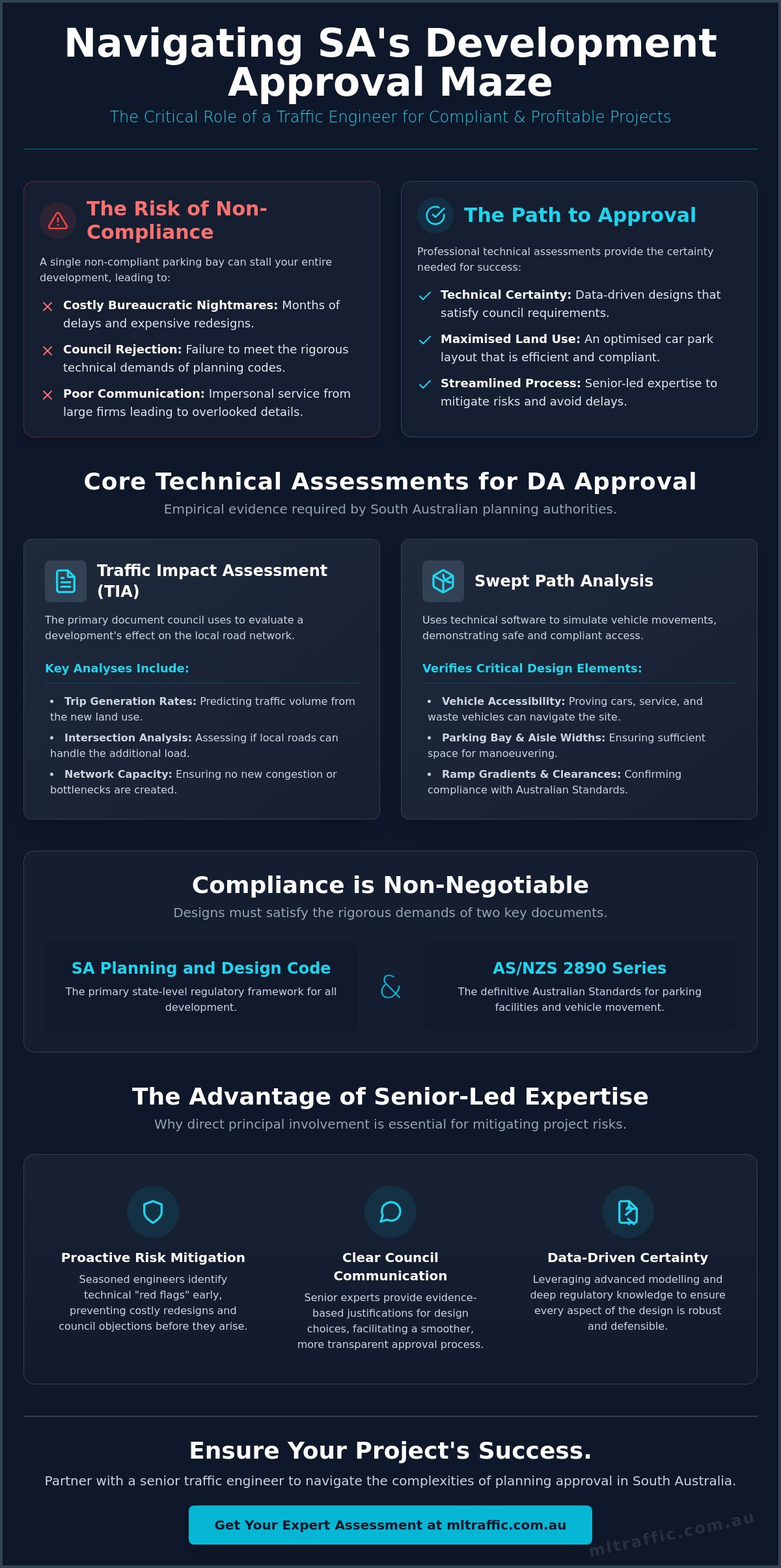
A single non-compliant parking bay can stall your entire development for months, turning a profitable project into a costly bureaucratic nightmare. Securing a qualified traffic engineer Adelaide ensures your design doesn’t just look good on paper but satisfies the rigorous technical demands of the South Australian Planning and Design Code 2026.11. We recognise that navigating the complexities of AS/NZS 2890.1:2021 is often a source of significant uncertainty, especially when large engineering firms provide poor communication and impersonal service.
You deserve a car park layout that maximises space without risking council rejection. This article outlines how professional technical assessments, including swept path analysis and Traffic Impact Assessments, provide the certainty you need for a successful planning approval. We will examine the specific regulatory standards required in South Australia and explain how senior-led expertise ensures your project remains compliant, efficient, and ready for construction.
Key Takeaways
- Understand the essential role of technical movement assessments in securing planning approval for South Australian developments.
- Identify the core requirements for Traffic Impact Assessment (TIA) reports and how a traffic engineer Adelaide uses Swept Path Analysis to demonstrate vehicle accessibility.
- Navigate the complexities of the AS 2890 series to ensure your parking facilities meet current User Class dimensions and regulatory benchmarks.
- Learn why direct principal involvement and senior expertise are essential for mitigating project risks and streamlining communication with local councils.
- Discover how to maximise land use efficiency through optimised car park design and comprehensive waste management planning.
The Essential Role of a Traffic Engineer in Australian Developments
A professional traffic engineer serves as a critical technical specialist responsible for the safe and efficient movement of people and goods. Within the Australian development sector, this role focuses on ensuring that new site designs comply with rigorous parking and access standards. Traffic engineering combines the principles of civil safety, urban planning, and transport logistics to create functional environments that support local infrastructure. For developers, engaging a qualified traffic engineer Adelaide is a prerequisite for most Development Applications (DA), particularly when a project significantly alters land use or increases vehicle volumes.
Professional engineering input is mandatory because councils must verify that a proposed development won’t compromise road safety or the performance of the surrounding network. Early involvement from a consultant allows for the identification of design constraints before they become embedded in the project architecture. This proactive approach prevents the need for expensive redesigns during the late stages of the planning phase, ensuring the project remains viable and compliant from the outset.
To better understand this concept, watch this helpful video:
Beyond Basic Reports: Strategic Transport Planning
Expertise in traffic engineering extends beyond simple car park layouts. It involves a comprehensive analysis of how a development interacts with the broader Adelaide road network. Our senior consultants focus on the following strategic areas:
- Network Capacity Analysis: Determining if existing intersections and road segments can accommodate the projected increase in traffic flow.
- Safety and Accessibility: Balancing the requirements for vehicle access with the safety of pedestrians and cyclists.
- Data-Driven Modelling: Using technical software to simulate traffic patterns and predict potential bottlenecks for large-scale projects.
Mitigating Risk in the Council Approval Process
The council approval process is often hindered by technical “red flags” that junior staff might overlook. A seasoned traffic engineer Adelaide identifies these issues early, providing evidence-based justifications for any necessary parking variations. This level of technical scrutiny ensures that the traffic data aligns perfectly with the broader Statement of Environmental Effects. Our specialised services include providing expert testimony and rigorous technical assessments to eliminate council friction. By addressing potential objections through empirical data and compliance-driven design, we facilitate a smoother path to successful planning approval.
Core Technical Assessments Required for DA Approval
Securing council approval for any significant development requires a suite of rigorous technical reports. A professional traffic engineer Adelaide must provide empirical evidence that the proposed design functions safely within the existing infrastructure. These assessments aren’t mere formalities; they are technical requirements that address specific safety and operational risks. Our senior engineers focus on delivering precise data that satisfies both the South Australian Planning and Design Code and relevant Australian Standards. Adhering to A Practitioners Guide to Best Practice ensures that every assessment provides the technical certainty required by planning authorities.
The Anatomy of a Traffic Impact Assessment (TIA)
The TIA is the primary document used by council for development evaluation. It involves evaluating trip generation rates using standardised industry databases to predict how much traffic the new land use will produce. We perform detailed intersection analysis to determine if the local road network can handle the additional load without creating congestion. The TIA serves as the definitive evidence of a project’s viability on the road network.
Vehicle Swept Path and Access Analysis
Proving that vehicles can manoeuvre safely on site is a non-negotiable requirement. We utilise AutoTURN software to simulate the turn circles and clearances of the largest expected vehicles, including heavy rigid vehicles (HRVs) for waste collection and emergency services. This process identifies potential conflict points in loading docks and access ramps. Ensuring compliance with swept path analysis requirements is essential for preventing operational failures once the building is occupied.
Car Park Design and Demand Assessment
Generic parking codes don’t always reflect the reality of a specific project. A Car Parking Demand Assessment justifies the provision of parking spaces based on empirical data rather than rigid, one-size-fits-all requirements. We design efficient layouts that integrate disability access and pedestrian safety while adhering to the dimensions specified in AS 2890.1 explained. For example, ensuring a standard User Class 1A bay meets the 2.4 metre by 5.4 metre requirement is a baseline for compliance.
Safe property access also relies on Sight Distance Assessments. These ensure that drivers exiting the site have a clear line of sight to oncoming traffic, preventing collisions and meeting civil safety standards. If you are currently preparing a development application, our team can provide the technical reports necessary to satisfy council requirements and avoid costly delays.
Navigating Australian Standards and Regulatory Compliance
Compliance with Australian Standards is the primary benchmark for planning authorities when evaluating a development application. In South Australia, the planning system relies on technical adherence to the AS 2890 series to ensure car parks function safely and efficiently. Non-compliance with these specific dimensions and gradients is the leading cause of DA refusal or costly requests for further information (RFI). A qualified traffic engineer Adelaide must interpret these standards with precision to ensure the design satisfies both state-level regulations and local council expectations.
AS 2890.1 and AS 2890.2: The Benchmarks for Parking
The hierarchy of parking standards distinguishes between different land uses and vehicle types. AS 2890.1:2021 governs off-street car parking, categorising spaces into User Classes. For example, User Class 1A applies to residential developments where drivers are familiar with the layout, requiring a standard bay width of 2.4 metres. In contrast, User Class 3 covers high-turnover retail environments, where the width increases to 2.6 metres to accommodate frequent door opening and diverse driver skill levels. While AS 2890.1 focuses on passenger cars and light vehicles, AS 2890.2 provides the mandatory requirements for commercial vehicle facilities and heavy vehicle loading areas.
Designers must also consider aisle widths and blind aisle extensions. A standard 90-degree parking aisle typically requires a width of 5.8 to 6.2 metres depending on the bay width. Failing to provide the required 1-metre blind aisle extension at the end of a parking row often results in vehicles being unable to manoeuvre out of end bays in a single movement, leading to safety hazards and non-compliance.
Driveway Ramp Grades and Sight Distance
Vertical geometry is just as critical as the horizontal layout. AS 2890.1 Section 2.5 specifies maximum ramp grades to prevent vehicle scraping and ensure driver comfort. For most developments, the maximum grade for a ramp longer than 20 metres is 1 in 5 (20%). We must also implement “break of grade” rules, which use transitions or “summits” to prevent low-clearance vehicles from bottoming out. Furthermore, ensuring adequate sight lines for pedestrians at the property boundary is a non-negotiable safety requirement. Drivers must be able to see pedestrians on the footpath before the vehicle crosses the boundary line.
Meeting Local Government Requirements
Local councils in Adelaide often have specific Development Control Plans (DCP) that exist alongside national standards. Conflicts can arise when local policy demands higher parking ratios or specific streetscape treatments that contradict Australian Standards. An experienced traffic engineer is essential for negotiating these complexities with council officers. We provide the technical justifications needed when a project requires a variation from standard codes, ensuring the design remains safe while maximising the development potential of the site.
Selecting a Traffic Consultant: Why Senior Expertise Matters
Selecting a traffic engineer Adelaide is a strategic decision that directly impacts your project timeline. Many large engineering firms operate under a model where senior leaders secure the engagement, but junior staff execute the technical assessments. This practice introduces significant risk. Junior staff often lack the deep-seated expertise required to navigate the nuanced bureaucratic requirements of council planning departments. This delegation frequently leads to errors in parking layouts and access designs that a seasoned expert would have identified during the initial site assessment.
The Advantage of Senior Principal Involvement
Direct involvement from a senior principal ensures a right-first-time approach to technical analysis. Senior engineers possess the foresight to anticipate council objections during the design phase, rather than reacting to them after receiving a request for further information. When an expert handles complex negotiations during council meetings, they provide evidence-based justifications that carry professional weight. Our firm provides a specific promise of personnel continuity. The same expert who initiates the project performs the technical work. This hands-on, accountable philosophy eliminates the communication gaps found in impersonal firms and ensures technical integrity remains consistent throughout the life of the project.
Assessing Track Record and Industry Reputation
A consultant’s history with specific land-use types is a reliable indicator of future project success. Working with an experienced traffic engineer Adelaide ensures your project benefits from a meticulous, results-oriented approach across diverse environments. You should evaluate a firm based on their demonstrated experience in the following areas:
- Multi-level residential developments and social housing projects.
- Commercial retail centres and high-turnover mixed-use precincts.
- Industrial warehouses and heavy vehicle logistics hubs requiring AS 2890.2 compliance.
- Childcare centres, medical clinics, and educational facilities with specific set-down requirements.
A national perspective on Australian Standards provides a competitive edge. It allows engineers to apply best-practice solutions from various jurisdictions to local Adelaide projects. Always verify professional qualifications and active membership in relevant engineering bodies to ensure your consultant maintains current regulatory certification and adheres to industry-standard ethics. Selecting the right partner is critical for mitigating project risk and eliminating unnecessary bureaucracy.
If you require a senior-led approach to ensure your development meets all technical and regulatory benchmarks, contact our principals directly to discuss your specific project requirements.
ML Traffic Engineers Australia: National Expertise for Your Project
ML Traffic Engineers Australia provides a comprehensive consultancy service backed by over 15 years of professional experience. We specialise in delivering compliant traffic and parking solutions that satisfy the technical requirements of local councils and state authorities. While we maintain a national presence, our team functions as a dedicated traffic engineer Adelaide for South Australian developers. This dual perspective allows us to apply national best practices to local planning challenges. We ensure every Traffic Impact Assessment and Vehicle Swept Path Analysis meets the highest regulatory standards.
Our core identity is built on direct accountability. We reject the model where technical work is delegated to junior staff. Every client has direct access to our senior principals. The expert who initiates the relationship performs the technical assessment. This personnel continuity promise is a central signature of our service. It distinguishes us from larger firms with fragmented communication structures. You deal directly with the engineer responsible for your project success.
Comprehensive Traffic Engineering Services
We provide a full suite of services covering the entire development lifecycle. Our involvement often begins with initial site feasibility studies to identify potential traffic constraints before a design is finalised. We then move through several technical stages:
- Detailed Car Park Design following AS 2890.1 and AS 2890.6 requirements.
- Advanced AutoTURN simulations to prove vehicle turn circles for complex access requirements.
- Preparation of Waste Management Plans and Traffic Guidance Schemes (TGS).
- Driveway Ramp Grade Assessments and Sight Distance Assessments.
- Certification of car park designs for final occupancy.
Our experience spans a vast range of land-use categories. We have delivered successful outcomes for service stations, medical centres, childcare facilities, and industrial subdivisions. We provide customised solutions that address the specific vehicle movement profiles of each project type. This technical depth ensures your traffic engineer Adelaide delivers a report that is both robust and compliant.
Partnering with ML Traffic Engineers Australia for DA Success
A meticulous approach to traffic engineering is the most effective way to secure planning permits. We provide clear, evidence-based reports that address council concerns proactively. Our “no-gatekeepers” communication style means you receive technical answers directly from the experts. This reduces the revision cycle and accelerates project timelines by eliminating unnecessary middle management.
We understand the bureaucratic requirements of the South Australian planning system. Our reports are designed for clarity and easy digestion by council officers. This facilitates a smoother approval process and reduces the risk of costly requests for further information. Contact our senior team today to discuss your project and receive a project-specific fee proposal. We provide the technical certainty your development requires.
Secure Your Planning Approval with Technical Precision
Achieving a successful development outcome in South Australia requires more than just a standard report. It demands a meticulous application of the AS 2890 series and the SA Planning and Design Code to eliminate council friction. Senior-led technical assessments ensure your car park design and vehicle access points meet every regulatory benchmark while maximising land use efficiency. Engaging a seasoned traffic engineer Adelaide provides the technical certainty needed to navigate complex planning requirements without the risk of junior-led errors.
ML Traffic Engineers Australia brings over 15 years of specialised traffic engineering experience to your project. We have a proven track record involving thousands of successful DA approvals and offer direct access to senior principals on every engagement. This commitment to personnel continuity ensures that your project remains compliant and efficient from initial feasibility to final certification. Take the next step in your development journey today.
Get an Expert Traffic Assessment for Your DA Approval
We look forward to providing the technical expertise required to move your project toward a successful council decision.
Frequently Asked Questions
What is the difference between a Traffic Impact Assessment (TIA) and a Traffic Management Plan (TMP)?
A Traffic Impact Assessment (TIA) evaluates the long-term effects of a new development on the surrounding road network and parking capacity. In contrast, a Traffic Management Plan (TMP) or Traffic Guidance Scheme (TGS) outlines short-term arrangements for safety during construction or special events. Planning authorities require a TIA during the development application stage to ensure the permanent design is safe and functional for all road users.
Does every development application require a traffic engineer’s report?
Not every application requires a formal report, but most commercial, industrial, and multi-residential projects do. Councils mandate a technical assessment if a proposal significantly alters land use or increases vehicle movements. If your project involves a parking shortfall or complex access points, a professional report is essential to justify these variations and avoid a summary refusal from the planning authority.
How long does it typically take to prepare a Traffic Impact Assessment?
Preparation typically takes between two and four weeks depending on the project’s scale and technical complexity. Projects requiring site-specific traffic counts or complex intersection modelling using SIDRA software may require additional time. Engaging a qualified traffic engineer Adelaide early in the design phase ensures that technical data is ready for lodgement, preventing delays in the council’s assessment clock.
What is a Swept Path Analysis and when is it necessary?
Swept Path Analysis is a technical simulation that maps the path of a vehicle’s body and tyres during a turn. It is mandatory for proving that the largest expected vehicles, such as heavy rigid waste trucks or fire appliances, can manoeuvre safely within the site. We use AutoTURN software to verify that these vehicles don’t strike kerbs, walls, or other parked cars during standard operations.
Can a traffic engineer help if my car park design doesn’t meet council requirements?
We specialise in optimising car park layouts that initially fail to meet standard regulatory benchmarks. By applying empirical parking demand data, we can often justify variations to the strict rates found in the Planning and Design Code. Our senior engineers provide the technical evidence required to prove a design is safe and functional, even when it deviates from generic council DCP requirements.
What are the most common reasons councils reject traffic reports?
Rejections often stem from using outdated versions of Australian Standards or inaccurate trip generation rates. Councils also frequently identify non-compliant parking bay dimensions and insufficient sight distances at property boundaries as major red flags. A report lacking rigorous swept path analysis for heavy vehicles is another common reason for planning officers to issue a request for further information or refuse the application.
Is a traffic engineer required for a change of use application?
A change of use application usually requires a traffic assessment if the new activity increases parking demand or changes vehicle arrival patterns. For instance, transitioning a retail space into a medical centre significantly alters how many visitors arrive and how long they stay. A formal assessment proves the existing or proposed parking provision can accommodate the specific requirements of the new land-use category.
How do I know if my driveway ramp grade is compliant with AS 2890.1?
Compliance is verified by measuring the vertical profile against the limits set in Section 2.5 of AS 2890.1. A traffic engineer Adelaide calculates the maximum ramp grade, ensuring it doesn’t exceed 20% for ramps longer than 20 metres. We also design necessary transitions, or “summits”, to prevent low-clearance vehicles from bottoming out. This technical verification is essential for ensuring safe vehicle access and meeting South Australian regulatory standards.

Disclaimer
The content on www.mltraffic.com.au, including all technical articles, guides, and resources, is provided for general informational and educational purposes only. It is not intended to constitute professional advice in traffic engineering, transportation planning, development approvals, or any other technical or legal field.While ML Traffic Engineers makes every reasonable effort to ensure the accuracy, completeness, and timeliness of the information published, we do not provide any warranties or representations (express or implied) regarding its reliability, suitability, or availability for any particular purpose. Any reliance you place on the content is strictly at your own risk.In no event shall ML Traffic Engineers, its directors, employees, authors, or affiliates be liable for any direct, indirect, incidental, special, consequential, or punitive damages (including, without limitation, loss of profits, data, or business opportunities) arising out of or in connection with the use of, or inability to use, any information provided on this website.The articles and guides on this site are not a substitute for engaging a qualified, registered professional traffic engineer (such as an NPER or RPEQ engineer) to assess your specific project requirements. For tailored advice, compliance assessments, or traffic engineering services, please contact a competent professional.This disclaimer may be updated from time to time without notice. By accessing or using this website, you agree to be bound by the most current version of this disclaimer.
