

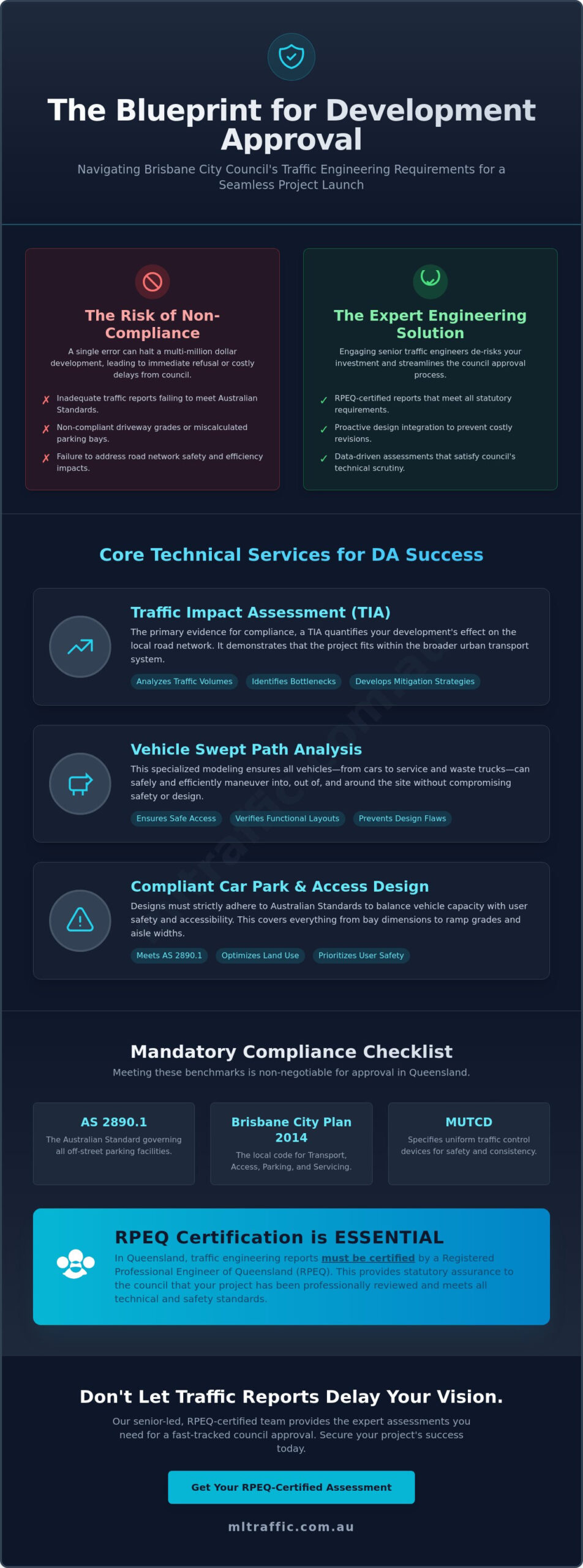
A single non-compliant driveway grade or a miscalculated parking bay can halt a multi-million dollar development application before it even reaches a desk at Brisbane City Council. You likely already know that navigating the Brisbane City Plan 2014 is a bureaucratic minefield. Delays in council approval usually stem from inadequate traffic reports that fail to meet strict Australian Standards like AS 2890.1. Engaging an experienced traffic engineer Brisbane ensures your project meets every regulatory hurdle, from Vehicle Swept Path Analysis to complex Waste Management Plans.
This article provides a comprehensive understanding of traffic engineering requirements for Australian development applications and explains how expert assessments guarantee council compliance. We will examine the essential technical reports needed for a successful lodgement, the role of RPEQ certification in Queensland, and how direct access to senior technical experts de-risks your investment. You will gain clarity on the 2026-2027 BCC fee structures and the technical benchmarks required to move your project from design to construction without costly requests for information.
Key Takeaways
- Understand why professional traffic engineering is a mandatory requirement for Brisbane development applications and how it mitigates road network impacts.
- Learn how Traffic Impact Assessments (TIA) and Vehicle Swept Path Analysis ensure safe site maneuvering and quantifying development effects on local infrastructure.
- Discover the technical benchmarks of Australian Standard AS2890.1 and how compliant car park design balances capacity with user safety.
- Identify the advantages of engaging a senior-led traffic engineer Brisbane to secure RPEQ-certified reports that streamline the council approval process.
- Gain insights into the essential site data, traffic counts, and parking surveys required to build a robust foundation for successful DA lodgement.
The Critical Role of Traffic Engineering in Australian Development Applications
Traffic engineering is not an optional add-on for urban development; it’s a legal and technical necessity. For most commercial and residential projects in Queensland, submitting a Development Application (DA) without a certified traffic report leads to immediate refusal or prolonged delays. Local councils require specific technical assurance that a new project won’t compromise the safety or efficiency of the existing road network. Traffic engineering focuses on the safe and efficient movement of people and goods, providing the data-driven foundation for all modern infrastructure. In Queensland, these professional services must be carried out or supervised by a Registered Professional Engineer of Queensland (RPEQ) to meet statutory requirements.
Engaging a qualified traffic engineer Brisbane early in the design phase allows for the identification of potential access or parking issues before they become embedded in the architectural plans. This proactive approach prevents costly design revisions and ensures that the site layout complies with the Transport, Access, Parking and Servicing Code within the Brisbane City Plan 2014. By integrating engineering expertise at the concept stage, developers can optimize their land use while adhering to the strict Manual of Uniform Traffic Control Devices (MUTCD) specifications.
To better understand how these experts shape our urban environment, watch this helpful video:
Facilitating Planning Approvals
Securing a planning permit requires addressing complex council concerns regarding traffic congestion, pedestrian safety, and site access. A comprehensive Traffic Impact Assessment (TIA) Report serves as the primary evidence for compliance. These reports bridge the gap between land use planning and transport engineering by demonstrating that the proposed development fits within the broader urban context. By providing rigorous technical data, developers can satisfy council requirements and move toward fast-tracked approvals. Our senior-led approach ensures that every report is prepared by an expert who understands the specific nuances of Brisbane’s road hierarchy.
Mitigating Road Network Impacts
Expert assessments are designed to quantify the effect of a development on local roads before construction begins. This involves analyzing existing traffic volumes and predicting future movements based on the specific land use. A traffic engineer Brisbane evaluates whether the surrounding infrastructure, such as intersections and arterial roads, can support the additional load. If the analysis identifies potential bottlenecks, the engineer develops mitigation strategies. These may include refined driveway placements, dedicated turn lanes, or intersection upgrades. You can explore our specialized engineering services to learn more about our data-driven approach to impact mitigation.
Core Technical Services: Traffic Impact Assessments and Swept Path Analysis
Technical assessments form the empirical basis of any development proposal. A professional traffic engineer Brisbane uses specialized modeling to prove that a site can handle its intended volume of vehicles without compromising public safety or road efficiency. These services aren’t merely paperwork; they’re critical design tools that ensure every square meter of a development is functional and compliant with local regulations. By providing data-backed evidence of site performance, we help developers de-risk their projects during the critical planning phase.
Traffic Impact Assessments (TIA)
A Traffic Impact Assessment (TIA) is a rigorous study that quantifies a development’s footprint on the surrounding road network. We conduct a detailed analysis of trip generation, calculating exactly how many vehicle movements a site will produce during peak hours. This data is then distributed across local intersections to identify potential capacity issues or required upgrades. For projects impacting state-controlled roads, we adhere strictly to the Guide to Traffic Impact Assessment issued by the Department of Transport and Main Roads.
The scope of reporting varies depending on the project’s scale. While a full TIA is required for major commercial or residential hubs, a simplified Traffic Statement may be sufficient for smaller developments with negligible impacts. Regardless of the scope, preparing a robust traffic engineering report is essential for satisfying council information requests. These assessments often include a Car Parking Demand Assessment. By providing empirical evidence of actual parking needs, we can often justify reduced parking rates, potentially saving developers significant construction costs on unnecessary basement levels.
Vehicle Swept Path Analysis
Precise maneuvering is vital for operational success and safety. Vehicle Swept Path Analysis provides a technical diagram showing the exact path of a vehicle’s tires and body overhang during a turn. This is not a manual calculation; we utilize industry-standard software like AutoTURN to generate high-accuracy simulations. These diagrams are mandatory for proving that waste collection vehicles, delivery trucks, and emergency services can enter and exit the site in a forward gear, as required by most council codes.
This analysis is particularly critical for loading docks and tight car park entries where the margin for error is minimal. We ensure all designs comply with Australian Standards, such as AS2890.1 for off-street parking and AS2890.2 for commercial vehicles. If your project involves complex site constraints or unique vehicle requirements, it’s beneficial to consult with our senior engineers during the initial design phase to ensure your layout is functionally sound from the start. This early technical oversight prevents the need for expensive structural changes later in the development cycle.
Compliance with Australian Standards for Car Park Design and Access
Adherence to Australian Standards isn’t a suggestion; it’s a mandatory requirement for development approval. A traffic engineer Brisbane must ensure that every car park layout meets the specific geometric requirements outlined in the AS 2890 series. Failure to comply with these benchmarks often leads to costly redesigns or the rejection of a development application. Our senior engineers provide meticulous certification of parking layouts, ensuring that bay dimensions, aisle widths, and circulation paths are optimized for both user safety and operational efficiency.
For developers seeking technical certainty before lodgement, Brisbane City Council offers a traffic and transport advice pre-design service for $750.00 per request. We frequently facilitate these requests to align designs with council expectations at the earliest possible stage. This proactive approach ensures that the balance between parking capacity and site accessibility is achieved without compromising regulatory standards.
AS2890.1 and AS2890.2 Requirements
The AS 2890 series is the technical foundation for all off-street parking in Australia. It’s divided into several parts, each governing different vehicle classes and use cases. AS 2890.1 (2004) focuses on residential and light vehicle parking, while AS 2890.2 (2018) sets the standard for commercial and heavy vehicle facilities. Distinguishing between these parts is vital for projects involving mixed-use developments where both passenger cars and delivery trucks share access points.
Key technical metrics we assess for compliance include:
- Bay Dimensions: Minimum widths and lengths based on user class (e.g., short-term vs. long-term stays).
- Aisle Widths: Ensuring sufficient space for maneuvering into and out of parking spaces.
- Blind Aisle Extensions: Providing the required 1-meter extension to allow for three-point turns at the end of parking rows.
- Accessible Parking: Adherence to AS 2890.6 for people with disabilities, including shared zones and bollard placements.
For a deeper technical breakdown, you can read our comprehensive guide on AS 2890.1 compliant car park design.
Driveway Ramp Grade Assessments
Steep sites and complex topographies require precise engineering to ensure safe vehicle access. A Driveway Ramp Grade Assessment is essential to prevent vehicle scraping and ensure smooth transitions between varying levels. We calculate vertical curves and transitions to ensure that low-clearance vehicles can navigate ramps without bottoming out or “topping out” at the crest. This is particularly critical in Brisbane’s hilly suburbs where driveway gradients can easily exceed standard limits.
Our assessment includes calculating maximum ramp gradients, which typically shouldn’t exceed 1 in 4 for private use, and ensuring sight distance requirements at property boundaries are met. We also verify that driveway widths comply with the Brisbane City Plan 2014 “Transport, Access, Parking and Servicing Code.” By addressing these constraints during the design phase, we help you avoid the functional failures that lead to long-term liability and tenant dissatisfaction.
Preparing for a DA: Essential Requirements for Traffic Engineering Reports
A successful Development Application (DA) requires more than just architectural drawings; it demands a rigorous technical defense of the project’s impact on the local environment. A traffic engineer Brisbane provides this defense by translating raw site data into a compliant submission document. Effective reporting begins with accurate development plans and current site data. Without this foundation, even the most innovative designs can be derailed by council requests for information (RFIs). We ensure that every report is prepared with the technical precision required to meet Brisbane City Council’s high standards for safety and efficiency.
Data Collection and Traffic Counts
Accurate empirical data is your best defense against council objections. We don’t rely on guesswork; we utilize verified data sources to build our assessments. For projects in Brisbane, this often involves obtaining Ultimate traffic volume information reports ($346.50 each) or standard traffic counts at signalised intersections ($155.30 each) directly from Brisbane City Council. These 2026-2027 fee structures represent the cost of obtaining the raw data necessary for a defensible report.
Historical data provides a baseline, but predictive modeling accounts for future growth and neighboring developments. By quantifying existing traffic flows during peak periods, we establish a baseline that councils can trust. This meticulous approach ensures that the Trip Generation rates used in your Traffic Impact Assessment (TIA) are defensible under technical scrutiny. Accurate data collection prevents the delays associated with inadequate reporting and ensures your project is evaluated on its actual merits.
Intersection and Access Design
Designing site access points requires balancing internal site efficiency with the safety of the external road network. We analyze intersection capacity using industry-standard SIDRA modeling software to predict delay times and queue lengths. This technical analysis ensures that your development doesn’t cause unacceptable levels of service (LoS) degradation at nearby junctions. If a project requires SCATS coordination timing or intersection phasing diagrams, these are requested from the council at a rate of $39.85 per request type.
Brisbane City Council maintains a strong focus on active transport. Your traffic plan must integrate safe routes for pedestrians and cyclists alongside vehicle movements. We assess sight distances at property boundaries to ensure that exiting vehicles have a clear view of approaching traffic and foot traffic. This holistic design approach minimizes disruption to the main road while maximizing site accessibility. Early collaboration between architects and traffic engineers is vital for site optimization. We work alongside your design team to refine car park layouts and driveway placements before they’re finalized.
If you’re preparing a development application, you can contact our senior technical experts to discuss your specific reporting requirements and ensure a compliant submission.
Selecting a Senior-Led Traffic Engineering Consultancy for Your Project
Choosing a traffic engineer Brisbane is a strategic decision that directly impacts your project’s timeline and budget. Many large engineering firms utilize a model where senior staff secure the contract, but junior engineers perform the actual technical analysis. This often leads to communication gaps and missed nuances in complex council requirements. A senior-led consultancy ensures that your project benefits from over 15 years of specialized experience in traffic engineering and transport planning from the initial consultation to final approval. Our results-oriented approach focuses on de-risking your investment through meticulous technical oversight.
One of our unique signatures is the “personnel continuity promise.” This means the senior expert who initiates your client relationship is the same professional who performs the technical work and manages the council negotiations. This hands-on, accountable philosophy distinguishes us from larger, more impersonal firms. It ensures that the deep site-specific knowledge gained at the start of the project isn’t lost during a hand-off to junior staff. This consistency is vital for maintaining the integrity of complex reports like a Traffic Impact Assessment (TIA) or a detailed Car Parking Demand Assessment.
Senior Principal Accountability
Direct access to leadership eliminates the “gatekeeper” effect common in larger firms. You don’t have to navigate through multiple layers of management to get a technical answer. Every report undergoes a meticulous, senior-level review to ensure it meets the highest standards of accuracy and compliance. This level of expertise leads to faster council negotiations because our senior principals can speak with authority on technical matters during pre-lodgement meetings or when responding to Requests for Information (RFIs). We focus on providing the technical assurance councils need to grant planning permits without unnecessary delays.
National Consultancy Experience
Applying broad industry knowledge to local challenges strengthens the technical quality of every assessment. We maintain professional traffic engineer services for national civil projects, bringing a high-level perspective to local council requirements across Australia. This extensive experience allows us to apply proven solutions from diverse project environments to solve specific site constraints in Brisbane. Whether your project is a small residential subdivision or a large-scale industrial hub, our national exposure ensures we’re familiar with the latest trends and regulatory shifts in urban planning.
Our senior-led model is built for reliability and deep-seated expertise. We provide technical services for a vast range of land-use categories, including:
- Residential and mixed-use developments
- Commercial and retail precincts
- Industrial and warehouse facilities
- Childcare and educational centers
- Medical and aged care developments
If you require a dependable partner for your next development application, contact the ML Traffic team for a comprehensive fee proposal. We provide a direct line to our senior experts to ensure your project receives the technical attention required for a successful outcome.
Securing Your Development Approval with Technical Precision
Navigating the Brisbane City Plan 2014 and mandatory Australian Standards requires a data-driven approach to site design. We’ve shown how rigorous assessments like Vehicle Swept Path Analysis and Traffic Impact Assessments provide the technical assurance councils demand. By integrating engineering expertise at the concept stage, you prevent costly design revisions and ensure your car park and access points are functionally sound. Engaging a seasoned traffic engineer Brisbane ensures your development application is supported by RPEQ-certified reports that meet both state and national guidelines.
Our senior-led model provides over 15 years of specialized experience with direct principal involvement on every project. We offer national coverage for all Australian councils, maintaining a personnel continuity promise where the expert who starts your project sees it through to completion. This hands-on accountability is essential for managing complex council negotiations and achieving fast approvals.
Request a Fee Proposal from Our Senior Traffic Engineers to de-risk your next project with meticulous engineering oversight. We look forward to facilitating your project’s success.
Frequently Asked Questions
What is a Traffic Impact Assessment (TIA) and why do I need one?
A Traffic Impact Assessment is a technical report that quantifies the effect of a proposed development on the surrounding road network. You need one to satisfy Brisbane City Council requirements and prove your project won’t compromise public safety or traffic flow. It’s a mandatory component of most Development Applications for commercial and residential sites.
How long does it take to prepare a professional traffic engineering report?
Preparing a comprehensive traffic engineering report typically takes between 2 to 4 weeks. This timeframe includes site inspections, data collection, and technical modeling. Complex projects requiring intersection analysis or SIDRA modeling may sit at the upper end of this range to ensure all technical benchmarks are met.
What is Swept Path Analysis and is it required for residential developments?
Swept Path Analysis is a technical simulation showing the path a vehicle’s body and wheels take during a turn. It’s mandatory for residential developments to prove that waste collection trucks and emergency vehicles can enter and exit the site in a forward gear. We use AutoTURN software to ensure these maneuvers comply with Australian Standards.
Do all developments require a traffic engineer for council approval?
Most commercial and multi-unit residential developments require a traffic engineer Brisbane to secure council approval. Under the Professional Engineers Act 2002, these engineering services in Queensland must be performed or supervised by a Registered Professional Engineer of Queensland (RPEQ). Submitting without certified reports often leads to immediate requests for information.
What are the most common reasons councils reject traffic reports?
Councils frequently reject reports due to non-compliance with AS 2890.1 or inadequate sight distance assessments at property boundaries. Other common issues include failing to demonstrate forward-gear maneuvers for heavy vehicles or providing insufficient parking data. Meticulous senior-level review is the best defense against these common technical errors.
How does AS2890.1 affect the number of parking spaces I can provide?
AS2890.1 dictates the minimum dimensions for parking bays, aisle widths, and blind aisle extensions. These standards define the physical capacity of your site. If your layout doesn’t adhere to these specific geometric requirements, the council won’t approve the parking count, regardless of how many spaces are drawn on the plan.
Can a traffic engineer help justify a parking shortfall for my project?
Yes, we can justify a parking shortfall through a Car Parking Demand Assessment. By analyzing empirical data and similar land-use cases, we provide technical evidence that your development requires fewer spaces than the standard council code suggests. This process can significantly reduce construction costs by eliminating unnecessary basement levels.
What data do I need to provide to a traffic consultant to get started?
You must provide accurate architectural site plans, the proposed land-use details, and any existing council correspondence or RFI documents. Precise modeling depends on the quality of the initial plans. Providing clear information on vehicle types and expected delivery schedules also helps us tailor the Vehicle Swept Path Analysis to your specific operational needs.

Disclaimer
The content on www.mltraffic.com.au, including all technical articles, guides, and resources, is provided for general informational and educational purposes only. It is not intended to constitute professional advice in traffic engineering, transportation planning, development approvals, or any other technical or legal field.
While ML Traffic Engineers makes every reasonable effort to ensure the accuracy, completeness, and timeliness of the information published, we do not provide any warranties or representations (express or implied) regarding its reliability, suitability, or availability for any particular purpose. Any reliance you place on the content is strictly at your own risk.
In no event shall ML Traffic Engineers, its directors, employees, authors, or affiliates be liable for any direct, indirect, incidental, special, consequential, or punitive damages (including, without limitation, loss of profits, data, or business opportunities) arising out of or in connection with the use of, or inability to use, any information provided on this website.
The articles and guides on this site are not a substitute for engaging a qualified, registered professional traffic engineer (such as an NPER or RPEQ engineer) to assess your specific project requirements. For tailored advice, compliance assessments, or traffic engineering services, please contact a competent professional.
This disclaimer may be updated from time to time without notice. By accessing or using this website, you agree to be bound by the most current version of this disclaimer.
