

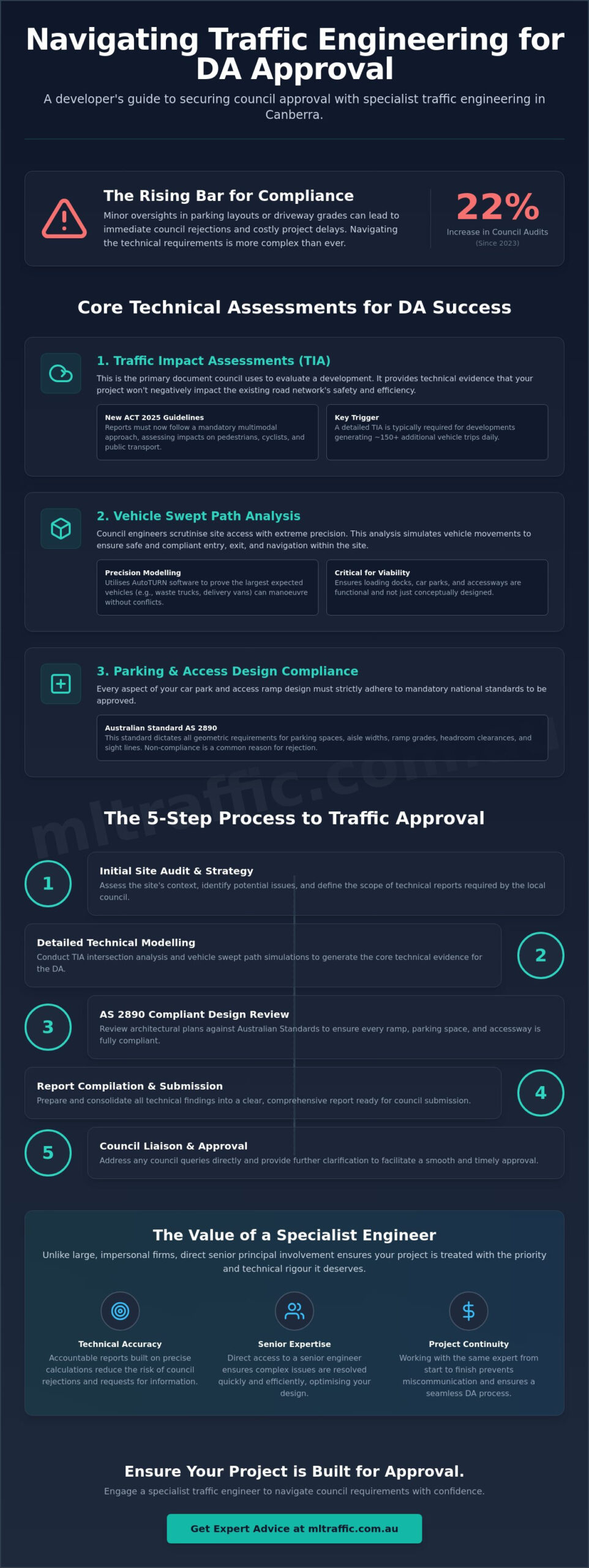
Since 2023, local councils have increased their audit rates by 22% to ensure strict compliance with traffic management standards. For any developer, this means a minor oversight in a parking layout or a non-compliant driveway grade can lead to immediate council rejections and costly delays. You probably recognise that navigating the technicalities of the ACT’s new 2025 Transport Impact Assessment Guidelines is an increasingly complex task. It’s often difficult to get clear answers when dealing with large, impersonal firms that lack a direct line to senior leadership. Engaging a specialist traffic engineer Canberra ensures your project isn’t just another file in the queue, but a technically sound proposal built for approval.
In this guide, you’ll gain a clear understanding of how professional traffic engineering secures council approvals and ensures your development meets all mandatory Australian Standards. We’ll examine the critical role of Traffic Impact Assessment (TIA) reports, the necessity of accurate vehicle swept path analysis, and how direct access to a senior expert can optimise your site’s access and parking layout for a seamless DA process.
Key Takeaways
- Understand why engaging a professional traffic engineer Canberra is essential for managing complex technical requirements and securing council approval.
- Learn how Traffic Impact Assessments (TIA) and Vehicle Swept Path Analysis provide the technical evidence required for site safety and operational viability.
- Identify the mandatory requirements of Australian Standard AS 2890 to ensure car park and access ramp designs are fully compliant.
- Follow a structured five-step process for securing traffic approval, from initial site audits to detailed technical modelling.
- Recognise the value of direct senior principal involvement and personnel continuity in producing accurate, accountable engineering reports.
Defining the Role of a Professional Traffic Engineer
A technical specialist in this field assesses exactly how a proposed development interacts with the existing road network. This role requires a meticulous balance of site accessibility, safety, and regulatory compliance to support sustainable urban growth. For developers, a traffic engineer Canberra provides the technical data necessary to satisfy council requirements and secure project viability. They serve as the critical bridge between architectural vision and civil functionality.
Understanding What is a Traffic Engineer? involves looking at the specific application of physics and mathematical modelling to road design. Unlike general civil engineers, traffic specialists focus on the movement of people and goods. They ensure that every vehicle, from a passenger car to a heavy rigid waste truck, can safely enter, exit, and navigate a site without compromising the efficiency of the surrounding public infrastructure.
The Distinction Between Traffic Engineering and Transport Planning
Traffic engineering and transport planning are often confused, but they serve different purposes within the development process. Engineering focuses on the physical design, compliance, and safety of vehicle movements. This includes the precise calculation of ramp grades, the placement of signage, and the layout of parking spaces. Planning, conversely, looks at broader trends, public transport integration, and long-term infrastructure strategy for a region.
Your project requires specific engineering precision to address immediate site-level issues. While a planner might suggest a site is well-located for bus access, an engineer proves that a 12.5m delivery vehicle can physically turn into the loading dock without hitting a structural column. This level of detail is what secures a DA approval.
When is an Expert Traffic Consultant Required?
Local government authorities usually trigger the requirement for a professional traffic report based on the scale of land use. Common triggers include a high number of expected daily vehicle trips, significant changes to site access, or a shortfall in provided parking spaces. Engaging an expert early in the design phase is a strategic move. It prevents the need for expensive layout reworks after the architectural plans are finalised.
Professional input from an experienced consultant mitigates risks associated with sight distances and vehicle safety. By reviewing the range of technical services available, developers can identify which assessments, such as swept path analysis or parking demand studies, are necessary to satisfy council auditors and avoid unnecessary delays. Expert oversight ensures that every design choice aligns with the mandatory Australian Standards from the outset.
Core Technical Assessments: TIA, Swept Path, and Parking
Securing a DA approval in the ACT requires more than just submitting architectural drawings. A traffic engineer Canberra must produce a suite of technical assessments that prove a development’s functionality. These documents are interdependent. A failure in one, such as an impractical parking layout, often invalidates the findings of the others. Our senior experts ensure that every report is technically sound and aligned with current regulatory expectations.
Traffic Impact Assessments and Statements
The Traffic Impact Assessment (TIA) is the primary document council uses to evaluate a development. Since 1 July 2025, the ACT has implemented new TIA guidelines that demand a multimodal approach. This means your report must account for pedestrians, cyclists, and public transport alongside private vehicles. For instance, any development generating approximately 150 additional vehicle trips daily requires a robust technical statement. We perform detailed intersection analysis to determine if the local road network can handle this increased load without causing congestion. You can find more detail in our definitive guide to Traffic Impact Assessments.
Vehicle Swept Path and Access Assessment
Council engineers scrutinise access points with extreme precision. We utilise AutoTURN software to perform a detailed swept path analysis. This simulation ensures that the largest expected vehicles, such as a 12.5m heavy rigid waste truck, can safely enter and exit the site. All designs must adhere to Australian Standards (AS 2890). If a basement ramp or loading dock fails this digital test, the DA will likely be refused. A traffic engineer Canberra integrates these path findings into the broader site design to ensure functional basement layouts and efficient driveway grades.
Car Park Design and Demand Assessment
Meeting generic parking codes isn’t always the most efficient path for a developer. We conduct Car Parking Demand Assessments to justify the actual number of spaces required based on specific land use. This often prevents the over-provision of parking, which increases construction costs and reduces site yield. Our approach to car park design focuses on:
- Optimising Yield: Strategic aisle widths and column placements to maximise available space.
- Safety Compliance: Eliminating blind-aisle turnarounds that cause safety hazards for pedestrians and motorists.
- Technical Accuracy: Ensuring every bay and ramp complies with the specific dimensional requirements of AS 2890.1.
If you need to secure a compliant Traffic Impact Assessment (TIA) report, our senior experts provide the technical precision required for approval.
Navigating Australian Standards (AS 2890) and Council Compliance
Compliance with AS 2890 is a non-negotiable requirement for car park and access design in Australia. Council engineers use these standards as the primary benchmark for every technical review of a Development Application. If a design deviates from these specifications without a rigorous technical justification, the application will likely face rejection. AS 2890.1 defines the minimum aisle widths and bay dimensions for all Australian developments. A qualified traffic engineer Canberra ensures that every centimetre of a site layout is optimised while remaining strictly within these regulatory boundaries.
Since 2023, local councils have increased their audit rates by 22% to ensure compliance with these traffic management standards. This increased scrutiny means that even minor deviations in parking bay length or aisle clearance can result in a “Request for Further Information” (RFI), adding months to your project timeline. We provide the technical certainty needed to bypass these bottlenecks by ensuring every design choice is defensible under national regulations.
Understanding AS 2890.1: Off-Street Car Parking
AS 2890.1 categorises parking based on specific user classes. Residential parking (Class 1A) allows for tighter dimensions than short-term retail parking (Class 3), where frequent vehicle turnover requires wider bays to maintain safety and efficiency. One of the most critical technical aspects is the design of driveway ramp grades. Incorrect vertical transitions lead to vehicle scraping, which is a common reason for DA refusal. We perform detailed Driveway Ramp Grade Assessments to ensure transitions comply with the specific grade limits mandated in the standard. For a deeper dive into these technical requirements, read our ultimate guide to AS 2890.1 compliance.
Commercial Access and AS 2890.2
Developments involving industrial or commercial land use must adhere to AS 2890.2. This standard dictates the geometry of loading areas and service bays to accommodate heavy rigid vehicles (HRVs) and articulated vehicles. A traffic engineer Canberra must also conduct Sight Distance Assessments at every driveway exit. This ensures that exiting drivers have a clear line of sight to pedestrians and oncoming traffic, as mandated by the standard. AS 2890.2 provides the specific formulas for calculating the required area for vehicle manoeuvring, ensuring that a 12.5m truck can operate safely within the site boundaries. Failing to demonstrate this through a Waste Management Plan or swept path analysis is a frequent cause of costly site layout rework.
The 5-Step Process for Securing Traffic Approval for Your DA
Securing traffic approval for a Development Application requires a structured technical workflow. A professional traffic engineer Canberra manages this process to minimise project risks and satisfy the specific requirements of the ACT’s 2025 TIA Guidelines. Following a methodical path ensures that technical issues are resolved before they become grounds for a council rejection. This approach provides the technical certainty needed for complex urban developments.
- Step 1: Initial Site Audit and Design Review: We identify potential red flags in the early architectural sketches. This involves checking driveway locations and basic parking layouts against the mandatory requirements of AS 2890.
- Step 2: Technical Modelling: This stage involves performing Vehicle Swept Path Analysis and calculating trip generation rates. We use precise data to prove the site can accommodate the expected traffic volume.
- Step 3: Report Preparation: We draft a comprehensive Traffic Impact Assessment (TIA) report or a concise Traffic Statement, depending on the scale of the development.
- Step 4: Liaison with Governing Bodies: We negotiate directly with road authorities and council engineers to resolve technical queries.
- Step 5: Final Certification: We ensure the final design meets all conditions of consent issued by the planning authority.
Liaising with Council and Road Authorities
An experienced engineer must speak the “language of council”. This involves understanding the specific bureaucratic expectations of ACT Transport Canberra and City Services (TCCS). When a council issues a Request for Further Information (RFI), we provide technical rebuttals or design adjustments that satisfy their safety concerns. In cases where site constraints make 100% compliance difficult, we negotiate sensible, safe outcomes that still meet the intent of the Australian Standards. This direct advocacy is essential for maintaining project momentum.
Ensuring DA Approval Through Meticulous Documentation
Clear diagrams and professional drafting are essential for reducing the time a project spends in the assessment queue. A high-quality report functions as the “proof of concept” that council engineers require to sign off on a project. We ensure the traffic report supports the broader Statement of Environmental Effects by providing data-backed evidence of site viability. Meticulous documentation prevents the ambiguity that often leads to delays. Professional reports provide a clear, defensible logic for every aspect of the site’s traffic and parking design.
If you are preparing a development application, you can contact our senior traffic engineers to begin your initial site audit and design review.
ML Traffic Engineers Australia: Senior Expertise and National Reliability
ML Traffic Engineers Australia provides a direct, senior-led consultancy service for developers, architects, and project managers. We operate with a “no-gatekeepers” approach. This means our clients speak directly to senior principals rather than being passed to junior staff or administrative intermediaries. Every traffic engineer Canberra on our team brings over 15 years of professional experience to your project. We have assisted with thousands of successful Development Applications across all Australian jurisdictions.
We specialise in producing technically precise Traffic Impact Assessments and car park designs that prioritise site yield. Our technical work is meticulous and designed to withstand the highest levels of council scrutiny. We focus on delivering results that align with both commercial objectives and regulatory requirements.
The Advantage of Senior-Led Consultancy
Many larger, impersonal engineering firms utilise a model where a senior partner signs off on work actually performed by inexperienced junior staff. ML Traffic Engineers Australia rejects this approach. We offer a Personnel Continuity Promise: the expert who initiates your client relationship is the same expert who performs the technical modelling and drafts your final report. This ensures that the technical nuances of your site are understood by the person actually doing the work.
This model ensures direct accountability. Our principals are personally responsible for the accuracy and compliance of every assessment. This personalised service is tailored to the unique constraints of your specific site. It results in reports that are technically defensible and logically sound, which significantly reduces the likelihood of council RFIs.
National Reach with Deep Regulatory Knowledge
While we operate on a national scale, we maintain a granular understanding of the diverse requirements of local government authorities. We have a proven track record in a wide range of project environments, including:
- High-density residential flat buildings.
- Large-scale commercial and retail centres.
- Industrial warehouse and logistics developments.
- Complex mixed-use urban precincts.
- Childcare centres, schools, and medical clinics.
Our deep regulatory knowledge allows us to navigate the intersection of national Australian Standards and local planning codes with precision. We understand the specific nuances required for a traffic engineer Canberra to satisfy ACT-specific guidelines and TCCS expectations. This expertise ensures that your project remains compliant while achieving its maximum functional potential.
Contact ML Traffic Engineers Australia to discuss your project requirements with a senior consultant today. We provide the technical certainty needed for a seamless approval process.
Secure Technical Certainty for Your Next Development
Technical precision is the foundation of every successful Canberra development. Engaging a specialist traffic engineer Canberra ensures that your site access and parking designs are not only compliant with Australian Standards but also strategically positioned for DA approval. Senior oversight eliminates the technical ambiguity that often leads to council rejections, providing a clear path from initial design to final certification.
ML Traffic Engineers Australia brings over 15 years of professional engineering experience to your project. By providing direct access to senior principals, we ensure every report is accurate and strictly compliant with the latest regulatory frameworks. Our proven success in securing DA approvals across Australia demonstrates our deep understanding of the complex intersection between commercial yield and civil functionality. We remain committed to a hands-on approach that guarantees accountability at every stage of the process.
Speak directly to a Senior Principal at ML Traffic Engineers Australia for your next project to discuss your specific site requirements. We look forward to providing the technical expertise required for your project’s success.
Frequently Asked Questions
What is a Traffic Impact Assessment (TIA) and why do I need one?
A Traffic Impact Assessment is a formal technical study that evaluates how a proposed development will affect the surrounding transport network. You need one to demonstrate to the planning authority that your project manages trip generation safely and efficiently. It provides the empirical evidence required to prove that the local road infrastructure can accommodate the additional volume without compromising public safety or traffic flow.
Does my small residential development require a traffic engineer?
Small residential projects often require professional input if they involve multi-dwelling units or shared access points. While a full TIA might not be necessary, a traffic engineer Canberra is frequently engaged to produce a Traffic Statement. This document confirms that the driveway locations, sight distances, and parking layouts comply with the mandatory requirements of AS 2890.1, which is a standard requirement for most DA submissions.
What are the most common reasons for council to reject a parking design?
Rejections typically occur due to non-compliant bay dimensions, inadequate aisle widths, or excessive driveway ramp grades that cause vehicle scraping. Council engineers also frequently identify failures in manoeuvring areas where a vehicle cannot exit the site in a forward direction. These issues are usually identified during the assessment of a vehicle swept path analysis, leading to a mandatory redesign of the basement or parking area.
How long does it typically take to prepare a traffic report for a DA?
Preparation times depend on the scale and complexity of the development. A standard Traffic Statement or swept path assessment usually takes between one and two weeks to complete. Larger projects requiring a comprehensive TIA, intersection modelling, or extensive parking demand surveys may take longer to ensure all technical data is accurately captured and analysed for the final submission.
What is the difference between AS 2890.1 and AS 2890.2?
AS 2890.1 is the specific Australian Standard for off-street car parking, focusing on light vehicles and passenger cars. AS 2890.2 governs commercial vehicle facilities, providing the geometric requirements for heavy rigid vehicles and articulated trucks. If your development includes a loading dock or requires waste collection on-site, a traffic engineer Canberra must ensure the design complies with the stricter clearances and turning circles defined in AS 2890.2.
Can a traffic engineer help me justify a parking shortfall to council?
We can justify a parking shortfall by conducting a formal Parking Demand Assessment. This involves analysing the specific land use, proximity to public transport, and empirical data from similar developments to prove that the actual parking demand is lower than the generic rates in the planning code. This technical justification allows council to approve a lower number of spaces without compromising the functionality of the local area.
What software is used for vehicle swept path analysis?
AutoTURN is the primary industry-standard software used for performing vehicle swept path analysis. It allows engineers to simulate the precise turning movements of various vehicle classes, from standard cars to large delivery trucks. This software provides the technical diagrams required by council to verify that vehicles can enter and exit the site safely without encroaching on curbs or structural elements.
Why is early engagement of a traffic consultant recommended for site planning?
Early engagement prevents the need for expensive architectural rework after the building footprint is finalised. Identifying site access constraints, required ramp grades, and column placements during the initial design phase ensures the project is viable from the outset. Professional input at this stage ensures that the proposed layout is compatible with mandatory Australian Standards, which streamlines the formal DA assessment process.

Disclaimer
The content on www.mltraffic.com.au, including all technical articles, guides, and resources, is provided for general informational and educational purposes only. It is not intended to constitute professional advice in traffic engineering, transportation planning, development approvals, or any other technical or legal field. While ML Traffic Engineers makes every reasonable effort to ensure the accuracy, completeness, and timeliness of the information published, we do not provide any warranties or representations (express or implied) regarding its reliability, suitability, or availability for any particular purpose. Any reliance you place on the content is strictly at your own risk. In no event shall ML Traffic Engineers, its directors, employees, authors, or affiliates be liable for any direct, indirect, incidental, special, consequential, or punitive damages (including, without limitation, loss of profits, data, or business opportunities) arising out of or in connection with the use of, or inability to use, any information provided on this website. The articles and guides on this site are not a substitute for engaging a qualified, registered professional traffic engineer (such as an NPER or RPEQ engineer) to assess your specific project requirements. For tailored advice, compliance assessments, or traffic engineering services, please contact a competent professional. This disclaimer may be updated from time to time without notice. By accessing or using this website, you agree to be bound by the most current version of this disclaimer.
