

A single non-compliant parking bay or a misinterpreted swept path requirement can stall a multi-million dollar development for months. For many developers, the difference between a project that breaks ground and one that languishes in council purgatory is the technical accuracy of their initial submission. You likely understand that meeting the Western Australian Planning Commission (WAPC) guidelines is not just a formality; it is a rigorous barrier to entry that demands absolute precision and deep industry knowledge.
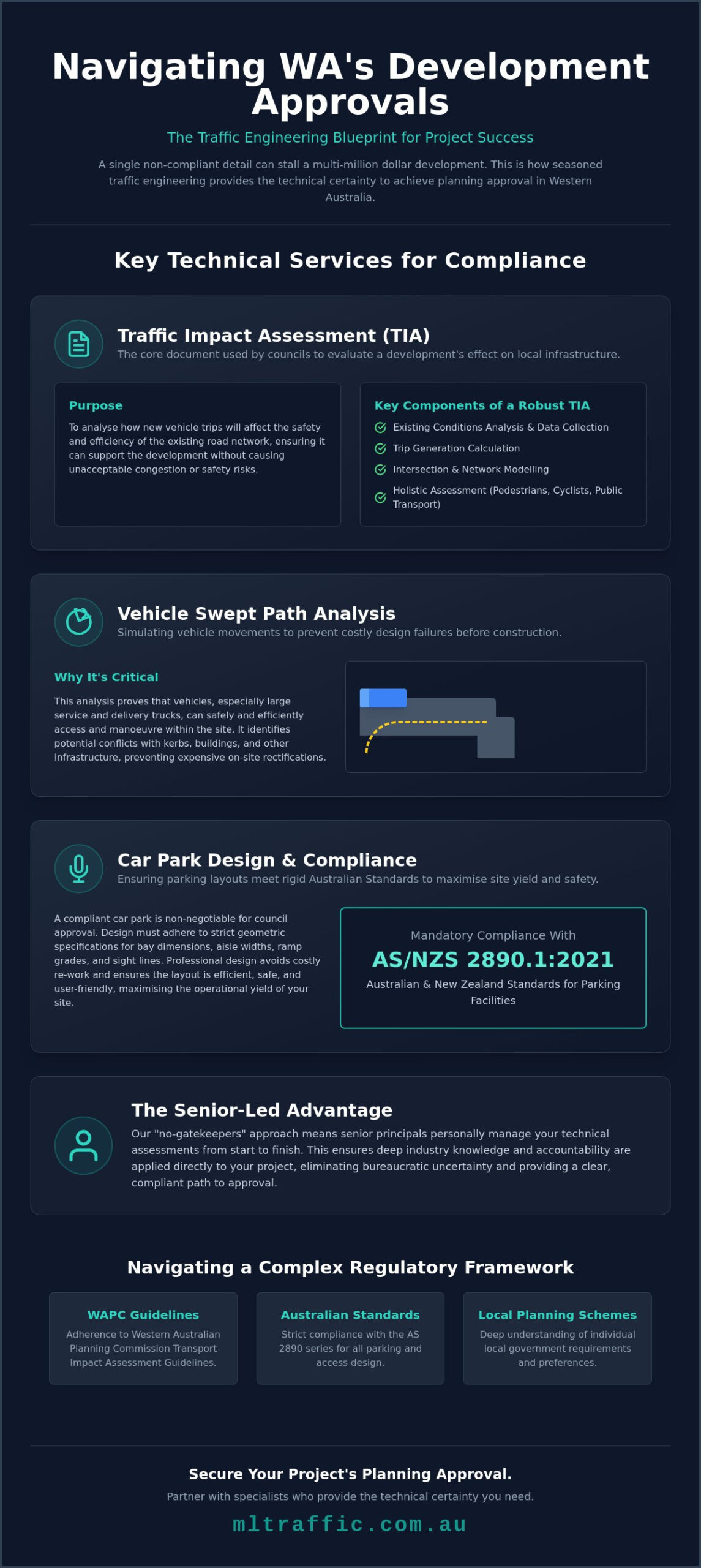
Securing a seasoned traffic engineer Perth ensures your development adheres to the latest AS/NZS 2890.1:2021 standards and local government planning schemes. We provide the technical certainty required to navigate complex regulatory frameworks while maximising your site’s operational yield and parking efficiency. This article outlines how professional Traffic Impact Assessments, vehicle swept path analysis, and senior-led design solutions eliminate bureaucratic uncertainty and provide a clear, compliant path to successful planning approval for your Western Australian project.
Key Takeaways
- Understand how a qualified traffic engineer Perth bridges the gap between development goals and local council requirements to secure planning approvals.
- Learn the technical components of a Traffic Impact Assessment (TIA) and how it validates your project’s effect on the existing road network.
- Discover how vehicle swept path analysis prevents design failures by simulating heavy vehicle movements before construction begins.
- Ensure your car park design meets rigid AS 2890.1:2021 standards to avoid costly rectifications and maximise site yield.
- Realise the benefits of a “no-gatekeepers” approach where senior principals personally manage your technical assessments from start to finish.
The Essential Role of a Traffic Engineer in Modern Developments
A qualified traffic engineer Perth is a specialised consultant responsible for managing the safe and efficient movement of people and vehicles within the built environment. Their primary role in any development project is ensuring the proposal meets the rigorous technical requirements of local planning authorities and state regulators. From the initial site feasibility stage through to the final certification of parking and access, these experts provide the technical data necessary to justify a project’s impact on the surrounding infrastructure.
Traffic engineering involves the application of scientific principles and data analysis to resolve complex transport challenges. In the context of a Development Application (DA), a traffic engineer serves as a pivotal link between design and regulatory approval. Without this specialised input, developers risk submitting plans that fail to comply with safety standards, leading to immediate rejection or costly redesigns.
To better understand the distinction between different engineering disciplines in this field, watch this helpful video:
When is a Traffic Consultant Required?
Most medium-to-large scale developments in Western Australia require a formal traffic report. Common triggers include changes in land-use, significant increases in floor area, or projects located near high-traffic intersections. Engaging a consultant during the concept design phase is critical. Early involvement identifies potential issues with driveway locations, intersection capacity, and road safety before they become structural problems. This proactive approach prevents the need for expensive revisions after plans have been finalised and submitted to council.
Navigating National and State Regulations
Traffic engineering in Perth requires a deep understanding of a complex hierarchy of controls. Consultants must balance national Australian Standards, such as the AS 2890 series for parking, with state-specific guidelines issued by the Western Australian Planning Commission (WAPC). The WAPC Transport Impact Assessment Guidelines, last confirmed as current in late 2022, dictate how new developments must assess their network footprint. A professional consultant ensures your project aligns with these broader transport planning objectives, providing the technical evidence needed to satisfy senior engineers at both the local council and Main Roads WA. This high level of specialised transport planning knowledge is what ultimately secures project approval.
Preparing a Compliant Traffic Impact Assessment (TIA)
A Traffic Impact Assessment (TIA) is the primary technical document council planners use to evaluate whether local infrastructure can support a new development. It isn’t merely a count of cars; it’s a comprehensive analysis of how additional vehicle trips will affect the safety and efficiency of the existing road network. For any medium-to-large scale project, engaging a traffic engineer Perth is a critical step in demonstrating that the development won’t lead to unacceptable congestion or safety risks.
The assessment must go beyond vehicle movements. It’s required to address public transport access, pedestrian safety, and cycling infrastructure to ensure a holistic transport solution. Industry professionals rely on the Guide to Traffic Management Part 12 to maintain consistency with national best practices. This ensures every report meets the high standards expected by Western Australian planning authorities and aligns with the WAPC guidelines confirmed in late 2022.
Key Components of a Robust TIA Report
A high-quality TIA relies on precise data and sophisticated modelling. The process begins with an existing conditions analysis, which involves surveying current traffic volumes and road geometry within the study area. This provides the baseline for all subsequent calculations.
- Trip Generation: We calculate the number of new trips the development will create based on its specific land-use and size.
- Intersection Modelling: Using specialised software, we predict future delays and levels of service at key access points.
- Multimodal Review: We assess how pedestrians and cyclists will interact with the site to ensure safe, compliant access for all users.
The TIA Approval Process: Step-by-Step
The path to approval is structured and requires clear communication with regulatory bodies. Following these steps ensures a smoother submission and reduces the likelihood of costly delays:
- Scoping: We define the requirements and study area with the local council or the relevant transport authority.
- Data Collection: This involves on-site traffic counts, site observations, and reviewing historical road safety data.
- Technical Analysis: As an experienced traffic engineer Perth, we draft the Traffic Impact Statement or Report based on the collected data and modelling results.
- Submission and RFI Management: After submission, we manage the response to any council queries or requests for further information (RFI).
Clear documentation is the key to avoiding delays. If you’re preparing a development application, you can view our full range of traffic engineering reports to see how we assist with compliance and technical accuracy.
Optimising Site Design with Swept Path Analysis
Vehicle swept path analysis is a technical requirement that uses specialised software, such as AutoTURN, to simulate vehicle movements on a site plan. This process ensures the largest anticipated vehicle can safely enter, circulate, and exit the development without colliding with structural elements or other vehicles. For a traffic engineer Perth, this simulation is a non-negotiable component of any submission involving loading docks, waste collection areas, or basement car parks. It provides the technical proof that a site’s physical layout supports its intended operational use.
Accurate swept paths prevent operational failures and potential damage to site infrastructure. If a waste truck cannot navigate a tight corner or a delivery vehicle cannot reach its bay without multiple manoeuvres, the site’s functionality is compromised. While the Guide to Traffic Impact Assessment establishes the broader framework for transport reviews, the technical precision of a swept path simulation provides the final evidence of feasibility to council planners. AutoTURN software allows us to overlay vehicle paths onto architectural drawings, revealing exactly where curbs, walls, or columns might obstruct movement. We don’t just look at the vehicle’s footprint; we assess the swept path of the body and the clearance path of mirrors and overhangs.
Vehicle Access and Manoeuvrability Standards
Designing for the “Design Vehicle” is the foundation of site access. This involves identifying the specific vehicle type, from standard cars to heavy rigid vehicles (HRV) or B-Doubles, that’ll frequent the site. We ensure compliance with driveway widths and turning radii at property boundaries as dictated by Australian Standards. Managing the interface between service vehicles and private cars in shared zones is also critical to maintaining safety. We verify that driveway gradients are synchronised with these swept paths to prevent vehicles from scraping or bottoming out on ramps.
Common Swept Path Challenges for Developers
Developers often struggle to fit heavy vehicle access into tight urban sites while trying to maximise parking yield. Every square metre used for a turning circle is a square metre lost for a parking bay or commercial space. An expert traffic engineer Perth works to balance these competing needs through meticulous design adjustments. We also address common council concerns regarding “reverse-in” or “reverse-out” movements, which are often restricted due to safety risks. For a deeper technical exploration of these requirements, refer to our Swept Path Analysis: A Complete Guide for Australian Developments. Providing these simulations early in the design phase prevents expensive post-construction rectifications and ensures a smoother approval process.
Car Park Design and AS 2890 Compliance
Every car park in Australia must be designed in accordance with the AS 2890 series of standards. AS/NZS 2890.1:2021 governs off-street car parking dimensions, while AS 2890.2 focuses on commercial vehicle facilities. Failure to meet these rigid specifications often leads to immediate council refusal or expensive post-construction modifications. A qualified traffic engineer Perth provides the technical certification necessary to prove the design is safe and functional for all users. This certification is a critical component of the development application process across Western Australia.
Critical Dimensions and Gradient Checks
Managing driveway ramp grades is a technical priority. Incorrect gradients cause vehicles to “ground” or scrape, leading to structural damage and liability issues. We perform meticulous assessments to ensure smooth transitions between the street and the site. We also verify that bay widths and aisle dimensions precisely match the intended user class, distinguishing between high-turnover retail centres and long-stay residential zones. Every design must also incorporate accessible parking spaces that strictly adhere to AS 2890.6 requirements for clearance and proximity to entrance points.
Parking Demand vs. Council Requirements
Local planning schemes often mandate a fixed number of bays that may not reflect actual site needs. We conduct specialised Car Parking Demand Assessments to justify a reduction in the required number of bays. By using empirical data and local surveys, we can prove that a development requires less parking than the standard code suggests. This process maximises site yield and significantly reduces construction costs. Modern developments must also integrate bicycle parking and end-of-trip facilities to meet contemporary transport objectives. These facilities are now a standard expectation for most metropolitan planning authorities.
If your project requires a compliant layout, contact us for a professional Car Park Design review to ensure your submission meets all regulatory standards.
Why Choose ML Traffic Engineers Australia for Your Project?
ML Traffic Engineers Australia brings over 15 years of specialised transport planning experience to every project engagement. We distinguish ourselves through a “no-gatekeepers” approach. This means you have direct access to senior principals who personally manage the technical requirements of your project. In many larger consultancies, senior staff secure the contract while junior engineers perform the actual analysis. We reject this model. Our personnel continuity promise ensures the expert who initiates your project remains your primary point of contact until the work is completed and approved.
This level of accountability is vital when dealing with complex regulatory submissions. Whether you’re working on a small-scale residential development or a major industrial facility, having a seasoned traffic engineer Perth handle your technical reports provides certainty. We operate nationally, allowing us to apply broad industry insights while remaining acutely aware of local council expectations and Western Australian planning standards. Our focus is on delivering meticulous, results-oriented documentation that withstands the scrutiny of planning authorities and senior council engineers.
Our Comprehensive Suite of Services
We provide a full range of technical assessments designed to support successful development applications. Our expertise spans diverse land-use categories, including residential, commercial, industrial, and childcare. Our core offerings include:
- Traffic Impact Assessment (TIA) Reports: Detailed evaluations of site-generated traffic and network capacity.
- Vehicle Swept Path Analysis: Technical simulations for heavy vehicles and service access using AutoTURN.
- Car Parking Demand Assessment: Technical justification for parking reductions based on empirical data.
- Car Park Design: Compliant layouts that maximise site yield and meet AS 2890 standards.
- Waste Management Plans: Coordinated strategies for refuse collection and vehicle circulation.
You can explore our full range of traffic engineering services to see how we tailor our technical expertise to your specific project requirements.
Get Started with Your Traffic Assessment
The first step toward a successful planning approval is a clear understanding of your site’s constraints. We provide a preliminary review of your site plans to identify potential traffic or parking issues early in the design phase. This proactive approach is followed by a clear, no-nonsense fee proposal that outlines the scope of work without hidden costs. Our engineers focus on practical, cost-effective solutions that streamline the DA approval process and satisfy council requirements. We don’t just provide data; we provide the professional advocacy needed to move your project forward.
If you’re ready to secure a dependable traffic engineer Perth for your next development, contact ML Traffic Engineers Australia today to discuss your specific needs. Our senior leadership is ready to provide the technical precision and regulatory compliance your project demands.
Securing Technical Certainty for Your Development
Successful planning approvals in Western Australia rely on the integration of senior-led technical reports and rigid adherence to national standards. As detailed throughout this guide, the combination of a robust Traffic Impact Assessment and precise vehicle swept path simulations removes the guesswork for council planners. Ensuring your car park layout complies with AS 2890.1:2021 provides the final layer of operational certainty needed to avoid costly post-submission redesigns. By engaging a qualified traffic engineer Perth, you secure a compliant design that bridges the gap between ambitious development goals and strict regulatory requirements.
ML Traffic Engineers Australia provides over 15 years of specialised transport planning experience, ensuring every project benefits from direct senior principal involvement. Our national reach, combined with deep local regulatory knowledge, guarantees that your technical documentation satisfies both state-level WAPC guidelines and specific local council schemes. We focus on delivering practical, cost-effective engineering solutions that maintain personnel continuity from initial feasibility through to final approval. We look forward to providing the technical precision required for your next Western Australian development.
Request a Traffic Engineering Quote from Our Senior Principals
Frequently Asked Questions
How much does a traffic engineer cost for a DA in Perth?
Fees for a traffic engineer Perth depend on the specific technical requirements and the scale of the development. A simple Traffic Impact Statement for a small change of use involves less analysis than a full TIA for a major commercial centre. We recommend requesting a site-specific fee proposal to ensure the scope of work matches the council’s requests. This avoids paying for unnecessary modelling while ensuring all regulatory triggers are addressed.
When do I need a Swept Path Analysis for my development?
You require a Vehicle Swept Path Analysis whenever a development involves heavy vehicle access, waste collection, or basement car parking. This simulation is mandatory for loading docks and delivery bays to prove that vehicles can enter and exit in a forward gear. We use AutoTURN software to overlay these movements on your site plan. This identifies any structural obstructions or narrow aisles before you submit your development application.
What is the difference between a Traffic Impact Statement and a TIA?
A Traffic Impact Statement is a concise report for developments with minimal network impact, while a Traffic Impact Assessment (TIA) is a comprehensive technical document. The WAPC Transport Impact Assessment Guidelines define the triggers for each. A TIA requires extensive intersection modelling and network analysis. Choosing the correct report level prevents council delays caused by insufficient data or over-engineering a simple proposal for the planning authority.
Does my small residential development need a traffic report?
Small residential developments often require a traffic report if they are located on a primary distributor road or involve a significant change in access. Local councils may request a basic assessment to verify sight distances or driveway gradients. Even if a full TIA isn’t triggered, a professional review ensures your parking layout meets Australian Standards. This reduces the risk of a Request for Further Information (RFI) during the assessment period.
Can a traffic engineer help reduce the required number of parking spaces?
Yes, a traffic engineer Perth can justify a reduction in parking spaces through a formal Car Parking Demand Assessment. We use empirical data from similar land uses and local surveys to prove that the actual demand is lower than the statutory requirements in the local planning scheme. This technical justification allows developers to maximise site yield and reduce the high costs associated with constructing unnecessary basement or surface parking.
How long does it take to prepare a standard traffic assessment report?
Preparing a standard traffic assessment report typically takes between two and four weeks. This timeframe accounts for necessary data collection, such as intersection traffic counts, and the subsequent technical modelling. More complex projects involving extensive network analysis or stakeholder liaison with Main Roads WA may require additional time. Providing all architectural site plans early in the process helps our senior engineers maintain these project timelines.
What is AS 2890 and why is it important for my project?
AS 2890 is the series of Australian Standards governing the design and layout of off-street parking facilities. AS 2890.1:2021 is the primary standard for car parks; AS 2890.2 covers commercial vehicle facilities. Adherence is critical because non-compliant designs lead to operational failures and council refusal. These standards define the minimum dimensions for parking bays, aisles, and driveway gradients to ensure safe vehicle movement throughout the site.
Do traffic engineers handle construction traffic management plans?
Traffic engineers prepare Traffic Guidance Schemes (TGS) to manage vehicle and pedestrian movements during the construction phase of a project. These plans are often a condition of development approval, especially for sites impacting the road reserve. While we don’t provide physical traffic control personnel, we design the technical layouts that ensure site access remains safe and compliant with the Main Roads WA Code of Practice and Austroads guides.

Disclaimer
The content on www.mltraffic.com.au, including all technical articles, guides, and resources, is provided for general informational and educational purposes only. It is not intended to constitute professional advice in traffic engineering, transportation planning, development approvals, or any other technical or legal field. While ML Traffic Engineers makes every reasonable effort to ensure the accuracy, completeness, and timeliness of the information published, we do not provide any warranties or representations (express or implied) regarding its reliability, suitability, or availability for any particular purpose. Any reliance you place on the content is strictly at your own risk. In no event shall ML Traffic Engineers, its directors, employees, authors, or affiliates be liable for any direct, indirect, incidental, special, consequential, or punitive damages (including, without limitation, loss of profits, data, or business opportunities) arising out of or in connection with the use of, or inability to use, any information provided on this website. The articles and guides on this site are not a substitute for engaging a qualified, registered professional traffic engineer (such as an NPER or RPEQ engineer) to assess your specific project requirements. For tailored advice, compliance assessments, or traffic engineering services, please contact a competent professional. This disclaimer may be updated from time to time without notice. By accessing or using this website, you agree to be bound by the most current version of this disclaimer.
