

Did you know a single Request for Information (RFI) from the Sunshine Coast Council regarding your traffic design can stall your development for over 30 days? These delays often result from non-compliant parking layouts or complex vehicle manoeuvring requirements that fail to meet current benchmarks. It’s a common frustration for developers who find their projects stuck in bureaucratic limbo, facing mounting holding costs due to technical oversights.
Securing a compliant Traffic Impact Assessment (TIA) shouldn’t be a gamble. By engaging an expert traffic engineer Sunshine Coast developers rely on, you ensure your submission meets the rigorous AS/NZS 2890.1:2021 standards and secures approval efficiently. Our senior engineers provide direct accountability, removing the gatekeepers to deliver technical precision from the outset. You’ll gain a clear understanding of how professional car park design and vehicle swept path analysis maximise space while satisfying the 2026-2027 council fee schedules. This article explores how senior-level expertise turns complex regulatory requirements into a streamlined path for your development approval.
Key Takeaways
- Learn why early technical involvement acts as a bridge between your design and council requirements to prevent expensive site plan revisions.
- Understand the critical role of a Traffic Impact Assessment (TIA) and how a qualified traffic engineer Sunshine Coast secures development approval.
- Gain insights into mandatory compliance with AS 2890.1 and AS 2890.2 to ensure your car park design meets Australian Standards for ramp grades and aisle widths.
- Discover the importance of the personnel continuity promise, ensuring the senior expert who starts your project remains the primary technical lead until completion.
- Explore the technical requirements for diverse land-use categories, including residential, commercial, and educational developments across Australia.
The Critical Role of a Traffic Engineer in Development Approvals
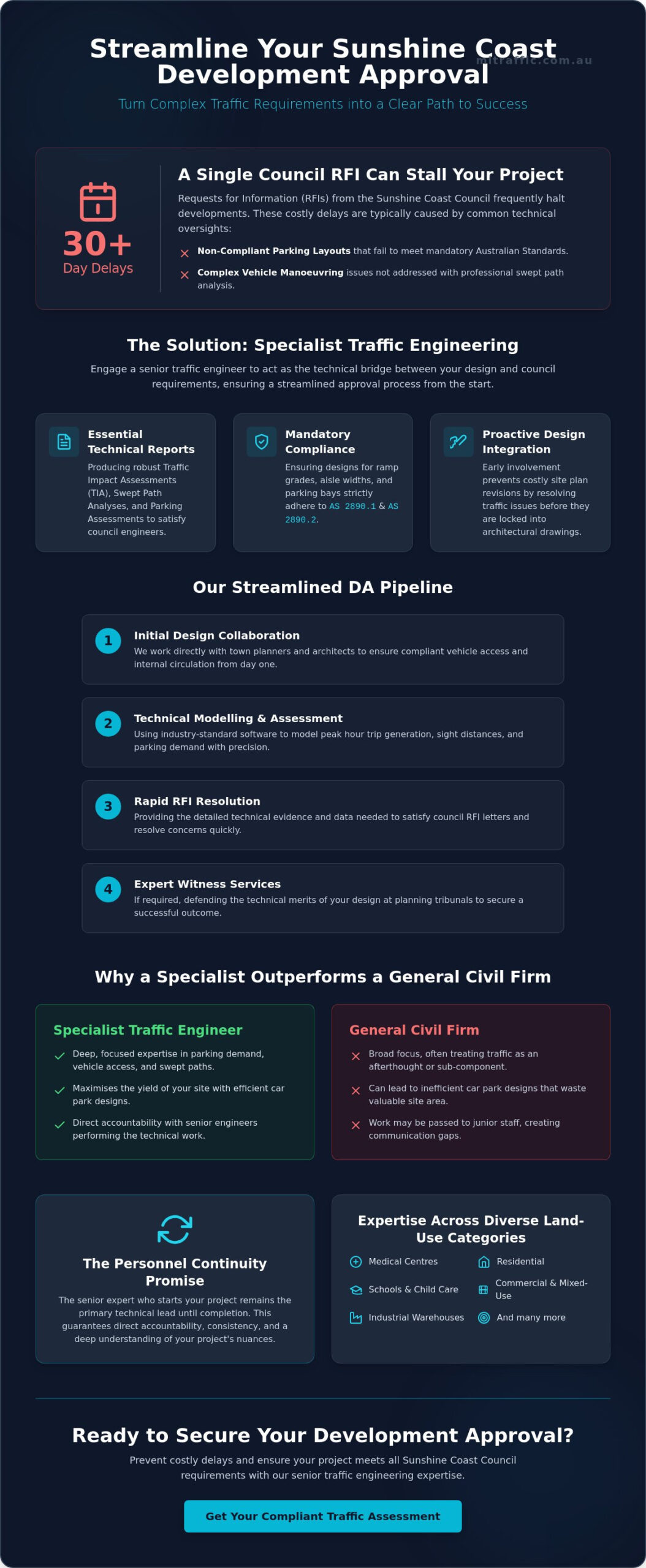
A traffic engineer Sunshine Coast developers trust acts as the technical bridge between a private project and the local council’s regulatory requirements. Securing planning approval requires more than just a basic site plan; it necessitates a rigorous demonstration of how a development integrates with the existing road network. With over 15 years of experience in securing planning approvals across Australia, our consultancy ensures that every technical assessment meets the specific benchmarks of the Sunshine Coast Council. Our portfolio spans diverse land-use categories, including medical centres, schools, and large-scale mixed-use developments. Each project type carries unique parking demand and access requirements that must be meticulously addressed to avoid delays.
Early involvement in the design phase is essential. It prevents costly site plan revisions by identifying potential access or parking issues before they are baked into the architectural drawings. Traffic engineering principles dictate the safe and efficient movement of people and goods; applying these early saves both time and capital. Whether you’re developing child care centres or industrial warehouses, professional engineering input is a mandatory requirement for a successful outcome. This proactive approach ensures that the traffic engineer Sunshine Coast clients engage is the same expert who performs the technical work, maintaining consistency throughout the project lifecycle.
To better understand the professional scope of this role, watch this helpful video:
Navigating the Development Application (DA) Pipeline
Our engineers work closely with town planners and architects during the initial design stages. This collaborative approach ensures that vehicle access and internal circulation layouts comply with Australian Standards from day one. When councils issue a Request for Further Information (RFI), we provide the technical evidence needed to resolve concerns quickly. Council RFI letters often demand granular data regarding peak hour trip generation or sight distance at new intersections. We use industry-standard software to model these scenarios, providing the precision required to satisfy council engineers. If a project reaches a planning tribunal, we offer expert witness services to defend the technical merits of the design.
Why Specialist Expertise Outperforms General Civil Engineering
Many developers mistakenly assume a general civil engineering firm can handle traffic requirements. While civil firms have a broad focus, a specialist traffic consultant provides deep technical expertise in parking demand and vehicle access. We focus exclusively on the complexities of how vehicles move and park. General civil firms often treat traffic as an afterthought or a sub-component of broader infrastructure works. This approach can lead to inefficient car park designs that waste valuable site area. By focusing on parking demand and vehicle swept paths, we maximise the yield of your site while maintaining full compliance with safety standards. For more information on our specific capabilities, you can view our full range of services.
Essential Technical Reports: TIA, Swept Path, and Parking Assessments
Securing development approval on the Sunshine Coast requires a suite of technical reports that satisfy both local planning schemes and state-controlled road requirements. A traffic engineer Sunshine Coast consultancy provides the necessary documentation to prove a project’s technical viability. Engaging an expert traffic engineer Sunshine Coast ensures your reports are prepared to a senior standard, minimising the risk of council rejection. While larger projects require a full Traffic Impact Assessment (TIA), smaller-scale developments might only need a Traffic Impact Statement. This shorter report still addresses key access and safety concerns but is tailored for lower-intensity land uses. For more complex projects, a Car Parking Demand Assessment is often the most valuable tool for a developer. It allows us to use empirical data to justify a reduction in council-mandated parking rates, saving significant construction costs and land area.
The Anatomy of a Traffic Impact Assessment (TIA)
A Traffic Impact Assessment (TIA) is a formal report analysing a development’s effect on the surrounding road network. This document is the primary tool used by council officers to evaluate your application. It must adhere to the Guide to Traffic Impact Assessment published by the Queensland Government. Core components of a compliant TIA include:
- Trip generation: Calculating the number of vehicle movements the site will produce during peak periods.
- Traffic distribution: Mapping where those vehicles will travel on the local road network.
- Intersection analysis: Assessing the capacity and safety of nearby junctions using SIDRA modelling software.
For a deeper look into these specific requirements, read our Traffic Impact Assessment: The Definitive Guide for Australian Developers.
Precision with Vehicle Swept Path Analysis
Vehicle Swept Path Analysis ensures functional site access for trucks, emergency vehicles, and passenger cars. We use AutoTURN software to simulate the exact movements of various vehicle types through your proposed layout. This precision is critical for designing loading docks, waste collection areas, and basement car parks where clearances are tight. If a waste truck cannot navigate a turn without hitting a kerb or obstructing an aisle, the council will reject the operational works application. Ensuring these paths are correct during the design phase avoids costly modifications later. You can learn more in our Swept Path Analysis: A Complete Guide for Australian Developments. If you need assistance with these technical requirements, you can contact our senior engineering team for a direct consultation.
Ensuring Compliance with Australian Standards AS 2890.1 and AS 2890.2
Adherence to national standards is the non-negotiable foundation of every successful development application. For a traffic engineer Sunshine Coast projects require, this means a meticulous application of the AS 2890 series. These documents act as the technical bible for all parking and access designs. AS 2890.1:2021 covers off-street car parking, while AS 2890.2:2018 dictates the requirements for off-street commercial vehicle facilities. Failing to meet these benchmarks often results in an immediate Request for Information or an outright rejection from the council. Precision is vital. A single percentage point error in a driveway ramp grade assessment can make a site inaccessible for certain vehicles. We certify that every design element, from the initial kerb crossing to the final parking bay, aligns with the Queensland Guide to Traffic Management and relevant Australian Standards. This certification provides the assurance councils need to move your application forward without technical delays.
When you engage a traffic engineer Sunshine Coast specialist, you gain the technical certainty that your driveway ramp grade assessment will withstand council scrutiny. Our role involves more than just checking boxes; we provide a rigorous technical review of your site’s geometry. This includes evaluating sight distance requirements to ensure safe entry and exit points for all road users. By certifying your project against these national standards, we eliminate the guesswork that often leads to costly redesigns during the operational works phase.
Optimising Car Park Design for Maximum Efficiency
Developers often face a conflict between maximising the number of parking bays and maintaining compliant manoeuvring space. Our role is to find the most efficient balance. We ensure that aisle widths and bay dimensions meet the updated 2021 requirements to accommodate larger modern vehicles. This includes strict adherence to AS 2890.6 for accessible parking facilities, which requires specific shared zones and vertical clearances. For a detailed breakdown of these metrics, see our guide on AS 2890.1 Explained: The Ultimate Guide to Compliant Car Park Design.
Commercial and Industrial Access Compliance
Industrial developments present unique challenges due to the size of Heavy Rigid Vehicles (HRV) and Articulated Vehicles (AV). Loading dock layouts must allow these vehicles to enter and exit the site in a forward direction, as required by most council planning schemes. We conduct thorough sight distance assessments to ensure that drivers exiting the property have a clear line of sight to oncoming traffic and pedestrians. This safety component is a critical part of AS 2890 compliance. Our technical assessments provide the empirical evidence that your industrial site can safely handle its intended commercial traffic volume.
How to Evaluate a Traffic Engineering Consultancy for Your Project
Selecting a consultancy is a critical decision that directly impacts your development’s timeline and budget. A traffic engineer Sunshine Coast developers hire must provide senior-level accountability throughout every project phase. Many larger firms use senior principals as the face of the business to win contracts, yet they often delegate the actual technical work to junior staff. This practice introduces significant risk to your application. Junior staff may lack the depth of experience required to navigate the specific nuances of Sunshine Coast Council planning schemes or the foresight to identify potential access issues before they become formal Requests for Information (RFI). Technical errors made at the design stage often result in expensive modifications during the construction phase.
ML Traffic Engineers Australia operates on a personnel continuity promise. This ensures the expert who initiates your project is the one who performs the technical work and signs off on the final report. This hands-on approach prevents the loss of critical information that occurs when a project is passed between various departments. When you engage a traffic engineer Sunshine Coast specialist from our team, you’re securing a commitment to technical integrity and senior oversight from start to finish. We don’t hide behind administrative staff; we provide direct access to the engineers responsible for your project’s success. This model ensures that every technical assessment, from swept path analysis to parking demand, is performed by a seasoned professional.
The Value of Direct Principal Access
Direct communication with a senior engineer significantly speeds up the RFI response process. When a council officer issues a technical query regarding driveway ramp grades or intersection capacity, you need an immediate, authoritative answer. Direct access to senior principals ensures that technical assessments are grounded in decades of practical experience and council negotiation. This direct line of communication removes the administrative gatekeepers found in impersonal firms, allowing for a more agile and responsive service. You can read more about our professional tenure and qualifications on our About ML Traffic Engineers Australia page.
Accountability and Technical Integrity
A “no-gatekeepers” approach to communication fosters a culture of accountability and precision. It ensures that the person responsible for the technical findings is directly answerable to the client. This results-oriented philosophy leads to meticulous reporting that stands up to council scrutiny. We avoid unnecessary bureaucracy, focusing instead on delivering compliant TIAs and efficient car park designs. This level of transparency is essential for maintaining the technical integrity of your application. If your project requires an expert who is personally accountable for the technical outcomes, contact ML Traffic Engineers Australia to discuss your development application today.
Comprehensive Traffic Engineering Services for National Land-Use Categories
Our consultancy provides comprehensive engineering solutions across a vast range of project environments. This exhaustive list includes residential flat buildings, multi-dwelling housing, seniors living, boarding houses, mixed-use developments, retail shopping centres, and commercial offices. While we serve as a premier traffic engineer Sunshine Coast consultancy, our capability extends across all Australian jurisdictions. We deliver technical reports that satisfy both national standards and the specific planning schemes of diverse local government authorities. This versatility ensures that regardless of the site location, our assessments remain technically robust and compliant. We adapt our reporting to meet the granular requirements of local councils while maintaining the rigorous standards expected at a national level.
Our project portfolio demonstrates an ability to handle high-complexity environments. We specialise in delivering results-oriented reports for industrial warehouses, medical centres, child care centres, schools, service stations, fast-food outlets, and hotel developments. By engaging a traffic engineer Sunshine Coast specialist with national experience, you ensure your project benefits from a broad perspective on traffic flow and parking demand. ML Traffic Engineers Australia is the logical choice for any Australian developer seeking a dependable, meticulous partner to navigate the bureaucratic requirements of development applications.
Specialist Sectors: From Child Care to Industrial Hubs
Different land-use categories present unique technical hurdles that require specialised engineering input. We address these through detailed analysis and practical design solutions:
- Child care centres: We focus on the pick-up and drop-off flow to ensure safe vehicle movements and pedestrian safety during peak periods.
- Retail and shopping centres: These sites require high-volume traffic management and efficient internal circulation to prevent queuing on public roads.
- Service stations and fast-food outlets: We solve specific parking and access challenges, particularly regarding heavy vehicle turning paths and fuel delivery requirements.
- Industrial hubs: Our assessments focus on the manoeuvring requirements of large articulated vehicles and the efficiency of loading dock layouts.
National Reach with Local Compliance
Our national capability extends beyond impact assessments. We provide essential documentation including Traffic Guidance Schemes (TGS) and Waste Management Plans for projects across Australia. This comprehensive service offering ensures that all technical aspects of your site’s operation are covered by a single, accountable expert. We remain committed to providing professional, authoritative, and dependable consultancy that prioritises your project’s approval. Our personnel continuity promise means you’ll always have a direct line to the senior engineer performing your work, ensuring accountability from the initial fee proposal to the final council submission. For a full list of our capabilities and technical assessments, view our ML Traffic Engineers Australia Services page.
Secure Your Development Approval with Technical Precision
Successful development applications on the Sunshine Coast rely on technical precision and an intimate knowledge of local and national standards. We’ve explored how senior-level engineering oversight and rigorous documentation like TIAs and Swept Path Analyses prevent the costly RFI delays that often stall projects for weeks. By engaging a specialist traffic engineer Sunshine Coast developers ensure their site layouts are not only compliant with the AS 2890 series but also optimised for maximum operational efficiency. This proactive approach identifies potential access issues before they become permanent architectural constraints.
ML Traffic Engineers Australia provides the accountability of direct principal access and the assurance of our personnel continuity promise. This means the senior expert who initiates your project remains your primary technical lead until council approval is secured. With over 15 years of experience across all Australian land-use categories, we provide the dependable consultancy required to navigate complex planning schemes. Contact ML Traffic Engineers Australia for a professional traffic assessment quote to streamline your development approval process today. We look forward to ensuring your project meets every technical benchmark with confidence.
Frequently Asked Questions
What is the difference between a Traffic Impact Assessment and a Traffic Impact Statement?
A Traffic Impact Assessment (TIA) is a detailed technical report for large-scale developments, whereas a Traffic Impact Statement is a concise version for smaller projects. TIAs require extensive intersection modelling and trip generation analysis to satisfy council engineers. Statements focus on basic access, safety, and parking for lower-intensity land uses where the impact on the surrounding road network is minimal. Both documents must adhere to state and local government guidelines.
When does a council require a Vehicle Swept Path Analysis?
Councils require a Vehicle Swept Path Analysis to prove that specific vehicles, such as waste collection trucks or emergency services, can safely navigate a site. This is a mandatory requirement for loading docks, basement ramps, and tight turning circles within industrial or commercial developments. We use AutoTURN software to simulate these movements, ensuring every turn complies with the dimensions set in AS 2890.2 and local operational requirements.
How much parking do I need for my commercial development?
Parking requirements are determined by the specific land-use category and the local council’s planning scheme. Each council sets different rates based on gross floor area, staff numbers, or the number of units. A Car Parking Demand Assessment can provide empirical evidence to justify a deviation from these standard rates if the project’s actual demand is lower. This assessment helps developers maximise site yield while maintaining functional parking levels.
Does my project need to comply with AS 2890.1 even for small renovations?
Yes, compliance with AS 2890.1 is mandatory for any development that alters off-street parking or vehicle access. Even minor renovations must ensure that bay dimensions, aisle widths, and ramp grades meet current Australian Standards. Failure to comply can lead to council rejection of the development application or costly redesigns during the operational works phase. Our senior engineers certify that your layout meets these critical national benchmarks.
What is the typical turnaround time for a professional traffic report?
Turnaround times vary based on project complexity and the current volume of technical assessments required for your application. Simple reports may be completed within one to two weeks, while complex TIAs involving intersection modelling take longer. Engaging a traffic engineer Sunshine Coast consultancy early in the design phase ensures that technical reports are delivered in alignment with your project’s submission deadlines and council expectations.
Can a traffic engineer help me reduce the number of required parking spots?
A traffic engineer can justify parking reductions through a formal Car Parking Demand Assessment. We use empirical data from similar developments and parking surveys to prove that the proposed parking supply is sufficient for the specific site. This evidence-based approach allows councils to approve fewer spaces than the default planning scheme rates require, which can significantly reduce construction costs and land requirements for developers.
What information do I need to provide for a traffic assessment quote?
To provide an accurate quote, we require a current site plan, the proposed land use, and any council feedback or RFI letters already received. Details regarding the number of residential units, the gross floor area for commercial spaces, or the scale of industrial operations are also essential. This information allows us to determine the necessary scope of work and the specific technical reports required for your development approval.
Does ML Traffic Engineers provide physical traffic control services?
No, our firm focuses exclusively on professional engineering consultancy and does not provide physical traffic control, road construction, or on-site event management. We specialise in the technical design and reporting phases of development applications, such as Traffic Impact Assessments and car park design. Our role is to provide the certification and engineering evidence required to secure council approval rather than managing physical road crews or equipment.

Disclaimer
The content on www.mltraffic.com.au, including all technical articles, guides, and resources, is provided for general informational and educational purposes only. It is not intended to constitute professional advice in traffic engineering, transportation planning, development approvals, or any other technical or legal field.While ML Traffic Engineers makes every reasonable effort to ensure the accuracy, completeness, and timeliness of the information published, we do not provide any warranties or representations (express or implied) regarding its reliability, suitability, or availability for any particular purpose. Any reliance you place on the content is strictly at your own risk.In no event shall ML Traffic Engineers, its directors, employees, authors, or affiliates be liable for any direct, indirect, incidental, special, consequential, or punitive damages (including, without limitation, loss of profits, data, or business opportunities) arising out of or in connection with the use of, or inability to use, any information provided on this website.The articles and guides on this site are not a substitute for engaging a qualified, registered professional traffic engineer (such as an NPER or RPEQ engineer) to assess your specific project requirements. For tailored advice, compliance assessments, or traffic engineering services, please contact a competent professional.This disclaimer may be updated from time to time without notice. By accessing or using this website, you agree to be bound by the most current version of this disclaimer.
