

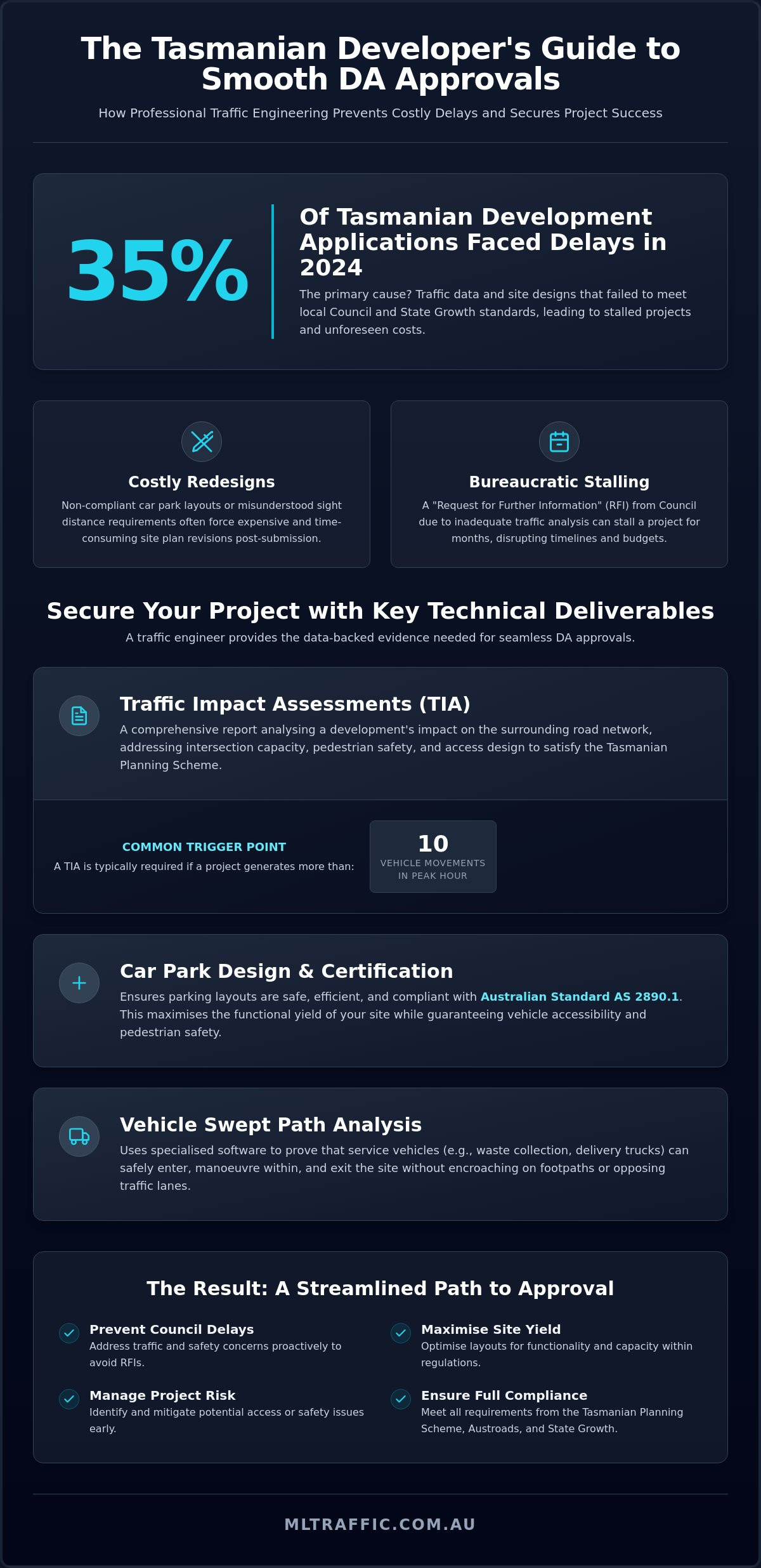
Did you know that in 2024, approximately 35% of Tasmanian development applications faced significant delays because their traffic data failed to align with both local Council and State Growth standards? When you engage a professional traffic engineer Tasmania, you’re not just buying a report; you’re securing a technical roadmap designed to navigate the specific complexities of the Tasmanian Planning Scheme. We understand that a non-compliant car park layout or a misunderstood sight distance requirement can result in costly redesigns and months of bureaucratic stalling.
You likely agree that the development process is complex enough without the added burden of technical reports that Councils reject on first submission. This article explains how to secure a TIA report that meets regulatory thresholds, such as the common 10-vehicle peak hour movement rule, and how direct communication with the senior engineer doing the work ensures your project remains on track. We’ll preview the essential components of compliant car park designs and the importance of adhering to the latest Austroads guidelines for seamless approvals.
Key Takeaways
- Learn how a Traffic Impact Assessment (TIA) identifies specific “trigger points” within the Tasmanian Planning Scheme to prevent avoidable Council delays.
- Discover how a qualified traffic engineer Tasmania applies AS2890.1 standards to car park designs and vehicle swept path analyses to maximise functional site yield.
- Understand the role of formal Road Safety Audits and intersection analysis in managing risk for developments involving significant public road infrastructure.
- Identify why direct access to senior principals ensures technical accountability and personnel continuity from the initial site assessment to final approval.
- Explore how professional traffic engineering integrates safe vehicle movement with efficient site layouts to satisfy both local government and State Growth requirements.
What Does a Traffic Engineer Do for Tasmanian Developments?
A traffic engineer Tasmania specialises in the safe and efficient movement of people and vehicles within a development and onto the public road network. This role involves more than just counting cars; it requires a deep understanding of What is Traffic Engineering? and how its core principles apply to civil infrastructure and urban planning. In Tasmania, our primary objective is ensuring new developments comply with the Tasmanian Planning Scheme and specific local government requirements. We act as the technical bridge between private developers and road authorities like the Department of State Growth.
To better understand this concept, watch this helpful video:
Our services range from initial site feasibility assessments to producing detailed traffic engineering reports for Development Applications (DA). By providing data-backed evidence, we help projects move through the approval process without the friction of technical requests for further information (RFI). We provide the technical assurance that a site’s access and parking layout are both safe and compliant.
The Intersection of Planning and Engineering
Engaging a traffic engineer Tasmania during the due diligence phase is critical for project success. Identifying access constraints or parking shortfalls early prevents expensive redesigns after the DA has been lodged. We mitigate potential Council objections by addressing traffic generation and road safety before they become roadblocks. For smaller projects, a concise Traffic Statement may suffice to address basic access issues. Larger developments typically require a full Traffic Impact Assessment (TIA) to analyse complex network interactions and seasonal variations in traffic volume.
Key Deliverables for Your Development Application
A successful DA depends on precise documentation that leaves no room for interpretation by Council planners. We provide several key deliverables designed for seamless approval:
- Traffic Impact Assessments (TIA): Comprehensive reports that satisfy the Road and Railway Assets Code and the Parking and Sustainable Transport Code within the Tasmanian Planning Scheme.
- Car park design certification: Verifying that layouts meet Australian Standard AS 2890.1 for safety and functional efficiency.
- Vehicle swept path analysis: Using specialised software to prove that waste collection vehicles and delivery trucks can safely access and exit the site without encroaching on footpaths or opposing lanes.
These technical assessments ensure that your site maximises its yield while remaining fully compliant with national and state regulatory standards. Our hands-on approach means the principal engineer who starts your project is the one who completes the technical work, ensuring accountability at every stage.
Traffic Impact Assessment (TIA) Requirements in Tasmania
A TIA is a formal report that analyses the likely traffic impact of a proposed development on the surrounding road network. In 2024, approximately 35% of Tasmanian development applications faced delays because traffic data did not align with both local Council and State Growth standards. Providing a compliant traffic impact assessment is the most effective way to avoid a “Request for Further Information” (RFI) that can stall a project for months. These reports must rigorously address intersection capacity, pedestrian safety, and adherence to Tasmanian road safety standards.
Under the Tasmanian Planning Scheme, specific “trigger points” necessitate a formal assessment. While requirements vary between municipalities, a common threshold for a full TIA is a project generating more than 10 vehicle movements during any peak hour. For developments on roads with high seasonal variation, such as those near tourist hubs where peak volumes can jump by 31% in January, the data must reflect these fluctuations to be considered valid by authorities.
The 5-Step Process of a Professional TIA
A qualified traffic engineer Tasmania follows a structured methodology to ensure report integrity. This process begins with data collection, where we gather existing traffic volumes and crash history to establish a baseline. We then calculate trip generation using industry-standard rates to determine the new traffic the development will create. The third step involves impact analysis to assess if the current road infrastructure can handle the increase without compromising safety. If deficiencies are found, we propose mitigation strategies, such as intersection upgrades or revised site access. Finally, we compile the documentation for Council submission.
Navigating State-Controlled vs. Local Roads
Developments often require a dual approval process. If your project sits on a major highway, the Department of State Growth maintains jurisdiction and applies different engineering standards than a local Council. We manage the complexities of the “Road and Railway Assets Code” and the “Parking and Sustainable Transport Code” to ensure the design satisfies both authorities. This technical coordination is vital for securing access permits on state-controlled routes. If you are unsure which standards apply to your site, you can request a preliminary assessment to clarify the necessary requirements.
Our approach focuses on technical precision. We ensure that every sight distance assessment and intersection analysis meets the strict criteria set by Tasmanian regulators. This meticulous attention to detail is why our reports are trusted by Councils across the state to facilitate safe, compliant development outcomes.
Optimising Site Design: Car Parks and Swept Paths
Designing a functional car park requires more than just allocating space for vehicles. It demands a rigorous application of Australian Standards to ensure safety and operational efficiency. For most commercial and multi-residential developments, strict adherence to AS2890.1 is mandatory. A professional traffic engineer Tasmania provides the technical certification needed to prove that a site layout is not only compliant but also maximises available land yield. This includes assessing the B85 and B99 design vehicles to ensure that the majority of the passenger car fleet can navigate the facility without incident.
Councils frequently reject applications that fail to demonstrate safe vehicle circulation. We use specialised AutoTURN software to simulate the movements of various vehicle types, creating what is known as a “Swept Path”. This visualises the envelope of a vehicle during a turn, ensuring it doesn’t strike curbs, buildings, or other parked cars. Proving that heavy rigid vehicles (HRV) or waste trucks can enter and exit the site in a forward direction is often a non-negotiable requirement for Tasmanian Councils. This level of technical rigour is essential for commercial loading docks and multi-unit residential basement car parks where clearances are often tight.
Compliance with AS 2890.1 and AS 2890.2
The technical requirements for car park design are exhaustive and leave little room for error. We focus on critical metrics including bay dimensions, aisle widths, and ramp grades to ensure user safety. For sites with non-standard constraints, we develop engineered solutions that remain compliant with national standards while addressing unique topography. A vital component of this assessment is the “Sight Distance” at the property boundary. We verify that exiting drivers have a clear line of sight to pedestrians and oncoming traffic, a factor that directly impacts the safety profile of the development and its likelihood of approval.
The Critical Role of Swept Path Analysis
A swept path is the path traced by the outer extremities of a vehicle’s body during a turning manoeuvre. In Tasmania, waste management plans require detailed swept path diagrams to prove that collection trucks can operate safely within the site without encroaching on opposing lanes. By using AutoTURN, we optimise driveway widths and turning circles. This precision prevents over-engineering, which can lead to lost land area, while ensuring the design accommodates the largest vehicle expected to visit the site. Our principal-led approach ensures these technical simulations are performed with meticulous accuracy, providing a solid foundation for your Development Application.
Road Safety Audits and Risk Management
A Road Safety Audit (RSA) is a formal, systematic procedure for assessing the accident potential and safety performance of a new or existing road project. Unlike a standard traffic impact assessment, which focuses on network capacity and trip generation, an RSA specifically targets design flaws that could lead to crashes. Councils across the state frequently require an RSA for new intersections or significant modifications to public road infrastructure. Engaging a qualified traffic engineer Tasmania for this process ensures that safety risks are identified and mitigated before they become permanent liabilities.
Conducting these assessments at various stages of the development lifecycle provides a comprehensive safety net for the project. Our senior principals personally oversee every audit to ensure technical accountability and personnel continuity. Audits are typically performed during the following phases:
- Feasibility stage: Assessing the initial concept and site access feasibility.
- Detailed design stage: Reviewing technical drawings and intersection geometry before construction begins.
- Pre-opening stage: Inspecting the physical site and signage placement before the road is opened to the public.
Identifying hazards like inadequate lighting or restricted sight lines early helps developers avoid the high costs of post-construction remediation. This proactive approach prioritises public safety while protecting the project from future legal challenges related to road design negligence and public liability.
When is a Road Safety Audit Required?
Tasmanian planning authorities often trigger the requirement for an RSA when a project introduces high-risk features. These include the creation of new public road connections, significant changes to existing traffic signals, or complex site access arrangements in high-pedestrian zones. An independent auditor provides an objective review, separate from the design team, which is a key requirement in the Tasmanian planning process. Engaging a professional traffic engineer Tasmania ensures that these high-risk features are reviewed against the latest national safety standards and the Austroads Guide to Road Safety.
Managing Pedestrian and Cyclist Safety
Active transport connectivity must be integrated into new residential subdivisions to satisfy the sustainable transport codes within the Tasmanian Planning Scheme. This involves more than just providing footpaths; it requires design features that actively reduce vehicle-pedestrian conflict. In busy commercial car parks, we focus on clear separation between heavy vehicles and vulnerable road users through designated walkways and high-visibility markings. All designs must meet the accessibility requirements of the Disability Discrimination Act (DDA), ensuring that ramps, gradients, and crossings are safe for users of all abilities. If your project involves significant changes to public road access, you can explore our full range of traffic engineering services to ensure your design meets these rigorous safety standards.
Why ML Traffic Engineers Australia is the Choice for Tasmanian Developers
ML Traffic Engineers Australia provides a specialised consultancy model designed to support the specific needs of the Tasmanian development sector. With over 15 years of experience and a portfolio of thousands of successful assessments, we offer the technical precision needed for complex site approvals. When you appoint a traffic engineer Tasmania, you require a partner who prioritises technical accuracy over generic reporting. Our focus remains on delivering fact-based assessments that satisfy regulatory bodies while protecting the commercial viability of your project.
Our comprehensive service suite includes every technical requirement for a successful Development Application:
- Traffic Impact Assessment (TIA) Reports: Rigorous analysis tailored to Tasmanian Planning Scheme codes.
- Vehicle Swept Path Analysis: Visual proof of accessibility for waste collection and delivery vehicles.
- Car Parking Demand Assessments: Data-backed justifications for parking variations.
- Driveway Ramp Grade Assessments: Ensuring compliance with AS2890.1 and site-specific topography.
- Intersection Analysis: Performance modelling to resolve network capacity concerns.
- Waste Management Plans: Functional strategies that integrate with site traffic circulation.
The Principal-Led Difference
Our “no gatekeepers” approach ensures that senior leadership is involved in every project phase. Direct access to senior principals means your project is never delegated to junior staff. This model provides faster turnaround times and ensures that the person performing the technical analysis is the same person you speak to. This direct accountability is vital when negotiating complex outcomes with Council engineers or addressing technical requests for further information. We prioritise personnel continuity, meaning the expert who starts your project is the one who sees it through to approval.
National Reach, Local Compliance
We provide professional traffic engineer services that bridge the gap between national engineering standards and local Tasmanian planning requirements. Our technical team utilises industry-leading software like AutoTURN and SIDRA to ensure every simulation meets the highest level of rigour. This data-driven approach allows us to defend development applications against potential community objections or Council refusals. We understand how to apply national standards effectively within the unique constraints of Tasmanian sites. Ready to start? Contact our senior team today for a fee proposal and direct access to our principal experts.
Secure Your Development Approval with Expert Traffic Engineering
Navigating the complexities of the Tasmanian Planning Scheme requires more than just standard documentation; it demands a technical roadmap that anticipates Council requirements before they become obstacles. Engaging a professional traffic engineer Tasmania provides the assurance that every aspect of your site layout, from intersection capacity to pedestrian safety, has been rigorously assessed against state-specific codes. This level of technical precision is the most effective way to protect your project from unnecessary bureaucratic friction.
ML Traffic Engineers Australia brings over 15 years of specialised experience to every project. By ensuring Senior Principal involvement at every stage, we provide a level of accountability and technical depth that streamlines the approval process. Our comprehensive knowledge of Australian Standards and the local planning framework allows us to deliver reports that satisfy authorities on the first submission. To move your project forward with confidence, Get a Professional Traffic Engineering Fee Proposal today. Our team is ready to provide the results-oriented expertise your development requires.
Frequently Asked Questions
When is a Traffic Impact Assessment (TIA) required in Tasmania?
A TIA is required when a development meets specific trigger points defined within the Tasmanian Planning Scheme. Common thresholds include generating more than 10 vehicle movements during any peak hour or proposing significant changes to existing road access. Local Councils or the Department of State Growth determine the exact requirement based on the Road and Railway Assets Code and the potential impact on the surrounding road network.
What is the difference between a TIA and a Traffic Statement?
The primary difference lies in the scale of the project and the depth of technical analysis required. A TIA is a comprehensive report that analyses complex network interactions, intersection capacity, and long-term infrastructure impacts. A Traffic Statement is a more concise assessment used for smaller developments with minor traffic generation, focusing primarily on basic site access and parking compliance according to local standards.
How much does a traffic engineer cost for a Tasmanian development?
Professional fees for a traffic engineer Tasmania are determined by the project’s technical complexity and the specific scope of analysis required by the relevant planning authority. Costs vary depending on whether your development necessitates a basic Traffic Statement, a full TIA, or specialised vehicle swept path simulations. We provide detailed, tailored fee proposals after reviewing your specific site plans and any relevant Council planning conditions.
What is AS 2890.1 and why does my car park need to comply?
AS 2890.1 is the Australian Standard governing off-street car parking facilities. Compliance is mandatory for most commercial and multi-residential developments to ensure the safety of all road users and the functional efficiency of the site. The standard sets rigorous technical specifications for bay dimensions, aisle widths, and ramp grades. Non-compliant designs frequently lead to Council refusal or costly post-construction remediation to fix safety hazards.
Can a national traffic engineering firm handle Tasmanian Council requirements?
Yes, a national firm can manage these requirements if they possess a thorough understanding of the Tasmanian Planning Scheme and local government specifications. Combining national technical expertise with a deep knowledge of state-specific codes, such as the Parking and Sustainable Transport Code, ensures that reports satisfy both local Councils and the Department of State Growth. Our senior principals oversee all work to ensure technical accountability and regulatory compliance.
How long does it take to prepare a traffic report for a DA?
Preparation timelines depend on the specific report type and the availability of current traffic data. A standard Traffic Statement or vehicle swept path analysis can typically be completed within one to two weeks. More complex TIAs that require fresh traffic counts or detailed intersection modelling using SIDRA software may take longer to ensure the data accurately reflects peak periods and seasonal traffic variations across the state.
What is a Swept Path Analysis and why did Council ask for one?
Swept Path Analysis is a technical simulation that visualises the envelope of a vehicle’s body during a turning manoeuvre. Councils require this to prove that design vehicles, such as waste collection trucks or heavy rigid vehicles, can safely enter and exit a site in a forward direction. We use industry-standard AutoTURN software to provide these visual proofs, ensuring your site layout accommodates the largest expected vehicles without striking infrastructure.
Does a traffic engineer help with waste management plans?
Yes, a traffic engineer Tasmania is essential for developing functional and compliant waste management plans. We perform the necessary swept path analyses to ensure collection vehicles can access bin storage areas and manoeuvre safely within the site boundaries. This technical input ensures the waste management plan satisfies local Council requirements for vehicle clearances, overhead heights, and safe site circulation for heavy vehicles.

Disclaimer
The content on www.mltraffic.com.au, including all technical articles, guides, and resources, is provided for general informational and educational purposes only. It is not intended to constitute professional advice in traffic engineering, transport planning, development approvals, or any other technical or legal field.While ML Traffic Engineers makes every reasonable effort to ensure the accuracy, completeness, and timeliness of the information published, we do not provide any warranties or representations (express or implied) regarding its reliability, suitability, or availability for any particular purpose. Any reliance you place on the content is strictly at your own risk.In no event shall ML Traffic Engineers, its directors, employees, authors, or affiliates be liable for any direct, indirect, incidental, special, consequential, or punitive damages (including, without limitation, loss of profits, data, or business opportunities) arising out of or in connection with the use of, or inability to use, any information provided on this website.The articles and guides on this site are not a substitute for engaging a qualified, registered professional traffic engineer (such as an NPER or RPEQ engineer) to assess your specific project requirements. For tailored advice, compliance assessments, or traffic engineering services, please contact a competent professional.This disclaimer may be updated from time to time without notice. By accessing or using this website, you agree to be bound by the most current version of this disclaimer.
