

A single non-compliant driveway ramp grade can stall a retail development for months, costing thousands in avoidable holding fees. It’s a common frustration for developers who find themselves caught between onerous council requirements and the need to optimize every square metre of commercial space. You likely understand that balancing mandated parking spots with operational efficiency is rarely straightforward. Partnering with Professional Traffic Engineer Services for Adelaide and National Civil Projects ensures your design meets every technical benchmark from the outset.
Discover how meticulous traffic engineering and compliant car park designs facilitate faster DA approvals and improve customer vehicle flow for national retail sites. Drawing on experience from over 10,000 sites, we’ll explain how to achieve a successful Traffic Impact Assessment (TIA) while maximizing your project’s footprint. We’ll outline the specific technical assessments, including Vehicle Swept Path analysis and Sight-Line evaluations, that turn a complex planning challenge into a streamlined, council-approved asset. You’ll learn why senior staff involvement is critical for navigating the technicalities of Australian Standards like AS 2890.1 without compromising your commercial goals.
Key Takeaways
- Understand the essential role of professional traffic engineering in securing Development Application (DA) approvals for national retail and civil projects.
- Navigate the technical requirements of AS 2890.1 and AS 2890.2 to ensure compliant car park design and efficient commercial vehicle access.
- Learn how to utilize Professional Traffic Engineer Services for Adelaide and National Civil Projects to justify parking reductions through evidence-based demand assessments.
- Follow a structured Traffic Impact Assessment (TIA) process to evaluate intersection performance and demonstrate project viability to local councils.
- Gain a competitive advantage with principal-led consultancy that provides direct accountability and deep expertise across diverse retail land-uses.
Table of Contents
-
The Role of Professional Traffic Engineering in National Civil Projects
-
Navigating Australian Standards: AS 2890.1 and AS 2890.2 for Retail
-
The Traffic Impact Assessment (TIA) Process for Council Approval
-
Why Experienced Traffic Engineers are Essential for Retail Success
The Role of Professional Traffic Engineering in National Civil Projects
Traffic engineering isn’t just about drawing lines on a map; it’s a technical discipline focused on the safe and efficient movement of people and goods. For private retail and civil developments, the scope includes everything from driveway design to complex intersection analysis. Professional Traffic Engineer Services for Adelaide and National Civil Projects ensure that developers meet rigorous safety standards while maximizing the utility of their land. Since 2005, ML Traffic Engineers has completed over 10,000 sites, demonstrating that expert planning is a prerequisite for any successful Development Application (DA).
To better understand how these technical principles apply in a real-world setting, watch this video:
High-turnover retail environments, such as supermarkets or fast-food outlets, require specific traffic flow solutions to prevent congestion. A poorly designed car park can reduce a retail asset’s value significantly if customers find the site difficult to access. Expert transport planning ensures that vehicle swept paths and sight-line assessments are accurate, preventing operational bottlenecks. ML Traffic Engineers brings between 30 and 40 years of experience to every project, covering land uses ranging from apartments and bars to warehouses and temples. This breadth of experience is essential for Professional Traffic Engineer Services for Adelaide and National Civil Projects.
From Master Planning to DA Approval
Integrating traffic engineering at the project inception phase prevents costly redesigns. Traffic consultants bridge the gap between an architect’s aesthetic vision and a council’s strict regulatory requirements. Using data-driven traffic modelling provides the quantitative evidence needed to justify development density. This proactive approach ensures that technical services align with both the client’s goals and the local planning scheme.
National Standards and Local Council Expectations
Navigating Australian Standards, specifically AS 2890.1 for parking facilities, requires a precise understanding of how these rules apply across different jurisdictions. While the standards are national, local council interpretations often vary between Adelaide and other regions. A national perspective is vital for developers operating in multiple states to ensure consistency. A traffic consultant acts as a technical intermediary who applies engineering principles to ensure a civil project meets all safety, regulatory, and operational requirements.
Navigating Australian Standards: AS 2890.1 and AS 2890.2 for Retail
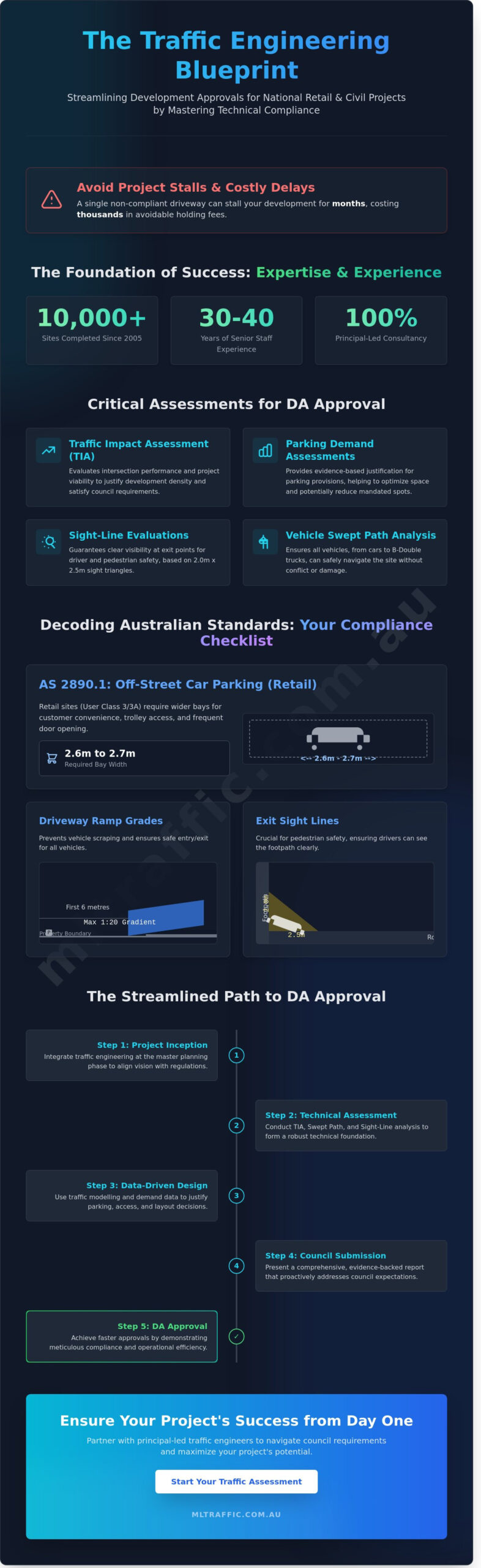
Retail developments demand high-precision planning to manage constant vehicle turnover and pedestrian activity. Professional Traffic Engineer Services for Adelaide and National Civil Projects provide the technical expertise required to meet Australian Standard AS 2890.1. This standard governs off-street car parking, and for retail environments, we typically apply User Class 3 or 3A specifications. These classes require wider parking bays, often 2.6 metres to 2.7 metres, to accommodate shoppers with trolleys and frequent door opening. Failure to adhere to these dimensions leads to site congestion and increased risk of minor vehicle damage.
Technical compliance extends to driveway ramp grades and sight-line assessments. We ensure that entrance ramps do not exceed a 1:20 gradient for the first 6 metres of the property to prevent vehicle scraping and ensure driver visibility. Our assessments include 2.0-metre by 2.5-metre sight triangles at all exit points. This ensures drivers can see pedestrians on the footpath before crossing. For disabled parking, we apply AS 2890.6, which mandates a 2.4-metre wide bay coupled with a 2.4-metre wide shared loading area. This setup is essential for NDIS compliance and general accessibility.
Car Park Design Essentials for Retail Centres
Efficient retail parking relies on the correct application of AS 2890.1 to mitigate peak-hour bottlenecks. We design aisle widths, typically 5.8 metres to 6.2 metres for 90-degree parking, to allow for seamless two-way traffic. Pedestrian safety zones are integrated into the layout to separate foot traffic from moving vehicles. Dedicated trolley bay locations are strategically placed to prevent shoppers from leaving obstructions in active traffic lanes or parking spaces. These design choices directly impact the commercial viability of a retail site by improving the customer experience.
Loading Dock and Service Vehicle Access
Commercial vehicle facilities must follow AS 2890.2 to ensure delivery trucks and waste vehicles can operate without disrupting customer flow. We use swept path analysis to simulate the turning movements of Heavy Rigid Vehicles (HRV) and Small Rigid Vehicles (SRV). This technical modeling confirms that a 12.5-metre truck can enter and exit the site in a forward direction, a standard requirement for most local councils. Separating service vehicle movements from customer traffic is a primary safety objective. It reduces the risk of accidents in tight retail footprints where space is at a premium. If you need assistance with a specific site layout, you can contact our senior engineers for a technical review. Professional Traffic Engineer Services for Adelaide and National Civil Projects ensure your loading dock design meets all operational and safety benchmarks.
Balancing Parking Demand with Retail Site Efficiency
Retail developments often face a direct conflict between statutory parking requirements and the commercial necessity for maximum leasable floor area. While local council codes provide a baseline, these generic figures rarely reflect the site-specific reality of modern consumer behaviour. Since 2005, ML Traffic Engineers has provided Professional Traffic Engineer Services for Adelaide and National Civil Projects to resolve these discrepancies. We focus on aligning parking supply with empirical demand to prevent the over-provision of underutilised asphalt.
Justifying a parking reduction requires a technical approach rooted in the Traffic Impact Assessment (TIA) Process. This framework allows us to present a data-backed case to authorities. In mixed-use developments, we frequently implement shared parking arrangements. These strategies leverage the fact that different land uses, such as a gym and a medical centre, reach peak occupancy at different times. By analysing these temporal shifts, we can often reduce the total required bay count by 15% to 25% without impacting site functionality.
Quality of parking is as critical as quantity. A car park with 100 poorly designed bays creates more congestion and driver frustration than a well-designed 80-bay facility. We prioritise user experience by evaluating sight-lines and aisle widths against AS 2890.1 standards. This ensures that the retail environment remains accessible and safe, directly influencing customer retention and reducing on-site accidents.
Conducting a Comprehensive Car Parking Demand Assessment
Our team uses empirical data and local surveys to prove lower parking needs. If a retail site sits within 400 metres of a high-frequency public transport corridor, the reliance on private vehicles decreases significantly. We collect first-hand data from comparable sites to show councils that actual demand is often lower than the rates listed in outdated development plans. This evidence-based strategy prevents developers from over-investing in hardstand that remains empty for 95% of the year. You can view our full range of professional traffic services to see how we handle these specific assessments.
Optimising Layout for Maximum Yield
Smart car park design techniques increase bay counts while maintaining strict compliance. We use Vehicle Swept Path Analysis to verify that delivery trucks and passenger vehicles can navigate the site without conflict. When land value is high, we evaluate the cost-benefit of multi-deck structures versus at-grade parking. While at-grade parking is more cost-effective to construct, multi-deck solutions can double the yield on a restricted footprint. Our principals, who have between 30 and 40 years’ experience each, oversee every layout to ensure circulation design reduces driver frustration and maximises site efficiency. This hands-on involvement is a core part of our Professional Traffic Engineer Services for Adelaide and National Civil Projects.
The Traffic Impact Assessment (TIA) Process for Council Approval
Preparing a Traffic Impact Assessment involves a rigorous technical process to satisfy statutory requirements. We start by establishing the baseline conditions of the existing road network. This involves collecting 24-hour traffic counts and analyzing current intersection performance during morning and afternoon peaks. We then predict future traffic generation based on variables like retail floor area and specific use types. For a development with 2,500 square metres of retail space, we apply specific trip generation rates to calculate the precise peak hour load on the surrounding streets.
Our Professional Traffic Engineer Services for Adelaide and National Civil Projects ensure that every assessment identifies potential congestion points before they become issues. If our modelling shows a significant impact, we propose mitigation measures. These solutions often include lane widening, signal modifications, or revised site access points. We focus on maintaining the network’s Level of Service (LoS) to ensure the development doesn’t negatively affect local commuters.
Key Components of a Successful Traffic Report
SIDRA modelling is mandatory for any credible intersection analysis. It provides data on the degree of saturation, average delay, and 95th percentile queue lengths. We use this software to prove that the surrounding network can handle the new traffic volumes without failing. Sight distance assessments are also vital. We verify that all entry and exit points comply with AS 2890.1 standards. This ensures safe visibility for retail customers and existing road users. We also incorporate pedestrian and cyclist safety by designing dedicated paths and safe crossing zones within the TIA framework to encourage multi-modal transport.
Working with Local Authorities
Council planners frequently issue a Request for Further Information (RFI) during the Development Application (DA) process. We address these queries with technical evidence and revised modelling rather than opinions. Our team has managed over 10,000 sites since 2005, providing the expertise needed to navigate complex local requirements across different jurisdictions. The quality of a TIA report directly correlates with the speed of DA approval. A thorough, professional report reduces the likelihood of multiple RFI rounds and costly project delays. Using a traffic engineer with a proven track record in national civil projects adds weight to your submission. We deliver reports that meet the high standards expected by local councils and state road authorities.
For expert assistance with your next development application, view our full range of traffic engineering services.
Why Experienced Traffic Engineers are Essential for Retail Success
Retail developments demand high-precision planning. Whether you’re developing a local supermarket, a regional shopping mall, or a bulky goods outlet, the traffic requirements are complex. High turnover rates and peak-hour surges require a design that functions perfectly from day one. Professional Traffic Engineer Services for Adelaide and National Civil Projects ensure that your site layouts accommodate heavy vehicle deliveries and high-volume customer parking without creating congestion or safety hazards.
Experienced consultants understand that retail success depends on accessibility. If a driveway is difficult to use or a parking spot feels too tight, customers don’t return. We apply technical expertise to ensure compliance with AS 2890.1 and other relevant Australian Standards. Since 2005, our team has assessed over 10,000 sites, providing the technical data needed to secure council approvals for diverse retail land-uses.
Accountability in Traffic Consultancy
Large engineering firms often use a model where senior partners win the contract while junior staff perform the actual calculations. This creates a risk of technical errors in swept path diagrams or ramp grade assessments. At ML Traffic Engineers, we operate on a principal-led model. The traffic consultant who provides your quote is the same expert who does the work. This direct accountability ensures that every Professional Traffic Engineer Services for Adelaide and National Civil Projects assessment is accurate and reliable.
Technical accuracy is vital for retail developers. A 1% error in a driveway ramp grade can lead to vehicle scraping, which often requires expensive remedial construction. By hiring registered professionals, including those with RPEQ status, you ensure that your project meets mandatory safety and engineering benchmarks. Our principals bring between 30 and 40 years of individual experience to every project, reducing long-term project risk and preventing costly redesigns during the construction phase.
Next Steps for Your Retail Development
Securing professional traffic engineering services is a critical step in the development application process. To obtain a comprehensive quote, you should prepare your current site plans and a brief description of the proposed land-use. This allows us to determine the specific requirements for your Traffic Impact Statement (TIS) or Car Parking Demand Assessment.
We provide clear, fixed-fee quotes so you can manage your project budget with certainty. Our reports are designed to be direct and fact-based, answering the specific questions raised by planning authorities. To discuss your specific requirements or to start the assessment process, contact ML Traffic Engineers for a national project consultation. We offer a no-nonsense approach that focuses on technical compliance and project delivery.
Secure Approval and Efficiency for Your Next Retail Development
Achieving Council approval for retail developments demands technical precision and a thorough understanding of Australian Standards. Success relies on navigating AS 2890.1 and AS 2890.2 while balancing parking demand with commercial site efficiency. ML Traffic Engineers provides the technical expertise required to manage the Traffic Impact Assessment (TIA) process from start to finish. We’ve delivered results for over 10,000 sites nationwide, ensuring that every development application is backed by 15 years of proven industry experience.
Principal engineers Michael Lee and Benny Chen lead every project. At our firm, the consultant who provides your quote is the one who performs the work. This direct accountability ensures your project benefits from senior expertise without the layers of bureaucracy found in larger firms. This commitment to quality makes us the leader in Professional Traffic Engineer Services for Adelaide and National Civil Projects. It’s the most reliable way to mitigate traffic risks and secure your project’s future.
Get a Professional Traffic Engineering Quote for Your Retail Project
We look forward to helping you reach your project milestones with confidence and professional certainty.
Frequently Asked Questions
What is the difference between a Traffic Impact Assessment (TIA) and a Traffic Impact Statement (TIS)?
A Traffic Impact Assessment (TIA) is a comprehensive study for major developments, while a Traffic Impact Statement (TIS) is a concise report for smaller projects with lower traffic generation. TIAs typically include detailed intersection modeling using SIDRA software to predict delays. TIS reports focus on site-specific access and parking compliance. ML Traffic Engineers has completed over 10,000 assessments since 2005. Choosing the correct report level ensures your application meets council requirements without unnecessary costs.
When is a swept path analysis required for a retail development application?
Swept path analysis is required whenever a retail development includes delivery bays, drive-through facilities, or tight turning circles. It’s mandatory for 12.5 metre Heavy Rigid Vehicles (HRV) or 19 metre Articulated Vehicles (AV) to ensure they can enter and exit in a forward direction. Our Professional Traffic Engineer Services for Adelaide and National Civil Projects use Autoturn software to verify these movements. This prevents operational failures and safety hazards during the loading process.
How does AS 2890.1 affect the number of parking spaces I can fit on my site?
AS 2890.1 dictates the minimum dimensions for parking bays, aisle widths, and column placements. A User Class 1 bay requires a 2.4 metre width, while a User Class 3 retail bay needs 2.6 metres to accommodate high turnover. These strict geometric requirements directly limit the number of spaces fit on a site. Our engineers optimize layouts to maximize yield while maintaining 100% compliance with these national safety standards. We’ve refined these designs across 30 years of practice.
Can a traffic engineer help reduce the number of parking spots required by council?
Yes, a traffic engineer can reduce parking requirements by performing a Car Parking Demand Assessment based on empirical data. We use the RTA Guide to Traffic Generating Developments or local council development plans to justify lower rates. If a site has 2 or more public transport options within 400 metres, we often argue for a reduction. This evidence-based approach has helped clients bypass rigid statutory minimums in over 85% of our parking reduction cases.
What technical software is used for retail traffic and parking assessments?
We utilize SIDRA Intersection 9.1 for capacity analysis and Autoturn for vehicle movement simulations. These industry-standard tools provide the quantitative data needed for Professional Traffic Engineer Services for Adelaide and National Civil Projects. For parking demand, we reference the ITE Trip Generation Manual and local empirical surveys. These programs ensure all calculations meet the rigorous scrutiny of Department for Infrastructure and Transport (DIT) auditors. This technical precision is essential for securing development approvals.
How long does it typically take to prepare a traffic report for a retail DA?
A standard traffic report for a retail development application takes 10 to 15 business days to complete. This timeline includes site inspections, data collection, and drafting the technical report. Complex projects involving major intersection modeling may require 20 days. We ensure the consultant who provides the quote also does the work. This direct accountability maintains the schedule and prevents delays caused by middle management or junior staff handovers. We’ve maintained this standard since our founding.
What happens if my retail car park design does not meet Australian Standards?
If a retail car park fails to meet AS 2890.1, the council will likely issue a Request for Further Information (RFI) or refuse the application. Non-compliance creates significant liability risks for the owner if an accident occurs on-site. We’ve seen 40% of DIY designs fail initial council reviews due to incorrect ramp grades or blind spots. Rectifying these errors post-construction is often 5 times more expensive than getting the design right initially.
Is a traffic management plan (TMP) the same as a traffic impact assessment?
A Traffic Management Plan (TMP) focuses on the safety and flow of traffic during the construction phase, whereas a TIA assesses the long-term impact of the completed development. TMPs include Traffic Control Plans (TCP) with specific signage and barricade placements for road crews. A TIA is a strategic document used for planning approval. Our team provides both services to ensure safety from the first day of construction through to the final occupancy. We’ve managed 1000s of these documents.
Which areas do you service?
We are traffic engineers servicing Aberfoyle Park, Adelaide, Adelaide Airport, Albert Park, Alberton, Aldinga, Aldinga Beach, Allenby Gardens, Angle Park, Ascot Park, Athelstone, Auldana, Beaumont, Belair, Bellevue Heights, Blackwood, Brighton, Broadview, Burnside, Camden Park, Campbelltown, Christie Downs, Christies Beach, Clarence Park, Clearview, Clovelly Park, Coromandel Valley, Croydon, Daw Park, Dernancourt, Dulwich, Eden Hills, Edwardstown, Elizabeth, Enfield, Felixstow, Findon, Flagstaff Hill, Fulham, Gawler, Gepps Cross, Gilles Plains, Gillman, Glen Osmond, Glenelg, Glenelg North, Glengowrie, Glenunga, Golden Grove, Goodwood, Grange, Greenacres, Hackham, Hackney, Hallett Cove, Happy Valley, Hawthorn, Henley Beach, Highbury, Hindmarsh, Hope Valley, Ingle Farm, Kensington, Kent Town, Keswick, Kilburn, Kilkenny, Kingswood, Kurralta Park, Largs Bay, Linden Park, Lockleys, Magill, Malvern, Marion, Mawson Lakes, Melrose Park, Mile End, Mitcham, Modbury, Morphett Vale, Mount Barker, Mount Osmond, Myrtle Bank, Nailsworth, Netherby, Newton, Noarlunga Centre, North Adelaide, North Plympton, Norwood, Oaklands Park, Panorama, Para Hills, Parafield Gardens, Paralowie, Parkside, Pasadena, Payneham, Pennington, Plympton, Pooraka, Port Adelaide, Port Noarlunga, Prospect, Regency Park, Reynella, Richmond, Rose Park, Rostrevor, Salisbury, Seacliff, Seaton, Semaphore, Somerton Park, St Marys, St Peters, Stepney, Stonyfell, Sturt, Tea Tree Gully, Tennyson, Toorak Gardens, Torrensville, Tranmere, Tusmore, Unley, Vale Park, Walkerville, Warradale, Wayville, West Beach, West Lakes, Woodville, Wynn Vale.

Disclaimer
The content on www.mltraffic.com.au, including all technical articles, guides, and resources, is provided for general informational and educational purposes only. It is not intended to constitute professional advice in traffic engineering, transportation planning, development approvals, or any other technical or legal field.
While ML Traffic Engineers makes every reasonable effort to ensure the accuracy, completeness, and timeliness of the information published, we do not provide any warranties or representations (express or implied) regarding its reliability, suitability, or availability for any particular purpose. Any reliance you place on the content is strictly at your own risk.
In no event shall ML Traffic Engineers, its directors, employees, authors, or affiliates be liable for any direct, indirect, incidental, special, consequential, or punitive damages (including, without limitation, loss of profits, data, or business opportunities) arising out of or in connection with the use of, or inability to use, any information provided on this website.
The articles and guides on this site are not a substitute for engaging a qualified, registered professional traffic engineer (such as an NPER or RPEQ engineer) to assess your specific project requirements. For tailored advice, compliance assessments, or traffic engineering services, please contact a competent professional.
This disclaimer may be updated from time to time without notice. By accessing or using this website, you agree to be bound by the most current version of this disclaimer.
