

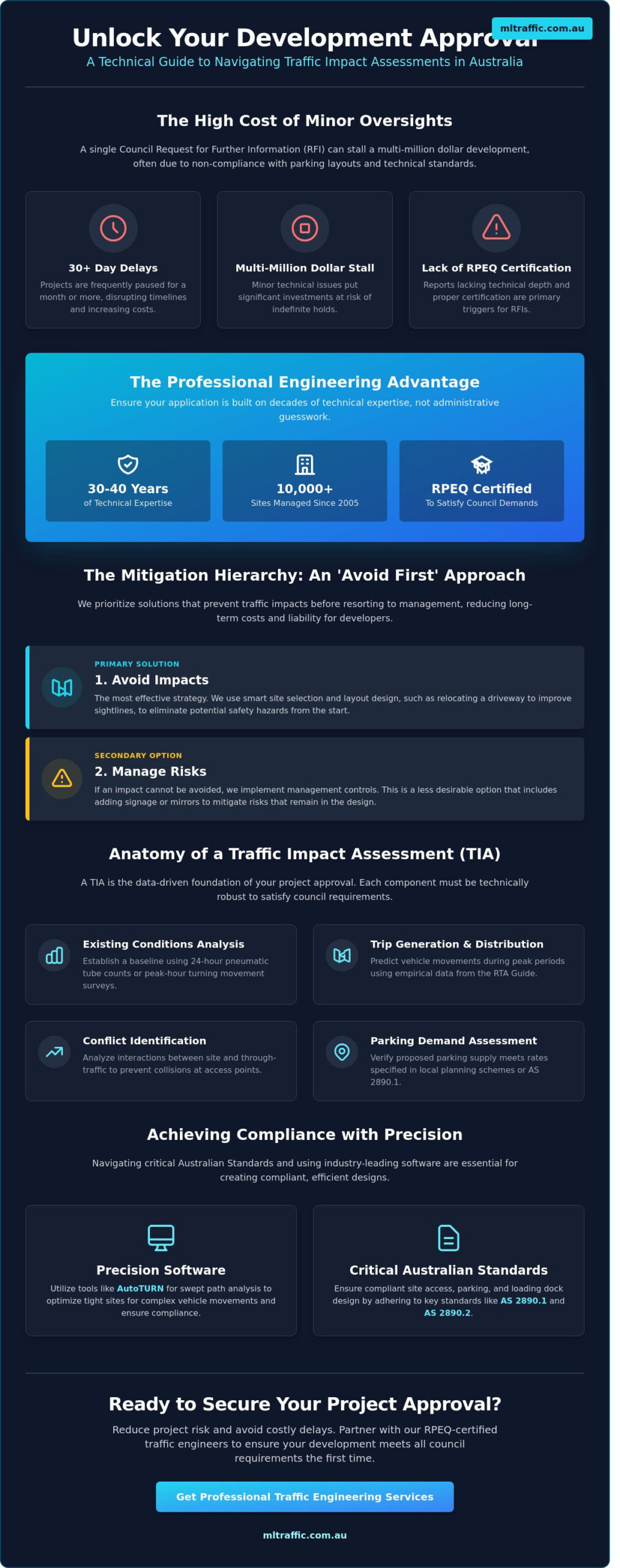
A single Council Request for Further Information (RFI) can stall a multi-million dollar development for 30 days or more, often due to minor technical oversights in parking layouts. Non-compliance with AS 2890.1 isn’t an option when project timelines are at stake. We understand the frustration of seeing a project stall because a Traffic Impact Assessment (TIA) lacked the necessary RPEQ certification or technical depth. Accessing Professional Traffic Engineer Services for Brisbane and National Civil Projects ensures your application is built on 30 to 40 years of technical expertise rather than administrative guesswork.
Our senior engineers have personally managed over 10,000 sites since 2005, ensuring that the traffic consultant who provides your quote is the same expert who performs the work. This article serves as a comprehensive guide to managing traffic impact assessments and mitigation strategies for successful development approvals across Australia. You’ll learn how to address common compliance hurdles, optimize tight sites for complex swept path requirements, and provide the authoritative documentation needed to satisfy Council demands the first time.
Key Takeaways
- Understand how the ‘Mitigation Hierarchy’ prioritizes impact avoidance to align your development with rigorous Australian planning frameworks.
- Learn to utilize precision software like AutoTURN for swept path analysis and accurate parking demand assessments.
- Compare physical infrastructure upgrades against operational management solutions to determine the most cost-effective mitigation for your project.
- Navigate critical Australian Standards, including AS 2890.1 and AS 2890.2, to ensure compliant site access and loading dock design.
- Discover how Professional Traffic Engineer Services for Brisbane and National Civil Projects reduce project risk by identifying technical ‘deal-breakers’ before they impact your approval timeline.
Table of Contents
-
Understanding the Fundamentals of Mitigating Traffic Impact of a New Development
-
A Step-by-Step Guide to Developing an Effective Traffic Mitigation Strategy
-
Comparing Physical Infrastructure vs. Operational Traffic Management Solutions
-
Navigating Australian Standards and Compliance Requirements for Site Access
-
Why Professional Traffic Engineering is Critical for Successful Project Approval
Understanding the Fundamentals of Mitigating Traffic Impact of a New Development
Traffic mitigation is the technical process of identifying, predicting, and reducing the adverse effects a new land use has on the surrounding transport network. Within Australian planning frameworks, such as the Queensland Development Code and various local planning schemes, mitigation isn’t optional. It’s a statutory requirement. Traffic engineering standards dictate that a development’s footprint shouldn’t compromise the safety or efficiency of existing public infrastructure. Our firm provides Professional Traffic Engineer Services for Brisbane and National Civil Projects to ensure these regulatory benchmarks are met during the initial design phase.
To better understand the scope of this profession and its impact on infrastructure, watch this helpful video:
The industry adheres to a strict ‘Mitigation Hierarchy’. We prioritize avoiding impacts through smart site selection and layout design before moving to management or compensation. If a proposed driveway creates a safety hazard due to limited sightlines, the primary solution is relocating the access point. Managing the risk through signage or mirrors is a secondary, less desirable option. This hierarchy reduces long-term maintenance costs for councils and minimizes liability for developers.
A Traffic Impact Assessment (TIA) serves as the foundation for all civil project approvals. It’s a data-driven document that proves a project is viable. The traffic engineer’s role is to bridge the gap between a developer’s commercial goals and a council’s strict infrastructure requirements. We translate complex spatial data into actionable design recommendations. By utilizing Professional Traffic Engineer Services for Brisbane and National Civil Projects, developers can navigate the RPEQ certification process and avoid costly delays during the Information Request (IR) stage. You can view our full range of technical capabilities on our services page.
Why Councils Require Traffic Impact Mitigation
Local authorities are responsible for maintaining the road network’s Level of Service (LoS). If a new commercial hub drops an intersection’s performance from an acceptable LoS ‘C’ to an unstable LoS ‘F’, the developer is usually required to fund the necessary upgrades. Councils also prioritize pedestrian and cyclist safety, particularly in high-density urban renewal zones. Effective mitigation protects local amenity by preventing excessive noise and stopping through-traffic from using quiet residential streets as shortcuts.
Key Components of a Traffic Assessment Report
-
Existing conditions analysis: We establish a baseline using 24-hour pneumatic tube counts or peak-hour turning movement surveys conducted within the last 12 months.
-
Trip generation and distribution: We use empirical data from the RTA Guide to Traffic Generating Developments to predict exactly how many vehicles will enter and exit the site during peak periods.
-
Conflict identification: This involves analyzing the interaction between site-generated traffic and through-traffic to prevent rear-end or T-bone collisions at access points.
-
Parking demand: We verify if the proposed parking supply meets the rates specified in the local planning scheme or Australian Standard AS 2890.1.
A Step-by-Step Guide to Developing an Effective Traffic Mitigation Strategy
Developing a robust traffic mitigation strategy requires a technical approach that balances developer goals with local government requirements. When providing Professional Traffic Engineer Services for Brisbane and National Civil Projects, we follow a structured five-step methodology to ensure every development application meets safety and capacity standards. This process removes guesswork and replaces it with data-driven design.
Step 1 & 2: Data Collection and Maneuverability
Accurate data forms the foundation of any successful strategy. We begin by collecting peak-hour traffic data to reflect real-world usage patterns rather than theoretical estimates. This data includes turning movements and pedestrian volumes at key conflict points during the busiest times of the day. Once we establish the baseline, we use AutoTURN software for precise vehicle swept path analysis. This step is critical for ensuring that service vehicles, such as 12.5-meter Heavy Rigid Vehicles (HRV) for waste collection or delivery, can access the site safely. We ensure these vehicles enter and exit in a forward gear, which is a standard requirement for most Australian councils. For a deeper look at this technical process, see our Swept Path Analysis: A Complete Guide for Australian Developments.
Step 3 & 4: Analysis and Solution Design
After establishing maneuverability, we identify network deficiencies using specialized intersection analysis tools. We evaluate how the proposed development impacts the Level of Service (LoS) at nearby junctions. If the analysis shows a delay increase beyond acceptable thresholds, we design physical or operational interventions. This might involve optimizing car park layouts to reduce internal queuing or relocating driveways to improve sight-line distances. We integrate core Traffic Engineering principles early in the design phase to avoid costly redesigns later. Our team references the Austroads Guide to Traffic Management to ensure all proposed mitigations align with national road safety frameworks and operational standards.
The final stage involves documenting every finding in a formal Traffic Impact Assessment (TIA) report. This document proves compliance with Australian Standards, specifically AS 2890.1 for off-street car parking and AS 2890.2 for commercial vehicle facilities. A TIA report signed by an experienced consultant provides the evidence councils need to approve a project. If you’re planning a new development, you can view our full range of Professional Traffic Engineer Services for Brisbane and National Civil Projects to see how we assist with the application process.
-
Step 1: Conduct a comprehensive site access and parking demand assessment.
-
Step 2: Utilize software like AutoTURN for precise vehicle swept path analysis.
-
Step 3: Identify specific network deficiencies using intersection analysis tools.
-
Step 4: Design physical or operational interventions to address identified impacts.
-
Step 5: Document compliance with Australian Standards in a formal TIA report.
Comparing Physical Infrastructure vs. Operational Traffic Management Solutions
Mitigation strategies for development applications generally fall into two categories: physical upgrades and operational management. Physical mitigation involves hard engineering solutions like road widening, the construction of new turning lanes, and intersection upgrades. These are often mandatory when a Traffic Impact Assessment (TIA) identifies that the existing road capacity cannot accommodate a projected 10% or greater increase in peak hour traffic. Professional Traffic Engineer Services for Brisbane and National Civil Projects provide the technical data required to determine which path is most cost-effective for DA approval.
Operational mitigation focuses on software and policy-based solutions. This includes traffic signal phasing adjustments, restricted turning movements, and improved signage. While physical upgrades carry higher capital costs, they’re sometimes unavoidable if the Level of Service (LoS) at a nearby intersection drops below acceptable thresholds. Demand-side management also plays a role. Implementing Green Travel Plans and car-sharing incentives can reduce required parking ratios by 15% to 20% in high-density urban areas.
-
Physical mitigation: Road widening, new turning lanes, and intersection upgrades.
-
Operational mitigation: Traffic signal phasing, restricted turning movements, and signage.
-
Demand-side management: Implementing Green Travel Plans and car-sharing incentives.
-
Cost-benefit analysis: Determining when physical upgrades are unavoidable for council approval.
Physical Infrastructure Upgrades
Hard engineering ensures site compliance with AS 2890.1 standards. We design compliant driveway crossovers and specific ramp grades to prevent vehicle scraping, which is essential for RPEQ certification. Intersection treatments often require a choice between roundabouts and signalized junctions. Roundabouts facilitate continuous flow but demand more land. Signalized junctions allow for complex pedestrian phases. Every physical change impacts the Statement of Environmental Effects (SEE). It’s a requirement to detail how these upgrades alter local drainage or noise profiles for the surrounding community.
Operational and Management Plans
Management plans offer a lower-cost alternative to heavy construction. A Traffic Management Plan (TMP) is essential during the construction phase and for ongoing site operation. We implement Car Parking Management Plans (CPMP) for mixed-use sites to prevent parking overspill into residential streets. Using RFID or boom gate systems helps control access and maintain steady flow. Professional Traffic Engineer Services for Brisbane and National Civil Projects ensure these systems integrate with existing local infrastructure without causing bottlenecks.
Navigating Australian Standards and Compliance Requirements for Site Access
Compliance with Australian Standards is the most critical hurdle for any development application. At ML Traffic Engineers, we recognize that site access isn’t just about convenience; it’s about strict adherence to safety and engineering benchmarks. Our Professional Traffic Engineer Services for Brisbane and National Civil Projects focus on integrating these standards from the initial design phase to prevent costly revisions during the council approval process. We prioritize AS 2890.1:2004 for off-street car parking to ensure every bay and aisle meets the specific requirements of the intended user class.
Commercial and industrial sites face even more rigorous demands under AS 2890.2. This standard governs commercial vehicle facilities, including loading docks and heavy vehicle maneuvering areas. Failure to account for the turning circle of a 19-meter articulated vehicle or a 12.5-meter heavy rigid vehicle (HRV) can render a warehouse or retail center dysfunctional. We provide detailed driveway ramp grade assessments to ensure clearance for all vehicle types, preventing "bottoming out" or scraping on steep transitions.
AS 2890.1 Compliance Checklist
-
User Class Identification: We determine if your site requires Class 1 (long-term parking), Class 3 (short-term retail), or Class 3A (high-turnover) dimensions.
-
Bay and Aisle Dimensions: Standard bays typically require a 2.4-meter width, but we adjust these based on the specific user class and door opening requirements.
-
Headroom Clearance: Basement car parks must maintain a minimum of 2.2 meters for standard vehicles and 2.5 meters for accessible spaces.
-
Safety Transitions: We design ramp grades to ensure smooth entry and exit without compromising vehicle undercarriages.
For a deeper dive into these technical requirements, read our AS 2890.1 Explained: The Ultimate Guide to Compliant Car Park Design.
Swept Path and Sight Line Assessments
Our team uses industry-standard software to conduct vehicle swept path assessments. We don’t guess; we simulate. We use 85th and 99th percentile vehicles to verify that cars and trucks can navigate your site without hitting curbs or structures. It’s a non-negotiable requirement that the ‘B99’ vehicle can enter and exit the site in a single forward maneuver. This ensures traffic flow remains steady and prevents dangerous reversing into public roadways.
Sight distance is equally vital for driveway safety. We calculate Safe Intersection Sight Distance (SISD) based on the 85th percentile approach speed of the adjacent road. On high-speed roads, these calculations determine whether a driveway location is viable or if it poses an unacceptable risk to motorists. Our Professional Traffic Engineer Services for Brisbane and National Civil Projects provide the data-backed assurance that councils demand.
If you need a meticulous review of your site’s access and compliance, view our full range of traffic engineering services to see how we can assist your project.
Why Professional Traffic Engineering is Critical for Successful Project Approval
Traffic engineering isn’t just a box-ticking exercise for a Development Application (DA). It’s a risk management strategy. Identifying traffic deal-breakers early, such as non-compliant driveway ramp grades or insufficient sight lines, prevents expensive design revisions after you’ve already committed to a site layout. Securing Professional Traffic Engineer Services for Brisbane and National Civil Projects ensures that technical constraints don’t become financial liabilities during the planning phase.
ML Traffic Engineers brings a level of technical defense that junior firms cannot match. We provide expert witness services and support during council negotiations, drawing on a database of over 10,000 completed sites. If a council officer challenges a parking provision or access point, you need an engineer who can cite specific Australian Standards (AS 2890.1) and historical precedents to justify the design. Our senior staff, each with between 30 and 40 years’ experience, handle these high-stakes discussions directly.
For developers with multi-state portfolios, national compliance is a major hurdle. Traffic laws and council expectations vary significantly between Queensland, New South Wales, and Victoria. We manage this complexity by applying a consistent, high-standard methodology that meets local requirements while maintaining the integrity of your national project standards. We’ve been trading since 2005, giving us the longevity to understand how regulatory landscapes shift over decades.
Avoiding Costly Delays in the Planning Process
A low-quality report is the fastest way to trigger a Request for Further Information (RFI) from Council. Each RFI cycle can add 4 to 12 weeks to your timeline. Submitting a high-quality Traffic Impact Assessment from the start reduces these cycles. Our reports carry RPEQ and Chartered Engineer certification, which is a mandatory requirement for many technical submissions in Brisbane and across Australia. This certification gives planning authorities the confidence to move your project from DA submission to construction without unnecessary technical delays.
Choosing the Right Engineering Partner
The right partner is one who offers accountability. At many large firms, a senior engineer signs the quote, but a graduate does the work. At ML Traffic, the traffic consultant who provides the quote, does the work. This "no-gatekeepers" approach means you get direct access to principals Michael Lee and Benny Chen. You can call their mobile numbers and get an immediate answer on technical specifics. We have experience across a massive range of land-use types, including:
-
High-density residential apartments and townhouses
-
Large-scale industrial warehouses and distribution centres
-
Retail shopping centres and mixed-use developments
-
Childcare centres, schools, and medical clinics
Don’t leave your project approval to chance. Explore our full range of Traffic Engineering Services to see how we can streamline your next development. Whether you’re dealing with a complex urban site or a national rollout, our Professional Traffic Engineer Services for Brisbane and National Civil Projects provide the technical certainty required for success.
Secure Your Development Approval with Expert Traffic Engineering
Navigating Australian Standards like AS 2890.1 and securing RPEQ certification are mandatory steps for any successful civil project. Effective traffic mitigation requires a precise balance between physical infrastructure and operational management. Whether you’re managing a small residential site or a large scale industrial warehouse, meeting these technical requirements ensures your development application moves through council without costly delays.
ML Traffic Engineers brings over 15 years of industry experience to your project. We’ve assessed more than 10,000 sites nationally, providing the technical data and swept path assessments needed for compliance. When you choose our Professional Traffic Engineer Services for Brisbane and National Civil Projects, you’re working directly with senior consultants. We maintain a strict policy; the traffic consultant who provides the quote is the one who does the work. This direct accountability eliminates communication gaps and ensures your traffic impact statement is accurate and professional.
Get a professional traffic engineering quote for your project today. We’re ready to help you meet every regulatory milestone with confidence.
Frequently Asked Questions
What is a Traffic Impact Assessment (TIA) and why do I need one?
A Traffic Impact Assessment (TIA) is a technical report evaluating how a proposed development impacts the surrounding road network. You need one to satisfy Council requirements under the Planning Act 2016 and ensure road safety. Our Professional Traffic Engineer Services for Brisbane and National Civil Projects provide these reports to address traffic generation and access. Most Brisbane City Council applications for developments over 20 dwellings or 1,000sqm GFA require a formal TIA.
How much parking is required for a new commercial development?
Parking requirements are determined by the specific land use and local planning scheme, such as the Brisbane City Plan 2014. For instance, a suburban office typically requires 1 space per 30sqm of Gross Floor Area. These rates vary significantly between local government areas. We assess your site against Table 9.4.1.3.B of the Brisbane City Plan to determine the exact number of visitor and staff spaces required for compliance.
What is a Vehicle Swept Path Analysis and when is it required?
A Vehicle Swept Path Analysis is a computer simulation using software like AutoCAD Vehicle Tracking to map the path of a vehicle’s body during a turn. It’s required for any development where service vehicles, such as an 8.8m Medium Rigid Vehicle, must enter and exit the site in a forward gear. Australian Standard AS 2890.2 mandates these clearances for loading docks and waste collection areas to prevent property damage and ensure safe access.
Can a traffic engineer help reduce my parking requirements?
Yes, we can justify parking reductions through a Car Parking Demand Assessment. By using empirical data from the RTA Guide to Traffic Generating Developments, we often prove that actual demand is 20% lower than standard council rates. It’s a common strategy for sites within 400 meters of a high frequency transit station where lower car ownership is documented. This approach helps maximize your developable area while remaining compliant with local planning regulations.
What are the common reasons councils reject traffic reports?
Councils frequently reject reports due to non-compliance with AS 2890.1 or insufficient sight distance data. In 2023, 15% of initial submissions were flagged for inadequate maneuverability evidence or failing to account for peak hour background traffic growth. Using Professional Traffic Engineer Services for Brisbane and National Civil Projects ensures that technical details, like driveway gradients exceeding 1:5, are addressed before submission. We ensure your report meets the specific technical criteria required by authorities.
What is the difference between a Traffic Management Plan and a Traffic Guidance Scheme?
A Traffic Management Plan (TMP) is a strategic document outlining the overall approach to managing traffic risks during construction. Conversely, a Traffic Guidance Scheme (TGS), formerly known as a Traffic Control Plan, is a specific technical drawing showing the exact placement of signs and cones. The TGS follows the Manual of Uniform Traffic Control Devices (MUTCD) Part 3 to ensure workers stay safe. Every TGS must be signed off by a qualified person.
When should I engage a traffic engineer in the development process?
You should engage a traffic engineer during the pre-lodgement or concept design phase before the architectural plans are finalized. Early involvement prevents design errors, such as placing a basement ramp at a 1:4 grade that violates AS 2890.1 standards. By reviewing the site layout before the 50% design milestone, we ensure that access points are functional and compliant. This proactive approach prevents the need for expensive structural changes during construction.
Are Australian Standards for parking (AS 2890) legally binding?
Australian Standards like AS 2890.1 aren’t laws on their own, but they become legally binding when referenced in a local planning scheme. If your project doesn’t meet the 2.4m minimum width for a Class 1A parking space, Council can refuse the application under the Planning Act 2016. Our engineers ensure every design meets these dimensions to guarantee your development is legally compliant. We’ve applied these standards to over 10,000 sites across Australia since 2005.
Which areas do you cover?
We are traffic engineers servicing Brisbane, Brisbane City, Fortitude Valley, New Farm, Teneriffe, Kangaroo Point, East Brisbane, South Brisbane, West End, Highgate Hill, Dutton Park, Woolloongabba, Ascot, Clayfield, Albion, Bowen Hills, Newstead, Bulimba, Hawthorne, Morningside, Balmoral, Indooroopilly, Taringa, Toowong, Auchenflower, Milton, Paddington, Red Hill, Bardon, Ashgrove, The Gap, Enoggera, Mitchelton, Aspley, Chermside, Kedron, Stafford, Everton Park, Gordon Park, Wilston, Grange, Alderley, Kelvin Grove, Herston, Lutwyche, Windsor, Nundah, Wavell Heights, Chermside West, Zillmere, Carseldine, Bald Hills, Bracken Ridge, Brighton, Sandgate, Shorncliffe, Deagon, Taigum, Fitzgibbon, Boondall, Virginia, Banyo, Nudgee, Northgate, Hamilton, Hendra, Eagle Farm, Murarrie, Cannon Hill, Seven Hills, Norman Park, Coorparoo, Camp Hill, Carina, Carindale, Mount Gravatt, Upper Mount Gravatt, Mansfield, MacGregor, Robertson, Sunnybank, Sunnybank Hills, Acacia Ridge, Inala, Oxley, Corinda, Graceville, Sherwood, Yeronga, Annerley, Moorooka, Tarragindi, Holland Park, Holland Park West, Coopers Plains, Greenslopes, Fairfield, Yeerongpilly, Stones Corner, Wynnum, Wynnum West, Manly, Manly West, Tingalpa, Hemmant, Lota, Wakerley, Rochedale, Eight Mile Plains, Runcorn, Calamvale, Parkinson, Algester, Doolandella, Forest Lake, Richlands, Darra, Wacol, Archerfield, Rocklea, Salisbury, Nathan, Mount Gravatt East, Wishart, Karawatha, Stretton, Kuraby, Belmont, Chandler, Gumdale, Lytton, Port of Brisbane, Kenmore, Jindalee, Mount Ommaney, Sinnamon Park, Fig Tree Pocket, Chapel Hill, St Lucia, Petrie Terrace, Spring Hill, Wooloowin, Newmarket, Gaythorne, Keperra, Ferny Grove, Upper Kedron, Bridgeman Downs, McDowall, Stafford Heights, Geebung, Pinkenba, Brisbane Airport, Nudgee Beach, Kalinga, Albion (duplicate avoided), Anstead, Bellbowrie, Brookfield, Chelmer, Chuwar, England Creek, Enoggera Reservoir, Jamboree Heights, Karana Downs, Kenmore Hills, Kholo, Lake Manchester, Middle Park, Moggill, Mount Coot-tha, Mount Crosby, Pinjarra Hills, Pullenvale, Riverhills, Seventeen Mile Rocks, Upper Brookfield, Westlake, Banks Creek, Burbank, Drewvale, Durack, Ellen Grove, Heathwood, Larapinta, Mackenzie, Pallara, Sumner, Tennyson, Willawong, Carina Heights, Ransome, Cannon Hill (duplicate avoided), Carindale, Manly, Moreton Island, Bulwer, Cowan Cowan, Kooringal.
Can you help with developments outside of Brisbane, like the Gold Coast or Sunshine Coast?
Yes. While we have deep expertise in Brisbane, our senior engineers have extensive experience securing DA approvals with councils across Queensland, including the Gold Coast, Sunshine Coast, Moreton Bay, Logan, and Ipswich.

Disclaimer
The content on www.mltraffic.com.au, including all technical articles, guides, and resources, is provided for general informational and educational purposes only. It is not intended to constitute professional advice in traffic engineering, transportation planning, development approvals, or any other technical or legal field.
While ML Traffic Engineers makes every reasonable effort to ensure the accuracy, completeness, and timeliness of the information published, we do not provide any warranties or representations (express or implied) regarding its reliability, suitability, or availability for any particular purpose. Any reliance you place on the content is strictly at your own risk.
In no event shall ML Traffic Engineers, its directors, employees, authors, or affiliates be liable for any direct, indirect, incidental, special, consequential, or punitive damages (including, without limitation, loss of profits, data, or business opportunities) arising out of or in connection with the use of, or inability to use, any information provided on this website.
The articles and guides on this site are not a substitute for engaging a qualified, registered professional traffic engineer (such as an NPER or RPEQ engineer) to assess your specific project requirements. For tailored advice, compliance assessments, or traffic engineering services, please contact a competent professional.
This disclaimer may be updated from time to time without notice. By accessing or using this website, you agree to be bound by the most current version of this disclaimer.
