
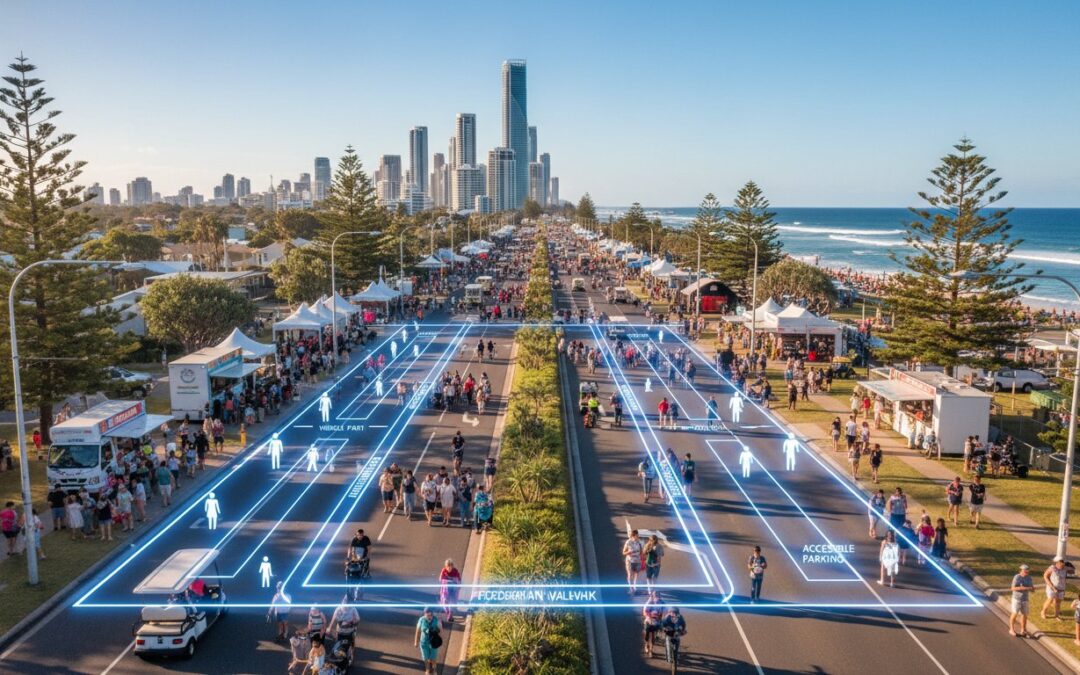
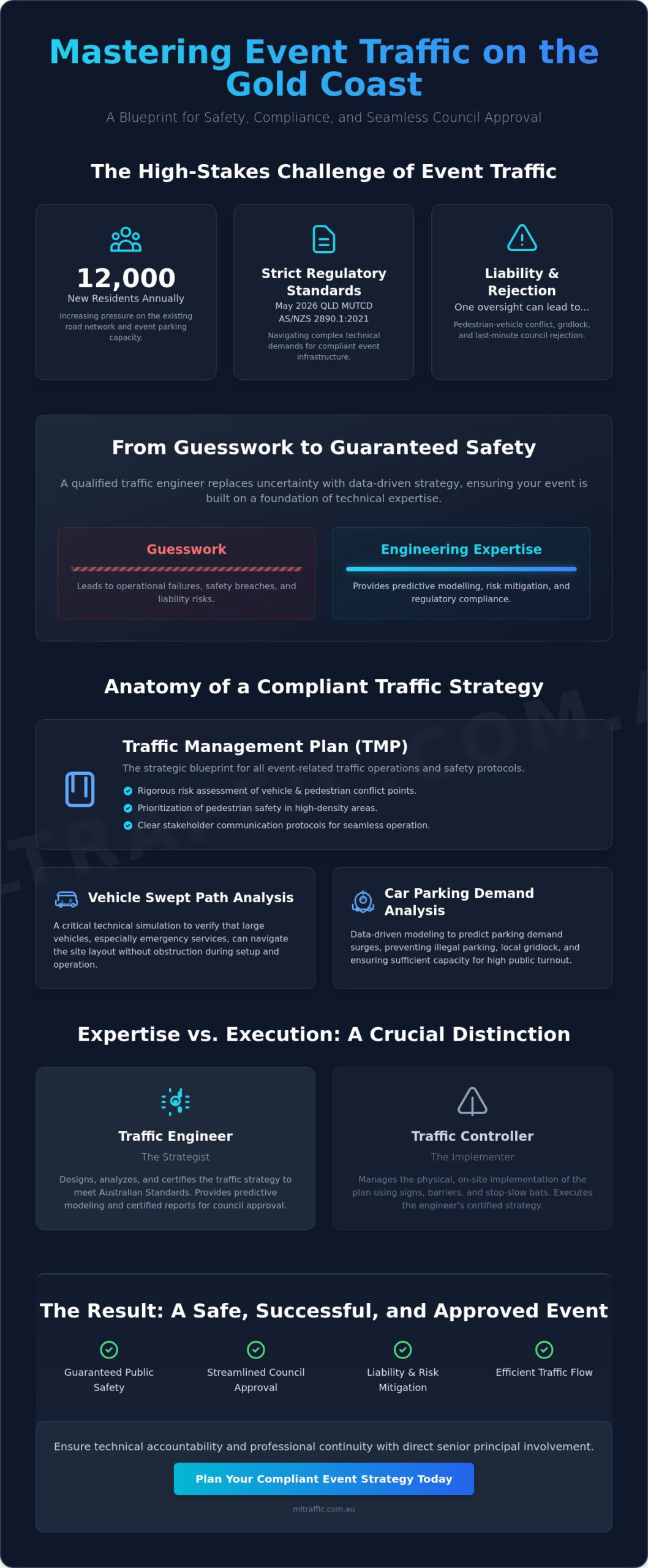
A single oversight in your traffic plan can transform a successful community event into a liability nightmare involving pedestrian-vehicle conflict and council rejection. Engaging a qualified traffic engineer Gold Coast ensures your strategy is built on technical expertise rather than guesswork. You likely feel the pressure of meeting strict local requirements while managing the logistical strain caused by 12,000 new residents moving to the region each year. It’s a complex task to ensure your event’s parking and access requirements don’t result in gridlock or safety breaches.
It’s a significant challenge to balance high public turnout with the technical demands of the May 2026 Queensland MUTCD updates and AS/NZS 2890.1:2021 parking standards. This guide explains how to plan a compliant strategy that guarantees safety and facilitates council approval. We’ll examine the necessity of professional Traffic Guidance Schemes and how specific technical assessments, including Car Parking Demand and Vehicle Swept Path Analysis, prevent congestion and ensure your event’s infrastructure remains fully compliant with current Australian Standards.
Key Takeaways
- A professional traffic engineer Gold Coast provides the predictive modelling and risk mitigation required to manage liability and safety for temporary land-use changes.
- A compliant Traffic Management Plan identifies potential conflicts between vehicles and pedestrians to ensure a safe and efficient event environment.
- Swept Path Analysis is a necessary technical tool to verify that emergency vehicle access remains unobstructed during site setup and operation.
- Successful council approval depends on the provision of certified reports for Development Applications and a clear understanding of special event permit requirements.
- Working with senior principals directly ensures technical accountability and professional continuity throughout the duration of your project.
Table of Contents
- The Role of a Traffic Engineer in Community Consultation Planning
- Key Components of a Compliant Traffic Management Plan (TMP)
- Managing Pedestrian Safety and Site Access
- Navigating Council Approvals and Regulatory Standards
- Why ML Traffic Engineers Australia is the Right Partner for Your Event
The Role of a Traffic Engineer in Community Consultation Planning
In the context of community consultation planning, the role of a traffic engineer Gold Coast extends far beyond simple site access. It involves technical predictive modelling and rigorous risk mitigation for temporary land-use changes. While permanent infrastructure design focuses on long-term stability, event-based engineering manages a dynamic environment where the margin for error is minimal. Professional certification is a prerequisite for liability assurance and safety. A qualified engineer ensures that every temporary modification to the road network adheres to the latest Traffic engineering standards and state-level regulatory frameworks.
Securing early engineering input is a critical step in the development application process. It prevents last-minute council rejections by identifying potential bottlenecks before they become operational failures. This proactive approach allows for the inclusion of certified reports in your submission, demonstrating a commitment to professional standards and public safety. By addressing traffic flow and parking demand during the design phase, organizers can navigate the complexities of local government requirements with greater certainty.
To better understand the technical scope involved in this field, watch this helpful video:
Why Consultation Events Present Unique Traffic Challenges
Short-term events attract high volumes of drivers who are often unfamiliar with the specific site layout. This lack of familiarity increases the risk of accidents, particularly during peak-hour arrivals. On the Gold Coast, where the population grows by approximately 12,000 residents annually, the pressure on the existing road network is constant. Popular public sessions create a surge demand for car parking that can quickly overwhelm standard site capacity. Without professional modelling, this surge leads to illegal parking, blocked driveway access, and local traffic gridlock. Engaging a traffic engineer Gold Coast early in the planning phase provides the data-driven insights needed to manage these surges safely.
Expert Oversight vs. General Traffic Control
It’s vital to distinguish between traffic control and engineering. A traffic controller manages the physical implementation of a plan on-site using stop-slow bats or barriers. In contrast, a traffic engineer is responsible for the design, analysis, and certification of the strategy. All project plans must align with established Traffic Engineering principles to ensure compliance with Australian Standards. ML Traffic Engineers Australia prioritises senior-level principal involvement in every assessment. This means the expert who initiates your project is the one performing the technical work, providing a level of accountability that larger consultancy firms often lack. Our focus remains on delivering precise Traffic Impact Assessments and Swept Path Analysis to guarantee site functionality.
Key Components of a Compliant Traffic Management Plan (TMP)
A comprehensive Traffic Management Plan (TMP) serves as the strategic blueprint for all event-related traffic operations. It’s a technical document that outlines the logic behind safety protocols and traffic flow adjustments. Every compliant TMP must include a rigorous risk assessment. This analysis identifies potential points of conflict between vehicles, cyclists, and pedestrians. Prioritising Pedestrian Safety is a core requirement, especially in high-density Gold Coast areas where event crowds interact with local road networks.
Engaging a traffic engineer Gold Coast ensures that your TMP includes clear stakeholder communication protocols. These protocols keep event organisers, emergency services, and council authorities aligned during the event. If your consultation event is a component of a larger development, the TMP must integrate with the total project lifecycle plan to avoid operational contradictions. This structured approach is essential for maintaining site safety and meeting regulatory expectations.
Traffic Guidance Schemes (TGS) vs. TMPs
There’s a distinct difference between a TGS and a TMP. A TGS is the operational diagram showing the precise placement of signs, taper lengths, and traffic control devices. It’s the visual instruction for site implementation. While the TGS provides the layout, the TMP provides the strategic justification for those choices. Most Gold Coast City Council permits require both documents for anything beyond low-impact activities. All schemes must comply with the current Queensland MUTCD and AS 1742.3 standards. For the 2025-2026 period, council assessment fees for high-impact road closures are $635.00, making it critical to submit accurate, compliant documentation the first time.
Parking Demand and Capacity Assessments
Inadequate parking planning often leads to site congestion and council complaints. We conduct Car Parking Demand Assessments to calculate exact space requirements based on expected attendee volumes and turnover rates. This process includes designing strategies for overflow parking and identifying areas where ‘no parking’ enforcement is required for safety. All temporary parking layouts must align with AS 2890.1, specifically the AS/NZS 2890.1:2021 standards for off-street facilities. This ensures that aisle widths and bay dimensions are sufficient for the expected vehicle types. If your event site has unique geographical constraints, our technical engineering assessments can provide the certification needed for council approval.
Managing Pedestrian Safety and Site Access
Vulnerable road users require primary consideration during the site design phase. A traffic engineer Gold Coast establishes safe pedestrian corridors that separate foot traffic from vehicle movements. This design starts at the designated parking zones and extends to the venue entrance. Effective management of entry and exit points is critical. It prevents vehicle queuing from backing up onto high-speed arterial roads, which is a significant safety risk in high-traffic zones. All signage must adhere to Australian Standards for visibility and legibility to ensure immediate recognition by all road users. We prioritise the creation of logical, unobstructed pathways to minimise the risk of pedestrian-vehicle conflict.
The technical design process involves evaluating the interaction between different transport modes. We analyse how attendees arrive, whether by private vehicle, ride-share, or public transport. Our assessments ensure that the site layout facilitates efficient movement without compromising safety. Proper planning at this stage reduces the likelihood of congestion and ensures that the event remains compliant with local government bylaws and safety regulations.
Utilising Swept Path Analysis for Event Vehicles
Temporary event layouts are often constrained by existing infrastructure, temporary fencing, or landscaping. We use Swept Path Analysis to verify that delivery trucks and emergency services can navigate these tight spaces without obstruction. Using software-driven diagrams such as AutoTURN, we provide the technical proof of access feasibility required by the Gold Coast City Council. This analysis prevents site gridlock by ensuring that the largest expected vehicles can complete turns and manoeuvres safely. It is a vital component for any event involving heavy equipment or requiring guaranteed emergency vehicle access. We provide these diagrams as part of the formal submission to demonstrate operational readiness.
Pedestrian Flow and Accessibility (DDA Compliance)
Designing for all abilities is a regulatory requirement under the Disability Discrimination Act (DDA). We ensure that wheelchair and pram access is integrated into the consultation session layout. This includes adherence to AS 2890.6:2022, which provides specific requirements for dimensions, clearances, and gradients for accessible parking bays. Managing the ‘last mile’ from public transport hubs to the event site is equally important. We assess sight distance and temporary lighting requirements for evening consultation events to maintain safety after dark. Our engineering team ensures that the transition from public transport to the venue is safe, well-lit, and easy to navigate for all attendees, regardless of their mobility level.
Navigating Council Approvals and Regulatory Standards
Securing local government approval for a community event requires a submission that transcends basic site maps. A traffic engineer Gold Coast provides the technical certification necessary for Development Applications (DA) and special event permits. These reports verify that your proposed temporary land-use changes won’t compromise the safety or efficiency of the existing transport network. We ensure your documentation aligns with the Statement of Environmental Effects, addressing potential noise, congestion, and access issues before the assessment phase begins.
Liaising with state road authorities and local transport departments is a specialized task. We manage the communication with these governing bodies when your project impacts arterial roads or high-traffic corridors. This direct involvement ensures that technical objections are addressed early in the application process. ML Traffic Engineers Australia provides the professional continuity council officers expect. The same senior principal who designs your plan is the one who defends it during the assessment process, ensuring accountability and technical accuracy across every project phase.
Mandatory Documentation for Council Submission
Submitting an incomplete application is the most common cause of project delays. Council officers require a specific suite of technical documents to assess public risk properly. Engaging a traffic engineer Gold Coast ensures your submission includes every required technical drawing and certification. Typical lead times for traffic plan approvals are 4 to 6 weeks minimum. If your event involves road closures or speed limit reductions, this timeline often extends due to the increased impact on public infrastructure. A standard submission checklist includes:
- Detailed Traffic Management Plan (TMP) certified by a qualified designer.
- Traffic Guidance Schemes (TGS) showing precise sign and device placement.
- Public Liability Insurance Certificates meeting council’s minimum coverage.
- Stakeholder and Resident Notification letters with proof of distribution.
- Traffic Impact Assessment (TIA) for high-impact or multi-day events.
Providing accurate documentation the first time prevents the need for costly variations and administrative delays. We ensure your documentation is site-ready and compliant, allowing your team to focus on event execution rather than bureaucratic hurdles.
Adherence to Australian Standards (AS 2890 & AS 1742)
Generic plans frequently fail to meet the rigorous engineering standards required for modern developments. We ensure full compliance with the AS 2890 series for parking and AS 1742 for traffic control devices. Using outdated standards creates significant legal exposure for your organization. In the event of an incident, non-compliant traffic management can lead to severe liability claims and the potential voiding of insurance policies. Professional certification acts as a critical ‘due diligence’ defense. It proves you’ve taken every reasonable step to ensure public safety through expert analysis and adherence to national regulatory standards. For expert assistance with your regulatory submissions, you can contact our senior engineering team today.
Why ML Traffic Engineers Australia is the Right Partner for Your Event
ML Traffic Engineers Australia brings over 15 years of professional experience in traffic engineering and transport planning across the country. Choosing a traffic engineer Gold Coast with a deep-seated understanding of local regulatory nuances is essential for project success. We’ve secured thousands of successful council approvals for a diverse range of land-use categories and project environments. Our firm operates with a high degree of technical accountability, ensuring that every report meets the exact requirements of assessing authorities. We don’t rely on generic templates; we provide site-specific solutions based on rigorous data analysis.
A core signature of our consultancy is the promise of personnel continuity. We don’t use junior staff or administrative intermediaries for technical assessments. The senior principal who initiates your project performs the actual engineering work from start to finish. This “no-gatekeepers” approach ensures that technical questions from council are answered directly by the expert who designed the plan. Our comprehensive suite of technical services includes everything from Vehicle Swept Path Analysis and Traffic Guidance Schemes to detailed Traffic Impact Assessment (TIA) Reports.
A Results-Oriented Approach to Traffic Consulting
We deliver no-nonsense, fact-based reports designed for quick digestion by council planning officers. Our focus remains on achieving cost-effective compliance that doesn’t over-engineer simple event requirements. While we maintain national coverage, we possess specific local expertise in the regulatory nuances of the Gold Coast. We understand the technicalities of the latest Australian Standards, ensuring your site remains safe, accessible, and legally defensible. Our reports provide the clarity needed to facilitate rapid approvals and minimize the risk of costly variations during the assessment phase.
Get a Quote for Your Next Community Consultation
Our firm is built on reliability and deep-seated expertise. To receive a rapid, authoritative fee proposal, simply provide your site details and expected attendee volumes. Our direct communication style allows us to meet tight project deadlines without the bureaucracy typical of larger, more impersonal firms. You’ll have a direct line to senior leadership throughout the duration of your project. Contact ML Traffic Engineers Australia today to discuss your event’s specific requirements and ensure your next community consultation meets every technical and safety standard required for council approval.
Executing Your Event’s Traffic Strategy with Precision
Successful community event planning relies on the integration of compliant Traffic Guidance Schemes and robust risk assessments. A qualified traffic engineer Gold Coast ensures that every technical aspect, from Car Parking Demand to Intersection Analysis, adheres to current Australian Standards. This level of professional oversight is necessary to prevent site congestion and ensure that pedestrian corridors remain safe and unobstructed. By securing certified engineering reports early, you establish the technical foundation required for successful council approval and legal liability protection.
ML Traffic Engineers provides the dependability and meticulous detail required for complex urban environments. With over 15 years of experience and a commitment to direct principal involvement, we ensure your project receives expert attention without unnecessary bureaucracy. Our results-oriented approach focuses on achieving full regulatory compliance for your specific site requirements. Secure your event’s success with expert traffic engineering from ML Traffic. We are ready to assist with your next professional assessment.
Frequently Asked Questions
When is a formal Traffic Management Plan (TMP) required for an event?
A formal TMP is required for any activity that interferes with the normal operation of a road or detours pedestrians. This includes lane closures, speed limit reductions, or significant changes to site access points. The City of Gold Coast mandates this document to ensure public safety and transport network efficiency during temporary land-use changes.
What is the difference between a TGS and a TMP?
A Traffic Guidance Scheme (TGS) is the physical drawing showing exact sign and device placement. In contrast, a Traffic Management Plan (TMP) is the strategic document that justifies those measures through risk assessments and traffic flow logic. Most council permits require both documents to ensure implementation aligns with the broader safety strategy.
How much lead time is needed for council traffic approvals?
You should allow a minimum of 4 to 6 weeks for council traffic approvals on the Gold Coast. Applications involving high-impact road closures or state-controlled roads often require longer assessment periods for internal review. Early submission prevents project delays and allows for any technical amendments requested by assessing authorities.
Does every community event need a certified traffic engineer?
Events involving road network modifications or high pedestrian volumes require a traffic engineer Gold Coast to certify the safety strategy. Professional certification ensures the plan complies with the Queensland MUTCD and current Australian Standards. This expert oversight provides a necessary due diligence defense regarding public safety and professional liability.
How do I determine the amount of parking needed for a public consultation?
We determine parking requirements through a formal Car Parking Demand Assessment based on expected attendee numbers and turnover rates. This analysis accounts for peak arrival times and ensures the layout complies with AS/NZS 2890.1:2021. Accurate modeling prevents illegal parking in surrounding residential streets and maintains local traffic flow.
Can I use standard construction traffic signs for my community event?
All signage must comply with the AS 1742 series and the Queensland Manual of Uniform Traffic Control Devices (MUTCD). Signs must be the correct size, color, and reflectivity for the specific road environment. A traffic engineer Gold Coast specifies the exact signage requirements within the TGS to ensure legal compliance and driver recognition.
What happens if our event exceeds the predicted parking capacity?
Exceeding parking capacity typically results in site gridlock and potential council enforcement actions. We mitigate this risk by designing overflow strategies and identifying ‘no parking’ zones within the initial Car Parking Demand Assessment. Planning for secondary parking locations and managing pedestrian transit prevents safety hazards and unauthorized vehicle placement.
Is Swept Path Analysis necessary for a temporary event site?
Swept Path Analysis is necessary if the event site requires access for large vehicles such as delivery trucks or emergency services. We use AutoTURN software to simulate vehicle movements within constrained temporary layouts. This technical proof is often a mandatory requirement for council approval to ensure that critical access remains unobstructed.

Article by
Michael Lee
Practising traffic engineer with over 35 years experience.
Disclaimer
The content on www.mltraffic.com.au, including all technical articles, guides, and resources, is provided for general informational and educational purposes only. It is not intended to constitute professional advice in traffic engineering, transportation planning, development approvals, or any other technical or legal field.
While ML Traffic Engineers makes every reasonable effort to ensure the accuracy, completeness, and timeliness of the information published, we do not provide any warranties or representations (express or implied) regarding its reliability, suitability, or availability for any particular purpose. Any reliance you place on the content is strictly at your own risk.
In no event shall ML Traffic Engineers, its directors, employees, authors, or affiliates be liable for any direct, indirect, incidental, special, consequential, or punitive damages (including, without limitation, loss of profits, data, or business opportunities) arising out of or in connection with the use of, or inability to use, any information provided on this website.
The articles and guides on this site are not a substitute for engaging a qualified, registered professional traffic engineer (such as an NPER or RPEQ engineer) to assess your specific project requirements. For tailored advice, compliance assessments, or traffic engineering services, please contact a competent professional.
This disclaimer may be updated from time to time without notice. By accessing or using this website, you agree to be bound by the most current version of this disclaimer.
