

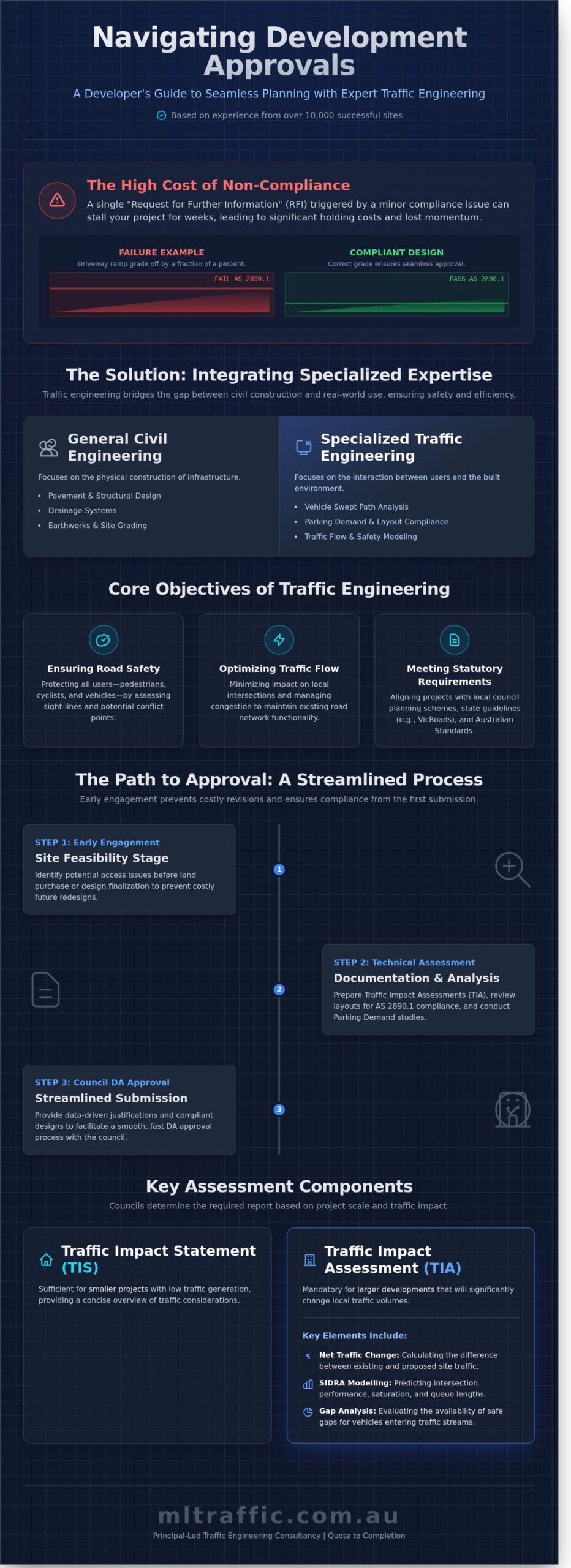
How much does a single "Request for Further Information" from a planning authority actually cost your project timeline when it’s triggered by a non-compliant parking grade? For developers seeking specialist traffic engineering expertise to lead their application, these delays are more than just an inconvenience. They often represent weeks of lost momentum and significant holding costs. We’ve seen projects stalled because a driveway ramp grade was off by a fraction of a percent, failing to meet AS 2890.1 requirements.
You likely agree that interpreting complex Clause 52.06 and Australian Standards shouldn’t be the bottleneck in your development process. This article explains how specialized traffic engineering, like that provided by ML Traffic Engineers Australia, integrates with civil design to ensure seamless planning approvals. Drawing on experience from over 10,000 successful sites, we provide a clear roadmap of the TIA process. You’ll discover how to achieve compliance from the first submission and avoid the expensive revisions that typically plague late-stage civil works.
Key Takeaways
-
Understand how specialized traffic engineering integrates with civil design to ensure the safe and efficient movement of people and goods.
-
Learn about the technical role of Traffic Impact Assessments (TIA) and Swept Path Analysis in validating site functionality and safety.
-
Gain insights into navigating Australian Standards AS 2890.1 and AS 2890.2 to meet strict off-street parking and commercial loading requirements.
-
Discover how a professional traffic engineer Melbourne can streamline council DA approvals by providing data-driven justifications for RFIs.
-
Explore the advantages of a principal-led consultancy model where senior experts manage your project directly from quote to completion.
Table of Contents
What is Traffic Engineering in the Context of Civil Projects?
Traffic engineering is a specialized branch of civil engineering. It focuses on the safe and efficient movement of people and goods across our transport networks. While general civil engineering deals with the physical construction of infrastructure like drainage and pavement, a What is Traffic Engineering assessment focuses on the interaction between human behavior and the built environment. A professional traffic engineer Melbourne uses technical data and predictive modeling to ensure new developments don’t compromise the functionality of existing roads.
To better understand the role of these professionals in the Victorian context, watch this overview of a traffic engineering position in the city:
The role of a consultant is critical during the planning and Development Application (DA) phase. They interpret complex regulatory frameworks to ensure a project meets statutory requirements. This involves analyzing vehicle swept paths, driveway ramp grades, and car parking demand. Early involvement is essential. It prevents costly design revisions that occur when a site layout fails to meet Australian Standards or Council expectations. Meticulous planning at the start can save developers thousands in avoidable redesign fees and project delays.
The Core Objectives of Traffic Engineering
-
Ensuring road safety: This applies to all users, including pedestrians, cyclists, and heavy vehicles. We assess sight-line requirements and potential conflict points within a site layout.
-
Optimizing traffic flow: Minimizing the impact on local intersections ensures the existing road network remains functional and congestion is managed.
-
Meeting statutory requirements: Every project must align with local council planning schemes and state road authority guidelines, such as those set by VicRoads.
When to Engage a Specialized Traffic Consultant
Engaging a traffic engineer Melbourne early in the process is the most effective way to secure a permit. Our involvement typically begins during the initial site feasibility stage to identify potential access issues before land purchase or design finalization. We provide the following essential services:
-
Preparing technical documentation like a Traffic Impact Statement (TIS) or Traffic Impact Assessment (TIA) for Council submission.
-
Reviewing internal site layouts to confirm compliance with AS 2890.1 for parking and access.
-
Conducting Car Parking Demand Assessments to justify a reduction in standard parking requirements.
-
Learn about our full range of services to see our specialized technical capabilities for various land-use types.
Key Components of a Traffic Engineering Assessment
A comprehensive traffic engineering assessment provides the empirical data required by Victorian councils to approve a development. This process involves evaluating how a project interacts with the existing transport network. Each assessment focuses on safety, efficiency, and statutory compliance. Engaging a qualified traffic engineer Melbourne ensures that these reports meet the rigorous standards set by local authorities and the Department of Transport and Planning.
Traffic Impact Assessments (TIA) vs. Statements (TIS)
Councils determine the level of reporting required based on the scale of the proposed development. A Traffic Impact Statement (TIS) is generally sufficient for smaller projects with low traffic generation. In contrast, a full Traffic Impact Assessment (TIA) is mandatory for larger developments that significantly change local traffic volumes. Key elements include:
-
Net Traffic Change: Calculating the difference between existing site use and the proposed development.
-
SIDRA Modelling: Using industry-standard software to predict intersection performance, including degree of saturation and queue lengths.
-
Gap Analysis: Evaluating the availability of safe gaps for vehicles turning into or out of the site.
If a project adds more than 10 to 30 vehicle movements during peak hours, councils often require SIDRA analysis to ensure nearby intersections don’t drop below acceptable levels of service.
Vehicle Swept Path and Access Assessments
Ensuring that vehicles can navigate a site safely is a non-negotiable requirement. We use AutoTURN software to simulate the movements of specific vehicles, from standard B85 cars to 12.5-metre heavy waste trucks. This analysis confirms that vehicles can enter and exit the site in a single forward motion without striking curbs or structures. You can find more technical details in our Swept Path Analysis guide.
Critical factors in these assessments include:
-
AS 2890.1 Compliance: Meeting Australian Standards for off-street car parking and driveway ramp grades.
-
Waste Management: Verifying that private or council waste trucks have sufficient clearance and turning radii.
-
Sight-Line Assessments: Ensuring drivers have clear visibility of pedestrians and oncoming traffic at the property boundary.
Car Parking and Intersection Analysis
A car parking demand assessment compares the number of spaces required by the planning scheme against the number provided. If a developer seeks a parking reduction, the traffic engineer Melbourne must justify the shortfall using empirical data or empirical evidence from similar land uses. Intersection analysis further evaluates how the development affects the broader network. This involves assessing 85th percentile speeds and existing traffic volumes to determine if upgrades, such as new turn lanes or signals, are necessary. To see how these components fit into your planning permit, review our full range of technical services.
Navigating Australian Standards for Parking and Access
Compliance with Australian Standards is the primary hurdle for any development application in Victoria. A traffic engineer Melbourne must ensure every design aspect aligns with the AS 2890 series to avoid costly revisions or council refusal. These standards dictate the physical limits of vehicle movement and storage on-site. They aren’t suggestions; they’re the benchmarks used by planning authorities to evaluate safety and functionality.
AS 2890.1: The Foundation of Compliant Car Park Design
AS 2890.1 governs off-street car parking for light vehicles. It specifies exact dimensions for parking bays, often requiring a 2.4-metre width for residential use or up to 2.7 metres for short-term retail visitors. Aisle widths usually range between 5.8 and 6.6 metres depending on the angle of parking. For more technical detail, see AS 2890.1 Explained: The Ultimate Guide to Compliant Car Park Design. When site constraints prevent strict adherence, we provide expert justification to prove the design remains functional and safe. This technical advocacy is essential for sites with limited footprints.
Driveway and Access Compliance
Driveway design often fails during council review due to incorrect ramp grades. AS 2890.1 requires specific transitions to prevent vehicle scraping, particularly where a steep ramp meets a level floor. A common requirement is a maximum grade of 1 in 4 for domestic driveways, while commercial ramps are more restricted. We use precise calculations to ensure the transition lengths are sufficient for the expected vehicle types.
Sight distance is another critical factor. We assess the 2.0-metre by 2.5-metre sight triangles at the property boundary. This ensures drivers can see pedestrians on the footpath before exiting the site. Failure to meet these metrics often leads to permit delays or requirements for expensive mirrors and warning signals. Commercial sites must also reference AS 2890.2 for heavy vehicle access. This involves:
-
Calculating swept paths for Medium Rigid Vehicles (MRV) or Heavy Rigid Vehicles (HRV).
-
Ensuring loading docks allow vehicles to enter and exit in a forward direction.
-
Verifying vertical clearances for waste collection trucks, which typically require a minimum of 4.5 metres.
-
Designing turning circles that accommodate the B99 design vehicle without impacting parked cars.
Certification from an experienced traffic engineer Melbourne is mandatory for most council submissions. We provide signed compliance letters and detailed plans that streamline the approval process. It’s a fact-based approach that removes ambiguity for council planners. Our senior staff handle these assessments personally to ensure every driveway and parking bay meets the required 2024 regulatory standards.
How Traffic Engineering Facilitates Council DA Approvals
Securing a planning permit from Victorian councils requires more than just a compliant design; it demands technical justification that satisfies both statutory requirements and the specific concerns of council transport departments. A traffic engineer Melbourne acts as the bridge between a developer’s vision and the council’s regulatory framework. When a council issues a Request for Further Information (RFI), it often targets perceived deficiencies in parking provision, site access, or traffic generation. We resolve these by providing empirical evidence, such as parking demand surveys or SIDRA intersection modelling, to demonstrate that the proposal won’t negatively impact the local road network.
Our role involves constant collaboration with town planners and architects. We refine site plans by assessing vehicle swept paths for B85 and B99 vehicles, ensuring that every car park and accessway complies with Australian Standards (AS 2890.1). If a council refuses an application, the matter may proceed to the Victorian Civil and Administrative Tribunal (VCAT). Our senior engineers provide expert evidence at these hearings, presenting technical findings that withstand rigorous cross-examination. This level of professional representation is often the deciding factor in overturning a refusal or resolving complex permit conditions.
The Traffic Report as a Negotiation Tool
Council planners often apply the standard parking rates found in Clause 52.06 of the Victoria Planning Provisions. However, these rates don’t always reflect the reality of modern urban developments near high-frequency public transport. We use data-driven justifications to support parking reductions, ensuring the project remains commercially viable. By presenting empirical data from similar land-use types, we balance council expectations with the practicalities of the site. Meet our experienced team of consultants to see how we apply decades of expertise to your project negotiation.
Construction Traffic Management Plans (TMP)
Once a permit is issued, the focus shifts to the build phase. A Construction Traffic Management Plan (TMP) is a mandatory requirement for most Melbourne developments. This document outlines how heavy vehicles will access the site, where materials will be loaded, and how pedestrian safety is maintained. It’s about minimizing disruption to the local network while keeping the construction schedule on track. For a deeper look at these requirements, see our Traffic Management Plan (TMP): The Definitive Guide for Australian Projects.
Ensure your development application meets all council requirements with professional technical support. Contact ML Traffic Engineers Australia today for a comprehensive assessment of your site.
Partnering with ML Traffic Engineers for Your Next Project
ML Traffic Engineers operates on a principal-led model. The senior traffic engineer Melbourne developers speak with during the quoting phase is the same expert who completes the technical reports. Since 2005, the firm has successfully delivered assessments for over 10,000 sites across Australia. This direct accountability ensures that technical tasks, such as Vehicle Swept Path Analysis, Sight-Line Assessments, and driveway ramp grade calculations, are handled by qualified professionals. Clients receive direct access to Michael Lee and Benny Chen. These principals bring between 30 and 40 years of individual experience to every project they touch.
Our expertise spans an exhaustive range of land-use categories. We’ve completed work for apartments, bars, car washes, child care centres, gymnasiums, hotels, medical facilities, schools, temples, and large-scale industrial warehouses. This breadth of experience means we understand the specific traffic generation and parking requirements for almost any development type. We don’t rely on guesswork; we rely on decades of data and successful project outcomes.
Our National Capability and Local Expertise
The firm provides comprehensive traffic engineering services across every Australian state. We maintain a deep understanding of varying council requirements and the specific nuances of local planning schemes. We don’t hide behind layers of management or administrative staff. Our communication style is direct and focused on technical compliance with Australian Standards like AS 2890.1. This approach allows us to navigate the complexities of transport planning without the bureaucracy that often slows down major civil projects. Whether your project is in a metropolitan hub or a regional area, our team delivers the same level of meticulous detail.
Get Started with a Traffic Engineering Quote
A hands-on approach delivers better value for your development application. By having senior experts involved in every step, we identify potential site constraints early in the process. This prevents costly redesigns and ensures your project meets the necessary regulatory benchmarks for TIS or TIA submissions. If you require a straightforward assessment of your site needs, our team is ready to assist. You can Contact ML Traffic Engineers for a professional quote today. Direct access to our principals ensures that your technical requirements are handled with the authority and precision required for modern project approvals.
Secure Your Project Approval with Proven Traffic Expertise
Navigating the technicalities of Council DA approvals requires precise data and strict adherence to Australian Standards like AS 2890.1. A professional traffic engineer Melbourne ensures your project meets all parking, access, and safety requirements from the start. This reduces the risk of costly revisions or project delays. Our team has assessed over 10,000 sites across Australia, providing the technical depth needed for complex civil developments and private land-use projects. You’ll work directly with senior staff who bring between 30 and 40 years of individual experience to every assessment.
We maintain a hands-on approach where the consultant who provides your quote is the expert who completes the work. This direct accountability ensures your traffic impact statements and swept path assessments are accurate and defensible. You can reach our principal engineers directly via mobile to discuss your specific site requirements without navigating gatekeepers. Let’s ensure your next development meets every regulatory benchmark efficiently. Contact ML Traffic Engineers for a Professional Traffic Assessment to start your project on the right track.
Frequently Asked Questions
What is the difference between a traffic engineer and a transport planner?
A traffic engineer focuses on the technical design and physical operation of road infrastructure, including intersection geometry and parking layouts. They apply specific technical standards like AS 2890.1 to ensure site-specific compliance. A transport planner handles the broader strategic movement of people and policy integration across urban networks. Our team combines both disciplines to ensure your development meets the rigorous technical and planning requirements of Melbourne councils.
When is a Traffic Impact Assessment (TIA) required for a development?
A Traffic Impact Assessment is required when a development proposal exceeds the trip generation or parking thresholds defined in Clause 52.06 of the Victoria Planning Provisions. Councils trigger this requirement for commercial, industrial, or high-density residential projects that may alter local traffic flow. Our traffic engineer Melbourne team reviews your site plans to determine if you need a full TIA or a more concise Traffic Impact Statement.
Can a civil engineer sign off on a traffic report?
A civil engineer can only sign off on a traffic report if they possess specific, documented expertise in traffic engineering and transport planning. Most Victorian councils require reports prepared by a specialist traffic engineer Melbourne professional to ensure adherence to Department of Transport and Planning guidelines. Specialist engineers are necessary for technical tasks like SIDRA intersection modelling and ensuring compliance with AS 2890.1 for car parking facilities.
How long does it typically take to prepare a traffic assessment for council?
Preparing a standard traffic assessment usually takes between 10 and 15 business days once we receive your final architectural plans. This period allows for data collection, site inspections, and detailed technical analysis. Complex projects involving multi-day traffic counts or extensive intersection modelling can take up to 4 weeks. We maintain a direct workflow where the consultant who provides your quote also performs the technical work.
What software is used for vehicle swept path analysis?
AutoCAD equipped with AutoTURN or Vehicle Tracking software is the industry standard for conducting vehicle swept path analysis. These tools allow our engineers to simulate the movement of specific vehicles, such as an 8.8 metre Medium Rigid Vehicle, through your proposed site layout. This process confirms that all driveways and loading areas meet the turning circle requirements set out in Australian Standard AS 2890.2.
How much does a traffic engineering report cost for a standard DA?
The cost of a traffic engineering report depends on the scale of the development and the specific requirements issued by the council. Basic assessments for small-scale projects often start at approximately A$1,500 based on current industry benchmarks. Larger developments requiring SIDRA modelling or parking surveys involve higher fees due to the increased technical hours. We provide fixed, transparent quotes based on our experience with over 10,000 completed sites.
What happens if my development doesn’t meet the statutory parking requirements?
If your development cannot meet the statutory parking requirements of Clause 52.06, you must submit a Car Parking Demand Assessment to justify a parking reduction. Our engineers use empirical data, local census statistics, and public transport accessibility scores to support these applications. We have a proven track record of securing permits for sites with significant physical constraints by demonstrating that the actual parking demand is lower than the statutory rate.
Is a traffic engineer required for small-scale residential developments?
A traffic engineer is required for small-scale residential projects if the design includes complex driveway gradients or non-standard parking arrangements. Councils often request a Sight-Line Assessment or a Vehicle Swept Path Assessment even for two-dwelling subdivisions to ensure road safety. Engaging a specialist early helps avoid a Request for Further Information (RFI) and prevents expensive structural changes during the planning permit process.
Which areas do you cover?
We service all suburbs of Melbourne metropolitan area, such as Abbotsford, Aberfeldie, Aintree, Airport West, Albanvale, Albert Park, Albion, Alphington, Altona, Altona Meadows, Altona North, Ardeer, Armadale, Arthurs Seat, Ascot Vale, Ashburton, Ashwood, Aspendale, Aspendale Gardens, Attwood, Avondale Heights, Balaclava, Balwyn, Balwyn North, Bangholme, Bayswater, Bayswater North, Beaconsfield, Beaumaris, Bellfield, Bentleigh, Bentleigh East, Berwick, Bittern, Blackburn, Blackburn North, Blackburn South, Bonbeach, Boronia, Box Hill, Box Hill North, Box Hill South, Braeside, Braybrook, Brentford Square, Brighton, Brighton East, Broadmeadows, Brooklyn, Brunswick, Brunswick East, Brunswick West, Bulla, Bulleen, Bundoora, Burnley, Burnside, Burwood, Burwood East, Cairnlea, Camberwell, Campbellfield, Canterbury, Carlton, Carlton North, Carnegie, Caroline Springs, Carrum, Carrum Downs, Caulfield, Caulfield East, Caulfield North, Caulfield South, Chadstone, Chelsea, Chelsea Heights, Cheltenham, Chirnside Park, Clarinda, Clayton, Clayton South, Clematis, Clifton Hill, Coburg, Coburg North, Cocoroc, Coldstream, Collingwood, Coolaroo, Craigieburn, Cranbourne, Cranbourne East, Cranbourne North, Cranbourne South, Cranbourne West, Cremorne, Croydon, Croydon Hills, Croydon North, Croydon South, Dandenong, Dandenong North, Dandenong South, Deer Park, Delahey, Derrimut, Diamond Creek, Diggers Rest, Dingley Village, Docklands, Doncaster, Doncaster East, Donnybrook, Donvale, Doreen, Doveton, Eaglemont, East Melbourne, Edithvale, Elsternwick, Eltham, Eltham North, Elwood, Emerald, Endeavour Hills, Epping, Essendon, Essendon Fields, Essendon North, Essendon West, Fairfield, Fawkner, Ferntree Gully, Ferny Creek, Fitzroy, Fitzroy North, Flemington, Footscray, Forest Hill, Frankston, Frankston North, Frankston South, Gardenvale, Gladstone Park, Glen Huntly, Glen Iris, Glen Waverley, Glenroy, Greensborough, Greenvale, Guys Hill, Hadfield, Hampton, Hampton East, Hampton Park, Harkaway, Hawthorn, Hawthorn East, Heathmont, Heidelberg, Heidelberg Heights, Heidelberg West, Highett, Hillside, Hoppers Crossing, Hughesdale, Huntingdale, Hurstbridge, Ivanhoe, Ivanhoe East, Jacana, Kalkallo, Kealba, Keilor, Keilor Downs, Keilor East, Keilor Lodge, Keilor North, Keilor Park, Kensington, Kew, Kew East, Keysborough, Kings Park, Kingsbury, Kingsville, Knoxfield, Lalor, Langwarrin, Laverton, Laverton North, Lilydale, Lower Plenty, Lynbrook, Lyndhurst, Lysterfield, Macleod, Maidstone, Malvern, Malvern East, Maribyrnong, McCrae, Meadow Heights, Melbourne, Mentone, Mernda, Mickleham, Middle Park, Mill Park, Mitcham, Mont Albert, Mont Albert North, Montmorency, Moonee Ponds, Moorabbin, Mooroolbark, Mordialloc, Mornington, Mount Waverley, Mulgrave, Murrumbeena, Narre Warren, Narre Warren North, Narre Warren South, Newport, Niddrie, Noble Park, Noble Park North, North Melbourne, Northcote, Notting Hill, Nunawading, Oak Park, Oaklands Junction, Oakleigh, Oakleigh East, Oakleigh South, Officer, Ormond, Pakenham, Parkdale, Park Orchards, Pascoe Vale, Pascoe Vale South, Patterson Lakes, Plenty, Point Cook, Port Melbourne, Portsea, Prahran, Preston, Princes Hill, Reservoir, Richmond, Ringwood, Ringwood East, Ringwood North, Ripponlea, Rosanna, Rosebud, Rowville, Roxburgh Park, Rye, Sandhurst, Sandringham, Scoresby, Seabrook, Seaholme, Seddon, Seaford, South Kingsville, South Melbourne, South Morang, South Wharf, South Yarra, Southbank, Spotswood, St Albans, St Helena, St Kilda, St Kilda East, St Kilda West, Strathmore, Sunshine, Sunshine North, Sunshine West, Surrey Hills, Sydenham, Tarneit, Taylors Hill, Taylors Lakes, Templestowe, Templestowe Lower, Thomastown, Thornbury, Toorak, Tottenham, Travancore, Truganina, Tullamarine, Vermont, Vermont South, Viewbank, Wantirna, Wantirna South, Watsonia, Watsonia North, Werribee, Werribee South, West Footscray, West Melbourne, Westgarth, Wheelers Hill, Wildwood, Williamstown, Williamstown North, Windsor, Wonga Park, Wyndham Vale, Yallambie, Yarraville.
Disclaimer
The content on www.mltraffic.com.au, including all technical articles, guides, and resources, is provided for general informational and educational purposes only. It is not intended to constitute professional advice in traffic engineering, transportation planning, development approvals, or any other technical or legal field.
While ML Traffic Engineers makes every reasonable effort to ensure the accuracy, completeness, and timeliness of the information published, we do not provide any warranties or representations (express or implied) regarding its reliability, suitability, or availability for any particular purpose. Any reliance you place on the content is strictly at your own risk.
In no event shall ML Traffic Engineers, its directors, employees, authors, or affiliates be liable for any direct, indirect, incidental, special, consequential, or punitive damages (including, without limitation, loss of profits, data, or business opportunities) arising out of or in connection with the use of, or inability to use, any information provided on this website.
The articles and guides on this site are not a substitute for engaging a qualified, registered professional traffic engineer (such as an NPER or RPEQ engineer) to assess your specific project requirements. For tailored advice, compliance assessments, or traffic engineering services, please contact a competent professional.
This disclaimer may be updated from time to time without notice. By accessing or using this website, you agree to be bound by the most current version of this disclaimer.
