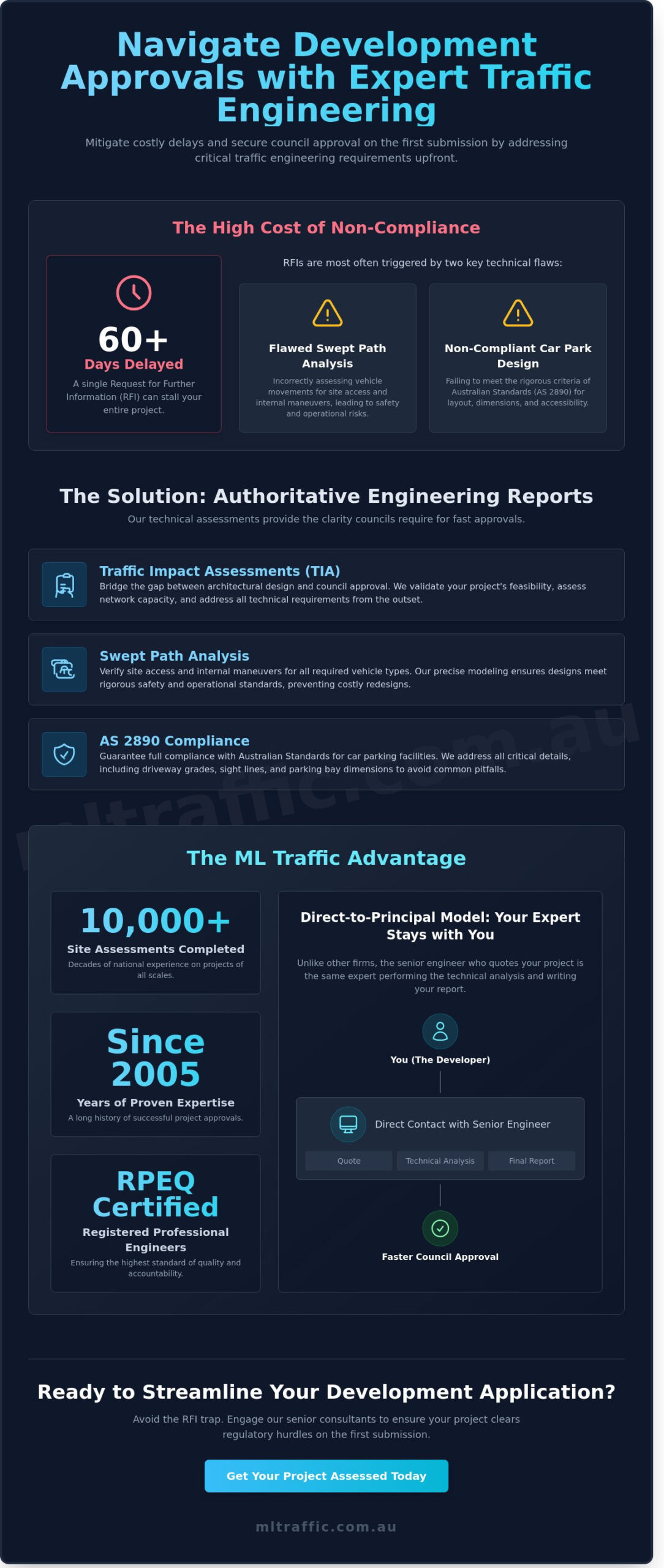

A single Request for Further Information (RFI) from council can stall a civil project for 60 days or more, forcing developers to manage mounting holding costs and unnecessary project delays. Most professionals recognize that a non-compliant car park design or a flawed vehicle swept path assessment is the primary trigger for these bureaucratic setbacks. By engaging Professional Traffic Engineer Services for Gold Coast and National Civil Projects, you mitigate these risks through technical precision and decades of industry experience. Since 2005, our senior consultants have completed over 10,000 site assessments, ensuring that every report meets the rigorous criteria of Australian Standards (AS 2890).
We agree that your priority is a high-yield site layout that clears regulatory hurdles on the first submission. This article details how our authoritative engineering reports provide the clarity councils require to grant fast approvals for civil and private developments. You’ll gain insights into our direct-to-principal model, where the engineer who quotes your project is the same expert performing the technical analysis. We examine the critical role of Sight-Line Assessments, Traffic Impact Statements, and compliant driveway grades in securing a successful Development Application.
Key Takeaways
-
Learn how specialized Traffic Impact Assessments (TIA) bridge the gap between architectural design and council approval to streamline your development application.
-
Understand the critical role of Swept Path Analysis in verifying site access and ensuring internal vehicle maneuvers meet rigorous safety standards.
-
Ensure full compliance with Australian Standards AS 2890 by utilizing Professional Traffic Engineer Services for Gold Coast and National Civil Projects to avoid common car park design pitfalls.
-
Identify specific traffic engineering strategies for complex sites like childcare centers to manage peak-hour drop-offs and pedestrian safety effectively.
-
Discover the benefits of a principal-led consultancy model where the senior expert providing your quote is the same professional performing the technical work.
Table of Contents
-
The Role of Professional Traffic Engineer Services in Development Approvals
-
Technical Assessments: Traffic Impact Statements and Swept Path Analysis
-
National Compliance: Australian Standards AS 2890 and Car Park Design
-
Traffic Reports for Childcare Centres and Complex Commercial Sites
-
The ML Traffic Advantage: Senior Expertise for Every Project
The Role of Professional Traffic Engineer Services in Development Approvals
Professional traffic engineering consultancy acts as the technical bridge between architectural design and local government approval. While an architect focuses on the building’s form, a traffic engineer ensures the site functions safely within the existing road network. Traffic engineering involves the application of scientific principles to the planning, functional design, and operation of transport systems. For developers, this means securing a Traffic Impact Assessment (TIA) that meets the specific requirements of the local council or state road authority. It’s a technical requirement that validates the feasibility of your project’s access and parking arrangements.
Choosing Professional Traffic Engineer Services for Gold Coast and National Civil Projects ensures that your development application (DA) addresses technical requirements from the outset. Specialized engineering planning differs significantly from physical traffic control. While traffic control manages on-site safety during construction with cones and signage, engineering planning involves complex data analysis, SIDRA modeling, and Vehicle Swept Path Assessments. High-quality reports prepared by RPEQ (Registered Professional Engineer of Queensland) certified consultants reduce the risk of Council Requests for Further Information (RFIs); these requests often cause project delays of 30 to 60 days.
To better understand the distinction between various engineering roles in this field, watch this helpful video:
When is a Traffic Engineering Report Required?
Common triggers for traffic reports in Australian DAs include any change in land use that increases vehicle trips or alters parking requirements. For residential projects, this often applies to dual occupancies or multi-unit developments exceeding 3 dwellings. Commercial projects, such as childcare centers or service stations, require more complex impact assessments due to high turnover rates. The legislative framework, including the Transport Planning and Coordination Act 1994 and various local planning schemes, dictates the depth of analysis needed. Smaller sites might only require a Traffic Impact Statement (TIS), while larger national civil projects demand comprehensive TIAs covering intersection performance and network capacity.
Securing Council Approval for Private Developments
Traffic engineers work alongside town planners and architects to optimize site layouts before submission. Providing early-stage advice prevents costly site redesigns after the DA has been lodged. Engineers assess the capacity of the local road network to handle the projected increase in traffic flow generated by the new development. Addressing council concerns regarding sight-line assessments and driveway ramp grades according to AS 2890.1 is critical. By identifying potential bottlenecks before submission, Professional Traffic Engineer Services for Gold Coast and National Civil Projects facilitate a smoother path to approval. Our team has provided these specialized traffic engineering services for over 10,000 sites across Australia since 2005.
Technical Assessments: Traffic Impact Statements and Swept Path Analysis
Technical assessments provide the empirical foundation for any successful development application. When engaging Professional Traffic Engineer Services for Gold Coast and National Civil Projects, you receive more than a basic report; you get a defensible technical argument. Planning panels and local councils require high-resolution data to approve projects that increase density or change land use. We use specific metrics to prove that your development won’t compromise the safety or efficiency of the existing road network. Our team has delivered these assessments for over 10,000 sites across Australia, ensuring each project meets rigorous regulatory standards.
The Mechanics of a Traffic Impact Statement (TIS)
A TIA is the technical evaluation of a development’s effect on the surrounding road environment. Our methodology begins with calculating existing traffic volumes through 24-hour or peak-period counts. We then apply growth projections, often looking 10 years into the future, to ensure the local infrastructure can handle the added load. This forward-looking approach prevents future congestion issues and protects the long-term viability of the site.
We evaluate intersection performance using SIDRA Intersection software. This identifies the Level of Service (LoS) and the specific degree of saturation at critical junctions. We also conduct sight-line assessments to confirm that drivers exiting your site have sufficient visibility to avoid collisions, adhering strictly to AS 2890.1. These reports align with the Transport Impact Assessment guidelines, providing a standard of documentation that satisfies both state and local authorities.
Swept Path Analysis for Loading and Service Areas
Swept Path Analysis (SPA) is essential for projects involving heavy vehicles or tight urban footprints. We use industry-standard software like AutoTURN to simulate the exact movements of design vehicles. This includes waste collection trucks, emergency vehicles, and delivery vans. Without this analysis, you risk costly redesigns during the construction phase or operational failures once the building is occupied.
-
Simulating turns to prevent kerb strikes or damage to structural columns.
-
Verifying that an 8.8m Medium Rigid Vehicle (MRV) can enter and exit in a forward gear.
-
Ensuring compliance with AS 2890.2 for commercial service and loading areas.
-
Meeting specific Gold Coast City Council requirements for on-site maneuvering and driveway ramp grades.
Our Professional Traffic Engineer Services for Gold Coast and National Civil Projects ensure that every internal maneuver is accounted for before you break ground. For a deeper look at these technical requirements, see our Swept Path Analysis Guide. If you need a technical review of your site plan, you can contact our senior engineers for a direct consultation on your project’s specific needs.
National Compliance: Australian Standards AS 2890 and Car Park Design
Adhering to Australian Standard AS 2890 is a non-negotiable requirement for any development application. In Australia, parking design isn’t a suggestion; it’s a strict regulatory framework. AS 2890.1 governs off-street car parking, while AS 2890.2 dictates requirements for commercial vehicle facilities. Failing to meet these standards often results in costly redesigns or rejected DA submissions. Professional Traffic Engineer Services for Gold Coast and National Civil Projects ensure that every centimetre of a site layout is optimized while remaining 100% compliant with these codes.
Developers often struggle to balance maximum parking yield with safety. Pushing for an extra two or three spots can compromise aisle widths or turn circles, leading to a non-compliant design. Our engineers use technical precision to find the "sweet spot" where a site reaches its full commercial potential without breaching AS 2890. Certification from a qualified traffic engineer is essential because it provides the Council with proof that the design works in the real world, not just on a 2D plan. We verify that B85 and B99 vehicles can navigate the space without conflict.
Mastering AS 2890.1 for Off-Street Car Parking
Effective car park design requires absolute precision. AS 2890.1 specifies minimum aisle widths, which usually range from 5.8 to 6.6 metres depending on the parking angle and bay width. Standard parking bays must measure 2.4 by 5.4 metres for User Class 1A. Clearance heights are equally critical; a minimum of 2.2 metres is required for standard areas, increasing to 2.5 metres for accessible spaces under AS 2890.6. For a deeper dive into these technicalities, review this AS 2890.1 Explained guide. We ensure that columns are placed outside of the required door-opening envelopes to prevent vehicle damage and user frustration.
Driveway Ramp Grades and Sight Distance
Driveway design is where many projects fail during the assessment phase. AS 2890.1 requires specific ramp gradients to prevent vehicle "grounding" or scraping. For example, a maximum grade of 1 in 4 (25%) is allowed for domestic driveways, but transitions of 1 in 8 for at least 2 metres are necessary at the top and bottom of steep sections. Pedestrian safety is another priority that cannot be overlooked. We assess sight lines at the property boundary to ensure drivers can see pedestrians before crossing the footpath. Professional Traffic Engineer Services for Gold Coast and National Civil Projects provide the necessary verification for constrained sites where standard templates simply don’t fit. We use swept path analysis to prove that even on steep or narrow lots, vehicles can enter and exit in a forward direction safely.
-
Verification of B85 and B99 vehicle templates.
-
Assessment of 1 in 20 grades for the first 6 metres of a driveway.
-
Compliance checks for AS 2890.6 disabled parking modules.
-
Calculation of headroom clearances for basement entries.
Mistakes in these calculations lead to construction errors that are often impossible to fix once the concrete is poured. Engaging an expert early prevents these failures and keeps the project on track for approval.
Traffic Reports for Childcare Centres and Complex Commercial Sites
Childcare developments and multi-use commercial hubs present the most complex challenges in modern traffic engineering. These "sensitive use" sites require meticulous planning to satisfy council requirements and ensure public safety. Our firm provides Professional Traffic Engineer Services for Gold Coast and National Civil Projects, focusing on high-risk zones where vehicle and pedestrian movements frequently intersect. We understand that council scrutiny is highest when children are involved, making technical accuracy non-negotiable.
Childcare centres experience intense pressure during peak periods, typically between 7:00 AM and 9:00 AM, and again from 4:00 PM to 6:00 PM. During these windows, the volume of vehicle movements can increase by 350 to 400 percent compared to off-peak hours. We address these surges by designing layouts that prioritize the physical separation of pedestrian paths from vehicle maneuvering areas. This ensures parents and children aren’t forced to walk behind reversing vehicles or through active driveways. We rely on Australian Standards (AS 2890.1) to guide every driveway ramp grade and sight-line assessment.
Childcare Centre Traffic Management
A successful Development Application (DA) for a childcare facility relies on a robust parking demand assessment. We calculate these requirements based on the maximum number of children and staff, often exceeding the minimums set by local planning schemes to prevent street overspill. A clear Traffic Management Plan (TMP) is essential for daily operations. In our experience across 10,000 sites, a TMP that defines one-way circulation and dedicated staff parking significantly reduces congestion. Our specialized reporting has secured approvals for centres in high-traffic corridors by proving that the local road network can absorb the 85th percentile of expected trip generation without failing intersections.
Commercial and Mixed-Use Project Requirements
Commercial sites must balance heavy vehicle logistics with customer convenience. We coordinate loading dock access to ensure delivery trucks don’t block customer parking flow. Our intersection analysis for high-volume entrances uses SIDRA modelling to predict delays and queue lengths accurately. We provide comprehensive Traffic Engineering Services that include Vehicle Swept Path Assessments. These assessments confirm that a 12.5-meter Heavy Rigid Vehicle (HRV) can enter and exit the site in a forward direction. This level of technical detail is what councils demand for complex commercial approvals.
Professional Traffic Engineer Services for Gold Coast and National Civil Projects are vital when addressing council concerns about traffic noise and safety in sensitive zones. If you’re developing a site with high turnover or complex access needs, contact our senior engineers today for a direct quote and expert assessment.
The ML Traffic Advantage: Senior Expertise for Every Project
Large engineering firms often rely on a rigid hierarchy where senior partners secure contracts and junior staff execute the technical work. This model creates a gap between the project’s vision and the final output. ML Traffic Engineers operates on a principal-led model to eliminate this disconnect. Since 2005, we’ve provided Professional Traffic Engineer Services for Gold Coast and National Civil Projects by ensuring senior experts stay involved in every detail. The traffic consultant who provides the quote is the same professional who does the work. This approach guarantees that 30 to 40 years of individual experience is applied directly to your development application.
Our firm has assessed over 10,000 sites across Australia. This volume of work isn’t just a number; it represents a deep library of data and precedents across every conceivable land use. We’ve handled projects ranging from high-rise apartments and shopping centers to specialized facilities like temples, schools, and medical centers. Clients benefit from direct access to RPEQ certified engineers who understand the specific bureaucratic requirements of local councils and state road authorities. You won’t wait days for a callback from a project manager; you get immediate, technical advice from the person writing your report.
A Hands-On Approach to Traffic Consultancy
Direct communication is the cornerstone of our service. By eliminating the middleman, we ensure that technical requirements aren’t lost in translation. Clients deal directly with Michael Lee or Benny Chen throughout the project lifecycle. This accountability extends to our field work. We don’t outsource site visits to data collection firms only to have a junior engineer interpret the findings. The person who stands on the curb to assess sight-line visibility and driveway ramp grades is the same person who signs off on the final Traffic Impact Statement (TIS). You can learn more about our senior-led team by visiting our About ML Traffic page.
-
Direct access to RPEQ and senior consultants for every project.
-
Elimination of corporate gatekeepers and administrative delays.
-
Ensured consistency between site observations and reported data.
-
Expertise in AS 2890.1 and other critical Australian Standards.
Partnering for National Civil Success
Success in national civil projects requires reports that are clear, concise, and compliant. We focus on providing Professional Traffic Engineer Services for Gold Coast and National Civil Projects that withstand the scrutiny of council reviewers and planning panels. Our reports address Vehicle Swept Path Assessments, Car Parking Demand, and Sight-Line Assessments with technical precision. We don’t produce fluff; we produce data-driven documents that facilitate approvals.
Getting started is straightforward. We provide project-specific quotes based on your unique site plans and proposed land use. There are no generic fee structures because no two developments are identical. We analyze your specific needs, provide a transparent quote, and begin the technical assessment immediately. Contact ML Traffic Engineers today for a project-specific quote to ensure your next development application is backed by senior engineering expertise.
Secure Your DA Approval with Proven Traffic Engineering Expertise
Navigating the complexities of development approvals requires technical precision and strict adherence to Australian Standards. Since 2005, ML Traffic Engineers has successfully completed over 10,000 sites across Australia. We provide specialized AutoTURN and swept path analysis expertise to ensure every car park design and site access point meets AS 2890 requirements. You’ll work directly with our principals, who each possess 30+ years of industry experience. We don’t use junior staff or gatekeepers; the consultant who provides your quote is the same expert who performs the technical work.
Our Professional Traffic Engineer Services for Gold Coast and National Civil Projects focus on delivering authoritative Traffic Impact Statements and transport planning reports that council officers trust. Whether you’re developing a childcare centre, a multi-unit residential complex, or a large-scale industrial warehouse, we provide the data-driven assessments necessary for project success. Don’t leave your approval to chance when you can leverage decades of specialized knowledge.
Get a Professional Traffic Engineering Quote for Your Project
We look forward to helping you move your development forward with confidence and technical certainty.
Frequently Asked Questions
What is the difference between a Traffic Impact Assessment and a Traffic Management Plan?
A Traffic Impact Assessment (TIA) evaluates the permanent, long-term impact a new development has on the surrounding road network. It’s a requirement for DA approvals to ensure local infrastructure can handle new vehicle volumes. In contrast, a Traffic Management Plan (TMP) focuses on temporary safety measures. TMPs detail specific signage, barricades, and traffic controller placements required during construction phases or special events to manage immediate road risks.
How much does a professional traffic engineering report cost for a DA?
The cost of a traffic engineering report depends on the project’s scale and the specific requirements set by the local Council. Factors like the number of intersections requiring SIDRA modeling or the complexity of the site’s access points determine the final fee. We provide fixed-price quotes after reviewing your architectural plans. This ensures you receive a precise price tailored to your specific development without any hidden administrative surcharges.
When is a Swept Path Analysis required for a residential development?
Council requires a Swept Path Analysis whenever a residential design includes tight turns, basement ramps, or narrow driveways that might hinder vehicle movement. We use specialized software to prove that a B85 or B99 vehicle can enter and exit the site in a single forward motion. This assessment is mandatory under Australian Standard AS 2890.1 for multi-unit developments and any site where driveway gradients exceed a 1:20 slope.
Can a traffic engineer help if my car park design is already non-compliant?
Our Professional Traffic Engineer Services for Gold Coast and National Civil Projects specialize in resolving non-compliance issues through technical redesign or performance-based justifications. We’ve successfully rectified designs for over 10,000 sites since 2005 by applying deep knowledge of Australian Standards. If a bay or aisle doesn’t meet the 2.4-meter width requirement, we find engineering solutions that satisfy Council safety inspectors while maintaining your project’s yield.
Does ML Traffic Engineers provide services across all Australian states?
We provide traffic engineering services in every Australian state and territory, ensuring all reports comply with local planning schemes and state transport regulations. Our senior engineers hold RPEQ certification for Queensland and NER registration for national projects. Whether your development is in Sydney, Melbourne, or Perth, we deliver the same authoritative expertise. The consultant who provides your initial quote is the same senior expert who performs the technical work.
How long does it typically take to prepare a Traffic Impact Statement?
A standard Traffic Impact Statement (TIS) is typically completed within 5 to 10 business days once we receive your final site plans. Larger projects that require 24-hour traffic counts or complex intersection modeling may take up to 15 business days. We understand that DA timelines are strict. Because our principals have between 30 and 40 years of experience each, we work efficiently to meet your submission deadlines without sacrificing technical accuracy.
Why do councils require an RPEQ signed report for certain projects?
Councils mandate an RPEQ signed report to comply with the Professional Engineers Act 2002, which ensures only qualified experts perform engineering services in Queensland. This registration is a legal guarantee that the engineer has the necessary competency to protect public safety. An RPEQ certification confirms that your traffic assessments, sight-line checks, and road designs meet rigorous professional standards. It’s a critical requirement for any project involving public infrastructure or high-risk civil works.
What information do I need to provide to get a quote for a traffic report?
To receive an accurate quote for our Professional Traffic Engineer Services for Gold Coast and National Civil Projects, you must provide your current site plans and a description of the proposed land use. Include details like the number of residential units or the total square meterage for commercial builds. If you’ve received a Request for Further Information (RFI) from Council, sharing that document allows us to address their specific concerns in our initial fee proposal.
Which areas do you cover?
We are traffic engineers servicing Advancetown, Alberton, Arundel, Ashmore, Austinville, Beechmont, Benobble, Benowa, Biddaddaba, Biggera Waters, Bilinga, Birnam, Bonogin, Broadbeach, Broadbeach Waters, Bundall, Burleigh Heads, Burleigh Waters, Carrara, Cedar Creek, Clagiraba, Clear Island Waters, Coolangatta, Coombabah, Coomera, Currumbin, Currumbin Valley, Currumbin Waters, Elanora, Gaven, Gilberton, Gilston, Guanaba, Helensvale, Highland Park, Hollywell, Hope Island, Jacobs Well, Kingsholme, Labrador, Lower Beechmont, Luscombe, Main Beach, Maudsland, Mermaid Beach, Mermaid Waters, Merrimac, Miami, Molendinar, Mount Nathan, Mudgeeraba, Natural Bridge, Nerang, Neranwood, Norwell, Numinbah Valley, Ormeau, Ormeau Hills, Oxenford, Pacific Pines, Palm Beach, Paradise Point, Parkwood, Pimpama, Reedy Creek, Robina, Runaway Bay, South Stradbroke, Southport, Southern Moreton Bay Islands, Springbrook, Stapylton, Steiglitz, Surfers Paradise, Tallai, Tallebudgera, Tallebudgera Valley, Tugun, Upper Coomera, Varsity Lakes, Willow Vale, Wongawallan, Woongoolba, Worongary, Yatala

Disclaimer
The content on www.mltraffic.com.au, including all technical articles, guides, and resources, is provided for general informational and educational purposes only. It is not intended to constitute professional advice in traffic engineering, transportation planning, development approvals, or any other technical or legal field.
While ML Traffic Engineers makes every reasonable effort to ensure the accuracy, completeness, and timeliness of the information published, we do not provide any warranties or representations (express or implied) regarding its reliability, suitability, or availability for any particular purpose. Any reliance you place on the content is strictly at your own risk.
In no event shall ML Traffic Engineers, its directors, employees, authors, or affiliates be liable for any direct, indirect, incidental, special, consequential, or punitive damages (including, without limitation, loss of profits, data, or business opportunities) arising out of or in connection with the use of, or inability to use, any information provided on this website.
The articles and guides on this site are not a substitute for engaging a qualified, registered professional traffic engineer (such as an NPER or RPEQ engineer) to assess your specific project requirements. For tailored advice, compliance assessments, or traffic engineering services, please contact a competent professional.
This disclaimer may be updated from time to time without notice. By accessing or using this website, you agree to be bound by the most current version of this disclaimer.