
How many weeks of project delays can your budget absorb before a non-compliant traffic report turns a profitable development into a liability? Since 2005, we’ve seen that technical errors in swept path assessments are a leading cause of council refusal. Securing Professional Traffic Engineer Services for Perth and National Civil Projects is the most effective way to navigate these bureaucratic hurdles. You likely understand that meeting Australian Standards like AS 2890 is non-negotiable for project success, yet many developers still face unexpected costs from poor driveway or car park design.
You’ll learn how to secure project approvals and ensure safety through expert traffic engineering and compliant site access design. We provide a clear roadmap to DA approval and demonstrate how to achieve safe, efficient vehicle maneuverability on-site. This article outlines the technical requirements for your next project and explains the advantage of direct communication with the engineer who actually performs your assessment. We’ll show you how to eliminate technical confusion and move your project toward construction without unnecessary delays.
Key Takeaways
- Understand why strategic site access planning is essential for securing Development Application (DA) approvals and maintaining safety on civil projects.
- Navigate the hierarchy of Australian Standards and AS 2890.1 to ensure your site access and parking designs meet strict regulatory compliance.
- Discover how Swept Path Analysis provides the technical proof required to show your site can safely accommodate garbage trucks and semi-trailers.
- Master the five-stage process for Traffic Impact Assessments through Professional Traffic Engineer Services for Perth and National Civil Projects to accelerate council approval.
- Learn how direct access to the senior quoting engineer eliminates communication gaps and ensures higher technical accuracy in project delivery.
Table of Contents
-
How to Define Traffic Control for Site Access on Civil Projects
-
How to Navigate Australian Standards for Site Access Compliance
-
How to Use Swept Path Analysis to Prove Site Access Viability
-
How to Prepare a Traffic Impact Assessment for Council Approval
-
How Professional Engineering Oversight Streamlines National Project Delivery
How to Define Traffic Control for Site Access on Civil Projects
Site access traffic control is the strategic planning of vehicle entry and exit points for a development. It isn’t just about placing bollards or signs. It’s a technical discipline that manages how vehicles transition from the public road network into a private site without compromising safety or traffic flow. We provide Traffic engineering solutions that focus on engineering-led design rather than the mere provision of physical hardware. This approach ensures that every access point is optimised for the specific geometry of the surrounding road network.
This design process is a critical component of the Development Application (DA) process. Local councils in Perth and across Australia require rigorous proof that a site won’t cause congestion or safety hazards. Our Professional Traffic Engineer Services for Perth and National Civil Projects ensure that every driveway, ramp, and intersection complies with Australian Standards such as AS 2890.1. We balance the need for operational efficiency with strict regulatory compliance to secure project approvals without unnecessary delays.
To better understand the role of a specialist in this field, watch this video:
The Impact of Site Access on Project Feasibility
Poor access design leads to rejected applications or expensive site reworks during construction. If a retail site’s entry is poorly positioned, it restricts customer flow and reduces commercial viability. For industrial projects, inadequate swept paths for heavy vehicles can render a warehouse unusable. Engaging professional traffic engineering early in the design phase prevents these issues. Since 2005, we’ve assessed over 10,000 sites, ensuring that traffic flow supports the long-term commercial success of the development while meeting all safety requirements.
Identifying Your Project Scope
Project requirements vary significantly based on the land-use scale. A small childcare centre requires different assessments compared to a large-scale logistics hub or a multi-storey apartment block. You must distinguish between temporary construction access, which focuses on short-term safety during the build, and permanent operational site access. Our Professional Traffic Engineer Services for Perth and National Civil Projects cover both aspects. We use technical tools like Vehicle Swept Path Assessments to confirm that the largest expected vehicles can navigate the site safely. Effective site access design prioritises the safety of the public road network while maximising the internal functionality of the development.
How to Navigate Australian Standards for Site Access Compliance
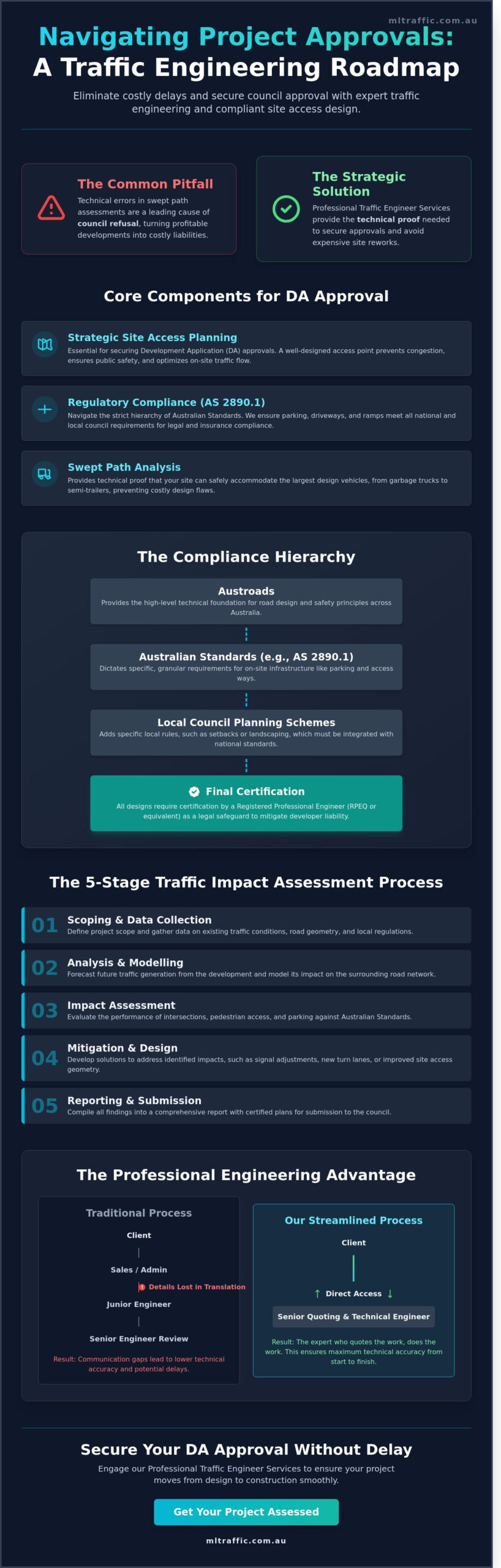
Site access compliance in Australia operates through a rigid hierarchy of regulations. At the top sits Austroads, providing the technical foundation for road design and safety. Beneath this, Australian Standards (AS) dictate the granular specifications for on-site infrastructure. For any development application, Professional Traffic Engineer Services for Perth and National Civil Projects must synthesize these national standards with local council planning schemes. Councils often have specific setback or landscape requirements that overlay national codes, making a "one size fits all" approach impossible.
Every design requires certification by an RPEQ (Registered Professional Engineer of Queensland) or an equivalent state-registered professional. This isn’t just a bureaucratic hurdle; it’s a legal safeguard. Certification ensures that the driveway, ramp, or loading dock meets the safety requirements necessary to mitigate developer liability and satisfy insurance prerequisites. At ML Traffic Engineers, the consultant who provides your quote is the same senior expert who performs the technical work, ensuring no details are lost in delegation.
Understanding AS 2890.1 and AS 2890.2
AS 2890.1:2004 governs off-street car parking. It mandates specific driveway widths, typically ranging from 3.0 to 5.5 metres depending on the number of parking spaces and user class. Driveway gradients are equally strict; a maximum grade of 1:20 is required for the first 6 metres of a property to prevent vehicle scraping and ensure sight-line safety. For projects involving heavy rigid vehicles (HRV) or articulated vehicles, AS 2890.2:2018 applies. This standard dictates loading dock dimensions and clearance heights, often requiring a minimum of 4.5 metres for commercial service areas. For a technical deep dive into these requirements, read this AS 2890.1 guide.
The Role of Austroads Guidelines
Austroads provides the technical basis for intersection design, pavement engineering, and road safety audits. Local councils rely on these guidelines to assess how a new project impacts the existing road network. If a proposed development increases traffic volume at a nearby junction by 5% or more, Austroads-compliant modeling is usually mandatory. Compliance isn’t optional. It acts as the baseline for legal and insurance requirements across all Australian jurisdictions. Using Professional Traffic Engineer Services for Perth and National Civil Projects ensures that your site access isn’t just functional, but fully defensible during the council approval process.
If you’re managing a complex site with tight constraints, you can view our full range of traffic engineering services to see how we handle swept path assessments and car parking demand.
-
AS 2890.1: Focuses on light vehicle parking and residential/commercial access.
-
AS 2890.2: Covers commercial vehicle facilities and heavy vehicle maneuvering.
-
Austroads: Governs the interface between private property and public road networks.
-
Local Planning Schemes: Provide site-specific variations to national standards.
How to Use Swept Path Analysis to Prove Site Access Viability
Swept path analysis is the computer-simulated mapping of a vehicle’s turning path as it moves through a specific design layout. It’s the industry gold standard for proving a site can safely and efficiently accommodate specific vehicles, such as 12.5-metre heavy rigid vehicles or 19-metre semi-trailers. By utilizing advanced software like AutoTURN, our team generates technical diagrams that visualize the vehicle’s body envelope and wheel paths. This empirical data is essential for Professional Traffic Engineer Services for Perth and National Civil Projects, especially when dealing with constrained urban environments or industrial loading docks.
Local councils and road authorities don’t accept guesswork. They require precise simulations to ensure that a garbage truck can maneuver without striking curbs or that a delivery van won’t block traffic flow. Technical diagrams provide the necessary assurance that car park entries and loading zones meet Australian Standards (AS 2890). Without this analysis, developers risk costly redesigns after construction has already commenced.
The Technical Process of Swept Path Mapping
The mapping process follows a rigorous sequence to ensure accuracy. First, we select the appropriate design vehicle based on the project’s intended use. Second, we define the operating speed, which is typically 5 to 10 km/h for tight on-site maneuvers. Finally, we map the path with a minimum 300mm clearance to all vertical obstructions. It’s vital to distinguish between a "design vehicle" and a "service vehicle." A design vehicle represents the standard car or van used to set the general layout, while a service vehicle, like a waste collection truck, determines the specific requirements for heavy-duty access points. For detailed visual examples of these simulations, you can view our swept path analysis guide.
Sight Distance and Driveway Ramp Grade Assessments
Access viability isn’t just about the turn; it’s about safety and physical clearance. Safe Intersection Sight Distance (SISD) is a critical metric we assess to prevent collisions at site entry points. If a driver can’t see oncoming traffic because of a wall or landscaping, the design fails safety protocols. Similarly, we evaluate driveway ramp grades to prevent vehicle "grounding" or scraping. A ramp that’s too steep or lacks proper transitions will damage vehicles and lead to liability issues. We use these assessments to ensure every Professional Traffic Engineer Services for Perth and National Civil Projects project stays compliant and functional.
-
We verify SISD against AS 2890.1 requirements for every driveway.
-
Ramp transitions are calculated to ensure low-clearance vehicles don’t bottom out.
-
Our simulations include the 99th percentile car (B99) for maximum reliability.
Swept path analysis provides the empirical evidence councils require to approve non-standard or tight-access site designs. By presenting a clear, data-driven simulation, we eliminate ambiguity in the development application process. This technical approach has been proven across more than 10,000 sites where ML Traffic Engineers has provided expert consultancy since 2005.
How to Prepare a Traffic Impact Assessment for Council Approval
Securing a Development Application (DA) requires a structured approach to traffic planning. The process for preparing a Traffic Impact Assessment (TIA) or Statement (TIS) follows a rigorous 5-stage methodology to ensure compliance with local government requirements. Our approach is technical and data-driven.
-
Project Scoping: We define the study area and identify key intersections in consultation with Council officers.
-
Data Collection: Engineers gather 7-day traffic counts and assess existing road geometry and speed environments.
-
Trip Generation: We calculate the volume of new traffic using the RTA Guide to Traffic Generating Developments or specific Western Australian data sets.
-
Impact Analysis: Using SIDRA software, we model intersection delays and levels of service to predict future performance.
-
Mitigation Strategy: We identify physical solutions, such as new turn lanes or updated signage, to manage increased demand.
Data collection serves as the foundation of every report. We use mechanical tube counters or video surveys to capture real-time movements. Once we establish the baseline, we calculate trip generation. This is a mathematical projection based on land-use type and Gross Floor Area (GFA). If the analysis shows a significant impact, we detail specific mitigation strategies. These might include dedicated deceleration lanes or modified signal phasing to keep the network moving. Our Professional Traffic Engineer Services for Perth and National Civil Projects ensure these technical requirements are met before your submission reaches the planner’s desk.
The Key Components of a TIA Report
A Traffic Impact Assessment is the standard requirement for Australian DAs. It must contain a parking demand assessment to prove the site can accommodate its own vehicles without overspilling into local streets. We also conduct intersection analyses to check for queuing that could block through-traffic. Safety is paramount. Every report addresses pedestrian visibility and vehicle sight-lines to meet AS 2890.1 standards. This focus on safety and flow reduces the risk of Council requests for further information (RFIs).
Common Pitfalls in Traffic Submissions
Many developers face delays because they use outdated traffic data. Councils generally reject surveys older than 36 months. Another error is ignoring peak hour surges, such as school drop-off times or Saturday retail peaks. Professional engineers preempt these objections through proactive design adjustments. We also integrate traffic findings into the Statement of Environmental Effects (SEE). This ensures that traffic volume doesn’t negatively impact local residential amenity. Utilizing Professional Traffic Engineer Services for Perth and National Civil Projects allows you to identify these issues during the design phase rather than during a costly appeal process.
Ensure your project meets all regulatory standards by speaking directly with our principals. Contact ML Traffic Engineers for a comprehensive TIA quote today.
How Professional Engineering Oversight Streamlines National Project Delivery
Large engineering firms often operate through a layered hierarchy. A senior partner secures the contract, then passes the technical execution to junior graduates. This creates a disconnect between the initial quote and the final report. ML Traffic Engineers operates differently. We use a direct access model. The principal who assesses your site is the same person who writes the report. This eliminates middle-management gatekeepers. It ensures the person responding to council queries has first-hand knowledge of the driveway ramp grades or sight-line assessments.
With experience spanning over 10,000 sites since 2005, we provide Professional Traffic Engineer Services for Perth and National Civil Projects. Every council has unique expectations. A project in Perth requires different compliance checks than one in regional Queensland or Melbourne. Our principals, Michael Lee and Benny Chen, bring between 30 and 40 years of experience each to every project. This seniority allows us to anticipate council objections before they lead to formal RFI (Request for Further Information) delays. We have worked on every land-use type including apartments, bars, boarding houses, car washes, child care centres, churches, clubs, fast food outlets, gymnasiums, hospitals, hotels, industrial units, medical centres, motels, offices, reception centres, restaurants, schools, service stations, shopping centres, showrooms, supermarkets, temples, and warehouses.
The "Consultant Who Quotes, Does the Work" Advantage
Our signature promise is simple: the traffic consultant who provides the quote, does the work. This model guarantees accountability. You don’t deal with account managers who lack technical depth. Instead, you get direct access to experts who understand AS 2890.1 and specific land-use requirements. This approach removes the risk of junior errors that often plague larger consultancies. Efficiency gains come from direct communication. When a council officer calls with a technical question, the engineer who did the work answers the phone. You can learn more about our senior principals and their decades of experience on our About page.
Next Steps for Your Civil Project
Securing Professional Traffic Engineer Services for Perth and National Civil Projects starts with clear documentation. To provide an accurate engineering quote, we require specific details. A professional quote reflects the actual engineering effort needed for compliance, not a generic estimate. Using a consultant who understands the nuances of various land-use types prevents costly redesigns later in the process.
-
Current and proposed site plans.
-
Detailed description of the proposed land use.
-
Any existing correspondence or RFIs from the local council.
-
Vehicle swept path requirements for the specific site.
Direct communication is the most efficient way to move your project forward. Contact ML Traffic Engineers for a direct consultation. We provide the technical certainty required for successful development applications across Australia.
Secure Your Site Access and Project Compliance
Navigating Australian Standards like AS 2890 requires technical precision and seasoned oversight. Successful civil projects depend on accurate Swept Path Analysis and comprehensive Traffic Impact Assessments to secure council approval without delays. ML Traffic Engineers brings over 15 years of industry experience across more than 10,000 sites nationwide. You get direct access to senior engineers Michael Lee and Benny Chen. The traffic consultant who provides your quote is the one who does the work. This hands-on approach ensures your project meets all regulatory requirements while streamlining delivery.
Whether you need a TIA for a local council or specialized oversight for a large-scale development, our Professional Traffic Engineer Services for Perth and National Civil Projects provide the technical certainty your development requires. We specialize in AS 2890 compliance to eliminate site access risks before they become costly bottlenecks. It’s essential to have experts who understand the nuances of local and national regulations to keep your project on schedule.
Get a Professional Traffic Engineering Quote from the Experts
We look forward to helping you move your project forward with confidence.
Frequently Asked Questions
What is the difference between a Traffic Impact Assessment (TIA) and a Traffic Management Plan (TMP)?
A Traffic Impact Assessment (TIA) evaluates the long term impact a new development has on the existing road network. It focuses on trip generation, parking demand, and intersection capacity. A Traffic Management Plan (TMP) is a short term operational document that outlines how traffic, pedestrians, and cyclists are managed during construction or specific events. ML Traffic Engineers has completed over 10,000 of these assessments since 2005 to ensure project compliance.
Does my small development really need a professional traffic engineer?
Yes, most local councils require a certified report to prove your project complies with local planning schemes and Australian Standards. We provide Professional Traffic Engineer Services for Perth and National Civil Projects to ensure small scale developments meet the technical requirements of the 139 local government areas in Western Australia. Without professional certification, your Development Application (DA) faces a high risk of refusal or significant processing delays.
How long does it typically take to prepare a traffic report for council?
A standard traffic report typically takes 5 to 10 business days to complete after we receive your final site plans. More complex projects that require intersection modelling or manual traffic counts may take up to 15 business days. Our senior consultants, who each have between 30 and 40 years of experience, manage the process directly to ensure we meet these strict deadlines for your submission.
What Australian Standards govern car park design and site access?
AS 2890.1:2004 is the primary standard for off-street car parking, while AS 2890.2 covers commercial vehicle facilities. We also use AS 2890.6 to ensure your development meets the mandatory requirements for people with disabilities. These standards dictate specific dimensions for parking bays, aisle widths, and driveway ramp grades. Our engineers use these metrics to verify that your site design is legally compliant and safe for all users.
Can a traffic engineer help if council has already flagged access issues in my DA?
We specialise in resolving existing Council objections by providing technical justifications or redesigning access points. If a council officer identifies a safety or congestion issue, we perform a site-specific sight-line assessment to prove the design is functional. Our team has a high success rate in negotiating with authorities to find practical solutions that satisfy both the developer and the engineering department’s safety requirements.
Is swept path analysis mandatory for all commercial developments?
Swept path analysis is mandatory for 100% of commercial developments where waste trucks, delivery vans, or emergency vehicles must enter the property. We use computer-aided design software to simulate the turning circles of these specific vehicles. This process ensures that the largest anticipated vehicle can enter and exit the site in a forward direction without hitting curbs, structures, or other parked cars.
What information do I need to provide to get an accurate traffic engineering quote?
You must provide a current site plan, the total floor area of the proposed building, and the specific land-use type. Providing these details allows us to deliver accurate Professional Traffic Engineer Services for Perth and National Civil Projects. If you’ve already received a request for further information (RFI) from the Council, include that document so we can tailor our scope to address their specific concerns immediately.
Which areas do you cover?
We are traffic engineers servicing Alexander Heights, Alfred Cove, Alkimos, Anketell, Applecross, Ardross, Armadale, Ascot, Ashby, Ashendon, Ashfield, Attadale, Atwell, Aubin Grove, Aveley, Balcatta, Baldivis, Balga, Ballajura, Banksia Grove, Bassendean, Bateman, Bayswater, Beaconsfield, Beckenham, Bedford, Beechboro, Beeliar, Beldon, Bellevue, Belmont, Bentley, Bertram, Bibra Lake, Bicton, Booragoon, Brentwood, Brigadoon, Brookdale, Bull Creek, Bullsbrook, Burns Beach, Burswood, Butler, Byford, Canning Vale, Cannington, Carine, Carlisle, Carramar, Casuarina, Caversham, Champion Lakes, Chidlow, Churchlands, City Beach, Claremont, Clarkson, Cloverdale, Cockburn Central, Connolly, Coogee, Coolbellup, Coolbinia, Cottesloe, Craigie, Crawley, Currambine, Dalkeith, Darch, Doubleview, East Perth, Edgewater, Ellenbrook, Floreat, Fremantle, Girrawheen, Greenwood, Guildford, Hamilton Hill, Heathridge, Hillarys, Inglewood, Joondalup, Kallaroo, Kingsley, Leeming, Mandurah, Maylands, Melville, Midland, Mindarie, Morley, Mosman Park, Mount Hawthorn, Mount Lawley, Mullaloo, Nedlands, North Perth, Northbridge, Ocean Reef, Osborne Park, Padbury, Perth, Piara Waters, Rockingham, Scarborough, South Perth, Subiaco, Swanbourne, Thornlie, Tuart Hill, Victoria Park, Wangara, Wanneroo, Warwick, Wembley, West Perth, Willetton, Woodvale, Yokine.

Disclaimer
The content on www.mltraffic.com.au, including all technical articles, guides, and resources, is provided for general informational and educational purposes only. It is not intended to constitute professional advice in traffic engineering, transportation planning, development approvals, or any other technical or legal field.
While ML Traffic Engineers makes every reasonable effort to ensure the accuracy, completeness, and timeliness of the information published, we do not provide any warranties or representations (express or implied) regarding its reliability, suitability, or availability for any particular purpose. Any reliance you place on the content is strictly at your own risk.
In no event shall ML Traffic Engineers, its directors, employees, authors, or affiliates be liable for any direct, indirect, incidental, special, consequential, or punitive damages (including, without limitation, loss of profits, data, or business opportunities) arising out of or in connection with the use of, or inability to use, any information provided on this website.
The articles and guides on this site are not a substitute for engaging a qualified, registered professional traffic engineer (such as an NPER or RPEQ engineer) to assess your specific project requirements. For tailored advice, compliance assessments, or traffic engineering services, please contact a competent professional.
This disclaimer may be updated from time to time without notice. By accessing or using this website, you agree to be bound by the most current version of this disclaimer.
