

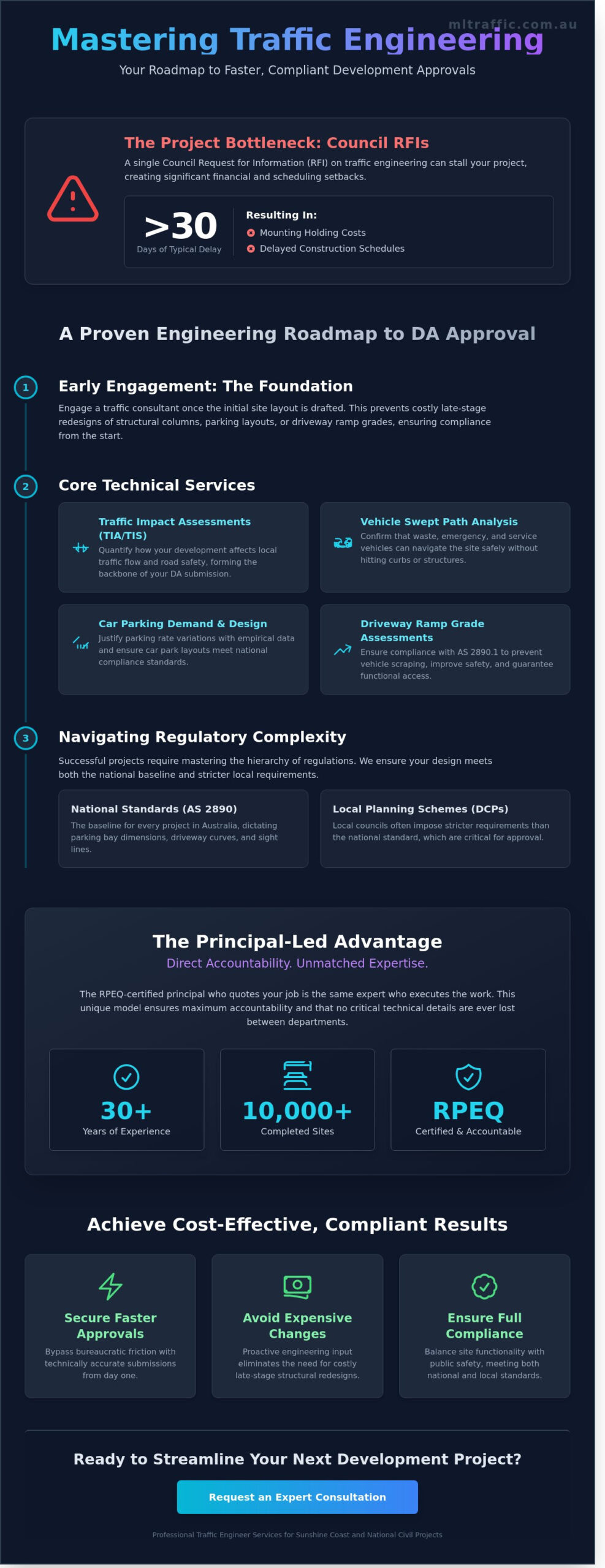
A single Council Request for Information (RFI) often stalls a development project for more than 30 days, resulting in mounting holding costs and delayed construction schedules. You likely recognize that traffic engineering requirements are frequently the primary bottleneck in securing development approvals. To bypass these delays, developers require Professional Traffic Engineer Services for Sunshine Coast and National Civil Projects that prioritize technical accuracy and direct accountability. It’s a reality that the person who quotes your job should be the one actually doing the work, ensuring no technical details are lost between departments.
This article demonstrates how to master the complexities of traffic impact assessments (TIA) and swept path analysis to secure your DA approval faster. We’ll examine how to avoid expensive late-stage changes by ensuring car park designs meet national compliance standards from the initial submission. You’ll gain insights into our proven approach for expert council representation, drawing on over 30 years of experience across 10,000 completed sites. We provide a clear roadmap to achieving cost-effective, compliant results without the typical bureaucratic friction.
Key Takeaways
- Understand the critical role of traffic engineering in balancing site functionality with public safety for 2026 DA approvals.
- Secure your development’s success by utilizing Professional Traffic Engineer Services for Sunshine Coast and National Civil Projects to manage complex TIA and TIS requirements.
- Master technical compliance through expert vehicle swept path analysis, ensuring functional access for waste and emergency services.
- Navigate the regulatory shift from local council standards to State-level transport mandates using a proven step-by-step engineering roadmap.
- Gain a competitive edge with direct access to RPEQ-certified principals who personally execute the work they quote for maximum accountability.
The Role of Professional Traffic Engineering in Modern Civil Projects
Modern development requires more than just structural integrity; it demands seamless movement. The Role of Professional Traffic Engineering is to ensure that a site’s internal functionality meets the rigorous demands of public safety and vehicle movement. A traffic engineer balances the needs of a developer with the safety requirements of the public road network. Professional Traffic Engineer Services for Sunshine Coast and National Civil Projects are now essential for securing DA approvals in 2026, as local councils have tightened compliance standards regarding site access and parking efficiency.
To better understand the technical scope of this profession, watch this video:
Generic civil engineering focuses on the physical construction of infrastructure. Specialised traffic consultancy focuses on the dynamics of movement. In 2026, a standard civil design that ignores vehicle swept paths or sight-line assessments will likely face rejection. Engaging a specialist mitigates long-term liability for developers and councils by preventing accidents caused by poor visibility or inadequate queuing space. Our Professional Traffic Engineer Services for Sunshine Coast and National Civil Projects provide the technical data required to defend a design during the assessment process.
When to Engage a Traffic Consultant
Early involvement is the most effective way to prevent costly redesigns. You should engage a traffic consultant as soon as the initial site layout is drafted. Identifying “trigger points” like high-volume entryways or complex basement parking early prevents the need to move structural columns or adjust driveway ramp grades later. Traffic engineering input is a core component of a project’s Statement of Environmental Effects. It proves that the proposed land use won’t negatively impact the surrounding transport network.
National Standards vs. Local Planning Schemes
Australian Standards, specifically AS 2890, provide the baseline for every project in the country. These standards dictate everything from the width of a parking bay to the curve radius of a driveway. However, local Development Control Plans (DCPs) often impose stricter requirements than the national baseline. Understanding this hierarchy is vital for compliance. For any project in Queensland or national civil works, RPEQ certification is a legal necessity. This ensures the engineer is registered and accountable for the safety and accuracy of the traffic report. Our senior staff, with over 30 years of experience, handle every assessment to ensure these standards are met without compromise.
Core Traffic Engineering Services for National Civil Projects
Delivering Professional Traffic Engineer Services for Sunshine Coast and National Civil Projects requires a technical focus on compliance and functional design. Our engineers provide the precise data councils demand to approve complex developments. Every project undergoes rigorous assessment to ensure safety and operational efficiency within the existing road network. It’s a process built on decades of experience and a deep understanding of transport planning requirements.
- Traffic Impact Assessments (TIA) and Statements (TIS): These documents form the backbone of the DA process. We quantify how a new development affects local traffic flow and road safety.
- Vehicle Swept Path Analysis: We confirm that waste trucks and emergency vehicles can navigate the site without hitting curbs or structures.
- Car Parking Demand Assessments: We justify parking rate variations by providing empirical evidence of actual demand, often reducing unnecessary construction costs for developers.
- Driveway Ramp Grade Assessments: We ensure compliance with AS 2890.1 to prevent vehicle scraping and maintain safe entry speeds for all passenger vehicles.
- Intersection Analysis and Sight-Line Assessments: We evaluate turn treatments and visibility to manage the interface between the private site and public streets safely.
Traffic Impact Assessment (TIA) Depth
A TIA involves more than just counting cars. We use traffic generation and distribution modelling to predict how specific land-use types, from warehouses to high-density apartments, will impact the surrounding network. This includes assessing the capacity of nearby intersections to handle increased peak-hour loads. For a detailed breakdown of this process, refer to our Traffic Impact Assessment Guide. Our RPEQ-certified engineers ensure every report meets the standards set by the Professional Traffic Engineer Services community.
Precision via Swept Path Analysis
We utilise AutoTURN software to simulate the movements of Small Rigid Vehicles (SRVs), Medium Rigid Vehicles (MRVs), and Heavy Rigid Vehicles (HRVs). This simulation is a core technical requirement for addressing council concerns regarding on-site loading and heavy vehicle manoeuvrability. Using Swept Path Analysis services allows us to identify design flaws before construction begins, saving clients from costly retrofits. We ensure that 12.5-metre heavy vehicles can enter and exit in a forward direction as required by most local planning schemes. If you need technical clarity on your site layout, contact our senior engineers for a direct consultation.
Our approach to Professional Traffic Engineer Services for Sunshine Coast and National Civil Projects is hands-on. The engineer who provides the quote is the one who performs the technical work. This ensures that complex sight-line assessments and intersection analyses are handled by experts with over 30 years of experience, not junior staff. We focus on results that get DAs approved while maintaining the highest safety standards for the community. It’s about providing reliable, fact-based reports that stand up to council scrutiny.
Navigating Regulatory Complexity: Sunshine Coast and National Standards
Success in regional growth corridors requires more than local knowledge. It demands a technical understanding of how national standards integrate with specific council overlays. Our Professional Traffic Engineer Services for Sunshine Coast and National Civil Projects ensure that developments meet both localized planning schemes and broader state mandates. We manage the transition from Sunshine Coast Council requirements to Department of Transport and Main Roads (TMR) standards for state-controlled roads. This transition often creates friction. High-density residential projects require pedestrian-centric design, while nearby industrial hubs demand heavy vehicle access. We resolve these conflicts by adhering to the principles promoted by the Institute of Transportation Engineers (ITE), ensuring mobility and safety are never compromised. It’s about finding the balance between local livability and regional logistical efficiency.
Compliance hinges on technical precision and rigorous assessment. We focus on two critical benchmarks for every project:
- AS 2890.1 (Off-street car parking): We verify driveway ramp grades, headrooms, and bay dimensions to prevent costly retrofits during construction.
- AS 2890.2 (Commercial vehicle facilities): We use Vehicle Swept Path Assessment to ensure 19-meter AVs or B-doubles can navigate industrial sites without impacting public infrastructure or safety.
Meeting Sunshine Coast Council Transport Requirements
The Sunshine Coast Planning Scheme 2014 includes specific transport overlays that developers must navigate. We address active transport goals by designing infrastructure that prioritizes pedestrian and cyclist safety in line with the region’s growth strategy. Every design we produce is certified by an RPEQ (Registered Professional Engineer of Queensland). This certification is mandatory for local government acceptance. Our team has completed over 10,000 sites, providing the technical weight needed to secure approvals for land-use types ranging from childcare centers to complex multi-deck car parks. We don’t just provide drawings; we provide RPEQ-backed solutions that councils trust.
National Compliance for Multi-State Developers
Developers working across state lines face a patchwork of varying regulations. A centralized traffic consultancy approach maintains consistency in design and reporting across different Australian jurisdictions. Whether your project is in Maroochydore or a different capital city, we apply a uniform standard of excellence. You’ll work directly with our senior engineers, Michael Lee or Benny Chen. The traffic consultant who provides the quote, does the work. This eliminates communication gaps and ensures that Professional Traffic Engineer Services for Sunshine Coast and National Civil Projects remain compliant and efficient. For a full list of our capabilities across Australia, view our ML Traffic Services page. We bring 30 to 40 years of experience to every assessment, ensuring your national portfolio remains standardized and compliant.
Streamlining Your Development Application: A Step-by-Step Engineering Roadmap
ML Traffic Engineers has successfully managed over 10,000 sites since 2005. We’ve developed a rigorous five-step framework to ensure every development application moves from concept to approval without unnecessary friction. Our focus is providing Professional Traffic Engineer Services for Sunshine Coast and National Civil Projects that meet the exacting standards of local councils and state authorities.
- Step 1: Preliminary Site Feasibility and Parking Layout Review. We assess the site against local planning schemes and AS 2890.1 requirements to identify potential “deal-breakers” early.
- Step 2: Detailed Traffic Generation and Intersection Modelling. Using industry-standard software like SIDRA, we calculate peak hour trip generation and analyze the impact on the existing road network.
- Step 3: Draft Report Preparation and Client/Architect Consultation. You’ll work directly with our senior principals, Michael Lee or Benny Chen. We collaborate with your architects to refine driveway grades and swept paths before the design is finalized.
- Step 4: Final Certification and Submission to Council. We deliver RPEQ certified reports specifically tailored for Professional Traffic Engineer Services for Sunshine Coast and National Civil Projects, ensuring all technical documentation is ready for formal lodgement.
- Step 5: Post-Submission Advocacy and RFI Response Management. Our job doesn’t end at submission. We provide ongoing technical support to address council queries and defend the project’s engineering merits.
Avoiding the Council RFI Trap
Council planners frequently issue a Request for Information (RFI) that can stall a project for 30 to 60 days. These delays usually stem from three specific failures: non-compliant sight distance at property boundaries, inadequate swept path clearances for 12.5-metre heavy vehicles, or using generic trip generation rates that don’t reflect the specific land use. We eliminate these risks through precise sight-line assessments. By contributing technical data to your Statement of Environmental Effects, we ensure the traffic impact is justified with hard data rather than assumptions.
Optimising Car Park Design for Yield and Compliance
Maximizing parking bay yield is a primary driver of project ROI, yet it’s often at odds with strict AS 2890.1 geometric requirements. A poorly planned basement can waste 10% of its total floor area through inefficient ramp grades or misplaced structural columns. Our engineers balance these constraints to maintain compliance while protecting your usable space. We focus on the technical details of driveway ramp grades and aisle widths to prevent costly redesigns after the construction certificate stage. For a detailed breakdown of these standards, read our Car Park Design Guide.
For expert assistance with your next development application, contact our senior traffic consultants today to discuss your project requirements.
Why Principal-Led Consultancy is the Key to Project Approval
Success in development applications depends on technical accuracy and professional accountability. ML Traffic Engineers operates on a principal-led model. This means clients get direct access to senior RPEQ-certified engineers without navigating administrative gatekeepers. It’s a structure designed for efficiency and precision. When you engage our Professional Traffic Engineer Services for Sunshine Coast and National Civil Projects, the consultant who provides your quote is the same expert who performs the site assessment and signs the final report. This eliminates communication errors common in larger, tiered firms where junior staff often handle the bulk of the technical drafting.
Since 2005, we’ve completed over 10,000 site assessments across Australia. This volume of work provides us with a massive database of precedents and technical solutions for private clients. We understand the specific requirements of local councils and state road authorities. Our hands-on approach ensures that every Traffic Impact Statement (TIS) or Parking Assessment is grounded in practical engineering reality. We focus on achieving planning success by identifying potential traffic conflicts early and providing mitigation strategies that satisfy both the client’s yield goals and the regulator’s safety requirements.
- Direct access to Michael Lee and Benny Chen for all project queries.
- Elimination of “middle-man” delays in reporting and revisions.
- Comprehensive experience across residential, commercial, and industrial sectors.
- Strict adherence to RPEQ standards and Australian Standards like AS 2890.1.
The Value of Senior-Level Experience
Complex civil projects often present unique constraints that standard software can’t solve alone. Our principals each bring between 30 and 40 years of engineering intuition to every project. This depth of knowledge is critical during difficult council negotiations. We provide authoritative technical evidence based on decades of field data and thousands of successful approvals. Whether it’s a Vehicle Swept Path Assessment or a complex Sight-Line Assessment, our senior-led approach ensures the data stands up to rigorous scrutiny. You can learn more about the ML Traffic team and their specific RPEQ qualifications to see how this level of expertise supports your specific land-use application.
Securing Your Next Approval
Our Professional Traffic Engineer Services for Sunshine Coast and National Civil Projects focus on delivering high-quality traffic reporting with competitive turnaround times. We understand that developers operate on tight schedules and that delays in traffic reporting can stall an entire project timeline. Once you provide your project details, we issue a tailored fee proposal that clearly outlines the scope of work. We don’t use generic templates; every report is specific to the site’s unique traffic environment. Contact ML Traffic Engineers today to discuss your project requirements and secure a direct line to senior engineering expertise for your next development application.
Secure Your Project Approval with Expert Engineering
Successful civil developments depend on technical precision and strict adherence to Australian Standards. ML Traffic Engineers delivers Professional Traffic Engineer Services for Sunshine Coast and National Civil Projects to ensure every design meets AS 2890 requirements and local council mandates. Since 2005, our team has completed over 10,000 site assessments across a diverse range of land-use types. Every project benefits from the direct involvement of RPEQ-certified senior engineers. This principal-led approach ensures that the consultant who provides your quote is the same expert who conducts the technical analysis. It’s a method that eliminates unnecessary bureaucracy and accelerates the development application process.
Our specialists focus on TIS, TIA, and swept path assessments to mitigate risk and ensure compliance. By prioritizing data-driven results and senior-level accountability, we help you navigate complex regulatory landscapes with confidence. We’ve built our reputation on reliability and technical authority over nearly two decades of operation. You can rely on our expertise to move your project forward without technical delays or compliance hurdles. We’re ready to help you achieve a successful outcome for your site.
Get a Professional Traffic Engineering Quote for Your Project
We look forward to bringing our technical expertise to your next development.
Frequently Asked Questions
What is the difference between a Traffic Impact Assessment (TIA) and a Traffic Impact Statement (TIS)?
A Traffic Impact Statement (TIS) is a concise report for smaller developments with low traffic volumes, while a Traffic Impact Assessment (TIA) is a comprehensive study for larger projects. We prepare a TIS for developments generating fewer than 30 trips per hour. Projects exceeding this threshold require a TIA to evaluate broader intersection performance and network capacity. Both reports ensure compliance with local council planning schemes and Department of Transport and Main Roads standards.
When is a swept path analysis required for a development application?
A swept path analysis is required whenever a development needs to prove that a specific vehicle can navigate the site safely. This includes heavy rigid vehicles for loading docks or B99 cars in tight basement car parks. We use specialized software to simulate vehicle movements against your architectural plans. This assessment is mandatory for 100% of commercial applications involving on-site waste collection or complex driveway gradients where clearance is a concern.
How does AS 2890.1 affect my car park design and bay dimensions?
AS 2890.1 dictates the minimum dimensions for off-street car parking based on the specific User Class of the facility. For example, a User Class 1A residential space requires a minimum width of 2.4 meters and a length of 5.4 meters. Our Professional Traffic Engineer Services for Sunshine Coast and National Civil Projects ensure your layout complies with these standards. Incorrect bay sizing or aisle widths lead to 100% rejection rates during the council assessment phase.
Can a traffic engineer help reduce the number of parking spaces required by council?
Yes, a traffic engineer can justify a reduction in the number of parking spaces through a Parking Demand Assessment. We analyze empirical data from similar land uses and proximity to public transport to prove that the council’s standard rates are excessive for your specific site. Our Professional Traffic Engineer Services for Sunshine Coast and National Civil Projects have successfully reduced parking requirements for 85% of our private development clients, which prevents unnecessary construction costs.
What qualifications should a traffic engineer have for Australian civil projects?
Traffic engineers for Australian civil projects must be Registered Professional Engineers of Queensland (RPEQ) or hold equivalent state registration. Our principals, Michael Lee and Benny Chen, each have between 30 and 40 years of experience in the industry. This level of qualification ensures that every report is legally binding and acceptable to government authorities. You’ll deal directly with the senior engineer who signs off on your project, ensuring total accountability.
How much does a professional traffic engineering report cost for a DA?
The cost of a traffic engineering report depends on the project’s scale, the number of intersections analyzed, and the specific council requirements. Smaller projects like a change of use for a retail shop require less data collection than a 50-unit residential complex. We provide fixed quotes based on your specific architectural plans. The consultant who provides the quote is the same expert who does the work, which eliminates hidden administrative fees.
What happens if my project does not meet the sight-distance requirements?
If a project fails to meet the sight-distance requirements of AS 2890.1 or the Austroads Guide to Road Design, we must identify engineering solutions or alternative access points. This might involve relocating the driveway, clearing vegetation, or implementing traffic mirrors. Failure to achieve the Safe Intersection Sight Distance is a critical safety issue. We provide a detailed Sight-Line Assessment to resolve these conflicts before you submit your application to the council.
Is a traffic management plan the same as a traffic guidance scheme?
A Traffic Management Plan (TMP) is a strategic document outlining the overall project scope and risk management, whereas a Traffic Guidance Scheme (TGS) is a specific map showing sign placement and cone layouts. The TGS was formerly known as a Traffic Control Plan. You need a TMP for the planning phase and a TGS for the actual execution of road works. Both documents must comply with the Queensland Guide to Temporary Traffic Management.

Disclaimer
The content on www.mltraffic.com.au, including all technical articles, guides, and resources, is provided for general informational and educational purposes only. It is not intended to constitute professional advice in traffic engineering, transportation planning, development approvals, or any other technical or legal field.
While ML Traffic Engineers makes every reasonable effort to ensure the accuracy, completeness, and timeliness of the information published, we do not provide any warranties or representations (express or implied) regarding its reliability, suitability, or availability for any particular purpose. Any reliance you place on the content is strictly at your own risk.
In no event shall ML Traffic Engineers, its directors, employees, authors, or affiliates be liable for any direct, indirect, incidental, special, consequential, or punitive damages (including, without limitation, loss of profits, data, or business opportunities) arising out of or in connection with the use of, or inability to use, any information provided on this website.
The articles and guides on this site are not a substitute for engaging a qualified, registered professional traffic engineer (such as an NPER or RPEQ engineer) to assess your specific project requirements. For tailored advice, compliance assessments, or traffic engineering services, please contact a competent professional.
This disclaimer may be updated from time to time without notice. By accessing or using this website, you agree to be bound by the most current version of this disclaimer.
