

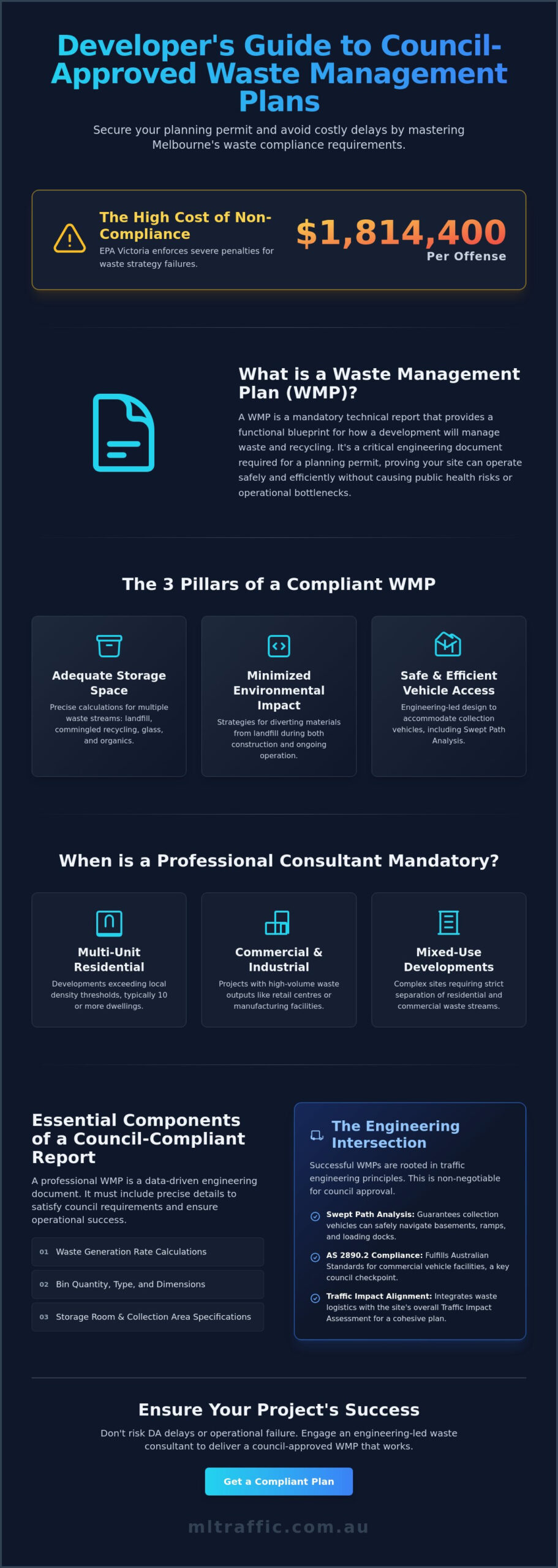
With EPA Victoria now enforcing penalties up to $1,814,400 per offense for non-compliance, a development’s waste strategy is no longer a secondary concern. For developers and architects, the primary challenge lies in translating complex council policies into a functional site design that does not trigger costly DA delays. Engaging a qualified waste management plan consultant Melbourne ensures that every technical detail, from waste generation rates to the mandatory General Environmental Duty, is addressed with professional precision.
It’s frustrating when a project stalls because a collection vehicle cannot safely navigate a basement or a bin room lacks the required clearance. You need a strategy that satisfies both the Environment Protection Act 2017 and the specific requirements of the City of Melbourne, including the $177.19 per tonne landfill levy considerations for the 2026-2027 financial year. This guide outlines how to secure a council-approved WMP by integrating seamless storage solutions and technical vehicle access engineering. We will cover the essential components of a compliant plan, the application of AS 2890.2 standards, and the use of Swept Path Analysis to guarantee operational success.
Key Takeaways
- Understand why a Waste Management Plan is a mandatory technical requirement for securing a planning permit in Melbourne.
- Learn how to achieve compliance with AS 2890.2 by integrating traffic engineering principles into your waste logistics strategy.
- Engage a professional waste management plan consultant Melbourne to provide precise waste generation calculations and storage room specifications.
- Identify the essential components of a council-compliant report, from bin dimensions to vehicle swept path requirements.
- Discover the advantages of an engineering-led consultancy that aligns waste strategies with broader Traffic Impact Assessments.
What is a Waste Management Plan and Why is it Mandatory?
A Waste Management Plan (WMP) is a detailed technical report required by local councils during the planning permit application process. It serves as a functional blueprint for how a proposed development will handle refuse and recyclables from the construction phase through to ongoing occupancy. For developers, a WMP isn’t merely a sustainability statement; it’s a critical engineering document that proves a site can function without creating public health risks or operational bottlenecks. Understanding What is Waste Management? involves looking at the entire lifecycle of materials. This is why councils demand these plans for multi-residential and commercial sites.
Engaging an experienced waste management plan consultant Melbourne early in the design phase prevents costly redesigns. Local authorities in Victoria, governed by the Environment Protection Act 2017, require evidence that waste handling is safe, efficient, and compliant with specific local laws. Without a professional WMP, a Development Application (DA) faces significant risk of rejection or lengthy delays. The plan must demonstrate that waste can be removed from the premises without obstructing traffic or endangering the public.
To better understand the role of these plans in the construction sector, watch this helpful video:
A consultant bridges the gap between architectural intent and regulatory necessity. They ensure that waste storage areas are sized correctly based on verified generation rates and that collection vehicles can physically access the site. This often involves collaborating with traffic engineers to verify vehicle swept paths and driveway gradients. You can view our full range of technical capabilities on our services page.
Core Objectives of a Professional WMP
A robust plan focuses on three primary pillars of site functionality. First, it ensures adequate storage space. Calculations must account for multiple waste streams, including landfill, commingled recycling, glass, and organics. Second, it minimises environmental impact. Plans detail how to divert materials from landfill during both the demolition and construction stages. Finally, it facilitates safe vehicle access. The design must accommodate the physical dimensions and turning circles of collection vehicles, whether they are council-owned or private contractors.
When is a Professional Waste Consultant Required?
Not every project needs a complex WMP, but professional input is mandatory for several development types. Multi-unit residential developments that exceed local density thresholds, typically ten or more dwellings, require a formal report. Commercial and industrial projects with high-volume waste outputs, such as retail centres or manufacturing facilities, also fall under this requirement. Mixed-use developments are particularly complex. They require a waste management plan consultant Melbourne to ensure residential and commercial waste streams remain strictly separated to prevent contamination and logistical conflicts.
Types of Waste Management Plans for Australian Developments
Waste planning for modern developments is divided into two distinct phases: the construction stage and the operational lifecycle. These documents are not standalone reports. They function as critical components of a broader Statement of Environmental Effects (SEE). A professional waste management plan consultant Melbourne ensures that both phases align with the Victorian Government’s circular economy targets and the General Environmental Duty (GED) requirements. Accurate, data-backed waste generation estimates are essential. Relying on generic figures often leads to undersized storage areas, which can trigger council refusal or operational failure once the building is occupied.
Compliance with state-specific strategies is mandatory. In Victoria, this means adhering to the Environment Protection Regulations 2021 and meeting the standards for a council-compliant WMP. These plans must account for the metropolitan Melbourne landfill levy, currently set at $177.19 per tonne for the 2026-2027 financial year. Failure to plan for waste diversion impacts the project’s long-term financial viability. Providing a clear roadmap for waste handling demonstrates professional due diligence to planning authorities.
Operational Waste Management Plans (OWMP)
The OWMP focuses on the long-term lifecycle of the completed building. It details how residents or commercial tenants will manage waste daily. Key technical requirements include:
- Calculating specific bin numbers based on land-use category and floor area.
- Designing dedicated bin storage rooms with adequate ventilation and wash-down facilities.
- Specifying waste chute systems or tug-unit requirements for high-rise developments.
- Defining the frequency of collection to prevent overflow and hygiene issues.
This phase requires precise coordination with architects to ensure waste infrastructure fits within the building footprint without compromising car parking or common areas. It’s vital to address these spatial needs during the initial design phase to avoid expensive structural changes later.
Demolition and Construction Waste Management Plans (CWMP)
A CWMP governs the site during the build. It outlines strategies for diverting at least 80% of waste from landfill, aligning with the Australian Government’s National Waste Policy targets for 2030. Engaging a waste management plan consultant Melbourne during the demolition phase prevents the mishandling of prescribed industrial waste. This involves:
- Identifying specific recycling pathways for concrete, steel, timber, and masonry.
- Managing site logistics to ensure collection vehicles can enter and exit safely during the build.
- Establishing protocols for the identification and disposal of hazardous materials.
Effective construction planning reduces the risk of site contamination and ensures compliance with EPA guidelines. If your project involves complex access requirements, reviewing our technical assessment services can help streamline the approval process.
The Engineering Intersection: Traffic and Waste Logistics
A Waste Management Plan is fundamentally a logistics and engineering document. It’s not enough to simply allocate space for bins; you must demonstrate that those bins can be serviced safely and efficiently. Traffic engineering provides the technical verification required for council approval, ensuring the site design accommodates heavy vehicle movements. This is why a waste management plan consultant Melbourne must possess deep expertise in Australian Standard AS 2890.2. This standard governs the design of off-street commercial vehicle facilities and is the benchmark for most Victorian councils. Adhering to the Waste Management Plan guidelines provided by the City of Melbourne is essential for navigating these technical requirements.
Councils won’t approve a development that relies on waste trucks reversing into busy thoroughfares or clipping curbs during transit. A professional Swept Path Analysis is a prerequisite for most medium-to-large developments. This analysis proves that the proposed site layout, including driveways and loading bays, matches the physical constraints of the specific waste vehicles intended for the site. By integrating traffic engineering early, you avoid the risk of significant site redesigns after a Development Application has been lodged.
Vehicle Swept Path Analysis for Waste Collection
We use industry-standard AutoTURN software to simulate the movements of a Heavy Rigid Vehicle (HRV). This simulation is critical for verifying that collection trucks can enter and exit the site in a forward gear, which is a common safety requirement for Melbourne councils. For the City of Melbourne’s fleet, the design must accommodate a minimum length of 8.8 metres. Our analysis also verifies overhead clearance. Waste collection vehicles require a minimum height clearance of 4.0 metres to account for bin lifting mechanisms. Without this technical verification, a waste management plan consultant Melbourne cannot guarantee that the bin room is actually functional.
Loading Dock and Collection Point Design
Optimising the layout of a loading bay requires more than just floor space. We assess the interface between pedestrians and collection vehicles to eliminate blind spots and conflict zones. Driveway grades are another critical factor. Heavy vehicles require stable, level surfaces for waste transfer to prevent bin roll-away or vehicle instability. We ensure that ramp grades comply with AS 2890.2, preventing the underside of the truck from scraping the pavement. This level of meticulous detail ensures that your waste strategy is as safe as it is compliant.
Key Components of a Council-Compliant WMP
A council-compliant Waste Management Plan must provide technical certainty to planning authorities. It’s an exhaustive document that details every stage of the waste lifecycle within a development. A professional waste management plan consultant Melbourne ensures that the report includes precise calculations and spatial layouts that meet local government standards. Without these specific components, a Development Application risks being flagged for insufficient detail or technical oversight.
The report must address the mandatory separation of four waste streams: general waste, commingled recycling, glass, and Food Organics and Garden Organics (FOGO). This alignment with the Victorian Government’s circular economy policy is essential for modern approvals. Additionally, the plan specifies collection frequencies and identifies the service provider. For CBD developments, this includes acknowledging the $3,750 annual fee per truck for commercial operators collecting from businesses, effective from 1 July 2026. Clear signage plans and defined management responsibilities are also included to ensure the system functions as intended once occupied.
Waste Generation Estimations
Calculations are based on established industry benchmarks for residential and commercial yields, typically measured in litres per day or week. Yield rates vary significantly by development type, with a high-density apartment complex requiring a different volume-to-space ratio than a retail showroom or industrial warehouse. We adjust these calculations for specific land-use sub-categories to prevent the installation of undersized bin systems that lead to overflow. This data-driven approach provides the evidence councils need to verify that the site can handle its own waste output.
Storage and Transfer Logistics
Designing for back-of-house efficiency is a core requirement of the engineering process. Bin storage areas must include specific dimensions to allow for easy maneuverability and access for both tenants and collectors. Technical requirements for these spaces include:
- Natural or mechanical ventilation systems to control odours and meet health standards.
- Dedicated bin wash-down areas equipped with appropriate drainage and sewer connections.
- Specified pathways for bin transfer that avoid steep gradients or narrow corridors.
- Sufficient spatial clearance for the transition of bins to the designated collection point.
Integrating these storage requirements with the overall site layout is critical for operational success. Our expertise in Car Park Design Services allows us to ensure that waste infrastructure does not conflict with vehicle parking or pedestrian safety. If you require a technical report that meets all Victorian regulatory standards, contact our senior principals today to discuss your project requirements.
Why Choose an Engineering-Led Waste Consultant?
Selecting an engineering-led waste management plan consultant Melbourne offers a technical advantage that generalist firms cannot match. Waste management is not a standalone sustainability exercise; it’s a critical logistics function that must be integrated with the site’s traffic flow. By aligning a Waste Management Plan with a Traffic Impact Assessment, we ensure that storage areas and collection points are physically compatible with vehicle movements. ML Traffic brings more than 15 years of experience to development approvals, ensuring every report complies with both the Environment Protection Act 2017 and Australian Standard AS 2890.2.
Our firm operates on a “Personnel Continuity Promise.” This means the senior principal who begins your project is the same expert who performs the technical analysis and signs off on the report. Potential clients gain direct access to leadership without the gatekeepers or junior hand-offs found in larger consultancies. We have a proven track record across diverse project environments, including:
- High-density residential towers and multi-unit developments
- Mixed-use precincts and retail shopping centres
- Industrial warehouses and distribution hubs
- Medical facilities and aged care centres
- Childcare centres and educational institutions
This deep-seated expertise allows us to anticipate council concerns before they become obstacles. Our approach is hands-on and results-oriented, focusing on practical site functionality rather than theoretical ideals.
Streamlining the Approval Process
Efficient project delivery relies on reducing the risk of Council Requests for Further Information (RFI). These requests often stem from inconsistencies between waste strategies and architectural designs. We eliminate these bottlenecks by coordinating waste reports with architectural drawings and traffic plans from the earliest design stages. You can read more about our professional tenure and commitment to technical excellence on our About ML Traffic Engineers page. This proactive coordination ensures that bin storage dimensions, chute systems, and vehicle access points are verified and ready for council scrutiny.
Expert Evidence and Representation
In cases where a site’s constraints require a departure from standard guidelines, engineering-backed justification is essential. We provide the technical support needed for planning tribunal hearings, using data to defend innovative or non-standard waste solutions. Our consultants are experienced in representing clients at VCAT, providing expert evidence that stands up to rigorous cross-examination. We justify site-specific strategies through precise vehicle swept path analysis and driveway ramp grade assessments. If you need a waste management plan consultant Melbourne who provides authoritative reports and direct accountability, Contact ML Traffic for a WMP Consultation today.
Secure Your Development Approval with Professional Waste Engineering
A compliant Waste Management Plan is a technical necessity for any modern Melbourne development. It ensures the site meets the stringent requirements of EPA Victoria and local council policies while maintaining long-term operational safety. Working with a specialized waste management plan consultant Melbourne provides the engineering precision required to navigate complex vehicle access, bin storage dimensions, and waste stream separation regulations. ML Traffic Engineers leverage over 15 years of planning approval experience to deliver technical reports that adhere strictly to AS 2890.1 and AS 2890.2 standards.
Clients benefit from our personnel continuity promise, ensuring direct accountability and consistent contact with senior principals throughout the project lifecycle. Our data-driven strategies prevent costly DA delays and ensure seamless site integration for high-density residential, commercial, and mixed-use projects. We focus on providing meticulous assessments that satisfy both regulatory bodies and site managers. Request a Waste Management Plan Quote from Our Senior Engineers. We look forward to streamlining your next development application and securing your planning permit with professional expertise.
Frequently Asked Questions
What is the difference between an Operational and Construction WMP?
Operational Waste Management Plans govern the long-term waste handling of a completed building, while Construction WMPs manage material diversion during the build phase. Operational plans focus on tenant bin systems, storage room design, and ongoing collection schedules. Construction plans specifically target the 80% recovery rate required by the National Waste Policy for materials like concrete, steel, and timber during demolition and assembly.
Why does my council require a swept path analysis for my waste plan?
Councils require a Vehicle Swept Path Analysis to verify that collection trucks can navigate the site safely without obstructing public traffic. This simulation ensures vehicles enter and exit in a forward gear, which is a critical safety standard for Victorian planning permits. It provides technical proof that the driveway and loading area comply with AS 2890.2 standards for off-street commercial facilities.
How are waste generation rates calculated for a new development?
Waste generation rates are calculated using standardized yield benchmarks provided by local Victorian councils. These rates specify the expected volume of waste in litres per bedroom for residential projects or per square metre for commercial floor area. A waste management plan consultant Melbourne adjusts these figures based on collection frequency and specific land-use categories to ensure storage areas are sized correctly.
Can a traffic engineer also prepare a waste management plan?
Yes, a traffic engineer is often the most qualified professional to prepare a WMP because waste collection is primarily a logistics and access challenge. We integrate the waste strategy with the Traffic Impact Assessment to ensure storage areas don’t conflict with car parking or pedestrian safety. This combined approach reduces the risk of council delays and ensures the site design is functionally sound. Engaging a waste management plan consultant Melbourne with engineering expertise provides the technical data councils demand.
What are the bin storage requirements for multi-unit residential buildings?
Multi-unit residential buildings must provide dedicated storage rooms with sufficient floor area for landfill, recycling, glass, and organics bins. These rooms require natural or mechanical ventilation, non-slip flooring, and wash-down facilities with sewer-connected drainage. The design must allow for efficient bin maneuverability and clear pathways for transfer to the designated collection point.
Do I need a private waste contractor or council collection?
The choice between council and private collection depends on the physical constraints of the development and the total waste volume. Council fleets have strict height and length requirements, such as the 4.0 metre clearance mandated by the City of Melbourne. If your site design cannot accommodate a standard council truck, you must engage a private contractor using specialized, smaller vehicles to service the building.
What is FOGO and how does it affect my waste management plan?
FOGO stands for Food Organics and Garden Organics, which is a mandatory waste stream aimed at reducing landfill emissions. Your plan must include dedicated storage space for FOGO bins and outline a collection schedule that prevents odour and hygiene issues. This requirement is a central part of the Victorian Government’s 2026-30 waste sector pledge to increase organic material diversion.
How long does it take to prepare a professional waste management report?
Preparation time for a technical waste management report depends on the complexity of the site and the required vehicle simulations. Most professional reports are finalized within a standard consultancy timeframe once all architectural plans and site data are provided. Early engagement with a consultant ensures the report aligns with your broader development application deadlines and avoids last-minute design changes.

Article by
Michael Lee
Practising traffic engineer with over 35 years experience.
Disclaimer
The content on www.mltraffic.com.au, including all technical articles, guides, and resources, is provided for general informational and educational purposes only. It is not intended to constitute professional advice in traffic engineering, transportation planning, development approvals, or any other technical or legal field.
While ML Traffic Engineers makes every reasonable effort to ensure the accuracy, completeness, and timeliness of the information published, we do not provide any warranties or representations (express or implied) regarding its reliability, suitability, or availability for any particular purpose. Any reliance you place on the content is strictly at your own risk.
In no event shall ML Traffic Engineers, its directors, employees, authors, or affiliates be liable for any direct, indirect, incidental, special, consequential, or punitive damages (including, without limitation, loss of profits, data, or business opportunities) arising out of or in connection with the use of, or inability to use, any information provided on this website.
The articles and guides on this site are not a substitute for engaging a qualified, registered professional traffic engineer (such as an NPER or RPEQ engineer) to assess your specific project requirements. For tailored advice, compliance assessments, or traffic engineering services, please contact a competent professional.
This disclaimer may be updated from time to time without notice. By accessing or using this website, you agree to be bound by the most current version of this disclaimer.
