
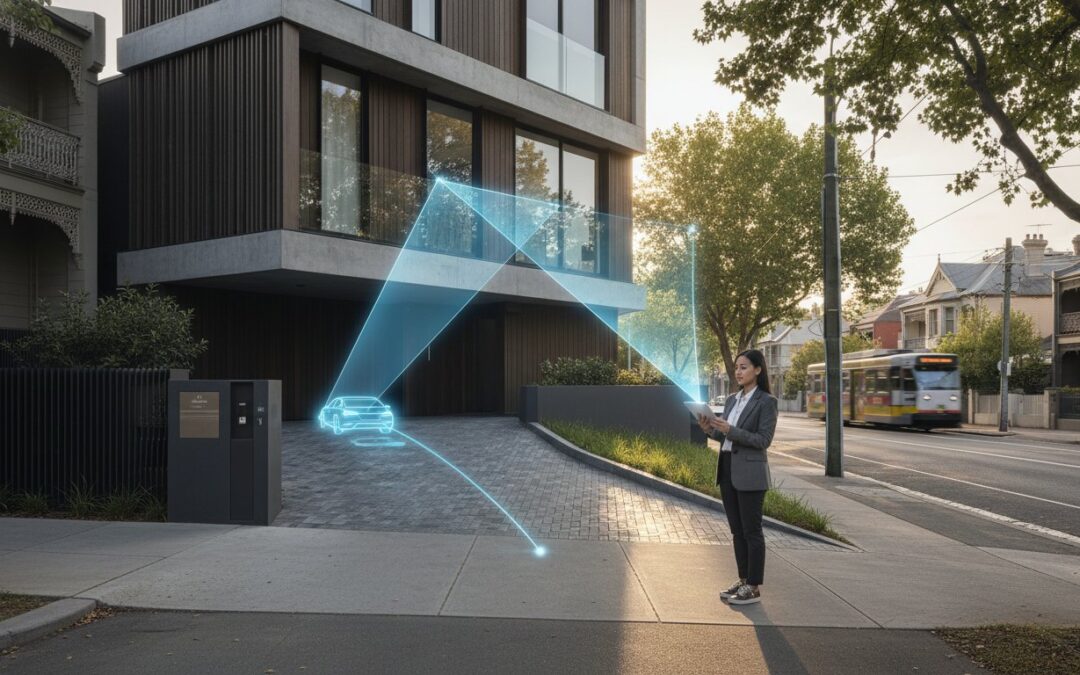
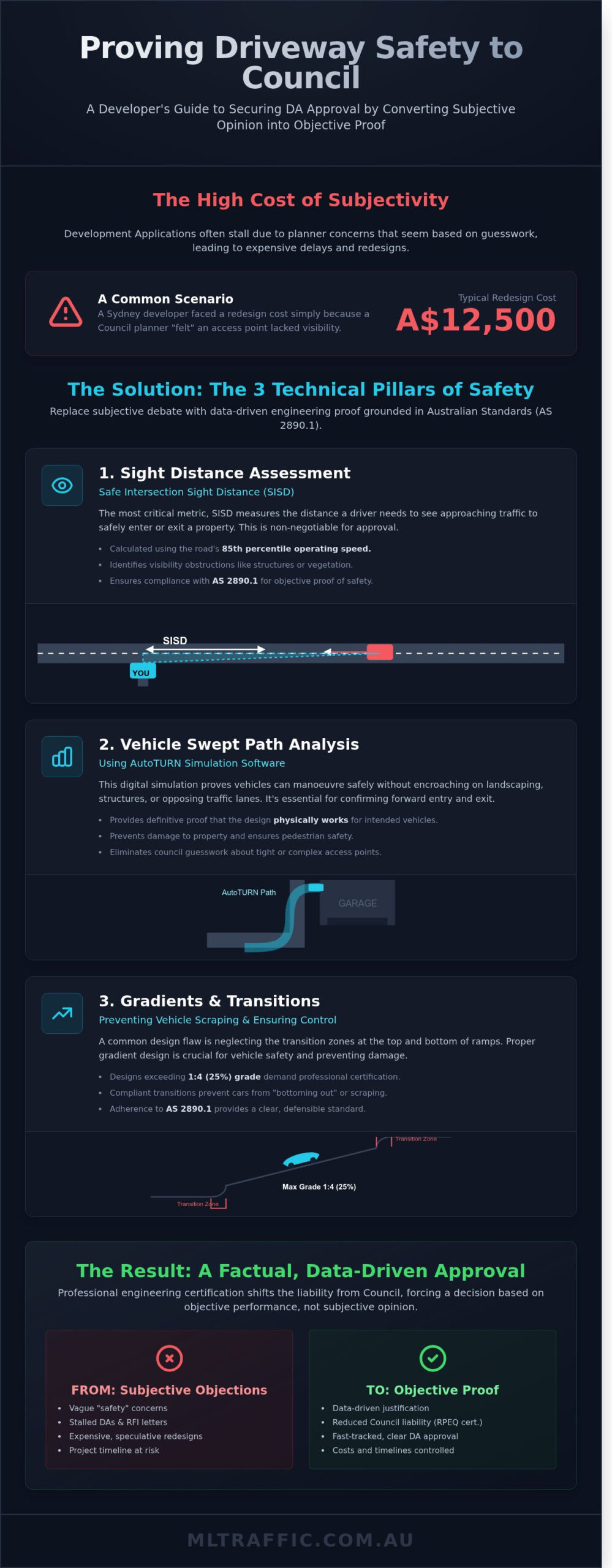
A developer in Sydney recently faced a A$12,500 redesign cost simply because a Council planner felt a proposed access point lacked sufficient visibility. It is a common scenario where subjective opinions override your project timeline, leading to expensive Request for Further Information letters. You likely already know that navigating the technical jargon of AS 2890.1 is a significant headache. It’s frustrating to see your Development Application stall because of safety objections that seem based on guesswork rather than geometry.
This guide provides the technical roadmap for proving driveway safety to council by converting these subjective concerns into objective engineering proof. We draw on our experience across 10,000 completed sites to show you how to secure your permit without the typical back and forth. You’ll learn how to present Vehicle Swept Path Assessments and Sight-Line Assessments that force a factual decision from the planning department. We will outline the specific documentation required to achieve a clear DA approval while keeping your redesign costs to an absolute minimum.
Key Takeaways
- Convert subjective Council concerns into objective engineering proof using the “Big Three” technical metrics: Sight Distance, Swept Paths, and Gradients.
- Navigate the legal hierarchy of the Roads Act and local planning schemes when proving driveway safety to council for DA approval.
- Utilise AS 2890.1 compliant designs to ensure your safety justification statement is grounded in recognised Australian Standards.
- Identify the specific underlying issues behind blanket safety objections to address the root cause of Council’s access concerns.
- Understand how professional RPEQ certification reduces Council liability and provides the authoritative proof needed to secure your permit.
Table of Contents
- Understanding the Legal Framework for Driveway Safety in Australia
- The Technical Pillars of Proving Driveway Safety
- Overcoming Common Council Objections to Access
- A Step-by-Step Guide to Preparing Your Safety Justification
- Securing Approval: Why Professional Engineering Certification Matters
Understanding the Legal Framework for Driveway Safety in Australia
Safety is the primary metric Councils use to evaluate any new vehicle access point. Planners prioritize the protection of road users and pedestrians above all other design considerations. When you’re proving driveway safety to council, you’re navigating a complex hierarchy of legislation. At the top sits the State Roads Acts, which govern classified roads. Local Government planning schemes, including Local Environmental Plans (LEPs) and Development Control Plans (DCPs), manage local street access. These regulations interact with the Australian Road Rules to ensure every vehicle movement minimizes risk to the public.
To better understand the critical nature of these safety measures, watch this brief overview from Transport For NSW:
Many developers assume their project qualifies as “Exempt Development.” This is a common error in judgment. While minor repairs might be exempt, any driveway involving complex geometry, steep gradients, or proximity to intersections requires a full Development Application (DA). If your design exceeds a 1:4 (25%) grade or requires significant earthworks, Council will demand professional engineering certification. These requirements are non-negotiable for sites located on arterial roads or near school zones.
The Significance of AS 2890.1 and AS 2890.2
AS 2890.1 (Off-street car parking) and AS 2890.2 (Commercial vehicle facilities) are the technical benchmarks for parking geometry in Australia. These standards define specific requirements for ramp grades, aisle widths, and sight distance. Compliance with these standards is the fastest path to DA approval. It provides objective proof that the design is safe. A frequent pitfall occurs when designers fail to account for transition zones at the top and bottom of ramps. This leads to vehicle scraping and reduced driver visibility. Using a professional Traffic Impact Assessment ensures these technical details meet the rigorous Australian Standards.
Council’s Duty of Care and Risk Mitigation
Planners are inherently risk-averse regarding new driveway crossovers. Their duty of care requires them to prevent foreseeable accidents. A Traffic Impact Assessment (TIA) serves as a formal risk mitigation tool. It shifts the conversation from subjective planning rules to objective engineering performance. By providing empirical data, a TIA assists in proving driveway safety to council by demonstrating that the access point meets the 85th percentile of safety requirements. This shift from opinion to data-driven engineering is essential for securing approval on difficult or constrained sites.
The Technical Pillars of Proving Driveway Safety
Council planners prioritize empirical data over aesthetic intent. Architectural sketches often lack the granular detail required to satisfy rigorous safety standards. Proving driveway safety to council requires a shift from visual representation to technical validation. Data-driven proof serves as the only reliable method to overturn a safety objection. This process relies on three primary metrics: Sight Distance, Swept Paths, and Gradients.
By 2026, technology allows for high-fidelity modelling that eliminates guesswork. We use advanced software to simulate real-world conditions, ensuring every centimetre of the proposed access point complies with Australian Standards (AS 2890.1). Professional certification from an experienced traffic engineer carries significantly more weight than a standard site plan. It demonstrates that the design has been vetted by specialists who understand the bureaucratic and technical requirements of the DA process.
Sight Distance Assessments: The Safe Intersection Sight Distance (SISD)
Safe Intersection Sight Distance (SISD) is the most critical safety metric for any council assessment. It measures the distance a driver needs to see approaching traffic to safely enter or exit a property. We calculate these sightlines based on the 85th percentile operating speed of the road and the specific topography of the site. If visibility is restricted by neighbouring structures or vegetation, we provide engineering data to prove the location remains safe through mitigating design measures or specific positioning. Compliance with AS 2890.1 is non-negotiable for approval.
Vehicle Swept Path Analysis using AutoTURN
A swept path analysis is a digital simulation showing the exact path a vehicle takes while turning. This is essential for proving driveway safety to council, as it confirms vehicles can enter and exit the site in a forward direction. Using AutoTURN software, we model the movements of the 99th percentile car (B99 vehicle) to ensure no part of the chassis clips kerbs, walls, or parked cars. This precision prevents future traffic flow disruptions and property damage. Detailed professional traffic engineering services provide the technical certainty councils demand.
Driveway Ramp Grade and Ground Clearance
Incorrect driveway gradients lead to vehicles scraping their undercarriages or losing traction. We calculate maximum gradients, typically adhering to 1:4 or 1:6 ratios depending on the land use and council requirements. Our assessments include:
- Transition Grades: Implementing 2-metre long sections at the top and bottom of ramps to prevent bottoming out.
- Pedestrian Safety: Ensuring the driveway grade is level where it crosses the property boundary to protect pedestrians on the footpath.
- Clearance Calculations: Verifying that low-clearance vehicles can navigate the change in elevation without incident.
Clear, technical documentation of these grades ensures the driveway is functional for all users while meeting local government safety criteria.
Overcoming Common Council Objections to Access
Council planners often use “safety” as a blanket term to cover various underlying technical concerns. When a Development Application (DA) faces resistance, the word safety might actually refer to sightline obstructions, traffic volume increases, or non-compliance with Australian Standards. Identifying the specific reason for an objection is the first step toward a resolution. You must distinguish between a “refusal” and a “request for redesign.” A refusal is a formal rejection, while a request for redesign is an invitation to provide better technical evidence or adjust the site layout.
Our engineers use a Traffic Impact Assessment to address these objections directly. This report moves the conversation from subjective opinion to objective data. By providing a professional analysis, you can demonstrate that the proposed access point meets all safety requirements without compromising the local road network. Proving driveway safety to council is about replacing their uncertainty with verified engineering facts.
Objection: Loss of On-Street Public Parking
Councils are protective of kerbside parking as it’s a limited public asset. If your driveway removes a street spot, planners may argue it negatively impacts the community. We counter this by using parking demand assessments. These studies show that the net benefit of providing off-street parking within your property outweighs the loss of a single street space. Strategic positioning is also vital. We often recommend locating driveways near existing infrastructure like power poles or fire hydrants where parking is already restricted. This ensures your access doesn’t reduce the actual number of available spots for the public.
Objection: Proximity to Intersections or Traffic Signals
Australian Standards, specifically AS 2890.1, outline “exclusion zones” near intersections. These zones typically prevent driveway placement within 6 to 10 metres of a corner’s tangent point to avoid collisions and queuing issues. If your property is on a corner lot, you’ll likely face this objection. We argue for “merit-based” exceptions by providing detailed traffic flow data. This data proves that the low volume of movements from a private driveway won’t interfere with intersection signals or cause hazardous queuing. Proving driveway safety to council in these instances requires precise vehicle swept path assessments to show that cars can enter and exit the site in a single forward motion without disrupting the flow of traffic.
- Data-driven responses: Replace vague safety concerns with empirical evidence.
- AS 2890.1 Compliance: Ensure all designs meet the specific requirements for off-street car parking.
- Swept Path Analysis: Use software to prove vehicles won’t cross into opposing lanes.
- Direct Consultation: We engage with council engineers to understand their specific reservations before submitting final reports.
A Step-by-Step Guide to Preparing Your Safety Justification
A safety justification statement must be logical, technical, and grounded in empirical data. Councils do not accept subjective opinions; they require evidence of compliance. Achieving an AS 2890.1 compliant car park design is the baseline requirement for any development application. You must structure your documentation so a Council engineer can verify safety claims quickly. Including visual evidence like 2D or 3D swept path diagrams provides the technical proof required to move past the assessment stage without unnecessary delays.
Step 1: Conduct a Professional Site Survey
Success begins with accurate site data. A professional surveyor must gather precise levels and locate existing infrastructure, including utility pits, street trees, and power poles. Many developers attempt to “eyeball” these elements, which frequently leads to DA failure later in the process. A 200mm discrepancy in the location of a stormwater pit or a telecommunications manhole can render a proposed driveway grade non-compliant. Identifying these physical showstoppers before the application is lodged allows for design adjustments that prevent costly refusals.
Step 2: Engage a Traffic Engineer for Modeling
Proving driveway safety to council requires technical simulation. You must request a Vehicle Swept Path Analysis to demonstrate that vehicles can maneuver safely within the site boundaries. The model must use the correct design vehicle for your specific land use, such as a B85 or B99 car for residential projects or a 12.5-meter Heavy Rigid Vehicle (HRV) for industrial warehouses. Our engineers iterate the design to find the precise balance between site yield and safety, ensuring vehicles can enter and exit in a forward direction as required by most local government authorities.
Step 3: Drafting the Merit-Based Argument
If your site has unique constraints, you need a merit-based justification. This document follows a strict technical format: “While the proposal varies from clause X of the DCP, it meets the underlying safety objective because…” Every claim must reference specific Australian Standards to back the argument. This report is then submitted as a core component of your Statement of Environmental Effects (SEE). High-quality documentation reduces the likelihood of a Request for Further Information (RFI), which can stall a project for 45 to 60 days. Proving driveway safety to council through professional modeling ensures your project stays on schedule.
Secure your development approval with a technical assessment from the experts. Contact ML Traffic Engineers today for a professional driveway safety report.
Securing Approval: Why Professional Engineering Certification Matters
Proving driveway safety to council is a technical hurdle that requires professional certification. An RPEQ or equivalent certified engineer provides the necessary technical weight to your application. This certification isn’t just a formality; it serves as a guarantee that the design meets Australian Standards, specifically AS 2890.1. By providing this level of assurance, you effectively reduce the Council’s liability. Planners are more comfortable approving a design when a qualified professional takes responsibility for the safety outcomes and technical accuracy.
At ML Traffic Engineers, we operate under a strict “the consultant who provides the quote, does the work” policy. This ensures that the person who understands your project’s specific constraints is the one performing the calculations. In larger firms, work is often passed to junior staff, which can lead to errors in sight-line assessments or ramp grade calculations. Direct accountability ensures your report is accurate and defensible during the assessment process. We’ve seen projects where a 1% error in ramp grade resulted in A$50,000 of remedial works after construction. Professional certification prevents these errors before they reach the site.
Negotiating with Council post-lodgement is often where projects stall. Having your traffic engineer present during these discussions is vital for resolving technical objections. We don’t just provide a report and disappear; we engage directly with Council planners. This hands-on approach allows us to address concerns regarding vehicle swept paths or pedestrian safety in real-time, often bypassing the need for multiple rounds of formal letters.
The Value of Senior Engineering Oversight
Senior oversight ensures your driveway design is buildable, not just “paper-safe.” Junior consultants often produce designs that meet theoretical standards but fail during construction due to overlooked site levels or existing infrastructure. With over 15 years of industry experience, our principals identify these practical issues early. You get direct access to experts who provide rapid responses to Council RFIs. This prevents the back-and-forth that typically delays DA approvals for months.
Next Steps for Your Development Application
To get a quote for a driveway safety assessment, you’ll need to provide your site survey, architectural floor plans, and any preliminary Council correspondence. We’ve completed assessments for over 10,000 sites across Australia, from residential apartments to large-scale warehouses. Our team provides the technical data needed for proving driveway safety to council with absolute clarity. Contact ML Traffic Engineers to start your assessment and move your development application forward with confidence.
Secure Your DA Approval with Technical Precision
Navigating the complexities of Australian Standards like AS 2890.1 is essential for any successful development application. Success depends on providing local government authorities with empirical data rather than general claims. Proving driveway safety to council requires a combination of technical justification and strict adherence to legal frameworks. By addressing common access objections through detailed swept path analysis and professional engineering certification, you remove the guesswork from the approval process.
ML Traffic Engineers brings over 15 years of experience to your project. We provide direct access to our senior principals, Michael Lee and Benny Chen. We don’t pass your project to junior staff; the traffic consultant who provides the quote does the work. Our team utilizes industry-leading AutoTURN software to ensure every vehicle movement is accurately mapped and compliant with current regulations. This meticulous approach has supported over 10,000 successful sites across Australia since 2005.
Get a professional traffic engineering assessment for your driveway today. Professional certification is the most effective way to protect your investment and move your project forward with confidence.
Frequently Asked Questions
What is the maximum gradient for a residential driveway in Australia?
The maximum gradient permitted by Australian Standard AS 2890.1 is 25 percent, which is a 1 in 4 grade. You must include transition grades of 12.5 percent for at least 2 metres at the top and bottom of steep sections to prevent vehicle undercarriages from scraping. The first 6 metres of the driveway from the property boundary should ideally not exceed 5 percent to maintain safe sight lines for exiting drivers.
How close can my driveway be to a street corner or intersection?
Your driveway must be at least 6 metres from the tangent point of the kerb return on a standard local street. This distance increases to 20 metres or more if your property is located on a major arterial road or near traffic lights. These setbacks ensure that exiting vehicles don’t interfere with the queueing or turning movements of the intersection, which is a critical factor in proving driveway safety to council during the DA process.
Why is Council asking for a swept path analysis for a single house?
Councils require a swept path analysis to prove that a B85 or B99 design vehicle can enter and exit your property in a single forward motion. This is standard for sites with steep terrain, narrow frontages, or battle-axe configurations. We use specialized CAD software to simulate these vehicle movements, ensuring the driveway width and turning radii meet the technical requirements of AS 2890.1.
Can I build a driveway over a council stormwater pit or near a street tree?
Building over a stormwater pit is generally prohibited because it restricts maintenance access for Council engineers. You must also maintain a minimum 3-metre clearance from the trunk of any significant street tree to avoid damaging the structural root zone. If your proposed crossover conflicts with these assets, you’ll need a formal assessment to determine if a heavy-duty pit cover or an offset driveway alignment is a viable engineering solution.
What happens if my driveway doesn’t meet AS 2890.1 exactly?
A non-compliant driveway requires a merit-based assessment from a qualified traffic engineer to achieve DA approval. We provide a Traffic Impact Statement that justifies the deviation by demonstrating that the design still provides safe and functional access. Proving driveway safety to council in these cases relies on technical data and site-specific evidence rather than strict adherence to the standard’s prescriptive dimensions.
How much does a traffic engineering report for a driveway cost?
A standard Traffic Impact Statement or driveway compliance report typically costs between A$1,500 and A$3,500 depending on the complexity of the site. If your project requires extensive swept path simulations for multiple vehicle types or a formal parking survey, the fee may increase toward A$4,500. These costs cover the professional assessment, RPEQ certification, and the technical documentation required by your local Council.
How do I prove that my driveway won’t cause a loss of street parking?
We conduct a Parking Demand Assessment to document the existing kerbside capacity within a 100-metre radius of your property. If your new driveway crossover removes an existing on-street space, we must demonstrate that the development provides sufficient internal parking to compensate. Council planners look for a net balance where the private parking provision offsets the reduction in public street space.
Do I need a traffic engineer if my architect already drew the driveway?
Architects focus on the building’s aesthetics and general layout, but they often lack the specialized CAD software and RPEQ certification needed for technical traffic compliance. A traffic engineer provides the specific vehicle templates and sight-line assessments that Council planners demand. Our senior consultants work directly on your file to ensure the driveway design is both functional and compliant with all relevant Australian Standards.
Which areas do you cover?
We are traffic engineers servicing Melbourne, Sydney, Brisbane, Gold Coast, Hobart, Perth, Adelaide, Darwin, Canberra and surrounding areas.
Disclaimer
The content on www.mltraffic.com.au, including all technical articles, guides, and resources, is provided for general informational and educational purposes only. It is not intended to constitute professional advice in traffic engineering, transportation planning, development approvals, or any other technical or legal field.
While ML Traffic Engineers makes every reasonable effort to ensure the accuracy, completeness, and timeliness of the information published, we do not provide any warranties or representations (express or implied) regarding its reliability, suitability, or availability for any particular purpose. Any reliance you place on the content is strictly at your own risk.
In no event shall ML Traffic Engineers, its directors, employees, authors, or affiliates be liable for any direct, indirect, incidental, special, consequential, or punitive damages (including, without limitation, loss of profits, data, or business opportunities) arising out of or in connection with the use of, or inability to use, any information provided on this website.
The articles and guides on this site are not a substitute for engaging a qualified, registered professional traffic engineer (such as an NPER or RPEQ engineer) to assess your specific project requirements. For tailored advice, compliance assessments, or traffic engineering services, please contact a competent professional.
This disclaimer may be updated from time to time without notice. By accessing or using this website, you agree to be bound by the most current version of this disclaimer.
