

A low-cost traffic report is often the most expensive mistake a developer can make. You’ve likely experienced the frustration of a project stalling because of a Council RFI or discovered that the senior expert you hired handed your car park design off to a junior staff member. It’s an exhausting cycle that leads to expensive reworks and missed deadlines. Knowing the specific questions to ask before hiring a traffic consultant is the only way to protect your project from these avoidable bottlenecks.
You need a partner who understands that technical findings must be defensible to Council and strictly compliant with Australian Standards; they shouldn’t just be a series of automated software outputs. This article identifies the critical questions that distinguish a mediocre traffic report from one that secures DA approval. We’ll preview the essential checklist for vetting personnel continuity, professional accreditation such as NER registration, and the senior-led expertise required for a smooth, efficient design process. By asking the right questions upfront, you ensure direct access to experts who can navigate the complexities of car park design and intersection analysis without the need for costly redesigns.
Key Takeaways
- Verify mastery of Australian Standards AS 2890.1 and AS 2890.2 to prevent non-compliant car park designs and costly project reworks.
- Ensure personnel continuity by confirming the senior principal who quotes the project is the same expert performing the technical analysis and reporting.
- Utilise our targeted questions to ask before hiring a traffic consultant to evaluate a firm’s reputation with local Council and their ability to handle RFIs.
- Assess the consultant’s specific experience with your land-use type to ensure the Traffic Impact Assessment (TIA) is defensible and technically accurate.
- Prioritise direct access to leadership to maintain accountability and streamline the communication process throughout the DA approval phase.
Assessing Technical Expertise and Australian Standards Compliance
Technical compliance is the foundation of any successful development application. If your consultant lacks a rigorous understanding of national standards, your project faces immediate rejection or costly redesigns. One of the primary questions to ask before hiring a traffic consultant is how they verify compliance with AS 2890.1 and AS 2890.2. A simple “yes” isn’t enough; you need to know their specific methodology for assessing driveway ramp grades and sight distances to ensure they meet local requirements without requiring expensive rework.
A consultant must demonstrate comprehensive technical expertise in traffic engineering to handle the nuances of urban planning. This includes the ability to certify that a car park design is fully compliant before it reaches the Council’s desk. Relying on junior staff to interpret these standards often leads to errors that a senior principal would catch instantly. You need a partner who takes accountability for every line and grade in the report.
To better understand the vetting process, watch this helpful video:
Understanding AS 2890 Compliance
Compliance isn’t optional; it’s a regulatory necessity. Ask your potential consultant if they provide a detailed AS 2890.1 checklist for every design they produce. This document should serve as a transparent record of how your project meets width, grade, and clearance requirements. Inquire about their experience with non-standard vehicle access, as these often require a performance-based solution rather than a simple “deemed-to-satisfy” approach. They should also explain their process for calculating car parking demand, especially when Council rates don’t reflect the actual needs of your specific land use.
Precision in Swept Path Analysis
Accuracy in vehicle movement is critical for functional car park design. Confirm they use the latest swept path analysis software, such as AutoTURN, to model vehicle turns. Static drawings are insufficient for modern developments. Ask for examples of complex vehicle manoeuvres they’ve modelled, such as heavy rigid vehicles (HRV) navigating tight loading docks. Ensuring they can accommodate specific truck sizes is vital for waste management plans and delivery logistics. Without this precision, you risk building a facility that’s physically unusable for its intended purpose.
Finally, ask if they provide a formal certification of compliance. A reputable consultant won’t hesitate to put their professional standing behind their work. This certification acts as a shield during the Council review process, providing the assurance that every element of your design meets the necessary regulatory benchmarks. Don’t settle for vague promises when your DA approval is on the line.
Experience is not a generic metric. When considering questions to ask before hiring a traffic consultant, you must drill down into their specific track record with your land-use category. A consultant who specialises in residential subdivisions may lack the technical nuance required for a complex industrial distribution centre or a high-traffic childcare facility. Each sector carries unique trip generation rates and parking requirements that dictate the success of a Traffic Impact Assessment (TIA).
You should ask for references from projects of a similar scale and complexity. A consultant’s ability to handle public infrastructure interface is just as critical as their work on private developments. Verify how many successful DA approvals they have supported in the last 12 months. This metric provides a clear indication of their current standing with local authorities and their ability to produce reports that meet Council expectations without repeated revisions.
Industry-Specific Experience
It’s vital to check their history with diverse sectors. Childcare centres, for example, require specific pick-up and drop-off analysis that differs significantly from the requirements of a high-density apartment block. Inquire how they adapt their traffic engineering strategy for these different project types. A seasoned expert will have a library of previous projects to draw from, ensuring that your specific land-use challenges are addressed using proven methodologies. They must be capable of handling both small-scale additions and major multi-stage developments with equal precision.
Navigating Unique Site Constraints
Not every site is a blank canvas. Many projects face significant hurdles like limited road frontage or difficult sight distances. Ask potential consultants how they manage these constraints while maintaining compliance with Australian Standards. Their approach to intersection analysis and road safety audits should be meticulous. For projects involving government road networks, understanding the prequalification of engineering consultants is often necessary to ensure the firm meets the rigorous standards required by state transport departments.
Request a specific case study where they solved a significant access challenge. This might include redesigning a complex driveway to improve safety or negotiating a parking shortfall with Council based on empirical data. Their ability to find technical solutions to physical limitations is what prevents your project from stalling. To see how a dedicated team manages these complexities, you can review our professional background and project history.
Ensuring your consultant has a proven track record isn’t just about vetting their past; it’s about securing your project’s future. A consultant with a high success rate in DA approvals understands the unwritten requirements of local Councils, which often saves weeks of delays during the assessment phase.
The Accountability Factor: Who is Actually Performing the Work?
Accountability is often compromised in larger firms where senior directors attend the initial sales meeting but delegate technical drafting to junior staff. This practice introduces significant risk to your development application. One of the most critical questions to ask before hiring a traffic consultant is whether the senior engineer you meet will be the one performing the technical work. Junior staff often lack the field experience required to navigate complex Council requirements, leading to avoidable errors in the final report.
A senior principal brings decades of professional longevity to a project. Their involvement ensures that technical findings are defensible and that the car park design adheres to the highest standards of safety and efficiency. When a firm guarantees senior-led expertise, they are taking personal responsibility for the project’s success. This hands-on approach distinguishes a reliable consultancy from an impersonal firm that prioritises volume over technical precision.
Direct Access to Senior Leadership
Confirm if you will have a direct line to the expert performing the Traffic Impact Assessment. Avoid firms where your project is handed off to junior graduates after the contract is signed. You should enquire about the consultant’s specific years of experience in the Australian market and their history with local regulatory authorities. Direct access to leadership means your queries are answered by the person who actually understands the data and the design. This “no-gatekeepers” approach streamlines communication and ensures that your project remains a priority throughout the DA process.
Transparency in the Consultancy Process
Technical accuracy requires a robust internal review process. Enquire about how the firm manages internal quality control for Swept Path diagrams and car park designs. The ‘Junior Hand-off’ risk is the industry practice of senior experts winning a contract only to delegate the actual analysis to inexperienced staff, which often results in technical discrepancies and Council delays. Ask how they ensure consistency between the architectural plans and the traffic report. Discrepancies between these documents are a primary cause of RFIs. A senior principal should review every technical drawing and statement before it is submitted to ensure it meets all Australian Standards.
Your consultant should offer a personnel continuity promise for the duration of the project. This ensures that the expert who understands your site’s history remains your primary contact from inception to Council approval. This continuity prevents information loss and ensures that the technical strategy remains consistent even if the project spans several months or years. When vetting your options, prioritise firms that value direct accountability and senior-level performance over those with high staff turnover or layered bureaucracy.
Navigating the Council Approval Process and Liaison
A technically sound report is only half the battle. If your consultant cannot effectively defend their findings during the assessment phase, the project will stall. When evaluating candidates, the primary questions to ask before hiring a traffic consultant should focus on their history of successful liaison with local authorities. You need to know if they have an established reputation for technical accuracy with the specific Council assessing your application. A consultant who is respected by Council engineers can often resolve potential objections through technical dialogue rather than a formal, protracted RFI process.
Inquire whether the consultant will represent the project if it is challenged. This includes attending Council meetings or participating in mediation sessions. Technical expertise is useless if the expert refuses to stand by their work in a public forum. Their strategy for negotiating parking shortfalls or access variations must be proactive. They should be prepared to explain why a variation is safe and functional, rather than simply stating that it is necessary. This level of advocacy is what distinguishes a senior-led consultancy from a high-volume report factory.
Post-Submission Support
Submission is not the finish line. You must ensure the initial quote includes responding to standard Council Requests for Further Information (RFIs). Ask about their success rate in defending reports against engineering objections. A consultant must be willing to collaborate with your architect and town planner to ensure the traffic strategy aligns with the broader development goals. This interdisciplinary cooperation is essential for a smooth DA approval process. If a consultant treats their report as a standalone document, they are likely to miss the nuances that lead to a successful approval.
Strategic Negotiation Skills
Negotiating parking shortfalls or access variations requires empirical evidence. Ask how they use site-specific data and parking surveys to justify deviations from standard Council rates. Their experience with Traffic Guidance Schemes (TGS) during the construction phase is also vital for project continuity. You must verify their understanding of the Traffic Management Plan requirements for your specific region. Different states and local government areas have unique triggers for TMPs and construction traffic management. A consultant who understands these local nuances can prevent expensive delays during the pre-construction phase.
To ensure your project moves through the approval pipeline without unnecessary delays, you can view our full range of traffic consultancy services. Securing a consultant who understands the bureaucratic landscape is just as important as securing one who understands the engineering standards. This dual expertise ensures that your project is not only compliant but also defensible under scrutiny.
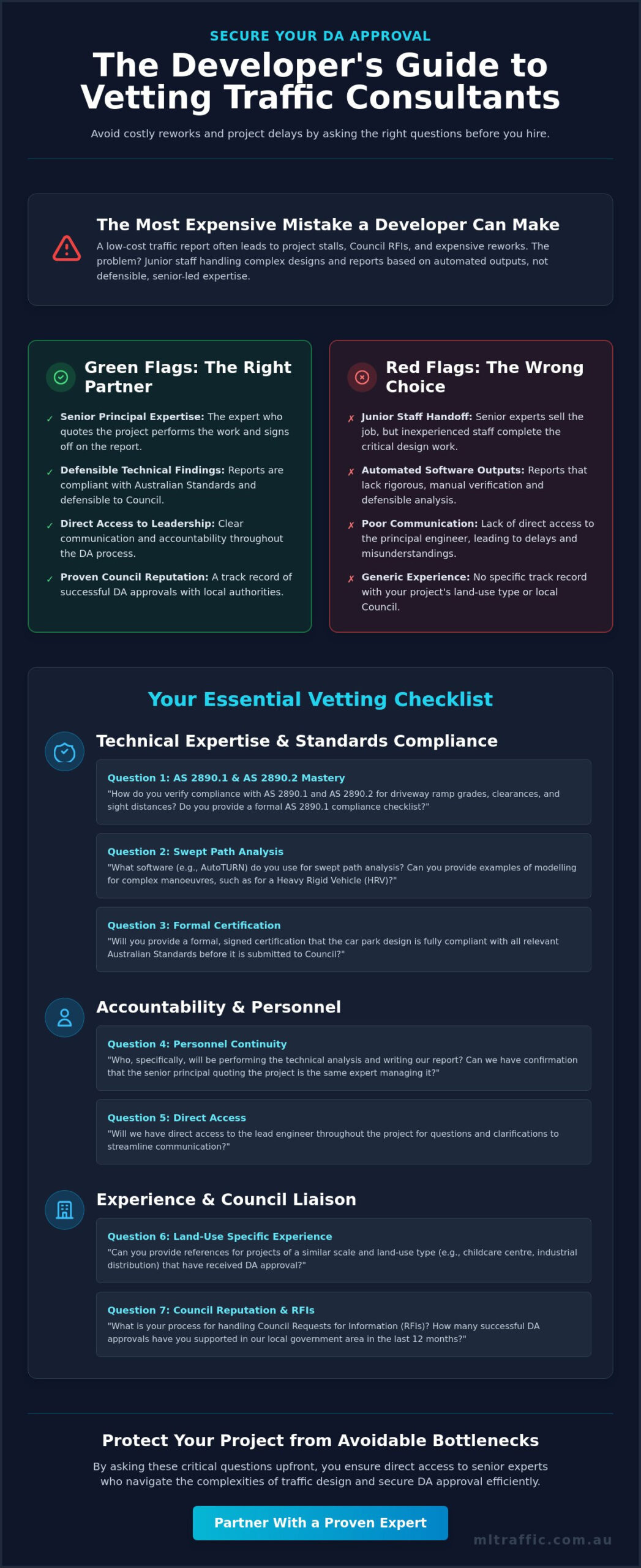
Final Selection: The Traffic Consultant Vetting Checklist
The final selection of a traffic consultant is a critical risk-management decision. A low-cost proposal often masks a lack of technical depth or a reliance on junior staff, both of which increase the probability of Council rejection. When reviewing your options, use the questions to ask before hiring a traffic consultant to filter out firms that prioritise volume over precision. Your final checklist must include a rigorous review of technical compliance, software capabilities, and the specific track record of the individual engineer assigned to your project.
Validate their experience with your specific land-use category beyond general claims. Assessing their communication style is equally vital; a consultant who cannot clearly explain their technical findings to you will likely struggle to defend them to a Council engineer during a formal hearing or mediation. Finally, compare the value of senior-led expertise against the potential costs of a non-compliant car park design that requires expensive structural rework. The right consultant acts as a strategic partner who ensures your DA progresses without technical bottlenecks.
Comparing Proposals Beyond Price
Look for a detailed scope of work that explicitly covers all potential Council requirements, including RFIs and post-submission support. A vague proposal is a red flag. It often leads to hidden costs for revisions when the first Council query arrives. Assess the clarity and professionalism of the initial proposal. If the consultant cannot organise their own documentation, they are unlikely to produce a meticulous Traffic Impact Assessment for your development. Ensure the quote includes specific line items for Swept Path Analysis and Driveway Ramp Grade Assessments to avoid unexpected variations later in the project timeline.
Why ML Traffic Engineers Australia Fits the Criteria
At ML Traffic Engineers Australia, we provide the technical rigour and accountability that modern developments demand. With over 15 years of specialised experience in traffic engineering and transport planning, we have supported thousands of successful DA approvals across Australia. Our personnel continuity promise ensures that the senior principal who initiates your project remains directly involved in the technical work. We don’t use junior graduates as gatekeepers; you have direct access to the experts performing the analysis. Our project experience is exhaustive, covering retail centres, industrial subdivisions, childcare facilities, high-density residential developments, and complex mixed-use sites.
We understand the bureaucratic landscape and the technical requirements of Australian Standards. Our reports are designed to be defensible, compliant, and accurate from the first submission. If you are preparing a development application and need a partner who understands the specific questions to ask before hiring a traffic consultant, we invite you to contact us for a direct consultation on your next project. We provide the certainty of senior-led results for every client, regardless of project scale.
Secure Your DA Approval with Expert Traffic Design
Selecting the right consultancy is a strategic move that dictates the speed and cost of your development. You now understand the critical questions to ask before hiring a traffic consultant to ensure your project avoids the common pitfalls of junior hand-offs and non-compliant designs. Prioritising senior leadership and a deep mastery of AS 2890.1 and AS 2890.2 standards will protect your project from expensive Council RFIs and reworks. Accountability is the foundation of a successful application.
ML Traffic Engineers Australia provides the technical rigour required for a smooth approval process. With over 15 years of Australian consultancy experience, we offer direct access to senior principals on every project. We specialise in car park design and impact assessments that meet the strictest regulatory requirements. Our team takes full accountability for the technical accuracy of our reports, ensuring they are defensible under Council scrutiny. We don’t delegate your success to inexperienced staff.
Take the next step in your development journey by engaging a team that values precision and professional continuity. Request a quote from our senior traffic engineers today to ensure your car park and access designs are fully compliant and ready for submission. We look forward to supporting your project’s success.
Frequently Asked Questions
What is the difference between a traffic engineer and a traffic controller?
A traffic engineer is a qualified professional who performs technical assessments, designs infrastructure, and ensures regulatory compliance for Development Applications. In contrast, a traffic controller is a field worker who physically manages vehicle flow on-site using stop-slow bats and signage. For a DA, you require an engineer to produce a TIA or Swept Path Analysis, as controllers do not provide design or planning services.
How much does a Traffic Impact Assessment (TIA) typically cost for a DA?
Fees for a Traffic Impact Assessment are determined by the technical hours required to complete the analysis for your specific project. Complexity factors include the number of intersections requiring SIDRA modelling, the volume of traffic counts needed, and the scale of the proposed development. While costs vary between firms, selecting a consultant based on their senior-led expertise is critical to avoid the risk of expensive Council RFIs.
Why does Council require a Swept Path Analysis for my driveway?
Council requires a Vehicle Swept Path Analysis to verify that vehicles can navigate your site safely and efficiently without striking infrastructure. This digital modelling proves that the largest designated vehicle, such as a heavy rigid vehicle for waste collection, can enter and exit in a forward direction. It’s a fundamental requirement for ensuring your driveway design complies with AS 2890.1 and local planning schemes.
Can a traffic consultant help if I don’t have enough parking spaces on-site?
Yes, a consultant can perform a Car Parking Demand Assessment to justify a parking shortfall to the assessing authority. By using empirical data from similar land uses or conducting site-specific surveys, they can demonstrate that the actual parking demand is lower than the standard Council rates. This evidence-based approach is one of the key questions to ask before hiring a traffic consultant when your site has physical space constraints.
How long does it take to prepare a standard traffic report for Council?
A standard traffic report generally takes between one and three weeks to complete depending on the project scope. This timeframe allows for necessary site inspections, data collection, and the drafting of technical findings. If your project requires specific intersection modelling or multi-day traffic counts, the duration may increase. Ensuring you have direct access to the expert performing the work can often streamline this process and prevent delays.
Is a traffic report required for every Development Application in Australia?
No, a traffic report is only required when a project meets specific trip generation, safety, or land-use triggers defined by local Councils. Small-scale residential renovations usually don’t need them, but commercial, industrial, or high-density residential developments almost always do. You should check your local Council’s planning scheme or consult an expert to determine if your specific land use necessitates a formal Traffic Impact Assessment.
What happens if Council rejects the traffic report provided by my consultant?
If a report is rejected, your consultant must provide a technical response to the Council’s Request for Further Information (RFI) or engineering objections. This often involves refining the car park design or providing additional data to support the original findings. Having a consultant with an established reputation for technical accuracy is vital, as they can negotiate variations and defend the engineering logic behind your proposal.
Do I need a separate Traffic Management Plan for the construction phase?
Yes, a separate Traffic Guidance Scheme (TGS) or management plan is typically required to manage safety during the construction phase. While the TIA addresses the permanent impact of the completed development, the construction plan manages temporary risks associated with heavy vehicle movements and site access. It’s important to include these requirements in your initial questions to ask before hiring a traffic consultant to ensure full project coverage.

Disclaimer
The content on www.mltraffic.com.au, including all technical articles, guides, and resources, is provided for general informational and educational purposes only. It is not intended to constitute professional advice in traffic engineering, transportation planning, development approvals, or any other technical or legal field.While ML Traffic Engineers makes every reasonable effort to ensure the accuracy, completeness, and timeliness of the information published, we do not provide any warranties or representations (express or implied) regarding its reliability, suitability, or availability for any particular purpose. Any reliance you place on the content is strictly at your own risk.In no event shall ML Traffic Engineers, its directors, employees, authors, or affiliates be liable for any direct, indirect, incidental, special, consequential, or punitive damages (including, without limitation, loss of profits, data, or business opportunities) arising out of or in connection with the use of, or inability to use, any information provided on this website.The articles and guides on this site are not a substitute for engaging a qualified, registered professional traffic engineer (such as an NPER or RPEQ engineer) to assess your specific project requirements. For tailored advice, compliance assessments, or traffic engineering services, please contact a competent professional.This disclaimer may be updated from time to time without notice. By accessing or using this website, you agree to be bound by the most current version of this disclaimer.
