

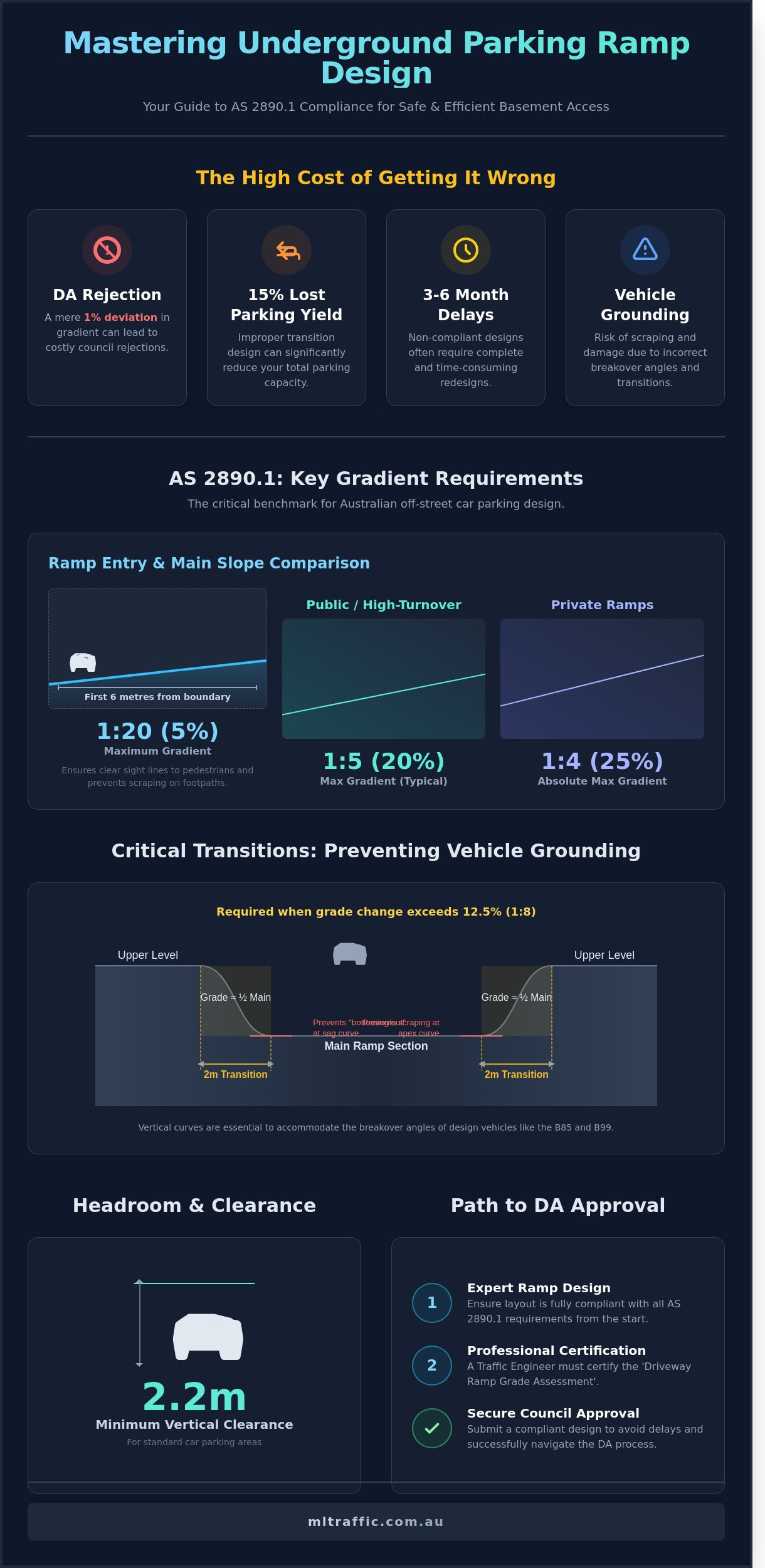
A 1% deviation in your driveway gradient is often the difference between a successful DA approval and a costly, months-long council rejection. It’s a reality our senior engineers see frequently; developers often lose 15% of their potential parking yield because they didn’t account for the transition requirements of AS 2890.1 during the initial design phase. You shouldn’t have to compromise your Gross Floor Area or risk vehicle grounding issues due to a non-compliant basement entry.
Mastering ramp design for underground parking requires a precise understanding of vertical clearances, sight lines, and grade changes. We’ve compiled this technical guide to help you navigate these complexities with the same professional rigor we apply to the 10,000+ sites we’ve assessed across Australia since 2005. You’ll learn how to implement compliant transitions, optimize your layout for maximum space efficiency, and meet the exact specifications required by local councils. We’ll break down the critical components of AS 2890.1 to ensure your next development project remains safe, functional, and fully compliant.
Key Takeaways
-
Understand the mandatory gradient requirements under AS 2890.1 to ensure your basement layout meets strict Australian Standards for both residential and commercial developments.
-
Evaluate the technical advantages of linear, dog-leg, and helical configurations to optimize site efficiency and maintain critical driver sight-lines.
-
Learn how to prevent vehicle grounding by applying precise ramp design for underground parking that accounts for the breakover angles of B85 and B99 design vehicles.
-
Discover the essential role of a professional traffic engineer in certifying your ‘Driveway Ramp Grade Assessment’ to secure council approval during the DA process.
Table of Contents
Understanding Ramp Design for Underground Parking
A parking ramp serves as the critical transition element between street level and underground vehicle storage. It’s more than a simple driveway; it’s a functional component that dictates the operational efficiency of the entire basement layout. In Australian property development, the ramp design for underground parking must adhere to the rigorous safety and clearance standards set by AS 2890.1. A well-designed ramp ensures that vehicles move fluidly between levels without the risk of structural scraping or driver disorientation. When a ramp is positioned poorly, it can reduce the total parking yield of a multi-storey car park or basement by 15% or more, directly impacting the project’s commercial viability.
To better understand this concept, watch this helpful video:
Why Ramp Geometry Matters for Development Approval
Council planning officers prioritize ramp geometry during the Development Application (DA) process because it determines how a site interacts with the public road network. If the ramp’s entry point is too close to a signalized intersection or lacks sufficient queuing space, it creates traffic congestion and safety hazards for pedestrians. Non-compliant ramp designs frequently lead to costly redesigns after a DA submission, often resulting in 3 to 6 months of project delays. Developers must ensure these designs are fully integrated with a comprehensive Traffic Impact Assessment to prove that vehicle movements won’t compromise local safety or traffic flow.
The Balance Between Space Efficiency and Vehicle Access
Engineers face a constant challenge when calculating the footprint of a ramp against the number of available parking spaces. While steep gradients can save significant floor space, they often sacrifice driver comfort and increase the risk of vehicle damage. Under AS 2890.1, a maximum gradient of 1:4 (25%) is permissible for short transitions, but this requires careful implementation of vertical curves to prevent bottoming out. Designers must weigh these technical constraints against the need to maximize the number of 2.4m wide parking bays. The ramp footprint is the total horizontal area occupied by the ramp structure that is typically excluded from Gross Floor Area (GFA) calculations to help developers optimize their site yield.
Key Requirements of AS 2890.1 for Parking Ramps
AS 2890.1:2004 serves as the critical benchmark for off-street car parking design in Australia. It provides the technical parameters necessary to ensure that vehicles can enter, exit, and circulate within a facility without damage or safety risks. For any ramp design for underground parking, compliance with these standards isn’t optional; it’s a prerequisite for council approval and operational safety. This standard applies to all private and public developments, ensuring a uniform level of accessibility across the built environment.
Maximum Gradient Limits for Private and Public Access
The standard dictates specific slope limits based on the intended user class and the ramp’s proximity to the property boundary. For the first 6 metres of a ramp measured from the property boundary, the gradient must not exceed 1:20 (5%). This prevents vehicles from scraping their undercarriages on the footpath and ensures drivers have a clear line of sight to pedestrians before crossing the boundary. Beyond this initial zone, private ramps can reach an absolute maximum gradient of 1:4 (25%). However, for public car parks or high-turnover residential developments (User Class 1A), a more conservative 1:5 (20%) limit is typically required to accommodate a broader range of driver abilities and vehicle types.
Transition Ramps and Vertical Curves
Sudden changes in slope lead to vehicle damage. AS 2890.1 requires a 2-metre transition section for any ramp where the grade change exceeds 1:8 (12.5%). This transition grade must be approximately half of the main ramp’s slope. For example, if the main ramp is 1:4, the transition section should be 1:8. These requirements are often integrated with broader urban planning frameworks like the Liveable Neighbourhoods Policy, which aligns technical parking standards with safe movement networks. Correctly calculating these vertical curves is vital to prevent low-clearance vehicles from bottoming out at the "apex" or "sag" of the ramp.
Headroom and Overhead Clearance Standards
Vertical clearance is a frequent point of failure in poorly planned basements. The minimum required headroom is 2.2 metres for standard car parking areas. If the ramp design for underground parking provides access to parking for people with disabilities, this requirement increases to 2.5 metres. It’s vital to measure this clearance perpendicular to the ramp’s slope, not just vertically. Designers must also account for the "sag" effect on long-wheelbase vehicles. Fire sprinklers, cable trays, and ventilation ducts must remain above this 2.2-metre envelope to maintain compliance and avoid costly onsite modifications.
Getting these technical details right during the planning phase prevents expensive rectifications during construction. If you’re managing a complex development application, our team provides detailed traffic engineering services to ensure your project meets all regulatory requirements and Australian Standards.
Comparing Straight vs. Curved Ramp Configurations
Selecting the optimal configuration for a basement ramp involves a direct trade-off between site efficiency and driver safety. Engineers must evaluate whether a linear, dog-leg, or helical layout fits the site’s footprint without compromising the basement’s parking capacity or the structural grid. The configuration choice dictates the flow of the entire facility and impacts the total number of yieldable parking spaces.
Straight Ramps: Simplicity and Visibility
Straight ramps provide the best line-of-sight for drivers. They’re the most cost-effective solution for small developments where site depth allows for a linear run. Visibility is the primary advantage here; drivers can see approaching vehicles or pedestrians from the top of the ramp, which significantly reduces the risk of collisions. On shallow or narrow lots, however, a straight ramp is often problematic. It can cut through the middle of a floor plate, creating "dead zones" where parking bays cannot be placed. This configuration works best when aligned with a side boundary to preserve the integrity of the internal parking layout.
Helical and Curved Ramps: Space Saving vs. Complexity
Helical ramps save significant horizontal space by stacking the vertical transition. AS 2890.1 specifies strict inner radius requirements, typically 4.0 metres for Class 1A residential facilities. Designers must carefully manage the cross-fall and superelevation on these sections. If the ramp is too steep on the inner edge, vehicles with low ground clearance will bottom out or scrape their undercarriage. These designs require a sophisticated Swept Path Analysis to ensure compliance. This technical assessment proves that the B85 or B99 design vehicle can navigate the turn without mounting kerbs or impacting structural columns. Curved configurations are more complex to construct and require precise formwork to maintain the required grades.
Two-Way vs. Single-Lane Ramps with Passing Bays
Single-lane ramp design for underground parking is generally acceptable for low-volume residential developments with fewer than 25 to 30 dwellings. These designs require dedicated passing bays at the top and bottom of the ramp. A passing bay must be at least 6.0 metres wide to allow two vehicles to pass safely. If the ramp length exceeds 20 metres or sight lines are obstructed, you must install traffic signal controls, such as red and green lights, to manage conflicting movements. For higher-volume sites, a two-way ramp with a minimum width of 5.5 metres is the standard. Every ramp corridor should also account for pedestrian safety. It’s common practice to integrate a 1.0-metre wide pedestrian path, separated by a 150mm raised kerb or safety bollards, to prevent vehicle-pedestrian conflict in tight basement environments.
Avoiding Grounding and Scraping: Transition Design
Vehicle grounding occurs when the undercarriage contacts the ramp surface at the apex or the base. This physical failure is usually the result of an inadequate breakover angle or poor transition planning. In ramp design for underground parking, the breakover angle is the maximum convex angle a vehicle can drive over without the chassis touching the ground between the wheels. If the ramp gradient changes too abruptly, the vehicle’s wheelbase creates a bridge that the ramp apex strikes, causing significant property damage.
To prevent this, engineers check ramp profiles against the B85 or B99 design vehicles defined in AS 2890.1. We use cross-sectional diagrams to verify clearance at every 500mm interval along the ramp. This process ensures that the lowest point of the vehicle chassis remains clear of the concrete at all times. Surface treatments are also vital. Steep gradients exceeding 15% require a broom finish or transverse grooving to maintain traction, particularly when tyres are wet from external road surfaces.
Calculating Breakover and Approach Angles
The wheelbase of a vehicle determines its risk of scraping the ramp apex; longer wheelbases require more gradual transitions. Mitigation strategies involve lengthening the transition zones or reducing the primary gradient to under 20%. The B85 vehicle standard protects 85% of cars on Australian roads by providing a conservative design baseline for most residential and commercial developments. For facilities expecting larger SUVs or luxury vehicles, we often apply the B99 standard to provide a higher safety margin.
The Importance of Swept Path Analysis in Ramp Design
AutoTURN software allows our team to identify potential pinch points where vehicles might strike structural columns or walls. This digital simulation tracks the outer path of the mirrors and the inner path of the rear wheels during turns. A professional Swept Path Analysis is a mandatory requirement for over 90% of council submissions across Australia. It provides the empirical proof that the ramp design for underground parking functions correctly without requiring multi-point turns or risking vehicle damage.
Drainage and Environmental Considerations
Basement flooding is a primary risk when ramps are not correctly drained. We design grate drains at the bottom of ramps to capture stormwater runoff before it enters the parking levels. These drains must handle the peak flow rates calculated for a 1-in-100-year storm event. Additionally, ramp surfacing impacts noise levels for residents. Using textured concrete or specialized acoustic coatings reduces tyre squeal, which is a frequent source of complaints in high-density residential units.
Ensure your project meets all council requirements and Australian Standards for vehicle access. Contact ML Traffic Engineers for a technical assessment of your ramp design.
Navigating the DA Process with Expert Traffic Design
Achieving council approval for a basement car park requires more than drawing lines on a plan. A professional traffic engineer must certify that the ramp design for underground parking aligns with local government requirements and Australian Standards. This certification provides the technical assurance that vehicles enter and exit the site without bottoming out or creating safety hazards. At ML Traffic Engineers, we’ve seen hundreds of projects stall because the initial architectural drawings ignored the geometric realities of vehicle clearance. We provide the technical weight needed to satisfy council planners and move your project forward.
Certifying Ramp Grades for Council Compliance
Councils prioritize safety and site functionality. When reviewing a parking and access report, assessing officers look for specific grade transitions, head clearances, and sightlines. Incomplete or vague longitudinal sections are the primary reason for a Request for Information (RFI). These delays can add weeks or months to your timeline. ML Traffic Engineers ensures every design meets AS 2890.1 standards by providing detailed Driveway Ramp Grade Assessments. We verify that 1:20 transitions and maximum 1:4 grades are geometrically sound before you lodge your application. Our senior engineers, Michael Lee and Benny Chen, personally oversee these assessments to ensure compliance. It’s a hands-on approach where the traffic consultant who provides your quote is the one doing the work.
Integrating Ramp Design into the Traffic Impact Assessment
The ramp design for underground parking directly influences a site’s overall traffic safety profile. If a ramp is too steep or lacks adequate queuing space, vehicles wait on the public roadway, which creates congestion and safety risks. Our Traffic Impact Assessments (TIA) analyze the critical connection between ramp capacity and street frontage queuing. We use vehicle swept path analysis to confirm that B85 and B99 vehicles navigate access points without crossing into opposing lanes. This level of detail reduces project risk by identifying bottlenecks early in the architectural design phase.
Once the design is approved, we facilitate the transition from design to construction with final certification. We’ve worked on over 10,000 sites across Australia, ranging from small residential units to large-scale industrial warehouses. This experience allows us to provide reliable, results-oriented advice that stands up to council scrutiny. For expert advice and a professional assessment of your site, contact our senior engineers for a project-specific quote.
Securing DA Approval for Your Underground Parking Project
Achieving a compliant ramp design for underground parking requires strict adherence to AS 2890.1. Errors in transition design or grade calculations lead to vehicle grounding and costly remedial works. Successful projects rely on precise swept path assessments and accurate sight-line evaluations to ensure safety and functionality. ML Traffic Engineers brings over 15 years of specialised experience in Australian traffic engineering to your development. We’ve delivered successful compliance for over 10,000 sites nationwide, ranging from residential apartments to complex commercial warehouses.
You’ll get direct access to our principal engineers, Michael Lee and Benny Chen. We maintain a strict policy where the consultant who provides your quote is the one who performs the technical work. This direct accountability ensures your project meets all Council requirements and Australian Standards from the first submission. Don’t risk DA delays or expensive redesigns due to non-compliant gradients. Our team provides the technical certainty needed for a smooth planning process. Get a professional Traffic Impact Assessment and Ramp Certification for your project to ensure your site is functional and fully compliant. We look forward to helping you move your project toward a successful construction phase.
Frequently Asked Questions
What is the maximum gradient for a car park ramp in Australia?
The maximum gradient for a car park ramp is 1 in 4 (25%) for private residential car parks according to AS 2890.1. For public car parks, the limit is restricted to 1 in 5 (20%) to accommodate a wider range of driver skill levels. Any ramp steeper than 1 in 8 (12.5%) requires specific transition sections to ensure vehicles don’t bottom out or scrape their bumpers.
Do I need a transition ramp for every underground car park?
You need a transition ramp whenever the change in grade between two sections exceeds 12.5% (1 in 8). These transitions are typically 2m long and use a grade that’s exactly half of the main ramp slope. For a 25% ramp, we design a 12.5% transition at the top and bottom. This prevents the vehicle chassis from hitting the pavement during the change in pitch.
How much headroom is required for an underground parking ramp?
AS 2890.1 requires a minimum vertical clearance of 2.2m for standard car parking areas. If the facility includes parking for people with disabilities, the height must increase to 2.5m as specified in AS 2890.6. We measure this clearance from the floor to the lowest overhead obstruction, which includes fire sprinklers, pipes, or structural beams. Accurate measurement is critical during the initial design phase.
Can a ramp be used for both vehicles and pedestrians?
Mixing vehicle and pedestrian traffic on a single ramp is generally unsafe and discouraged in professional engineering. If a shared path is the only option, you must provide a dedicated pedestrian walkway at least 1m wide. This walkway should be physically separated by a raised kerb or a safety barrier. We ensure these designs provide clear sight lines to prevent accidents at the ramp entry and exit points.
What is a B85 vehicle and why is it used for ramp design?
A B85 vehicle is a design template representing the 85th percentile of cars on Australian roads, measuring 4.91m long. We use this standard for ramp design for underground parking to ensure the majority of passenger vehicles can navigate the space safely. Designing for a B85 vehicle guarantees that wheelbase clearance and overhangs are sufficient for 85% of the current vehicle fleet in Australia.
How do I prevent cars from scraping the bottom of the ramp?
You prevent scraping by implementing transition grades at every point where the slope changes significantly. For a standard 20% ramp, we incorporate a 2m long transition at 10% to buffer the entry and exit. This design protects the front and rear overhangs of a B85 vehicle. Proper ramp design for underground parking must account for these vertical curves to avoid costly damage to client vehicles.
Is a Swept Path Analysis required for all underground parking ramps?
A Swept Path Analysis is mandatory for any ramp with curves or where the layout doesn’t follow standard straight dimensions. We use specialized software like Autoturn to simulate vehicle movements and confirm that cars won’t hit walls or other vehicles. Most local councils in Australia require this analysis as part of the Development Application (DA) process for multi-unit residential or commercial sites.
What are the width requirements for a two-way underground ramp?
The minimum width for a straight two-way ramp is 5.5m between kerbs to allow two vehicles to pass safely. If the ramp is curved, the width must increase to accommodate the wider swept path of turning vehicles. We typically design these with an additional 0.3m of clearance on each side. This ensures that drivers don’t feel cramped and reduces the risk of side-swipe collisions in tight underground environments.
Which areas do you cover?
We are traffic engineers servicing Melbourne, Sydney, Brisbane, Gold Coast, Hobart, Perth, Adelaide, Darwin, Canberra and surrounding areas.

Disclaimer
The content on www.mltraffic.com.au, including all technical articles, guides, and resources, is provided for general informational and educational purposes only. It is not intended to constitute professional advice in traffic engineering, transportation planning, development approvals, or any other technical or legal field.
While ML Traffic Engineers makes every reasonable effort to ensure the accuracy, completeness, and timeliness of the information published, we do not provide any warranties or representations (express or implied) regarding its reliability, suitability, or availability for any particular purpose. Any reliance you place on the content is strictly at your own risk.
In no event shall ML Traffic Engineers, its directors, employees, authors, or affiliates be liable for any direct, indirect, incidental, special, consequential, or punitive damages (including, without limitation, loss of profits, data, or business opportunities) arising out of or in connection with the use of, or inability to use, any information provided on this website.
The articles and guides on this site are not a substitute for engaging a qualified, registered professional traffic engineer (such as an NPER or RPEQ engineer) to assess your specific project requirements. For tailored advice, compliance assessments, or traffic engineering services, please contact a competent professional.
This disclaimer may be updated from time to time without notice. By accessing or using this website, you agree to be bound by the most current version of this disclaimer.
