

A single misunderstood symbol on your site plan can trigger a Request for Further Information (RFI) from council, delaying your project by months. Most Australian developers treat these documents as a black box; however, mastering the skill of reading a traffic engineering drawing is essential for protecting site yield and ensuring AS 2890 compliance. You likely find it difficult to distinguish between physical structures and swept path envelopes, which leads to uncertainty during the design phase.
We understand that technical acronyms often obscure the practical reality of your development. This guide provides the specific knowledge required to verify car park dimensions and ramp grades at a glance. You’ll gain the confidence to explain technical plans to stakeholders and understand exactly how vehicle movements impact your total floor area. We will examine everything from sight-line assessments to the specific markers required by Australian Standards.
Key Takeaways
- Identify essential drawing components and revision statuses to ensure legal and technical accuracy for your Australian development application.
- Master the professional skill of reading a traffic engineering drawing to accurately interpret R-series signage and line types required for regulatory compliance.
- Interpret vehicle swept path diagrams using B99 and MRV templates to verify that your site design accommodates necessary vehicle movements.
- Verify project adherence to AS 2890 standards by correctly identifying parking bay dimensions and aisle widths required for specific user classes.
- Streamline the Council approval process and minimize costly RFIs by providing the technical traffic certifications that standard architectural plans lack.
Table of Contents
The Anatomy of a Traffic Engineering Drawing
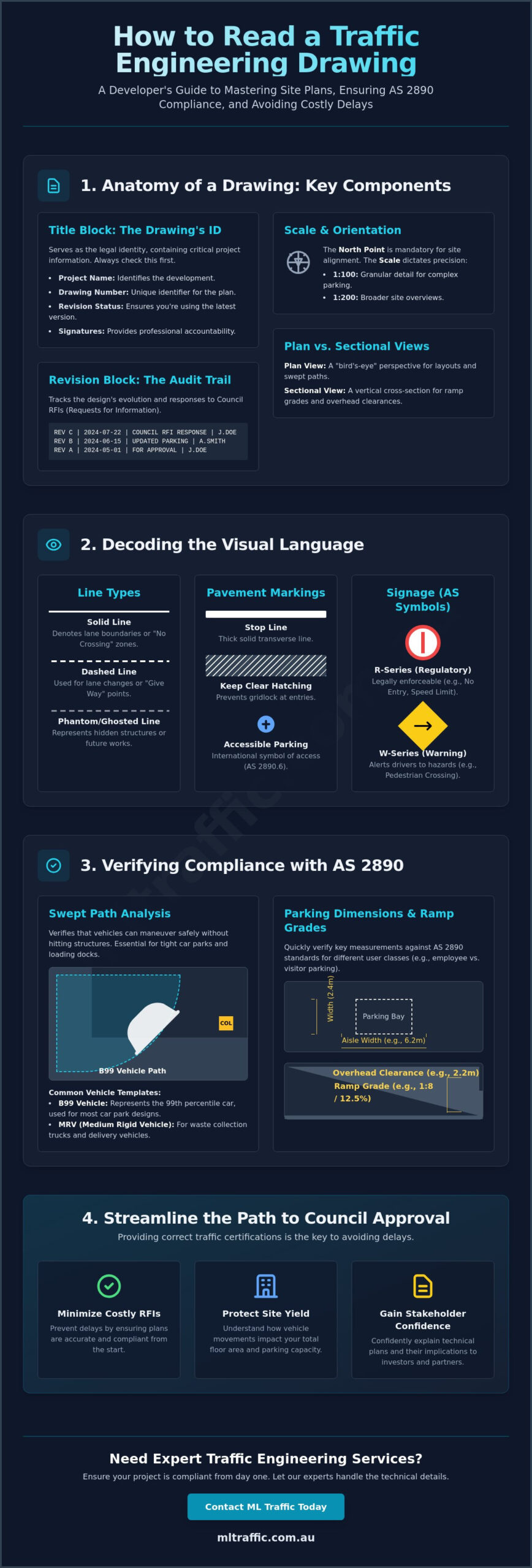
A traffic engineering drawing is a technical schematic that illustrates vehicle movement, parking geometry, and infrastructure compliance. It’s the primary communication tool between developers, engineers, and council assessors. To gain a professional level of proficiency in reading a traffic engineering drawing, you must first understand the basics of engineering drawings and how they translate to Australian Standards like AS 2890.1 for off-street parking. These documents aren’t just pictures; they’re legal representations of how a site will function safely.
To better understand this concept, watch this helpful video:
The Role of the Title Block and Revision History
The title block serves as the legal identity of the project. It includes the project name, drawing number, and current revision status. Council assessors check the revision date first. They must ensure they aren’t reviewing outdated designs that lack recent amendments required by previous RFI (Request for Information) letters. The "Designed By" and "Checked By" signatures provide professional accountability for the technical accuracy of the plans. We define the revision block as the audit trail of a development’s design evolution.
Scale and orientation are fundamental. When reading a traffic engineering drawing, the scale determines the level of precision you can expect from the measurements. A 1:100 scale provides the granular detail needed for complex parking maneuvers, while a 1:200 scale is often used for broader site overviews. The North point is mandatory for aligning the drawing with site surveys and cadastral data. The legend and abbreviations section allows for the quick identification of TGS (Traffic Guidance Scheme) symbols and TIA (Traffic Impact Assessment) notations. This section also defines the symbols used for vehicle swept path assessments, ensuring every line on the page has a clear technical meaning.
Understanding Plan Views vs. Sectional Details
Plan views offer a "birds-eye" perspective. These are essential for reviewing car park layouts and ensuring vehicle swept paths clear all structural elements like columns or bollards. Sectional views provide the vertical dimension. These cross-sections are vital for checking driveway ramp grades and overhead clearances. Together, these views provide a 3D understanding of traffic flow. They prevent costly construction errors, such as ramps that are too steep for standard vehicles or clearances that fail to accommodate waste collection trucks. For more information on technical assessments, view our traffic engineering services.
Decoding Symbols, Lines, and Traffic Annotations
Proficiency in reading a traffic engineering drawing requires a precise understanding of standardized visual shorthand. Every symbol on a traffic drawing corresponds to a specific Australian Standard requirement, ensuring consistency across different jurisdictions and projects. Developers must distinguish between solid lines, which typically denote lane boundaries or "no crossing" zones, and dashed lines used for lane changes or "give way" points. Hidden structures or future works are often represented by ghosted or phantom lines to provide context without cluttering the current design.
Pavement markings serve as critical instructions for vehicle behavior and site safety. Stop lines are indicated by thick solid transverse lines, while "Keep Clear" hatchings prevent gridlock at intersections or driveway entries. These markings are often informed by traffic studies and analysis to ensure they accommodate actual vehicle volumes and site-specific needs. Signage on a plan is categorized into R-series (Regulatory) signs, which carry legal weight like "No Entry" or "Speed Limit," and W-series (Warning) signs that alert drivers to hazards like "Pedestrian Crossing" or "Speed Hump Ahead."
Australian Standard Symbols for Signage and Marking
Accessible parking bays are identified by the international symbol of access and must comply with AS 2890.6. Loading zones often use specific cross-hatching patterns to indicate their purpose and restricted use. Shorthand for "No Stopping" (NS) and "No Parking" (NP) zones is used on technical layouts to maintain clarity within tight spatial constraints. These designations are vital for council compliance and operational efficiency. If you require a detailed Car Parking Demand Assessment, our team ensures every symbol aligns with current regulations.
Interpreting Grades and Vertical Clearances
When reading a traffic engineering drawing for a basement or multi-level car park, verticality is as important as the floor plan. Ramp grade annotations are expressed as ratios like 1:20 or percentages like 5%. These figures are critical for AS 2890.1 compliance to prevent vehicle scraping and ensure user safety. Drawings also highlight the BFA (Blind Flank Area), which identifies spatial constraints in basement designs where visibility or structural columns limit movement. Vertical clearances must be verified for waste collection vehicles or delivery vans, often requiring a 3.8m to 4.5m height depending on the local council’s waste management plan. Relative Level (RL) markers provide the exact elevation of surfaces, ensuring the transition between the street and the development site is seamless and compliant.
Understanding Swept Path Analysis Diagrams
Swept path analysis is the most technical component of reading a traffic engineering drawing. It visualizes the dynamic "envelope" a vehicle creates while moving through a site. This envelope isn’t just a static footprint; it represents the total area occupied by the vehicle body and its wheels during a turn. For Australian developers, understanding this diagram is vital to ensure that waste trucks, delivery vans, and passenger cars can navigate the site without striking structural columns or boundary walls.
Engineers use specific vehicle templates defined by Australian Standard AS 2890.1. The most common is the B99 vehicle, which represents the 99.8th percentile car, measuring approximately 5.2 metres in length. For commercial or mixed-use developments, you’ll also see the MRV (Medium Rigid Vehicle), an 8.8-metre truck typically used for refuse collection. Each vehicle has a unique turning circle that dictates the shape of the envelope on your plans.
When you’re reading a traffic engineering drawing, you must identify three critical lines:
-
Wheel Paths: These show where the tyres actually travel. They’re essential for checking gutter and kerb clearances.
-
Body Overhang: This line tracks the outermost corners of the vehicle. It’s almost always wider than the wheel path because the front and rear of the car swing out during a turn.
-
Safety Clearances: This is the outer boundary that includes the required buffer between the vehicle and fixed objects.
Directional arrows are another key feature. They map the "In" and "Out" maneuvers, showing the exact sequence of a turn. On a complex site, these arrows explain whether a driver is expected to perform a three-point turn or a single continuous movement to exit in a forward direction.
Reading AutoTURN and Vehicle Maneuvering Envelopes
Most professional consultants use AutoTURN software to generate these paths. The software typically applies color-coding to differentiate the vehicle’s components. Red lines usually denote the body envelope, while blue or green lines represent the wheel paths. When reviewing these, look for "hard spots" where the red line overlaps with a wall or column. This swept path analysis is the standard tool we use to verify that a site layout is functional and compliant with Council requirements.
Clearances and Safety Buffers
The 300mm clearance rule is a fundamental requirement in Australian traffic engineering. AS 2890.1 specifies that a vehicle envelope shouldn’t just "fit" between walls; it needs a 300mm safety buffer on either side to account for driver variance. In residential designs, you’ll often see "Reverse-In, Drive-Out" maneuvers. This layout is preferred by many Councils because it ensures vehicles enter the public roadway in a forward direction, significantly reducing the risk of pedestrian conflict. Always check for points where these envelopes cross pedestrian paths, as these are high-risk zones that require clear sight-lines.
Verifying Compliance with AS 2890 Standards
Confirming that a site layout adheres to Australian Standards is the most critical stage of reading a traffic engineering drawing. Local councils and consent authorities will reject any Development Application (DA) that fails to meet the geometric requirements specified in the AS 2890 series. These standards ensure that vehicles can enter, park, and exit a site safely without causing congestion or safety hazards on public roads.
Dimensions and User Classifications
The required width and length of a parking space depend entirely on its User Class. You will find this classification noted in the drawing legend or the traffic report summary. For residential developments or employee parking, designers typically apply Class 1 or 1A, which allows for a standard bay width of 2.4 metres. Retail or commercial sites often require Class 2 or Class 3, increasing the width to 2.5 metres or 2.6 metres to account for higher turnover and easier access. You can find a detailed breakdown of these requirements in this guide to AS 2890.1 explained.
-
User Class 1 & 1A: 2.4m width x 5.4m length. Used for residential and long-term staff parking.
-
User Class 2: 2.5m width x 5.4m length. Used for medium-term town centre or sports facility parking.
-
Disabled Parking: Must comply with AS 2890.6. Drawings must show a 2.4m wide dedicated bay adjacent to a 2.4m wide shared loading area marked with yellow cross-hatching.
Sightlines and Boundary Compliance
When reading a traffic engineering drawing, look for the sight distance triangles where the driveway meets the property boundary. AS 2890.1 requires a clear area of 2.0 metres along the boundary and 2.5 metres into the site. This zone ensures drivers can see pedestrians on the footpath before the vehicle crosses the boundary line. Any obstructions within these triangles, such as fences, mailboxes, or landscaping, must be marked "to be removed" or "restricted to a height of 1.1 metres." A Sight Distance Assessment is a critical safety check for all DAs to prevent collisions between vehicles and vulnerable road users.
Aisle Widths and Blind Aisles
Aisle widths must support a single-turn maneuver into and out of a bay. For a standard 90-degree parking arrangement, the aisle width is typically 5.8 metres for Class 1 and 6.2 metres for Class 2. If the drawing shows a dead-end aisle, it must include a "blind aisle extension." This is an additional 1 metre of space beyond the last parking bay. Without this extension, a driver cannot comfortably reverse out of the final space, leading to multi-point turns that block traffic flow. Ensure the drawing explicitly labels these extensions to avoid compliance failures during the ROL (Request for Out of Line) or construction certificate stage.
Ensure your development meets all council and Australian Standard requirements by booking our professional traffic engineering services for a detailed compliance review.
Using Traffic Drawings to Secure Council Approval
Architectural plans provide the visual framework for a development, but they rarely satisfy the technical requirements for traffic and parking certification. Council assessors require more than a layout; they need technical proof of functionality. Reading a traffic engineering drawing allows developers to see the data layers, such as B99 vehicle clearances and sight distance triangles, that an architect might overlook. Without these specific engineering details, a DA is likely to trigger a Request for Further Information (RFI), which can stall a project for 30 to 60 days.
A professional drawing acts as the geometric evidence for the Traffic Impact Assessment (TIA) report. While the TIA provides the written justification, the drawing provides the physical proof. This documentation ensures that the proposed access points and internal circulation meet Australian Standards (AS 2890.1) and local council planning schemes. Engaging a specialist early prevents the need for expensive structural changes once construction has commenced. It’s about ensuring the design works in reality, not just on paper.
Bridging the Gap Between Design and Engineering
Specialized traffic engineering is necessary to certify that an architect’s layout is buildable and safe. Architects design for space efficiency, but engineers design for vehicle physics. A drawing signed off by an RPEQ or equivalent registered engineer carries the weight of professional liability and technical accuracy. This certification covers critical elements that prevent costly site redesigns:
-
Compliance with driveway ramp grades to prevent vehicle scraping.
-
Verification of swept paths for waste collection and delivery vehicles.
-
Sight-line assessments at property boundaries to ensure pedestrian safety.
-
Accurate allocation of disabled parking and shared zones.
By identifying these constraints during the design phase, developers avoid the high costs of modifying concrete slabs or basement heights later. Proficiency in reading a traffic engineering drawing ensures that every parking bay and aisle width is functional before the first shovel hits the ground.
Consulting the Experts for Your DA
ML Traffic Engineers offers a direct, no-nonsense approach to traffic planning. We remove the bureaucracy of larger firms by ensuring the consultant who provides your quote is the same senior expert performing the technical work. With over 10,000 sites assessed since 2005, our principals, Michael Lee and Benny Chen, provide the expertise required to navigate complex council requirements. There are no gatekeepers; you get direct access to the engineers who understand your project technicalities. This direct communication is vital when facing urgent council deadlines or complex RFIs.
Ready to move your development forward? Contact ML Traffic Engineers to have your traffic drawings professionally prepared and certified by seasoned experts with decades of industry experience.
Secure Your Development Approval with Technical Precision
Mastering the art of reading a traffic engineering drawing is essential for navigating the complex Australian planning landscape. You’ve now seen how decoding symbols, verifying AS 2890 compliance, and analyzing vehicle swept paths can prevent costly redesigns during the DA process. These technical documents are the bridge between your project vision and council approval. Precise drawings ensure your site layout meets every regulatory demand without compromise.
ML Traffic Engineers brings over 15 years of experience to your project. Since 2005, we’ve helped developers secure approvals across thousands of sites. You’ll get direct access to senior engineers Michael Lee and Benny Chen; these are the consultants who quote the work and do the work. We specialize in AS 2890 standards and advanced swept path analysis to ensure your plans are bulletproof. Don’t leave your application to chance when expert precision is available.
Get a professional traffic drawing for your next DA approval. We’re ready to help you move your project forward with confidence.
Frequently Asked Questions
What is the difference between an architectural site plan and a traffic engineering drawing?
An architectural site plan focuses on building footprints and internal layouts, whereas a traffic engineering drawing prioritizes vehicle movement and compliance with Australian Standards. Traffic plans include specific details like swept path envelopes and aisle width dimensions. These elements ensure the site functions safely for the thousands of vehicle movements a development generates over its lifespan.
How do I know which vehicle type was used for my swept path analysis?
You can identify the vehicle type by looking at the drawing legend or the vehicle specification table. Most Australian residential projects use the B85 or B99 design vehicle as defined in AS 2890.1. If the drawing shows a delivery area, it’ll likely feature an 8.8m Medium Rigid Vehicle or a 12.5m Heavy Rigid Vehicle instead.
What does "AS 2890 compliance" actually mean on a drawing?
AS 2890 compliance means the design adheres to the specific requirements set out in the Australian Standard for Parking Facilities series. For example, AS 2890.1:2004 dictates that a standard parking space must be at least 2.4 metres wide for long-term parking. The drawing confirms that every ramp grade, parking bay, and blind aisle meets these safety and accessibility benchmarks.
Can I read a traffic drawing without specialized software like AutoCAD?
You don’t need AutoCAD to view these files, as most consultants provide plans in PDF format. Reading a traffic engineering drawing effectively only requires a PDF reader and an understanding of the scale, such as 1:100 or 1:200. Always check the "Scale at A3" note to ensure your measurements are accurate if you’ve printed the document.
What are the most common mistakes people make when reading traffic plans?
The most frequent error when reading a traffic engineering drawing is failing to account for the 300mm clearance buffer around the swept path. Another mistake involves misreading the gradient percentages on ramps. For instance, a 1 in 20 grade is significantly different from a 1 in 5 grade, and confusing them can lead to structural redesigns late in the project.
Why does my traffic drawing show a 300mm buffer around the vehicle path?
The 300mm buffer is a mandatory safety clearance required by AS 2890.1 to prevent vehicles from striking walls or columns. This margin accounts for minor driver errors and the natural swing of the vehicle body. In tight basement car parks, this 0.3 metre gap is the difference between a functional design and a failed Council application.
How do I check the ramp grades on my basement parking plan?
Check the ramp grades by looking for the ratio or percentage markers, such as 1:8 or 12.5%, typically found near the ramp centreline. You should also look for 2.0 metre long transitions at the top and bottom of the ramp. These transitions are crucial because they prevent the vehicle’s underside from scraping the floor when moving between different gradients.
What should I do if my drawing shows a vehicle hitting a structural column?
You must notify your traffic engineer and architect immediately if a swept path overlaps with a structural column. This overlap means the vehicle cannot physically complete the turn, which violates AS 2890.1 requirements. Resolving this usually involves shifting the column or widening the drive aisle to ensure the vehicle path and its 300mm buffer remain clear of all obstructions.
Which areas do you cover?
We are traffic engineers servicing Melbourne, Sydney, Brisbane, Gold Coast, Hobart, Perth, Adelaide, Darwin, Canberra and surrounding areas.

Disclaimer
The content on www.mltraffic.com.au, including all technical articles, guides, and resources, is provided for general informational and educational purposes only. It is not intended to constitute professional advice in traffic engineering, transportation planning, development approvals, or any other technical or legal field.
While ML Traffic Engineers makes every reasonable effort to ensure the accuracy, completeness, and timeliness of the information published, we do not provide any warranties or representations (express or implied) regarding its reliability, suitability, or availability for any particular purpose. Any reliance you place on the content is strictly at your own risk.
In no event shall ML Traffic Engineers, its directors, employees, authors, or affiliates be liable for any direct, indirect, incidental, special, consequential, or punitive damages (including, without limitation, loss of profits, data, or business opportunities) arising out of or in connection with the use of, or inability to use, any information provided on this website.
The articles and guides on this site are not a substitute for engaging a qualified, registered professional traffic engineer (such as an NPER or RPEQ engineer) to assess your specific project requirements. For tailored advice, compliance assessments, or traffic engineering services, please contact a competent professional.
This disclaimer may be updated from time to time without notice. By accessing or using this website, you agree to be bound by the most current version of this disclaimer.
