
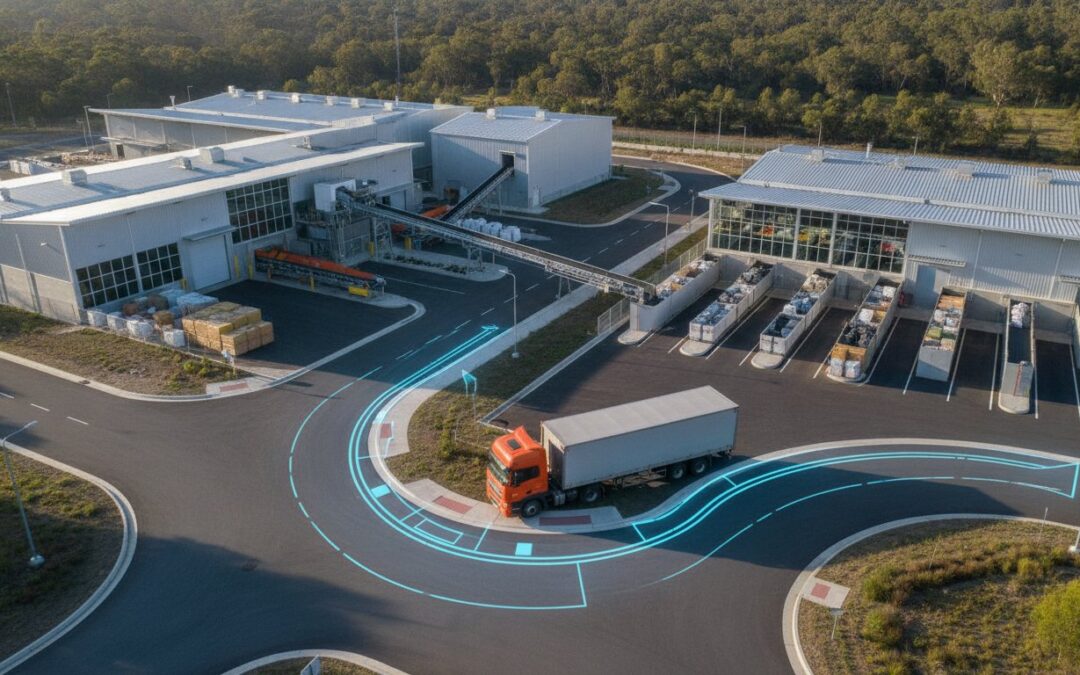
A single oversight in your heavy vehicle swept path analysis can stall a multi-million dollar development application for months. Securing council approval for waste management sites is notoriously difficult. You’re likely facing complex regulations, community opposition regarding noise, and the logistical headache of managing constant heavy rigid vehicle access. Developing a robust traffic report for a materials recycling facility is the only way to mitigate these risks and secure your DA.
It’s a common frustration for developers who understand the operational side but struggle with the bureaucratic requirements of local planning authorities. This guide provides the technical roadmap you need. You’ll learn exactly what’s required to satisfy council planners, adhere to Australian Standards, and maintain a safe, functional site. We detail the essential components of a compliant Traffic Impact Assessment, including AS 2890.2:2018 requirements, HRV manoeuvring, and the intersection analysis needed to keep your project moving forward. Our focus is on providing the technical certainty required for a successful approval and an efficient site layout.
Key Takeaways
- Understand the core technical requirements of a traffic report for a materials recycling facility to streamline the council approval process and avoid costly development delays.
- Learn why Vehicle Swept Path Analysis is essential for simulating heavy rigid vehicle movements and ensuring your site layout accommodates high-frequency waste collection traffic.
- Discover how to align your project with Australian Standards AS 2890.1 and AS 2890.2 to ensure site safety and address community concerns regarding road network capacity.
- Identify the strategic benefits of early engagement with senior traffic engineers to manage complex statutory requirements and optimise intersection analysis for heavy vehicle access.
What is a Traffic Report for a Materials Recycling Facility?
A traffic report for a materials recycling facility is a formal Traffic Impact Assessment (TIA) that quantifies the impact of facility operations on the local transport network. Unlike standard industrial developments, a Materials Recovery Facility (MRF) involves high-frequency heavy vehicle movements and specific loading requirements. This technical document provides council planners with the data needed to ensure the proposed development won’t compromise road safety or structural integrity. It serves as a core component of your Development Application (DA), addressing how your site manages the transport of waste and recovered materials.
When defining What is a Traffic Report for a Materials Recycling Facility?, engineers must account for the concept of induced traffic and specific trip generation rates. While a simple Traffic Statement might suffice for small-scale commercial changes, an MRF almost always triggers the requirement for a full TIA. This is due to the weight of the vehicles involved and the potential for queuing on public roads. Councils require certainty that your operations won’t lead to traffic congestion or safety hazards for other road users.
The Strategic Importance of Traffic Planning for MRFs
Strategic traffic planning is your primary tool for mitigating community opposition. Residents often raise concerns regarding noise, vibration, and safety when a recycling facility is proposed. A detailed report addresses these issues by outlining designated heavy vehicle routes and managing facility throughput to avoid local road saturation. It ensures the facility can handle peak hour arrivals without vehicles backing up onto public thoroughfares. By optimising the site layout, you reduce the time trucks spend idling or manoeuvring, which directly lowers the noise profile of the site. Effective planning proves to the council that you’ve considered the facility’s long-term operational footprint.
Regulatory Framework and Australian Standards
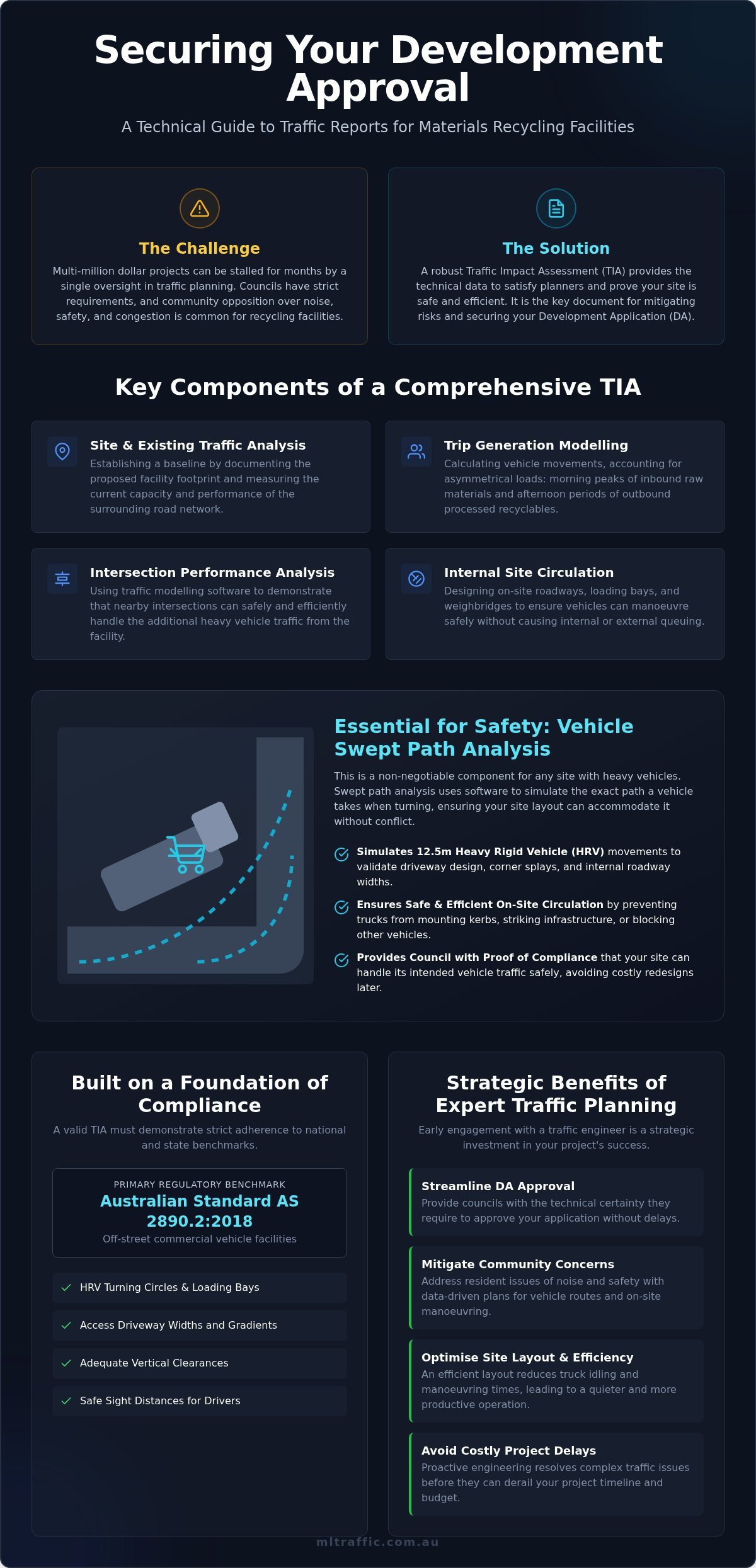
Compliance hinges on adherence to strict national and state-based benchmarks. The primary reference is AS 2890.2:2018, which dictates the standards for commercial vehicle facilities. This standard is critical for designing access ways that accommodate a 12.5-metre Heavy Rigid Vehicle (HRV), including specific requirements for vertical clearances and ramp gradients. Your traffic report must demonstrate compliance with these metrics to be considered valid.
- AS 2890.2 Compliance: Ensuring all heavy vehicle turning circles and loading bays meet national dimensions.
- State Transport Guidelines: Adhering to specific requirements from state authorities regarding intersection performance.
- Waste Management Integration: Aligning the traffic report with your Waste Management Plan to ensure collection frequencies match site capacity.
A qualified traffic engineer will integrate these standards into the early site planning stages. This proactive approach ensures that the physical constraints of the site, such as driveway widths and sight distances, are resolved before the DA is lodged. You can learn more about our technical approach on our services page.
Key Components of a Comprehensive Traffic Impact Assessment
A traffic report for a materials recycling facility must provide a granular breakdown of operational data. It isn’t enough to state that trucks will arrive at the site. We must define the specific vehicle types, arrival frequencies, and the nature of the waste stream. Every assessment begins with a detailed site description. This includes the proposed facility footprint, internal circulation roads, and the specific locations of weighbridges or loading bays. We then conduct a thorough analysis of existing traffic conditions on the surrounding road network. This baseline data is essential for determining how much residual capacity the local infrastructure has to accommodate your development.
Trip Generation and Distribution Modelling
Trip generation calculations for recycling facilities are complex. Unlike a standard warehouse, these sites often have asymmetrical load profiles. Morning peaks typically involve collection trucks arriving with raw materials, while afternoon periods focus on outgoing processed recyclables. We use historical data and industry benchmarks to model these movements accurately. When Navigating Council Requirements and Statutory Compliance, engineers must account for seasonal variations. For example, garden waste volumes often surge in spring, while packaging materials peak after major holiday periods. Our modelling ensures the road network can handle these maximum throughput scenarios without failure.
Trip distribution analysis follows generation. We map the “first mile” and “last mile” logistics for heavy vehicles. This process identifies which local streets will bear the brunt of heavy vehicle weight. It also highlights where potential conflicts with pedestrians or cyclists might occur. By defining these routes early, you can proactively address council concerns regarding residential amenity and road safety. If your project requires a specific assessment of your site’s capacity, you can contact our senior engineering team for a technical consultation.
Intersection Analysis and Road Network Impact
Intersection performance is the benchmark for council approval. We measure this using the Level of Service (LoS) metric. For high-traffic facility entrances, we utilise Sidra Intersection modelling to simulate how site access points perform under heavy load. This software allows us to calculate the Degree of Saturation and average delays for vehicles turning into and out of the site. If the modelling indicates that the facility will push an intersection beyond acceptable limits, the traffic report will identify necessary mitigation measures. These might include the construction of dedicated turning lanes, road widening, or adjustments to traffic signal timings. Providing this level of technical certainty is the most effective way to secure a DA for a complex industrial site.
Heavy Vehicle Manoeuvrability and Swept Path Analysis
Site design for a Materials Recovery Facility (MRF) prioritises the safe and efficient movement of heavy vehicles. A traffic report for a materials recycling facility must include a rigorous assessment of how these vehicles navigate the site. We use AutoTURN software to simulate the exact movements of the largest anticipated vehicles, such as 19-metre B-Doubles or standard 12.5-metre heavy rigid vehicles. This simulation identifies potential conflict points before construction begins. It’s essential to ensure that all vehicles can enter and exit the site in a forward direction, as reversing onto public roads is generally prohibited by Australian councils.
Designing for manoeuvrability involves more than just wide driveways. We must account for the specific turning characteristics of rear-loading waste trucks and skip bin transporters. These vehicles have unique pivot points and tail-swing requirements that standard industrial designs often overlook. By simulating these paths, we eliminate the risk of “dead-end” manoeuvres where a truck becomes trapped or is forced into a high-risk multi-point turn. This level of technical detail is critical for securing council approval and maintaining operational safety.
Compliance with AS 2890.2 for Heavy Vehicles
Adherence to AS 2890.2:2018 is the benchmark for all heavy vehicle site assessments. This standard dictates the minimum dimensions for loading docks and waste collection zones to prevent structural damage and operational delays. For recycling facilities, vertical clearance is a major factor. We ensure all overhead structures, hoppers, and internal processing sheds provide a minimum vertical clearance of 4.5 metres to accommodate raised tippers or high-clearance loaders. Safety is further enhanced by designing physical separation between heavy vehicle paths and pedestrian zones, reducing the risk of on-site incidents during peak processing hours.
Optimising Site Circulation and Hardstand Areas
Efficient site circulation requires a balance between storage capacity and the space required for truck turning circles. Every square metre of hardstand must serve a purpose. We optimise these areas to ensure that queuing for weighbridges or tipping floors doesn’t spill over into the public road network. Drafting clear Vehicle Swept Path Analysis diagrams is a core part of our service. These diagrams provide council with visual proof that your site can handle high-volume waste traffic safely. Our senior engineers perform this work directly, ensuring that the technical output meets the highest standards of accuracy and compliance. If you need a site-specific layout review, you can contact our team to speak with a principal engineer.
Navigating Council Requirements and Statutory Compliance
Securing approval for a recycling facility requires a systematic approach to transport planning. The process begins with identifying the specific Secretary’s Environmental Assessment Requirements (SEARs) or local council Development Control Plan (DCP) requirements. A traffic report for a materials recycling facility must satisfy these criteria to avoid immediate rejection. We recommend a five-step workflow to ensure compliance.
- Step 1: Scoping Requirements. Review the local Environmental Planning Instrument (EPI) to determine the specific transport assessment thresholds for waste management facilities.
- Step 2: Expert Engagement. Appoint a qualified traffic engineer during the initial site planning phase to identify potential access constraints.
- Step 3: Data Collection. Conduct tube counts and manual intersection observations to establish accurate baseline traffic volumes.
- Step 4: Technical Documentation. Prepare the formal TIA and detailed Swept Path diagrams using AutoTURN to demonstrate safe vehicle manoeuvring.
- Step 5: RFI Management. Address any Requests for Further Information from the council with technical evidence and revised modelling where necessary.
Common Challenges in MRF Traffic Approvals
Community objections are a significant hurdle. Residents often cite concerns regarding truck noise and vibration on local streets. Your report must prove that heavy vehicle routes are optimised to minimise residential impact. Additionally, you must ensure that on-site parking for staff and visitors adheres to AS 2890.1 standards. Councils frequently scrutinise the separation of heavy vehicle movements from light vehicle parking to ensure site safety. Failure to address these details often leads to lengthy delays or DA refusal.
The Importance of Early Engagement with Authorities
Pre-DA meetings with the council and state transport authorities are vital. These sessions allow you to clarify access expectations and negotiate potential road contributions or developer charges under local infrastructure plans. Aligning your traffic report with the Statement of Environmental Effects (SEE) ensures a cohesive argument for the development’s viability. This proactive strategy identifies high-risk issues, such as the July 2026 HVNL Master Code requirements for route planning, before they become roadblocks. If you are preparing a submission, contact our senior principals to ensure your technical documentation meets all statutory benchmarks.
Professional Traffic Engineering for Recycling Developments
ML Traffic Engineers provides the technical expertise required to navigate the complexities of waste management developments. Our firm brings over 15 years of industry experience to every project, ensuring a meticulous approach to compliance and site safety. We specialise in delivering a comprehensive traffic report for a materials recycling facility that addresses the specific operational demands of heavy vehicle environments. Our services encompass the full spectrum of traffic engineering, from initial site feasibility and Car Park Design to complex Vehicle Swept Path Analysis and Intersection Analysis. We ensure every assessment adheres to Australian Standards AS 2890.1 and AS 2890.2, providing the technical certainty required for council approval.
Why a Specialist Traffic Consultant is Essential
Industrial developments involving heavy rigid vehicles leave no margin for error. A specialist consultant identifies design flaws that don’t meet council expectations, such as inadequate turning radii or non-compliant ramp gradients. We focus on creating a site layout that is functional for operational staff while maintaining strict safety protocols for visitors and light vehicles. By providing expert traffic engineering advice, we ensure your project stands up to the scrutiny of council planners and transport authorities. Our signature “no-gatekeepers” approach means you have direct access to senior principals who perform the technical work themselves. This personnel continuity promise ensures the expert who initiates your project is the one performing the modelling, distinguishing our firm from larger, more impersonal consultancies.
Streamlining Your Development Application
The approval process for a Materials Recovery Facility is often hindered by lengthy Requests for Further Information (RFI) from local councils. We mitigate this risk by providing clear, information-dense reports that authorities can interpret without ambiguity. It’s our goal to quickly answer a potential client’s key questions regarding identity, capability, and accessibility. We utilise industry-leading software to produce the following:
- Detailed Sidra Intersection modelling for high-traffic access points.
- Precise AutoTURN simulations for B-Double and HRV movements.
- Compliant car parking demand assessments for staff and visitors.
- Strategic route planning in accordance with national regulatory standards.
Our meticulous approach fast-tracks your technical assessments without compromising on quality. We understand the bureaucratic requirements of Australian councils and provide the data-driven certainty needed for a successful outcome. Contact our team for a tailored traffic assessment quote to ensure your development meets all statutory requirements and operational benchmarks.
Securing Your Facility’s Operational Future
Successful recycling developments rely on a balance of technical compliance and operational efficiency. A robust traffic report for a materials recycling facility must provide empirical evidence that heavy vehicle movements won’t compromise the local road network or on-site safety. By prioritising rigorous swept path analysis and intersection modelling, you address council concerns before they lead to costly delays.
ML Traffic Engineers brings over 15 years of expert experience to your project. We ensure every assessment meets strict Australian Standards, including AS 2890.1 and AS 2890.2. Our firm provides direct senior engineer involvement on every project. This ensures that the principal you speak with is the one performing the technical work, providing you with accountability and deep-seated expertise.
Get a professional Traffic Impact Assessment for your facility to streamline your development application. With the right technical documentation, your facility can transition from a proposed design to a functional, approved reality.
Frequently Asked Questions
Do I need a traffic report for a small-scale recycling centre?
Most councils require a traffic report for any facility that introduces heavy vehicle movements, regardless of the site’s footprint. Small-scale centres often face unique challenges with limited manoeuvring space and proximity to residential areas. A traffic report for a materials recycling facility proves that your operation is safe and compliant. It ensures that collection trucks can access the site without causing local traffic congestion or safety risks.
What is the difference between AS 2890.1 and AS 2890.2?
Australian Standards differentiate between vehicle types to ensure specific design safety. AS 2890.1 provides the requirements for off-street car parking for light vehicles, focusing on stall dimensions and aisle widths. AS 2890.2 is the benchmark for commercial vehicle facilities, covering the larger turning circles and vertical clearances required by trucks. Both standards must be applied to recycling facilities to manage the interaction between staff cars and heavy collection vehicles.
How much does a traffic report for a materials recycling facility cost?
Project costs depend on the complexity of the site and the specific requirements set by the council. Factors such as the number of intersections requiring Sidra modelling and the volume of swept path diagrams needed will influence the final fee. We recommend requesting a tailored traffic assessment quote to ensure all technical requirements are covered without unnecessary expenses. This ensures your budget aligns with the actual engineering hours required.
Can a traffic report help reduce my insurance premiums?
A professional traffic report functions as a formal risk management document. By demonstrating that your site design adheres to Australian Standards and includes safe vehicle swept paths, you show a proactive approach to accident prevention. Insurers often look for this level of technical due diligence when assessing the risk profile of industrial operations. Providing evidence of safe site circulation can assist in negotiating more favourable terms during your policy review.
What happens if council rejects my traffic assessment?
If a council rejects an assessment, they will issue a Request for Further Information (RFI) detailing their specific concerns. This often relates to inadequate swept paths or insufficient intersection data. Our senior engineers respond to these requests by providing revised modelling or technical justifications. We work directly with council transport planners to resolve these issues, ensuring that your development application meets the necessary statutory benchmarks for approval.
How long does it take to prepare a Traffic Impact Assessment?
The preparation of a Traffic Impact Assessment generally requires several weeks to complete. This timeline accounts for the collection of baseline traffic data, operational modelling, and internal technical reviews. If your project requires manual intersection counts or tube counts, these must be scheduled during representative traffic periods. Engaging an engineer early in the planning process helps prevent these technical requirements from delaying your development application lodgement.
Is Swept Path Analysis mandatory for all industrial DAs?
Swept path analysis is a mandatory requirement for almost all industrial development applications involving heavy vehicles. Councils use these diagrams to verify that trucks can enter and exit the site in a forward direction without hitting kerbs or structures. It’s a critical component of a traffic report for a materials recycling facility. Without this visual proof, planners cannot be certain that your site layout is operationally functional or safe for public road users.
What vehicle types are usually modelled for recycling facilities?
We typically model the largest vehicles that will access the facility to ensure the layout is future-proof. This usually includes 12.5-metre heavy rigid vehicles (HRVs) for standard waste collection and 19-metre B-Doubles for outgoing bulk materials. We also simulate the movements of skip trucks and rear-loaders to account for their unique turning characteristics. This comprehensive modelling ensures that every vehicle type can navigate the site safely and efficiently.

Disclaimer
The content on www.mltraffic.com.au, including all technical articles, guides, and resources, is provided for general informational and educational purposes only. It is not intended to constitute professional advice in traffic engineering, transportation planning, development approvals, or any other technical or legal field.
While ML Traffic Engineers makes every reasonable effort to ensure the accuracy, completeness, and timeliness of the information published, we do not provide any warranties or representations (express or implied) regarding its reliability, suitability, or availability for any particular purpose. Any reliance you place on the content is strictly at your own risk.
In no event shall ML Traffic Engineers, its directors, employees, authors, or affiliates be liable for any direct, indirect, incidental, special, consequential, or punitive damages (including, without limitation, loss of profits, data, or business opportunities) arising out of or in connection with the use of, or inability to use, any information provided on this website.
The articles and guides on this site are not a substitute for engaging a qualified, registered professional traffic engineer (such as an NPER or RPEQ engineer) to assess your specific project requirements. For tailored advice, compliance assessments, or traffic engineering services, please contact a competent professional.
This disclaimer may be updated from time to time without notice. By accessing or using this website, you agree to be bound by the most current version of this disclaimer.
