

A single design error in a basement parking bay can cost your development project upwards of $85,000 in 2026. While many developers view the Traffic Impact Assessment (TIA) as a routine formality, failing to identify red flags in a traffic impact assessment report before lodgement is a fast track to a Council refusal. If your consultant relies on “copy-paste” templates or outdated traffic data, your Development Application (DA) becomes a liability rather than an asset.
We understand the frustration of receiving costly Council Requests for Information (RFIs) or being forced to redesign car parks because a report failed to meet technical compliance. You require a “bulletproof” submission that stands up to rigorous planning scrutiny. This article identifies the critical errors and omissions that trigger unnecessary Council pushback and lengthy project delays.
You will gain a clear understanding of current AS/NZS 2890.1 requirements, the necessity of data-driven parking demand justifications, and how to spot “junior consultant” syndrome. This guide provides the technical insight needed to ensure your traffic report is an asset to your DA submission.
Key Takeaways
- Identify critical red flags in a traffic impact assessment report, specifically outdated traffic counts and the omission of committed local developments.
- Confirm strict adherence to the current AS 2890.1 standards to avoid non-compliance and expensive structural redesigns during the DA process.
- Replace generic industry averages with first-principles Car Parking Demand Assessments to provide a robust justification for any parking shortfalls.
- Eliminate errors caused by junior consultants by ensuring senior oversight and verifying the accuracy of all LEP and DCP references.
- Minimise project delays and Council RFIs by treating the TIA as a technical defence rather than a routine administrative task.
Why a Traffic Impact Assessment (TIA) Report is More Than a Box-Ticking Exercise
A Traffic Impact Assessment (TIA) functions as a technical defence of your development’s interaction with the surrounding road network. It is not a descriptive summary of a site’s location or a generic document intended to fill a folder. Instead, it is a formal engineering justification that must satisfy the distinct requirements of both Council planners and transport engineers. These authorities scrutinise the report to ensure the project does not compromise public safety or infrastructure efficiency. A TIA is a vital element within the wider Transportation planning process, where every proposed vehicle movement is evaluated for its impact on road capacity and safety.
Failing to identify red flags in a traffic impact assessment report before lodgement creates significant financial exposure for developers. A “descriptive” report that merely states what exists without providing a technical “defensible” argument for the proposed changes will likely trigger a Request for Further Information (RFI). This formal request effectively pauses the assessment clock, leading to immediate project stagnation and potential loss of funding or holding costs.
To better understand the core components of this analysis, watch this helpful video:
The High Cost of DA Delays and Redesigns
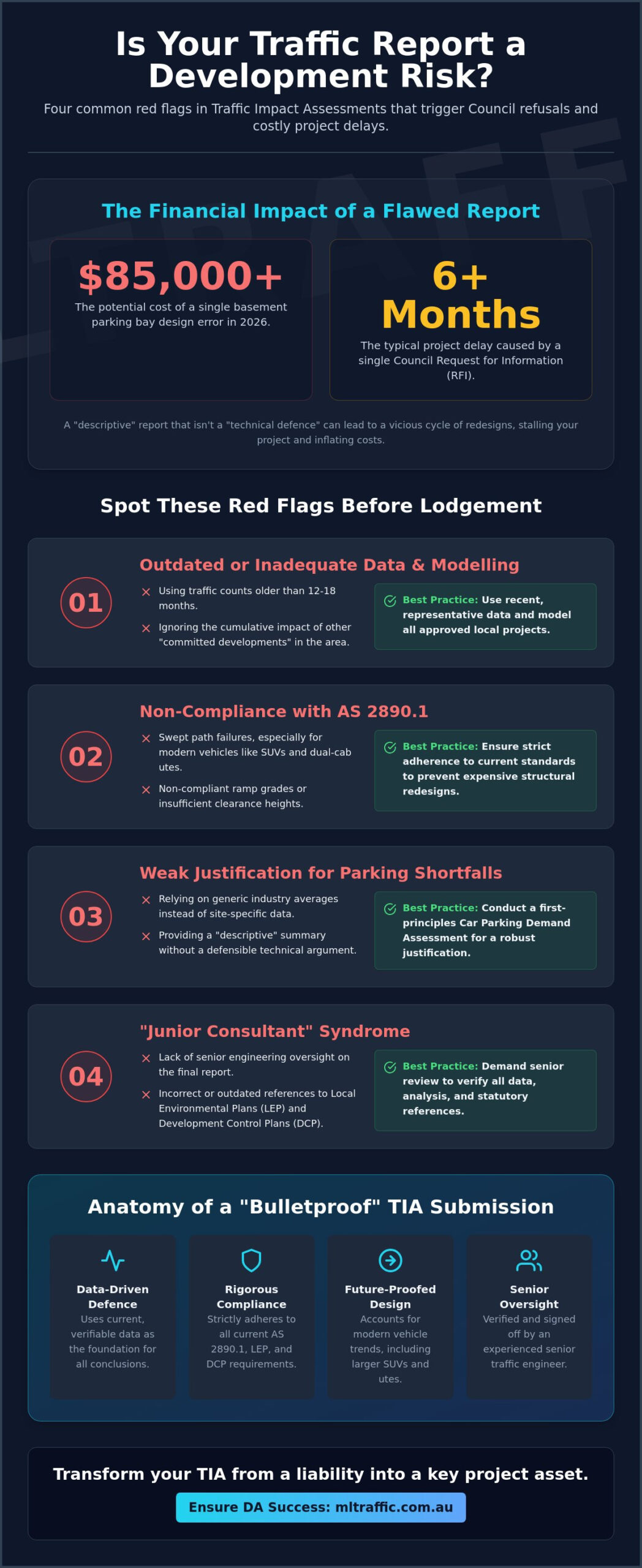
A single technical red flag can lead to a six-month delay in the planning cycle. Research indicates that a single design error in a basement parking bay can cost upwards of $85,000 in 2026. When a Council engineer identifies a non-compliant ramp grade or a failure in swept path analysis, the developer often faces a “vicious cycle” of redesign. Fixing a traffic flow error in a basement car park might require moving structural columns or reducing the total number of apartments to accommodate larger turning circles. Securing a high-quality Traffic Impact Assessment (TIA) Report from ML Traffic Engineers Australia ensures the design is compliant before it reaches the Council’s desk. This proactive approach avoids the financial drain of post-lodgement architectural revisions.
The 2026 Regulatory Landscape for Australian Developers
Scrutiny from state transport authorities has reached unprecedented levels in 2026. Reports produced using old templates no longer pass current technical audits. Authorities now expect submissions to be strictly data-driven and evidence-based. This includes using traffic counts that are typically no more than two years old and accounting for the cumulative impact of all “committed developments” in the immediate vicinity. A report that ignores these factors is a liability. Modern compliance requires a meticulous car park design that accounts for larger vehicle trends, such as SUVs and dual-cab utilities, which now dominate Australian roads.
Red Flag #1: Outdated or Inadequate Traffic Data and Modelling
The integrity of any traffic report depends entirely on the quality of the underlying data. One of the most common red flags in a traffic impact assessment report is the use of outdated traffic counts. In the 2026 planning environment, Council engineers generally reject data older than 12 to 18 months. Traffic patterns shift rapidly due to new infrastructure and changing work habits. Using “stale” data suggests the consultant hasn’t accounted for the current reality of the road network. While specific requirements vary by jurisdiction, state-level TIA guidelines globally emphasise the need for recent, representative data to ensure public safety and network efficiency.
Omissions regarding “committed developments” are equally damaging. A report must account for every project in the immediate vicinity that has already received DA approval but isn’t yet operational. If your consultant fails to include these future vehicle movements, the modelling will underestimate the cumulative impact on local intersections. This oversight is a primary reason for Council RFIs. Engaging a specialist for a comprehensive Intersection Analysis can identify these data gaps before they reach the Council’s desk.
Inadequate survey periods also trigger immediate pushback. For residential projects, ignoring the school pick-up and drop-off window is a significant error. If the survey only covers the traditional 8:00 AM to 9:00 AM peak but the local school creates a secondary peak at 3:00 PM, the assessment is incomplete. Council engineers will spot this omission immediately, leading to a demand for new surveys and months of delays.
Checklist: Vetting Your Traffic Counts
Developers should scrutinise the survey methodology used in their reports. Ensure that counts were taken during a representative week. Data collected during school holidays, public holidays, or major local events will be dismissed as non-representative. The report must include raw data appendices, not just summary tables, to allow Council officers to verify the findings. Finally, confirm that the survey locations cover every critical intersection affected by the site, not just the front gate. Ignoring a nearby congested roundabout is a major technical failure.
SIDRA Modelling Errors That Sink DAs
SIDRA software is the industry standard, but it’s easily manipulated. A common red flag is the use of “optimistic” saturation flows. If the software settings are adjusted to assume perfect driver behaviour, the resulting queue lengths will be unrealistically short. Council transport engineers look beyond the “Level of Service” (LoS) letter grade. They focus on the 95th percentile queue lengths to see if traffic will block neighbouring driveways or spill back into major thoroughfares. Modelling must reflect the “worst-case” peak hour scenario. If the report only presents average conditions, it won’t withstand a rigorous technical audit.
Red Flag #2: Non-Compliance with AS 2890 and Swept Path Failures
Technical compliance with Australian Standards forms the backbone of a successful Development Application. Identifying red flags in a traffic impact assessment report often begins with verifying which version of the parking standards the consultant has referenced. While AS/NZS 2890.1:2021 is the current standard, some local government authorities still operate under the 2004 version or have specific transitional arrangements. A report that fails to specify the correct version, or worse, mixes requirements from both, will be flagged immediately by Council transport engineers. They will check every bay dimension, aisle width, and blind-aisle extension against these benchmarks. There is no room for approximation in these measurements.
Another critical failure involves the selection of the design vehicle. Many consultants default to using a B85 vehicle (the 85th percentile car) for all manoeuvres. However, current trends toward larger SUVs and dual-cab utilities mean Councils increasingly require the use of a B99 vehicle (the 99.8th percentile car) for critical turns and specific land uses. If your TIA uses an undersized design vehicle, the report is a liability. It effectively hides potential access issues that will only be discovered during construction, leading to expensive retrofitting or the loss of parking spaces.
The Critical Importance of AS 2890.1 Compliance
Council engineers treat the parking code as a mandatory checklist, not a set of suggestions. Every bay must meet the minimum width and length requirements based on the intended user class. This includes specific allocations for disabled parking under AS 2890.6. Our guide on AS 2890.1 Explained serves as the baseline for all Australian car parks. If the written assessment ignores vertical clearance or fails to provide a detailed Driveway Ramp Grade Assessment, the DA will likely be stalled. “Close enough” is never an acceptable response to a technical non-compliance RFI.
Swept Path Analysis: The Most Common Rejection Point
The “Swept Path Gap” occurs when the traffic report’s turning diagrams do not align with the latest architectural plans. This is a significant red flag. It often happens when architects move a structural column or a fire hydrant after the traffic consultant has finished their initial modelling. A comprehensive Vehicle Swept Path Analysis must be integrated into the final TIA to ensure no “clipping” of kerbs or columns occurs. Service vehicle access is the Achilles heel of many reports. If a garbage truck or delivery van cannot enter and exit the site in a forward direction without multiple-point turns that block traffic, the Council will reject the proposal. Ensure your report includes specific diagrams for the largest vehicle expected to service the site.
Red Flag #3: Weak Justification for Parking Shortfalls
Weak justifications for proposed parking reductions are significant red flags in a traffic impact assessment report. Council planners expect a data-driven defence when a development fails to meet the minimum rates specified in a Development Control Plan (DCP). Relying on generic industry averages is a high-risk strategy. These averages often fail to account for the specific geographic context or the unique operational requirements of your site. A professional Car Parking Demand Assessment must replace vague assumptions with empirical evidence collected from comparable developments.
Another red flag is an over-reliance on Green Travel Plans (GTP) to offset parking shortfalls without providing the necessary physical infrastructure. A Council engineer will not accept a 20% parking reduction based on a promise of “increased cycling” if the plans lack secure bicycle lockers or end-of-trip facilities. Similarly, the “parking beat” survey, which assesses available on-street parking, must be thorough. If the survey only covers a single hour on a Tuesday morning, it fails to capture the peak demand of the local area. This leads to immediate technical pushback and demands for more comprehensive data collection.
When the DCP Doesn’t Fit: The Need for Expert Evidence
Simply stating that a parking shortfall will have “minimal impact” is an invitation for a Request for Further Information (RFI). When DCP rates are excessive or do not apply to a niche land use, you must provide “first principles” evidence. This involves surveying similar sites to determine actual peak demand. We structure these justifications by presenting a technical comparison of land-use intensity, public transport accessibility, and local car ownership rates. This evidence-based approach provides Council with the technical grounds to approve a variation from the standard code.
The “Ghost Parking” Trap
Double-counting spaces is a common error that undermines a report’s credibility. This includes attempting to count tandem bays as two independent spaces or miscalculating visitor allocations. Incorrect disabled parking ratios under AS 2890.6 are also a major red flag. With SUVs and dual-cab utilities now constituting over 75% of new car sales in Australia, ensuring that every bay meets the required physical footprint is essential. Failure to properly calculate bicycle parking and end-of-trip facilities according to the National Construction Code (NCC) or local DCP will result in a non-compliant assessment. Ensure your project remains on schedule by securing a professional Car Parking Demand Assessment that withstands Council scrutiny.
Red Flag #4: The “Junior Consultant” Syndrome and Lack of Senior Oversight
The human element is often where technical submissions fail. Identifying red flags in a traffic impact assessment report frequently involves looking past the data and scrutinising the quality of the authorship. A common issue in large consultancy firms is “Junior Consultant Syndrome,” where a senior principal secures the project, but the technical work is delegated to an inexperienced graduate. This often results in a report riddled with fundamental errors that a seasoned expert would have caught instantly. If the person signing the report hasn’t personally verified the site conditions or the modelling parameters, the document is a liability.
Basic clerical errors, such as typos or an incorrect site address, are immediate indicators of a lack of oversight. More damaging is the “copy-paste” error, where the consultant references the wrong Council or outdated Local Environmental Plan (LEP) and Development Control Plan (DCP) clauses. If your report mentions a neighbouring LGA’s parking rates, the Council assessment officer will lose confidence in the entire document. Failing to address specific pre-DA minutes provided by Council is another major red flag. If Council requested a specific intersection analysis during a preliminary meeting and the final TIA omits it, an RFI is guaranteed.
Why Senior Involvement Matters for DA Success
A senior engineer does more than just sign off on a report; they provide the strategic weight necessary to negotiate with Council transport departments. At ML Traffic Engineers Australia, we operate on a personnel continuity promise. The same expert who initiates the client relationship is the one performing the technical work, ensuring no loss of detail between the brief and the final submission. This level of Professional Traffic Engineer Services acts as a quality guarantee, ensuring the report is technically sound and strategically aligned with your project goals. Senior oversight ensures that complex challenges, such as steep driveway gradients or tight swept paths, are solved before the report is finalised.
How to Vet Your Traffic Consultant
Developers must be proactive in vetting their consultants to avoid red flags in a traffic impact assessment report. Ask directly: “Who is actually running the SIDRA models and drawing the swept paths?” Review the following checklist to ensure your consultant provides the necessary expertise:
- Verify the lead engineer’s AITPM membership status and professional qualifications.
- Confirm that the senior principal will be your direct point of contact throughout the project.
- Check for a proven track record with complex land-use types similar to your development.
- Ensure the consultant has reviewed all pre-DA meeting minutes and Council correspondence.
If you suspect your current report is non-compliant or lacks the necessary technical depth, contact ML Traffic Engineers Australia for a professional peer review before you lodge your application. A second opinion from a senior expert can identify critical omissions that lead to Council refusal.
Securing Your DA Approval Through Technical Excellence
A compliant traffic report is the difference between a project that breaks ground and one that remains stuck in planning purgatory. By systematically addressing the red flags in a traffic impact assessment report, you transform a potential liability into a technical asset that streamlines the assessment process. This proactive approach ensures your development aligns with the stringent 2026 regulatory environment and avoids the costly delays associated with technical non-compliance.
ML Traffic Engineers Australia offers over 15 years of specialised experience in ensuring TIA reports withstand the highest levels of scrutiny. Our senior principals handle every assessment personally, providing a direct line of accountability and a promise of technical integrity. Whether you are navigating complex car park designs or justifying parking shortfalls, our evidence-based methodology provides the clarity Council requires. Get a defensible Traffic Impact Assessment for your DA and ensure your project moves forward with technical certainty.
Frequently Asked Questions
What are the most common red flags Council finds in a TIA?
The most frequent errors include outdated traffic counts, non-compliance with the current AS 2890.1 standards, and failing to account for committed developments in the local area. These red flags in a traffic impact assessment report signal a lack of technical rigour and typically result in an immediate Request for Further Information (RFI) from Council engineers.
How old can traffic counts be for a valid TIA report in 2026?
Traffic counts should generally be no more than 12 to 18 months old to be considered valid by most Australian Councils. Stale data fails to reflect current road network conditions or recent shifts in local traffic patterns. It is essential to verify specific data freshness requirements with the relevant local government authority before commencing your assessment.
Does every DA require a full Traffic Impact Assessment?
No, the requirement for a full TIA depends on the scale of the development and the specific triggers in the local Development Control Plan (DCP). Small-scale projects with minimal vehicle generation may only require a concise Traffic Statement. Larger developments that significantly increase trip numbers must provide a comprehensive TIA to justify the impact on the road network.
Can I use a swept path analysis from a previous project?
No, a swept path analysis must be site-specific and based on the latest architectural plans for your current project. Reusing diagrams from previous developments is a major technical failure. It ignores the unique placement of structural columns, kerbs, and driveway ramp grades that are specific to your new site layout.
What happens if my traffic report is found to be non-compliant after lodgement?
If a report is found to be non-compliant, Council will issue a formal RFI, which effectively pauses the assessment clock for your Development Application. This leads to project stagnation and potential holding costs. In severe cases, you may be forced to undertake expensive architectural redesigns to fix non-compliant car park aisle widths or ramp gradients.
How long does it take to fix red flags in a traffic report?
Rectifying technical errors can take anywhere from two weeks to several months depending on the severity of the omissions. If the red flags in a traffic impact assessment report involve inadequate data, you will need to commission new traffic surveys. If the issues are design-related, the timeline depends on how quickly your architect can adjust the plans to meet compliance.
Is a Green Travel Plan enough to justify a parking shortfall?
A Green Travel Plan is rarely sufficient on its own to justify a significant parking shortfall. Council transport engineers require evidence-based justifications, such as a formal Car Parking Demand Assessment. You must also provide physical infrastructure, such as secure bicycle parking and end-of-trip facilities, to support the claims made in a travel plan.
What is the difference between a Traffic Statement and a TIA?
A Traffic Statement is a brief document for low-impact developments that outlines basic access and parking arrangements. A Traffic Impact Assessment is a detailed technical report required for larger projects. It involves complex SIDRA modelling, formal intersection analysis, and extensive data collection to prove the development will not degrade the existing road network’s performance.

Disclaimer
The content on www.mltraffic.com.au, including all technical articles, guides, and resources, is provided for general informational and educational purposes only. It is not intended to constitute professional advice in traffic engineering, transport planning, development approvals, or any other technical or legal field.While ML Traffic Engineers makes every reasonable effort to ensure the accuracy, completeness, and timeliness of the information published, we do not provide any warranties or representations (express or implied) regarding its reliability, suitability, or availability for any particular purpose. Any reliance you place on the content is strictly at your own risk.In no event shall ML Traffic Engineers, its directors, employees, authors, or affiliates be liable for any direct, indirect, incidental, special, consequential, or punitive damages (including, without limitation, loss of profits, data, or business opportunities) arising out of or in connection with the use of, or inability to use, any information provided on this website.The articles and guides on this site are not a substitute for engaging a qualified, registered professional traffic engineer (such as an NPER or RPEQ engineer) to assess your specific project requirements. For tailored advice, compliance assessments, or traffic engineering services, please contact a competent professional.This disclaimer may be updated from time to time without notice. By accessing or using this website, you agree to be bound by the most current version of this disclaimer.
