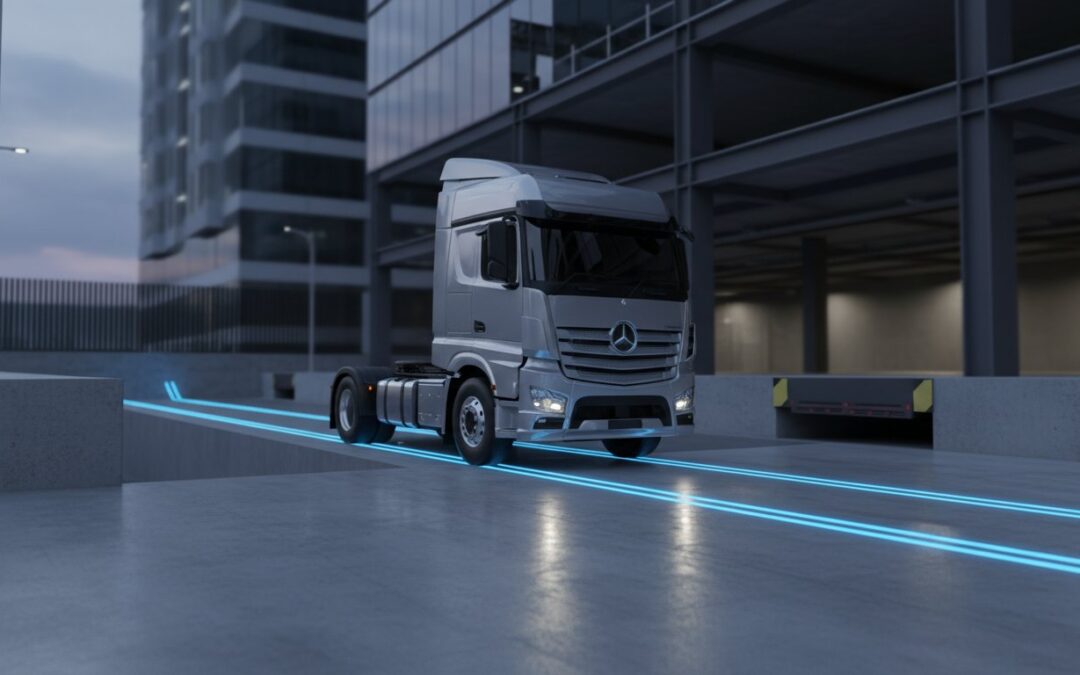
Last Tuesday, a Gold Coast developer watched their A$5.8 million project schedule slip by six weeks because a Heavy Rigid Vehicle couldn’t safely clear the site’s primary access point. It’s a common, expensive setback when a single Council RFI regarding rigid vehicle swept path analysis stalls your progress. You already know that every square metre on a tight urban site is a premium asset, and losing floor area to oversized, poorly planned loading docks is a direct hit to your bottom line.
We’ll show you how to satisfy Council requirements without sacrificing your project’s yield or design integrity. This guide provides the technical clarity you need to distinguish between SRV, MRV, and HRV classes while applying Australian Standards with precision. You’ll gain the specific insights required to secure a first-time approval and ensure your waste collection and delivery zones function perfectly from day one.
Key Takeaways
-
Understand the mechanics of "off-tracking" and how mapping a truck’s turning envelope prevents physical clashes with your site’s infrastructure.
-
Navigate the mandatory requirements of Australian Standard AS 2890.2 to ensure your commercial vehicle facilities meet strict council safety and compliance criteria.
-
Identify whether your project requires an SRV, MRV, or HRV design vehicle to avoid the common "bottleneck" trap where a truck fits the dock but cannot physically reach it.
-
Implement a professional rigid vehicle swept path analysis to catch architectural design flaws early, saving your project from the high costs of mid-construction redesigns.
-
Discover how direct access to senior traffic engineers ensures your technical simulations are accurate enough to withstand rigorous council scrutiny.
Table of Contents
What is Rigid Vehicle Swept Path Analysis?
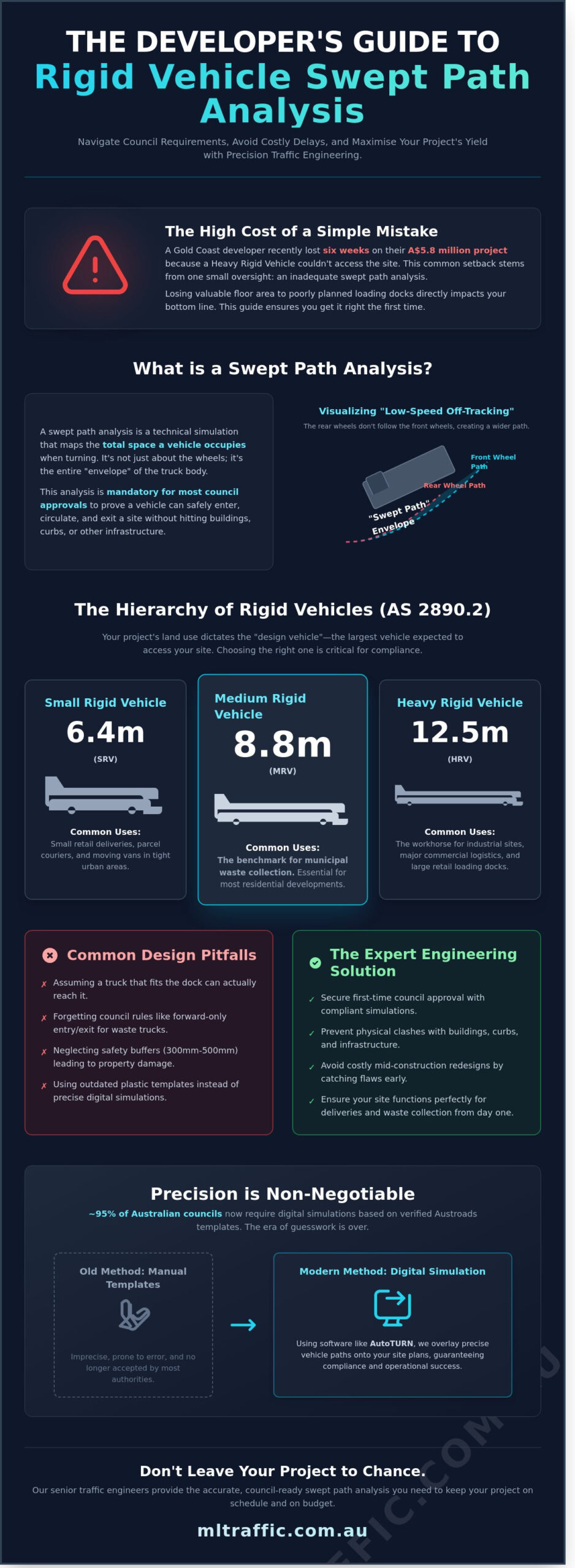
At its core, a rigid vehicle swept path analysis is a technical simulation that maps the horizontal "envelope" a truck occupies during a turn. Unlike a standard passenger car, a rigid vehicle’s rear wheels don’t follow the path of the front wheels. This discrepancy creates a wider arc known as the swept path. For developers in Australia, this analysis is a mandatory component of most planning approvals. It ensures that a heavy vehicle can enter, circulate, and exit a site without striking curbs, buildings, or other infrastructure.
This 2D simulation is the industry standard because it provides a clear, top-down view of how a vehicle interacts with a site’s physical constraints. It’s the most effective way to prove to a local council that your proposed loading dock or driveway is functional. Without this data, you risk costly redesigns after the construction phase has already begun.
To better understand how these simulations work in practice, watch this helpful video:
Understanding Low-Speed Off-Tracking
The primary challenge with rigid trucks is low-speed off-tracking. When a driver turns the steering wheel, the rear axles of the vehicle track toward the center of the turn. This means the rear of the truck covers a significantly wider path than the front. The severity of this effect depends directly on the wheelbase length. A truck with a 6-meter wheelbase requires a much larger turning radius than one with a 4-meter wheelbase. Engineers must also account for body overhangs and side mirrors. We typically include a 300mm to 500mm safety buffer beyond the wheel path to prevent expensive property damage during tight maneuvers.
The Role of AutoTURN and Vehicle Tracking Software
Professional engineers use specialized CAD-based vehicle swept path analysis software like AutoTURN to overlay these paths onto your site plans. It’s no longer enough to use generic vehicle models. Most Australian local councils, roughly 95% of them, now require simulations based on verified Austroads templates, such as the 8.8m Medium Rigid Vehicle (MRV) or the 12.5m Heavy Rigid Vehicle (HRV).
Manual plastic turning templates are a thing of the past. They lack the precision needed for modern high-density developments. By using digital simulations, we bridge the gap between your architectural vision and the operational reality of heavy vehicle movements. Our team at ML Traffic Engineers uses these tools to support development applications across Australia, ensuring every rigid vehicle swept path analysis meets the strict requirements of AS 2890.2.
The Hierarchy of Rigid Vehicles: SRV, MRV, and HRV
Every development project begins with identifying a "design vehicle." This is the largest vehicle expected to regularly access your site, and it’s dictated by your specific land use. You don’t get to choose this based on convenience; it’s a requirement for compliance. A precise rigid vehicle swept path analysis ensures that your site layout accommodates these vehicles without property damage or safety risks. We categorize these vehicles into three primary classes based on Australian Standard AS 2890.2.
-
Small Rigid Vehicles (SRV): These units are 6.4 metres long. They’re the standard for small retail deliveries, parcel couriers, and home moving vans in tighter urban environments.
-
Medium Rigid Vehicles (MRV): At 8.8 metres long, the MRV is the 19.3-tonne benchmark for most municipal waste collection trucks. If your project involves residential waste pickup, this is your primary concern.
-
Heavy Rigid Vehicles (HRV): These 12.5-metre units are the workhorses of industrial and major commercial logistics. They require significantly more room to manoeuvre, especially in reverse.
Choosing the Right Design Vehicle for Your Project
For residential developments, the 8.8m MRV is usually the gatekeeper for access. Most councils require waste trucks to enter and exit in a forward direction, meaning your turning circles must be generous. In commercial or retail settings, you’ll likely need to step up to a 12.5m HRV to meet loading dock compliance. Mixed-use projects present the toughest challenges. You might have an SRV for a ground-floor cafe and an MRV for residential waste sharing the same driveway. If you’re unsure which standard applies, our traffic engineering assessments can clarify the requirements for your specific council area.
Critical Dimensions That Dictate the Path
It’s not just about the total length. The wheelbase determines the "cut-in" during a turn; a longer wheelbase requires a wider arc. Front and rear overhangs are the hidden space-takers. A rear overhang can swing out and strike a structural column even if the wheels stay on the pavement. Finally, the minimum turning radius is limited by the vehicle’s steering lock. A standard 12.5m HRV typically requires a 12.5-metre turning radius to clear a 90-degree bend. Our rigid vehicle swept path analysis accounts for these physical limits to prevent "dead-end" designs that trap large vehicles.
Council Compliance and Australian Standard AS 2890.2
Australian Standard AS 2890.2 is the definitive rulebook for off-street commercial vehicle facilities. Every local council across Australia uses this standard to evaluate whether your development is safe and functional. When you submit a Development Application (DA), council engineers scrutinize your rigid vehicle swept path analysis to ensure that heavy vehicles won’t obstruct traffic or damage public infrastructure. If your plans don’t clearly demonstrate compliance, you’ll likely face a costly Request for Further Information (RFI) or an outright refusal. We’ve been trading since 2005, and we’ve seen how a lack of technical detail can stall a project for months.
Councils prioritize "neighbourly" impacts. This means they look at how your site affects the surrounding streetscape. A poorly planned loading dock that forces a truck to block a lane for five minutes isn’t just a nuisance; it’s a safety hazard that councils won’t approve. By providing a professional assessment, you show the council that you’ve accounted for every turn and transition. You can view our full range of compliance services at ML Traffic Engineers to see how we help developers meet these rigorous standards.
The ‘In and Out in a Forward Direction’ Rule
Safety is the core reason most jurisdictions ban heavy vehicles from reversing onto public roads. Reversing a rigid vehicle is dangerous because of significant blind spots and the slow nature of the manoeuvre. It’s almost always a non-negotiable requirement that vehicles enter and exit in a forward direction. Your rigid vehicle swept path analysis acts as the proof that a vehicle can turn around entirely within your site boundary. We solve these spatial puzzles using specific design elements:
-
Turning heads or hammerhead configurations for dead-end driveways.
-
Onsite circulation loops that allow continuous forward movement.
-
Optimized loading bay positioning to minimize the number of points in a turn.
Clearances and Safety Buffers
It’s not enough for a vehicle to simply fit; it needs a buffer to account for driver error and vehicle sway. AS 2890.2 defines a standard minimum horizontal clearance of 300mm between the swept path envelope and any fixed obstruction like a column or wall. We also perform vertical clearance checks. It’s a common mistake to overlook overhead services, fire sprinklers, or low soffits. If a rigid vehicle hits a structural beam because the ramp grade was too steep, the liability falls on the developer. We ensure your design accounts for both the horizontal footprint and the vertical height of the design vehicle.
Common Design Pitfalls and How Analysis Solves Them
Many architectural plans fail at the first turn because they rely on static 2D templates that don’t account for real-world physics. The ‘Tight Corner’ trap is a frequent offender. A designer might assume a 12.5m Heavy Rigid Vehicle (HRV) can navigate a 90-degree turn because the road width looks sufficient on paper. However, they often overlook the front overhang and rear wheel off-tracking. This oversight leads to vehicles clipping kerbs or encroaching on opposing traffic lanes, which causes immediate compliance failure during Council review. Using rigid vehicle swept path analysis during the concept phase identifies these clashes before they become permanent, expensive construction errors.
Shared access conflicts also create significant bottlenecks. Balancing passenger car movements with heavy vehicle paths requires more than just a wide driveway. Without simulation, developers often face "deadlocked" sites where a delivery truck blocks the only entrance for residents. We’ve seen projects where early-stage analysis saved developers over A$45,000 in potential redesign costs by identifying structural column conflicts before the first pour.
Optimising Loading Dock Maneuverability
A truck might physically fit inside a dock, but that doesn’t mean a driver can reach it safely. Drivers distinguish between ‘easy’ maneuvers, where they have a clear line of sight, and ‘challenging’ blind-side docks that require multiple shunts. Our rigid vehicle swept path analysis identifies these blind spots in the site layout. We ensure there’s adequate ‘apron space’—the concrete area in front of the dock—allowing the vehicle to straighten up completely. This precision prevents damage to the building facade and reduces the time trucks spend idling in active traffic lanes.
Maximising Yield on Constrained Sites
On tight urban sites, every square metre counts. Developers often lose yield by over-engineering driveways "just in case." We use precision analysis to trim ‘dead space’ that isn’t actually needed for vehicle turns. If a design looks tight on a standard plan, we provide data-backed simulations to prove to Council that the maneuver works within Australian Standards. This technical evidence is a powerful tool for negotiating with authorities, often allowing for an extra car park or larger building footprint that wouldn’t be possible with generic templates.
Don’t let a design oversight stall your development application. Contact ML Traffic Engineers to get a definitive assessment of your site’s access compliance.
The ML Traffic Advantage: Expert Rigid Vehicle Analysis
At ML Traffic Engineers, we operate on a simple principle: the consultant who provides your quote is the one who performs the work. This ensures that the technical nuances discussed during your initial consultation aren’t lost in a hand-off to junior staff. We’ve been trading since 2005, navigating the specific and often rigid requirements of local councils across Australia for nearly two decades.
Our approach to rigid vehicle swept path analysis goes beyond just running software simulations. While programs like AutoTURN are essential tools, they’re only as reliable as the engineer’s input. We’ve completed assessments for over 10,000 sites nationwide, giving us the perspective to identify design flaws that automated software might overlook. We look for the "tight spots" where a Heavy Rigid Vehicle (HRV) might clip a kerb or struggle with a blind turn, fixing these issues before they lead to a council refusal.
Automated tools often fail to account for the real-world behavior of drivers or the specific physical constraints of a site. By applying senior-level scrutiny to every simulation, we provide a level of reliability that minimizes the risk of costly redesigns during the construction phase.
Direct Access to Senior Expertise
You won’t deal with gatekeepers or administrative middle-men when you work with us. Clients get direct access to Michael Lee or Benny Chen to discuss project specifics. This direct line of communication is vital because it allows for rapid problem-solving when a design needs adjustment. Michael and Benny each bring between 30 and 40 years of experience to the table, providing a level of authoritative oversight that’s rare in larger firms.
Senior oversight is critical for projects involving heavy rigid vehicles because the margin for error is significantly smaller than with standard cars. We’re committed to delivering reports that are ready for immediate council submission, adhering strictly to AS 2890.1 and relevant local planning codes. We focus on getting it right the first time so your development application stays on track.
Comprehensive Traffic Solutions
We don’t view swept paths as isolated drawings. Instead, we integrate them into broader Traffic Impact Assessments to ensure your entire site functions safely and efficiently. This holistic view includes analyzing driveway ramp grades, sight-line requirements, and car park layouts to ensure your rigid vehicle swept path analysis reflects the actual physical environment of the site.
Our track record spans across various land uses, including warehouses, childcare centers, and high-density residential developments. We’ve successfully secured approvals for thousands of developers by providing technical clarity where others offer ambiguity. Whether your project is a simple crossover or a complex multi-level distribution hub, our technical spectrum covers every requirement.
Ready to secure your approval? Contact our expert team today to discuss your project requirements with a senior engineer.
Secure Your Project Approval with Precise Access Design
Achieving council approval for your development depends on more than just drawing lines on a plan. It requires a deep, technical understanding of how SRVs, MRVs, and HRVs navigate tight urban spaces. By identifying common design pitfalls during the planning phase, you protect your project from expensive structural changes and ensure total compliance with Australian Standards AS 2890.1 and AS 2890.2. It’s about getting the technicalities right the first time so your site functions safely and efficiently for every heavy vehicle.
At ML Traffic Engineers, we bring over 15 years of specialist experience to your project. We’ve completed assessments for more than 10,000 sites since 2005, and we maintain a strict policy where the senior traffic consultant who provides your quote is the one who performs the work. This hands-on approach ensures your rigid vehicle swept path analysis is accurate, professional, and ready for submission. We don’t use gatekeepers or juniors; you get direct access to senior expertise and a guarantee of compliance. Let’s get your access requirements sorted today.
Get a Professional Swept Path Analysis Quote
We look forward to helping you clear the final technical hurdles of your development application with confidence.
Frequently Asked Questions
What is the difference between an SRV and an MRV in swept path analysis?
An SRV is a 6.4 metre Small Rigid Vehicle, while an MRV is an 8.8 metre Medium Rigid Vehicle. These specific dimensions are defined by the AS 2890.2:2018 standard for off-street commercial vehicle facilities. You’ll typically use an SRV for small residential waste collection and an MRV for standard delivery docks. Choosing the wrong design vehicle often leads to council refusing your application because the turning circle won’t accommodate real-world logistics.
Do I need a swept path analysis for a small residential development?
You’ll likely need a swept path analysis if your development includes more than 2 dwellings or requires on-site waste collection. Local councils in NSW and Victoria often mandate these assessments to prove a 6.4 metre SRV can enter and exit the property without hitting structures. Even for small 3-unit townhouses, a professional report ensures your driveway design complies with the 300mm clearance required by most local planning schemes.
Can I perform my own swept path analysis using free software?
While some free online tools exist, councils generally reject swept path diagrams that aren’t produced using industry-standard software like AutoTURN or PATHPlanner. Most Australian authorities require these reports to be signed off by a qualified traffic engineer with NER or RPEQ status. Professional rigid vehicle swept path analysis accounts for steering lock, speed, and safety margins that free templates simply cannot replicate accurately.
What happens if my rigid vehicle path overlaps with a parking space?
Overlapping a vehicle path with a designated parking space results in a non-compliant design that councils will likely reject. AS 2890.2 requires clear separation between moving service vehicles and stationary cars to prevent collisions. If your 8.8 metre MRV clips a visitor bay, you must either relocate the bay or widen the driveway. We’ve seen 15% of initial site plans fail because they didn’t account for this 300mm safety buffer during the design phase.
Why does council require ‘forward entry and exit’ for trucks?
Councils mandate forward entry and exit to eliminate the safety risks associated with trucks reversing onto public roads. Statistics from transport authorities show that reversing maneuvers are responsible for 25% of heavy vehicle accidents in urban areas. By forcing a vehicle to turn around on-site, you ensure the driver has a clear line of sight when re-entering the traffic stream. This requirement is a non-negotiable safety standard for almost all new commercial developments.
How long does it take to get a rigid vehicle swept path report?
A standard rigid vehicle swept path analysis report typically takes 2 to 5 business days to complete once we receive your CAD files. This timeframe includes the simulation of various maneuvers, checking clearances against AS 2890.2, and drafting the final certification for your DA. If your site has complex topography or tight constraints, it might take an extra 48 hours to refine the design for compliance.
Does AS 2890.2 apply to all commercial developments in Australia?
AS 2890.2:2018 is the primary standard for off-street commercial vehicle facilities across all Australian states. It dictates everything from the size of the loading bay to the minimum turning radii for trucks. Whether you’re building a 500 square metre warehouse or a 10,000 square metre shopping centre, you must adhere to these specifications. Failing to meet these national standards often results in costly redesigns after the DA has been lodged.
What are the vertical clearance requirements for a Heavy Rigid Vehicle (HRV)?
A Heavy Rigid Vehicle (HRV) requires a minimum vertical clearance of 4.5 metres according to Australian Standards. You should also allow for an additional 0.3 metre safety margin if the vehicle is traveling over a ramp or change in grade to prevent the top of the truck from striking the ceiling. We recommend designing for 4.8 metres in most loading docks to account for modern high-cube trailers and overhead services like fire sprinklers.
Which areas do you cover?
We are traffic engineers servicing Melbourne, Sydney, Brisbane, Gold Coast, Hobart, Perth, Adelaide, Darwin, Canberra and surrounding areas.
Disclaimer
The content on www.mltraffic.com.au, including all technical articles, guides, and resources, is provided for general informational and educational purposes only. It is not intended to constitute professional advice in traffic engineering, transportation planning, development approvals, or any other technical or legal field.
While ML Traffic Engineers makes every reasonable effort to ensure the accuracy, completeness, and timeliness of the information published, we do not provide any warranties or representations (express or implied) regarding its reliability, suitability, or availability for any particular purpose. Any reliance you place on the content is strictly at your own risk.
In no event shall ML Traffic Engineers, its directors, employees, authors, or affiliates be liable for any direct, indirect, incidental, special, consequential, or punitive damages (including, without limitation, loss of profits, data, or business opportunities) arising out of or in connection with the use of, or inability to use, any information provided on this website.
The articles and guides on this site are not a substitute for engaging a qualified, registered professional traffic engineer (such as an NPER or RPEQ engineer) to assess your specific project requirements. For tailored advice, compliance assessments, or traffic engineering services, please contact a competent professional.
This disclaimer may be updated from time to time without notice. By accessing or using this website, you agree to be bound by the most current version of this disclaimer.
