

A single missing permit can halt a $5 million construction project in under ten minutes when a compliance officer steps onto your site. For many project managers, the gap between a Traffic Guidance Scheme (TGS) and a formal permit is a $2,000 per day mistake they didn’t see coming. Securing professional road occupancy license application support in Sydney is the only way to ensure your team stays on the asphalt instead of stuck in a boardroom. Since 2005, we’ve managed over 10,000 sites, helping developers avoid the bureaucratic traps that lead to rejected applications and expensive site idling.
You likely already know that dealing with Transport for NSW or local councils feels like a full-time job you didn’t sign up for. It’s frustrating when technical jargon stands between you and your project timeline. This guide will show you how to secure fast approvals and maintain 100% compliance with Australian Standard AS 1742.3 without the typical headache. We’ll break down the specific differences between planning and execution, ensuring your traffic plans align perfectly with your actual site work from day one.
Key Takeaways
- Understand the legal necessity of an ROL and identify which project activities require immediate regulatory approval to prevent unauthorized road use.
- Discover how to avoid common application pitfalls by securing professional road occupancy license application support in Sydney to ensure your documentation is audit-ready.
- Learn how to mitigate the high cost of “Stop Work” orders by implementing expert strategies that reduce administrative delays and keep your project on schedule.
- Gain a clear roadmap for navigating the application process, including the preparation of technical Traffic Guidance Schemes (TGS) and vehicle movement plans.
- Benefit from the direct involvement of senior principals with over 15 years of experience, ensuring your project receives authoritative and accountable engineering oversight.
What is a Road Occupancy Licence (ROL) and Why is it Critical?
A Road Occupancy Licence (ROL) is a formal legal permit that grants you permission to occupy a portion of the road or footpath for activities that disrupt the normal flow of traffic. It’s a mandatory requirement under the Roads Act 1993. Whether you’re positioning a 50-tonne mobile crane or conducting minor utility repairs, you must have approval before your team sets foot on the asphalt. Seeking professional road occupancy license application support in Sydney ensures you don’t fall foul of Transport for NSW (TfNSW) or the various local councils that govern the 128 local government areas across the state.
You need an ROL whenever your project impacts a traffic lane, parking bay, or pedestrian walkway. While a general council permit might suffice for a skip bin on a quiet residential street, high-impact areas require a more rigorous ROL process. This distinction is vital because state road authorities prioritize traffic flow on arterial routes. These regulations align with the Australian Road Rules, which provide the safety foundation for every state-specific traffic management plan and permit application.
To better understand how these permits function in a real-world setting, watch this helpful video:
The Legal and Safety Implications of ROL Compliance
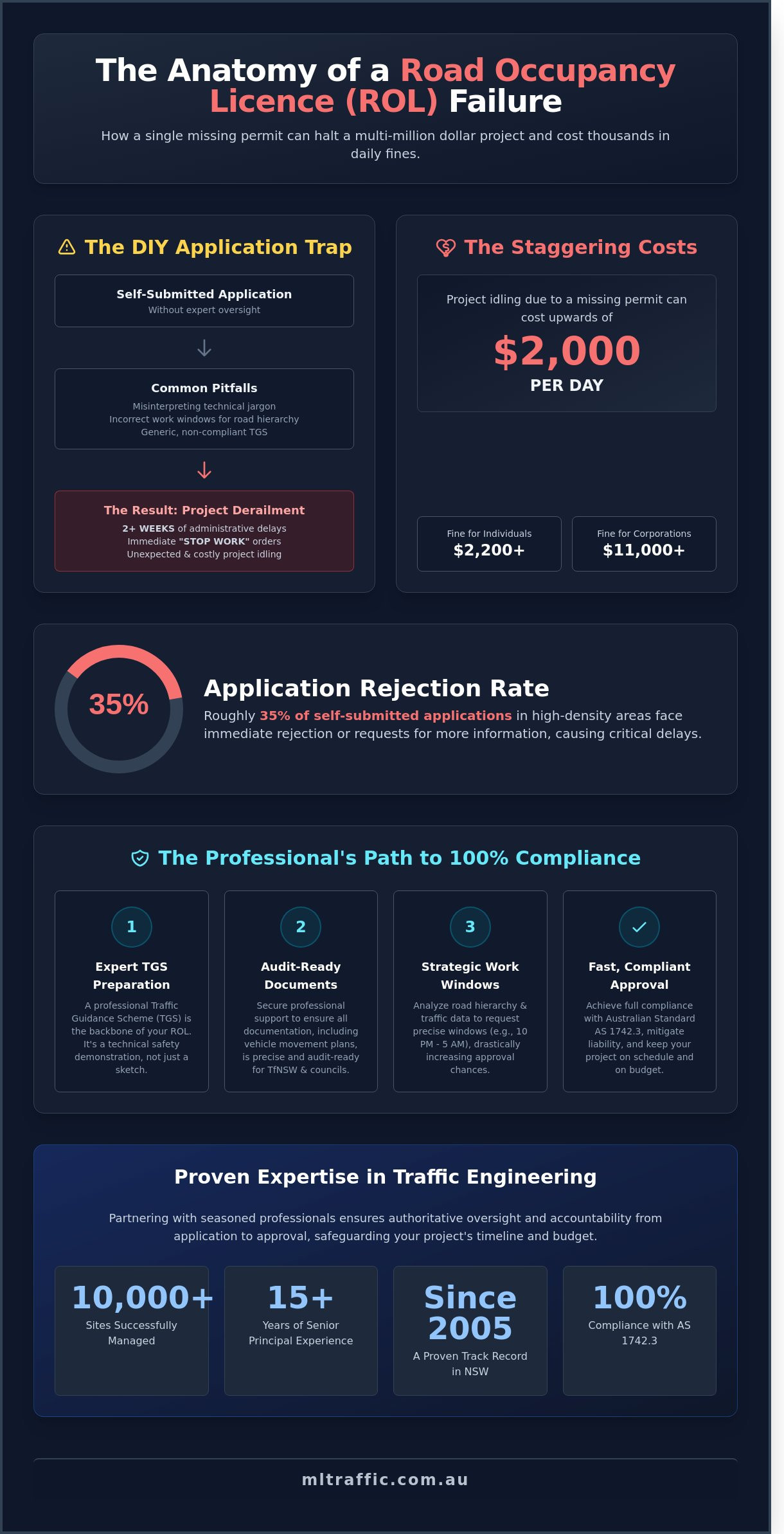
Operating without a valid ROL carries heavy risks. In NSW, unauthorized road occupancy can result in fines starting at $2,200 for individuals, while corporations face penalties reaching $11,000 or more. Beyond the financial hit, a valid licence is your primary shield against liability. If an accident occurs within your work zone, having a permit that adheres to AS 1742.3 standards proves you’ve met your duty of care. It’s the difference between a controlled site and a massive legal headache for your business.
Common Scenarios Requiring Road Occupancy Support
Most projects fall into two categories: short-term high-impact tasks or long-term infrastructure works. Concrete pours for a new apartment block usually require a 4-hour lane closure, while major utility upgrades might occupy a shoulder for three weeks. If you’re managing a site in a high-density area, obtaining road occupancy license application support in Sydney is the most efficient way to navigate these requirements. Our team at ML Traffic Engineers has managed over 10,000 sites, ensuring every Traffic Control Plan (TCP) meets the strict criteria of local authorities. We believe the traffic consultant who provides the quote should be the one who does the work, ensuring accountability from application to approval.
Key Requirements for a Compliant Road Occupancy Permit
Securing an ROL isn’t just about filling out a form; it’s a technical demonstration of safety and efficiency. Most generic applications fail because they don’t account for the specific site conditions or the granular requirements of Transport for NSW (TfNSW). In fact, roughly 35% of self-submitted applications in high-density areas face immediate rejection or requests for additional information, causing project delays of two weeks or more. Professional road occupancy license application support in Sydney eliminates this friction by ensuring every document aligns with the Road Management Act 2004.
Authorities look for precision in your “window of occupancy.” You can’t simply request a full day of access on a Tier 1 road. For instance, on major Sydney corridors, work windows are often restricted to night shifts between 10:00 PM and 5:00 AM to avoid peak hour clearways. We help you determine these exact windows by analyzing road hierarchy and traffic volume data. Aligning your request with our professional services ensures your project timeline stays intact while meeting every regulatory hurdle.
Traffic Guidance Schemes (TGS) and Management Plans
A professional TGS is the backbone of your ROL application. It isn’t a simple sketch; it’s a detailed engineering document that must comply with Australian Standard AS 1742.3. While a basic Traffic Control Plan (TCP) might suffice for a sidewalk repair, a comprehensive Traffic Management Plan (TMP) is required for larger disruptions. A TMP covers everything from pedestrian detours to public transport impacts, providing the level of detail council reviewers demand in 2024. Our team ensures these plans are site-specific rather than recycled templates.
Insurance and Liability Documentation
You can’t step onto the road without the right coverage. Most Australian councils and state authorities require a minimum of $20 million in Public Liability Insurance. When you present your Certificate of Currency, it must be current and specifically address indemnity clauses that protect the road authority. We verify that your documentation satisfies these legal requirements before submission. If your insurance doesn’t explicitly cover the scope of work or the specific location, the permit won’t be issued. It’s a binary check that stops many projects in their tracks.
The Real Cost of ROL Delays: Why Expert Support Matters
Financial losses from a “Stop Work” order can cripple a project’s budget within hours. For a mid-sized construction site in Sydney, idle machinery and labor costs often range from $5,000 to $12,000 per day. If Transport for NSW (TfNSW) or a local council identifies a permit breach, these costs don’t just sit; they compound with potential fines and liquidated damages. Professional road occupancy license application support in Sydney eliminates the 14-day delay typically caused by circular email chains and technical requests for further information (RFI).
You might wonder if professional support is worth the investment. It’s a simple calculation. Paying for expert intervention is significantly cheaper than a single day of site downtime. We speak the technical language of road managers, ensuring your application moves through the system without the friction of amateur errors. Our team bridges the gap between your project needs and the strict bureaucratic requirements of Australian road authorities.
Avoiding Common Pitfalls in the Application Process
Minor errors lead to immediate rejections. In a 2023 review of independent submissions, three mistakes appeared most frequently:
- Mistake #1: Inaccurate swept path analysis. If your plans don’t prove a 19-meter semi-trailer can clear a specific intersection without mounting a curb, the ROL will be denied.
- Mistake #2: Peak-hour ignorance. Sydney road managers strictly enforce “Clearway” and “No Stopping” periods. Failing to account for the 6:00 AM to 10:00 AM or 3:00 PM to 7:00 PM restrictions results in an automatic “Return to Sender.”
- Mistake #3: Non-compliant diagrams. Submitting a Traffic Guidance Scheme (TGS) that uses outdated 2020 standards instead of current 2024 requirements is a common reason for project stalls.
The Advantage of Senior Engineering Oversight
At ML Traffic Engineers, we operate on a specific philosophy: the traffic consultant who provides the quote, does the work. This hands-on approach ensures that your road occupancy license application support in Sydney is handled by someone with 30 to 40 years of experience, not a junior clerk. When a senior engineer reviews your site layout, they identify “red flag” issues before the council even sees them.
This level of oversight builds long-term credibility. Because we have submitted over 10,000 successful assessments, road managers trust our documentation. We don’t guess; we calculate. You can view our full range of traffic engineering services to see how we maintain this standard. Choosing experienced oversight means your project starts on time, every time, without the threat of unexpected regulatory shutdowns.
Navigating the ROL Application Process Step-by-Step
Securing an ROL isn’t just about filling out a form. It’s a technical sequence that requires precision from the first site visit. We start by identifying the road authority jurisdiction. This is critical because a local council street has different requirements than a state-managed arterial road. Our team conducts a site assessment to determine the impact on traffic flow and pedestrian safety. With experience across 10,000 sites, we know exactly what authorities look for in a submission.
Technical drawing preparation follows the assessment. These include Traffic Guidance Schemes (TGS) and Vehicle Movement Plans (VMP) that comply with Australian Standard 1742.3. We use specialized software to create Vehicle Swept Path Assessments, ensuring trucks can enter and exit your site without hitting curbs or blocking adjacent lanes. This level of detail prevents the common delays associated with poorly planned applications. Once the package is ready, we submit the formal application through digital portals like the Transport for NSW Opteon system. Professional road occupancy license application support in Sydney ensures that your submission isn’t rejected for missing data. We handle any Request for Information (RFI) from authorities, negotiating permit conditions to keep your project moving. After the permit is issued, you must implement the approved on-site traffic controls exactly as documented.
Timeline Expectations for Approval
Approval times vary by road classification. You should allow 10 business days for local council permits and up to 20 business days for state roads. For urgent utility repairs like burst mains, we manage emergency ROL requests in under 2 hours. Our pre-lodgement checks reduce RFI delays by 25%, ensuring your project starts on schedule without administrative bottlenecks.
Post-Approval Responsibilities for Developers
You must adhere to all permit conditions, such as working only between 9 PM and 5 AM. All signage and documentation must be available for on-site inspections. If your project timeline shifts, you’ll need to renew the ROL 5 days before it expires. We provide consistent road occupancy license application support in Sydney to handle these renewals and maintain your site’s compliance.
Partnering with ML Traffic Engineers for Seamless Approvals
Since 2005, ML Traffic Engineers has provided specialized consultancy services across Australia. We’ve built our reputation on a simple promise: the traffic consultant who provides your quote is the one who does the work. You won’t deal with junior staff or administrative gatekeepers. Instead, every project receives direct oversight from our senior principals, Michael Lee and Benny Chen. This hands-on approach ensures your project meets every technical requirement from the first submission.
We provide comprehensive road occupancy license application support in Sydney by integrating all necessary technical assessments into a single, streamlined package. Our team doesn’t just fill out forms. We combine Traffic Impact Assessments (TIA), Vehicle Swept Path Analysis, and Work Zone applications to create a cohesive strategy. This integration reduces the risk of conflicting data and speeds up the approval process with Transport for NSW and local councils.
Our Proven Track Record Across 10,000+ Sites
Our experience spans more than 10,000 sites across Australia, covering a vast range of land-use types. Whether you’re developing high-rise apartments, industrial warehouses, childcare centers, or retail hubs, we’ve likely managed a similar site before. You can learn more about our team and our technical background to see how this experience benefits your specific project.
- Residential developments and mixed-use towers
- Industrial precincts and logistics warehouses
- Educational facilities and community centers
- Commercial offices and medical suites
Authorities trust our reports because they’re grounded in Australian Standards, specifically AS 2890.1. We deliver meticulous data that addresses sight-line assessments and driveway ramp grades, leaving no room for bureaucratic delays. Our 15+ years of consultancy experience means we know exactly what assessors look for in a compliant application.
Get Started with Your ROL Application Today
Securing your project timeline requires proactive planning. We simplify the transition from initial project design to active road occupancy. By providing expert road occupancy license application support in Sydney, we help you avoid the common pitfalls that lead to rejected applications and costly construction delays.
Don’t let paperwork stall your progress. You can contact us today to discuss your site requirements and receive a direct quote from our lead engineers. We’re ready to help you secure the approvals you need to keep your project moving forward on schedule.
Finalize Your Site Access and Compliance
Navigating the technical requirements of Transport for NSW or local council permits doesn’t have to stall your construction schedule. A valid permit is essential to avoid costly site shutdowns and ensure public safety. By securing professional road occupancy license application support in Sydney, you eliminate the guesswork from complex traffic management plans. It’s about protecting your bottom line while meeting every regulatory hurdle with total precision.
ML Traffic Engineers provides over 15 years of technical expertise to every client. We’ve successfully managed traffic requirements for more than 10,000 project sites across Australia. You’ll have direct access to our senior principals, Michael Lee and Benny Chen, ensuring the expert who quotes your job is the one performing the work. We handle the bureaucracy so you can focus on building. Secure your Road Occupancy Licence with ML Traffic Engineers to keep your project moving. We’re ready to help you start work without the delays.
Frequently Asked Questions
How long does it take to get a Road Occupancy Licence in Australia?
Standard processing for a Road Occupancy Licence takes exactly 10 to 14 business days. Transport for NSW or local councils like the City of Sydney require this lead time to assess safety impacts. For complex projects on state roads, you should allow at least 20 business days for a full review. We recommend submitting your application 4 weeks before your start date to prevent costly project delays.
What is the difference between a Road Occupancy Permit and a Traffic Management Plan?
A Road Occupancy Licence is the legal permit to use the road space, while a Traffic Management Plan (TMP) is the technical document explaining your safety strategy. You can’t get your license without a compliant TMP that meets AS 1742.3 standards. Professional road occupancy license application support in Sydney ensures both documents align perfectly for council approval, saving you from repetitive resubmissions and administrative errors.
Can I apply for an ROL without a qualified traffic engineer?
You can technically apply yourself, but most councils require plans signed by an expert with a “Prepare Work Zone Traffic Management Plan” qualification. Applications without professional engineering input often face rejection within 48 hours. At ML Traffic Engineers, the consultant who provides your quote actually does the work. Our principals, Michael Lee and Benny Chen, have 30 years of experience and handle every application personally.
How much does a Road Occupancy Licence application cost?
Application fees start at $185 for most Sydney councils, but state road fees can be higher. This doesn’t include daily occupancy charges, which often range from $80 to $210 per day for a single parking lane. You must also budget for the professional preparation of your TGS and TMP. We provide fixed quotes for our engineering services so you know your total compliance costs before the project begins.
What happens if my ROL application is rejected by the council?
You’ll receive a formal notice detailing specific non-compliance issues, such as inadequate sight-lines or safety risks to pedestrians. You must address these technical concerns and resubmit, which usually triggers a new 10 day waiting period. Our team has completed over 10,000 sites across Australia. We use this experience to get your application right the first time, ensuring your project stays on its original 2024 schedule.
Do I need an ROL for a skip bin or a small delivery truck?
Yes, any activity that occupies the road reserve or a parking lane requires a specific permit. While skip bins often use a simplified “Skip Bin Permit,” the safety requirements remain strict. If your delivery truck stays longer than the signposted time or blocks a travel lane, you’ll need road occupancy license application support in Sydney. This prevents $1,500 fines and ensures your site remains compliant with local government regulations.
Is a Road Occupancy Licence required for work on private property that affects the footpath?
You need an ROL if your equipment, such as a concrete pump or crane, stands on or overhangs the footpath. Even if your physical work is inside the property line, blocking pedestrian access for more than 2 minutes requires a permit. Authorities require a clear 1.5 meter pedestrian corridor or a formal detour plan. We design these schemes to ensure your site remains compliant with AS 2890.1 standards at all times.
What is a Traffic Guidance Scheme (TGS) and is it mandatory for an ROL?
A TGS is a detailed diagram showing the exact placement of signs and cones; it’s mandatory for every ROL application. It was formerly known as a Traffic Control Plan (TCP). Under current AGTTM guidelines, your TGS must be site-specific rather than a generic template. We use professional CAD software to create these plans. This ensures every “Work Zone” sign and bollard is placed correctly to maximize safety for the public.
Disclaimer
The content on www.mltraffic.com.au, including all technical articles, guides, and resources, is provided for general informational and educational purposes only. It is not intended to constitute professional advice in traffic engineering, transportation planning, development approvals, or any other technical or legal field.
While ML Traffic Engineers makes every reasonable effort to ensure the accuracy, completeness, and timeliness of the information published, we do not provide any warranties or representations (express or implied) regarding its reliability, suitability, or availability for any particular purpose. Any reliance you place on the content is strictly at your own risk.
In no event shall ML Traffic Engineers, its directors, employees, authors, or affiliates be liable for any direct, indirect, incidental, special, consequential, or punitive damages (including, without limitation, loss of profits, data, or business opportunities) arising out of or in connection with the use of, or inability to use, any information provided on this website.
The articles and guides on this site are not a substitute for engaging a qualified, registered professional traffic engineer (such as an NPER or RPEQ engineer) to assess your specific project requirements. For tailored advice, compliance assessments, or traffic engineering services, please contact a competent professional.
This disclaimer may be updated from time to time without notice. By accessing or using this website, you agree to be bound by the most current version of this disclaimer.
