
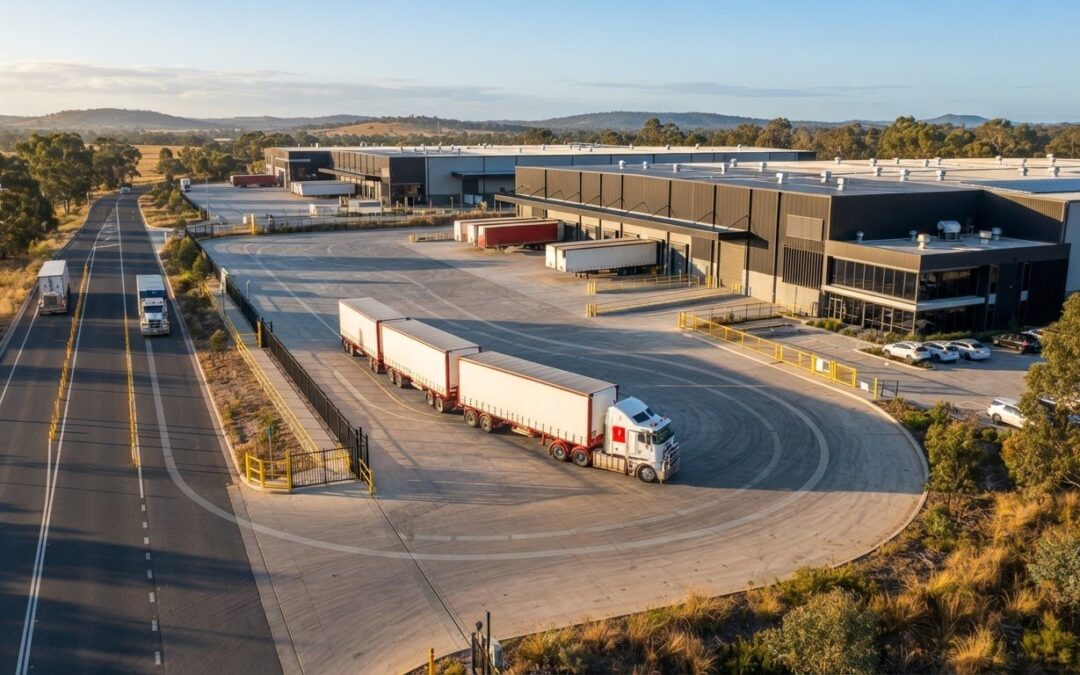
A wide gate isn’t enough to make an industrial site road-train ready. Effective road-train access design for industrial sites starts with the intended vehicle combination, its dimensions and the access conditions that apply to its route. If these assumptions are unclear, turning, queuing or loading conflicts can emerge after the layout has advanced.
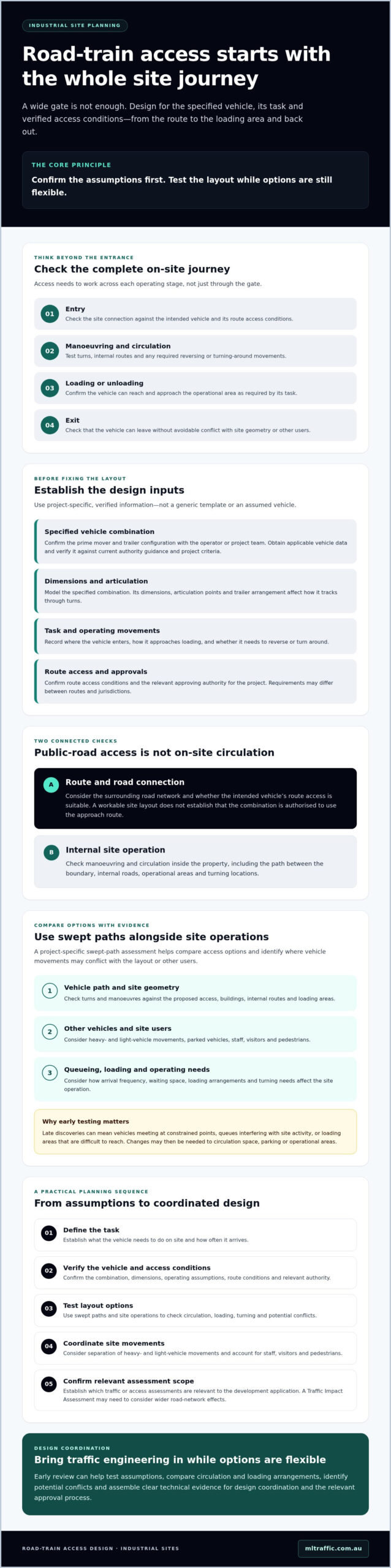
It’s understandable to focus first on getting the largest vehicle through the entrance. But access needs to work across the full site journey, from entry and manoeuvring to loading and exit, while accounting for staff, visitors and pedestrians. Confirm the suitable design vehicle, route access conditions and relevant approving authority for each project.
This article explains how to establish those assumptions before fixing the layout and how to compare circulation and loading arrangements using practical technical criteria. It covers project-specific swept-path assessment, separation of heavy and light vehicle movements, and the wider road-network effects a Traffic Impact Assessment may need to consider. The aim is to help you identify potential conflicts early and assemble clear technical evidence for design coordination and the relevant approval process.
Key Takeaways
- Road-train access design for industrial sites should be based on the specific vehicle combination, task and verified operating assumptions, not a generic template.
- Check dimensions, entry and exit conditions, loading needs and on-site circulation before settling the site layout.
- Use swept-path analysis to compare access options and identify where vehicle movements may conflict with site geometry or other users.
- Confirm route access conditions and the relevant approving authority for the project. Requirements may differ between routes and jurisdictions.
- Engage a traffic engineer while layout options are still flexible, and establish which traffic or access assessments are relevant to the development application.
Why road-train access design matters on an industrial site
Road-train access design for industrial sites determines whether the intended heavy vehicle can reach, manoeuvre within and leave a site under its operating conditions. It connects the site entrance to internal circulation routes, loading areas and turning locations. The design must suit the actual vehicle and task, not simply provide a large gate or paved area.
Road trains can have different configurations, dimensions and operating requirements. The relevant combination depends on the freight task and the route it will use. A useful starting point is understanding what is meant by a road train, then confirming the project-specific vehicle and applicable access conditions with the relevant authority.
The following video shows a road-train operation in an Australian context. Site access requirements still need to be assessed against the vehicle combination proposed for each project.
What does road-train access design cover?
Road-train access design is the assessment of whether a specified road-train combination can enter, circulate, complete its site task and exit within a proposed layout and verified access conditions. It considers vehicle movement from the site boundary through internal roads and operational areas to loading, unloading or turning locations. That means checking more than the entrance: the vehicle’s path must work through the whole site without creating avoidable conflicts with buildings, parked vehicles or other movements.
Public-road access and on-site circulation are related, but distinct. The first considers the connection to the surrounding road network and whether the intended vehicle’s route access is suitable. The second tests manoeuvring and circulation inside the property. A workable site layout can’t, by itself, establish that a road-train combination is authorised to use the approach route.
Which industrial sites need a road-train assessment?
Assessment may be relevant to freight and logistics facilities, manufacturing sites receiving or dispatching goods, and resource-support operations with heavy-vehicle tasks. The required scope depends on what vehicles do and how often they arrive. Regular deliveries, loading arrangements, waiting space and turning needs may call for different layout checks from occasional access.
Poorly planned access can lead to vehicles meeting at constrained points, queues interfering with other site activity, or loading areas that are difficult to reach. If these issues surface after the layout is advanced, changes to circulation space, parking or operational areas may be needed. Early assessment helps the project team test assumptions before fixing the site geometry.
Design inputs that determine whether a road train can move through the site
A reliable design starts with verified information, not assumed vehicle dimensions or a generic turning template. For road-train access design for industrial sites, the project team should agree on the vehicle, task and operating conditions before fixing access geometry. Keep these inputs coordinated: a change to the combination or loading arrangement may affect turning paths, staging space and the position of other site functions.
How do vehicle dimensions and operating tasks affect the design?
Confirm the intended combination with the operator or project team, including the prime mover and trailer configuration. Obtain the applicable vehicle data and verify it against current authority guidance and project criteria. Articulation points and trailer arrangement affect how the combination tracks through turns, so the assessment should model the specified vehicle rather than a loosely similar one.
Also record the task: where the vehicle enters, whether it needs to reverse or turn around, and how it approaches loading. These assumptions define the movements that need to be tested.
What site information should designers collect first?
Start with a current site plan and reliable information about boundaries, levels and proposed access locations. Then document operational requirements and the places where heavy vehicles interact with other users. The Heavy Vehicle Access Policy provides a state-specific network context. It doesn’t replace checking the access conditions and approving authority relevant to the project.
Use this checklist to assemble the design inputs:
- Vehicle and task: Confirm the combination, verified dimensions, operating frequency and loading or unloading method.
- Access and geometry: Record entrance position, gate clearances, internal road widths, turning areas and any constraints beside buildings or boundaries.
- Levels and transitions: Supply site levels and identify gradients, driveway transitions and changes between pavement areas that may affect vehicle movement.
- Operations: Locate loading areas, staging space and expected queuing positions. Check whether vehicles can wait or manoeuvre without obstructing other site activity.
- Other users: Map pedestrian routes and smaller-vehicle movements where they cross or share space with heavy vehicles.
With these inputs, a project-specific Vehicle Swept Path Analysis service can test whether the selected combination tracks through the proposed geometry. ML Traffic Engineers Australia prepares swept-path diagrams using specialist software such as AutoTURN. The assessment is only as useful as its assumptions, so provide current plans and confirm the vehicle data before relying on the result.
Compare road-train access layouts using swept paths and site operations
Two layouts may both fit the site boundary but perform differently during daily operations. Compare each option against the intended road-train task, available land and interactions with other site users. In road-train access design for industrial sites, the preferred arrangement supports the required movements without creating avoidable conflicts or compromising essential operating space.
What can swept-path analysis reveal about a proposed layout?
A project-specific swept-path assessment tests the selected vehicle’s movement into, through and out of the proposed site geometry. It can show whether the vehicle can negotiate an entrance, circulate around internal corners and reach a loading or turning area. ML Traffic Engineers Pty Ltd uses specialist software such as AutoTURN to prepare diagrams that make the vehicle path easier for the project team to review.
A diagram is evidence of a tested movement, not a complete operational review. Its value depends on accurate vehicle data, a current layout and clear assumptions about the manoeuvre. On its own, it may not resolve queuing, loading activity, pedestrian interactions or the suitability of the public-road approach. Review those matters alongside the swept path, and revisit the assessment if the vehicle or layout changes. For further detail, see the Vehicle Swept Path Analysis service.
How should project teams compare access configurations?
Test realistic alternatives against the same project-specific criteria. A direct route may reduce internal manoeuvres but use more circulation space. A turning area can help avoid reversing, but may take land needed for loading or parking. Check a layout that requires reversing against the actual operating task and nearby movements.
Use a comparison like this to guide discussion. Confirm the assessment criteria with the project team, as requirements depend on the site and operation.
| Layout option | Operational fit to assess | Potential conflicts to check |
|---|---|---|
| Direct access to loading | Does the vehicle reach and leave the loading position as intended? | Gate queues, loading activity and through-movements |
| Internal turning area | Can the specified combination turn within the available geometry? | Land take, parked vehicles and pedestrian routes |
| Shared circulation route | Can heavy vehicles and other site traffic use the route under expected operating conditions? | Passing, queuing and interactions with smaller vehicles |
Compare the options using the same vehicle, movement assumptions and plan base. This makes differences in land use and circulation visible, while keeping the swept-path evidence tied to the layout under review.
A practical workflow for planning and reviewing road-train access
A clear sequence helps the project team turn access assumptions into coordinated design checks. For road-train access design for industrial sites, confirm the vehicle and access context before detailed geometry is fixed, then review the evidence against the evolving plan.
What should the project brief provide to a traffic engineer?
Provide the intended vehicle combination, its operating frequency and the task it must complete. Include current drawings, proposed access options, loading plans, known site constraints, approval milestones and any authority correspondence. This gives the assessment a defined basis and helps identify information that still needs confirmation.
Which Australian requirements and references need checking?
Check current NHVR guidance, route-specific access conditions and advice from the relevant road or approving authority. Requirements and access arrangements can vary by jurisdiction and route, so don’t treat one authority’s criteria as a national rule. Consider Austroads guidance and Australian Standards where relevant, and verify that each reference is current and applies to the project.
Use this workflow to coordinate the assessment:
- 1. Set the brief. Record the intended combination, operating task, frequency, loading method and the movements the design needs to accommodate.
- 2. Confirm access conditions. Identify the relevant route and authority. Verify applicable vehicle access conditions and note any project-specific criteria or correspondence.
- 3. Review the concept plan. Check the site boundary, proposed entrance, internal routes, loading areas and constraints. Identify layout options while changes remain practical.
- 4. Verify vehicle information. Confirm the vehicle data with the operator or project team. Ensure the combination being assessed matches the access assumptions.
- 5. Test the proposed movements. Use project-specific swept-path analysis to assess entry, circulation, loading access and exit. Record the plan version and assumptions alongside the diagrams.
- 6. Coordinate and review. Discuss findings with the project team. Resolve geometry or operational conflicts, update the plan and reassess any changed movements before design decisions are finalised.
Keep the evidence traceable: identify the vehicle, drawing revision, movement tested and access assumptions. This helps designers and decision-makers understand what the assessment demonstrates and what still depends on authority confirmation.
If vehicle movements may affect the surrounding road network, consider whether a Traffic Impact Assessment is relevant to the project. The scope depends on the proposal and approval requirements. For a project-specific review of vehicle movements, discuss Vehicle Swept Path Analysis with ML Traffic Engineers Pty Ltd.
When to engage a traffic engineer for road-train access design
Engage a traffic engineer while access options are still being considered, not only after the site layout is settled. Early review can help test whether the intended road-train combination can complete its site task and highlight where an access option may affect loading, circulation or other site functions. This is particularly useful when vehicle requirements are still being confirmed, the concept plan has limited manoeuvring space, or approval discussions raise questions about access evidence.
Road-train access design for industrial sites doesn’t call for the same assessment package on every project. The appropriate scope depends on the vehicle, operating task, site layout, route access conditions and approval requirements. A defined brief helps identify which questions need answering and which evidence is relevant.
What should a road-train access assessment deliver?
Where included in the agreed scope, a Vehicle Swept Path Analysis can provide project-specific diagrams showing the tested vehicle movement against the proposed geometry. The assessment should identify the vehicle data, plan version and movement assumptions used, so the project team can understand what the diagrams demonstrate.
Findings can inform coordination between the site layout and the vehicle’s operating needs. They may also support discussions with the relevant authority as part of an approval process. However, a swept-path diagram doesn’t guarantee approval or establish route access permission. The appropriate format and level of detail depend on the project brief and authority requirements.
How can ML Traffic Engineers Australia support an industrial-site project?
ML Traffic Engineers Pty Ltd provides Vehicle Swept Path Analysis to test specified vehicle movements against a proposed layout. Where the project may affect the surrounding road network, a Traffic Impact Assessment may also be relevant. The consultancy can help define a technically focused scope around the project’s access questions, rather than assuming every development needs identical reports.
With over 15 years of experience in traffic engineering and transport planning, ML Traffic Engineers Pty Ltd prepares swept-path diagrams using specialist software such as AutoTURN. Its traffic engineering services also include intersection analysis and sight-distance assessment where relevant to the project.
Discuss your site, intended vehicle combination and assessment requirements with ML Traffic Engineers Pty Ltd through the contact page.
Set your site access up for the next design stage
Effective road-train access design for industrial sites begins with clear, project-specific assumptions. Confirm the vehicle combination and route access conditions, then assess how it enters, moves through and exits the site. Compare layout options against loading needs and other site movements before detailed design fixes the geometry.
A swept-path diagram helps test vehicle movement, but it should be considered alongside circulation and operating requirements. Where a proposal may affect the surrounding road network, a Traffic Impact Assessment can provide relevant supporting evidence. The assessment scope should match the project and its approval requirements.
ML Traffic Engineers Pty Ltd brings over 15 years of traffic engineering and transport planning experience. Its Vehicle Swept Path Analysis uses specialist software such as AutoTURN, and its traffic assessment services support development projects.
Discuss your industrial-site access assessment with ML Traffic Engineers Pty Ltd to identify the information and assessment scope relevant to your project. Start the discussion with your site plan, intended vehicle combination and the movements you need assessed.
Frequently Asked Questions
What is road-train access design for an industrial site?
Road-train access design for an industrial site assesses whether a specified vehicle combination can enter, move through, complete its task and exit within the proposed layout. It considers the site entrance, internal circulation, loading or turning areas, and how vehicle movements interact with other site users. The assessment also distinguishes on-site manoeuvring from access on the surrounding road network, which must be checked against relevant route conditions.
How do you check whether a road train can turn into a site?
Use a project-specific Vehicle Swept Path Analysis based on the proposed vehicle combination, verified vehicle data and current site drawings. The assessment tests the vehicle’s turning movement at the entrance and through the relevant internal paths, showing whether its swept path fits the proposed geometry. Confirm the movement assumptions and applicable design criteria with the project team. If the vehicle or layout changes, the analysis may need to be reviewed.
What information is needed for a road-train swept-path assessment?
Provide the proposed road-train combination and verified vehicle dimensions, along with the movements it needs to make. The assessment also needs current site plans showing boundaries, entrance locations, internal routes, loading areas and constraints such as buildings or gates. Include relevant levels or gradients where available, plus operating details such as loading, queuing and staging needs. Clear inputs help ensure the diagrams test the intended vehicle and layout.
Can one industrial-site layout accommodate different road-train combinations?
Possibly, but assess each combination against the layout rather than assuming it fits because another vehicle can manoeuvre there. Differences in configuration, dimensions and articulation can affect turning paths and the space needed for loading or circulation. Identify which combinations are genuinely required for the operation, then test their movements using verified vehicle data. The results can help the project team understand whether one layout works or access options need reconsideration.
Do road-train access requirements vary across Australia?
Yes. Applicable access conditions depend on the vehicle, route, jurisdiction and relevant authority, so don’t assume a requirement confirmed for one project applies nationally. Check current NHVR guidance where relevant, as well as route-specific conditions and advice from the responsible authority. Confirm the applicable road-train combination and approval requirements early. Project criteria and relevant technical references should also be checked for currency and scope before they inform the design.
When should a traffic engineer review road-train access?
Arrange a review while the concept layout and access options can still be adjusted. Early input is useful when the vehicle combination is uncertain, turning or loading space is constrained, or heavy vehicles may interact with queues, pedestrians or smaller vehicles. A traffic engineer can assess the proposed movements and help define relevant evidence for the project. The scope should reflect the site, operating task and approval requirements, not a standard report package.
Does a swept-path diagram prove an industrial site is suitable for road trains?
No. A swept-path diagram shows a specified vehicle movement tested against a particular plan and set of assumptions. It doesn’t, by itself, confirm route access, resolve every circulation or loading issue, or establish that the site meets all approval requirements. Review the diagram alongside operating needs, other site movements and authority conditions. If the vehicle, drawing or movement assumptions change, check whether the assessment still represents the proposed design.

Disclaimer
The content on www.mltraffic.com.au, including all technical articles, guides, and resources, is provided for general informational and educational purposes only. It is not intended to constitute professional advice in traffic engineering, transportation planning, development approvals, or any other technical or legal field.
While ML Traffic Engineers makes every reasonable effort to ensure the accuracy, completeness, and timeliness of the information published, we do not provide any warranties or representations (express or implied) regarding its reliability, suitability, or availability for any particular purpose. Any reliance you place on the content is strictly at your own risk.
In no event shall ML Traffic Engineers, its directors, employees, authors, or affiliates be liable for any direct, indirect, incidental, special, consequential, or punitive damages (including, without limitation, loss of profits, data, or business opportunities) arising out of or in connection with the use of, or inability to use, any information provided on this website.
The articles and guides on this site are not a substitute for engaging a qualified, registered professional traffic engineer (such as an NPER or RPEQ engineer) to assess your specific project requirements. For tailored advice, compliance assessments, or traffic engineering services, please contact a competent professional.
This disclaimer may be updated from time to time without notice. By accessing or using this website, you agree to be bound by the most current version of this disclaimer.
