

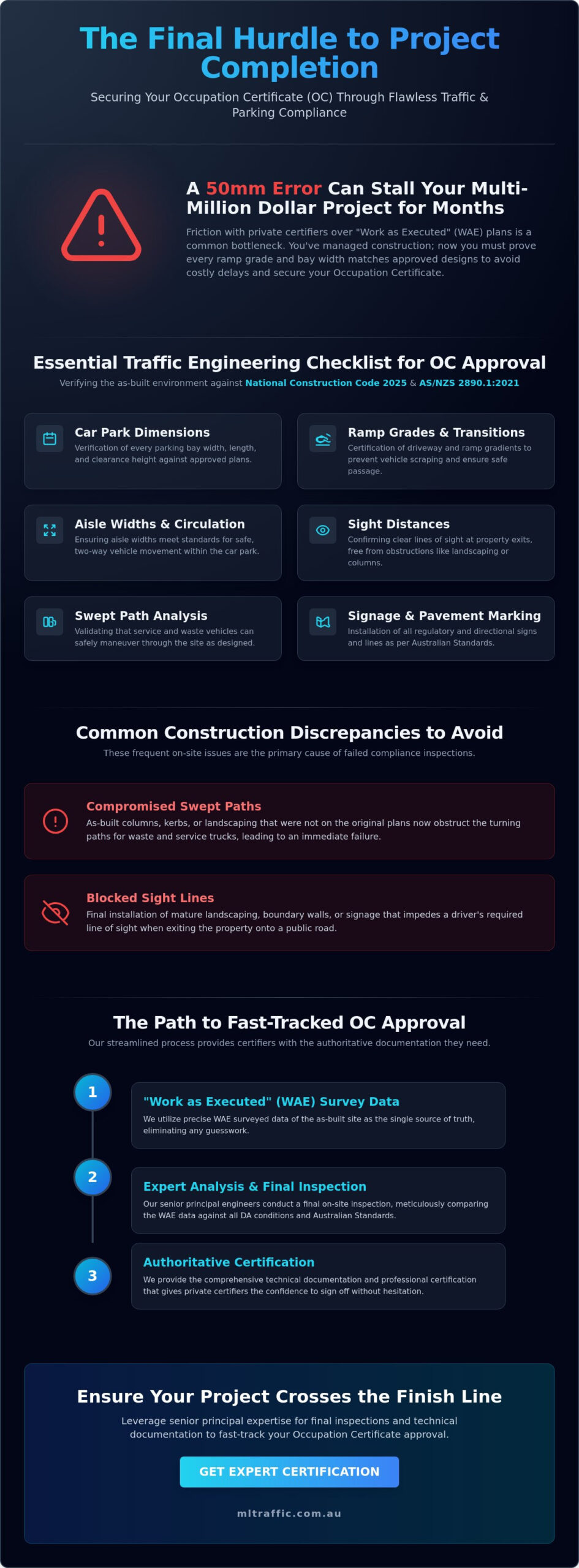
A 50mm discrepancy in a single parking bay dimension can stall a multi-million dollar development for months. Friction with private certifiers over “Work as Executed” (WAE) plans is a common bottleneck, making satisfying traffic requirements for an occupation certificate one of the most stressful final hurdles for any developer. You’ve managed the construction; now you must prove that every ramp grade and bay width matches the approved designs to avoid costly delays.
This technical verification process demands precision. It’s about ensuring your as-built infrastructure aligns with the National Construction Code 2025 and updated Australian Standards like AS/NZS 2890.1:2021. This guide provides a comprehensive roadmap to navigating these traffic and parking engineering requirements without the need for remedial works at the eleventh hour.
We’ll detail the specific traffic certifications you need, how to address common non-compliance issues in car park dimensions, and the exact steps to fast-track your OC approval through the NSW Planning Portal. By following this checklist, you can ensure your project moves from completion to occupancy without bureaucratic friction.
Key Takeaways
- Understand how satisfying traffic requirements for an occupation certificate is essential for legal building use and why certifiers cannot sign off until all DA conditions are met.
- Navigate the technical specifications of AS 2890.1, including car park dimensions and driveway ramp grades, to ensure your as-built site matches approved designs.
- Identify common construction discrepancies, such as compromised swept paths for waste trucks, that frequently lead to failed compliance inspections.
- Learn how to utilize Work as Executed (WAE) surveyed data to provide the authoritative certification required by private certifiers.
- Fast-track your OC approval by leveraging senior principal expertise for final site inspections and technical documentation.
The Role of Traffic and Parking Compliance in Securing an Occupation Certificate
Securing an Occupation Certificate is the final regulatory milestone for any development project. This legal document, often referred to as a Certificate of Occupancy, confirms that the building is safe for its intended use and complies with all relevant building standards. For developers, satisfying traffic requirements for an occupation certificate is frequently the most technically demanding part of this final phase. Private certifiers cannot legally issue the certificate until every traffic-related condition in the Development Application (DA) consent is fully satisfied and documented.
Traffic compliance isn’t limited to the physical parking bays within the basement. It encompasses the entire interface between the private property and the public road network. This includes driveway gradients, sight distances, and often external infrastructure works like intersection upgrades or new line marking. Failure to provide professional certification for these elements is a primary cause of project delays. Without this sign-off, the building remains legally unoccupied, preventing the commencement of leases or the settlement of sales.
To better understand the legal necessity of this document, watch this helpful video:
Why Traffic Engineering Matters at the OC Stage
Certifiers require professional indemnity that the as-built environment is safe for both vehicle and pedestrian movement. A traffic engineer’s final inspection validates that the developer has fulfilled all obligations to the local road network. This verification ensures that as-built car park dimensions, aisle widths, and ramp grades meet the stringent criteria of the National Construction Code 2025 and AS/NZS 2890.1. It protects the developer from future liability and ensures the site functions as intended without operational bottlenecks. Without satisfying traffic requirements for an occupation certificate, the risk of accidents and non-compliance remains high.
Understanding Your DA Conditions of Consent
The DA Conditions of Consent act as a mandatory checklist. Developers must identify specific clauses that require traffic engineer sign-off or “Work as Executed” (WAE) plans. These conditions often specify requirements for intersection upgrades, signage, or specific line marking that must be completed prior to the issuance of either a Partial OC or a Whole OC. Misinterpreting these requirements can lead to costly remedial works. For complex projects, our team provides comprehensive traffic engineering services to ensure every condition is met before the certifier arrives on site. Key elements to monitor include:
- Verification of car park layout against approved architectural plans.
- Certification of ramp grades to prevent vehicle scraping.
- Completion of any required external road works or public domain improvements.
- Installation of compliant signage and pavement markings as per Australian Standards.
Essential Traffic Engineering Checklist for OC Approval
Satisfying traffic requirements for an occupation certificate requires a meticulous technical audit of the as-built environment. Certifiers don’t just look for the existence of parking spaces; they require documented proof that every element functions according to the approved engineering plans. This checklist serves as the baseline for a final traffic compliance inspection. If any physical element deviates from the design, it must be rectified or technically justified before the certificate is issued.
A primary focus of this audit is the verification of sight distances. Obstructions like landscaping, signage, or structural columns that weren’t present in the initial design phase can often block a driver’s line of sight at property exit points. Similarly, a final Vehicle Swept Path Analysis is often required to confirm that waste collection vehicles or heavy delivery trucks can safely maneuver through the completed site without striking curbs or structural elements. These legal requirements for occupation certificates ensure that the development doesn’t create a safety hazard for the public road network.
Car Parking and Access Compliance (AS 2890)
Compliance with AS 2890.1 and AS 2890.6:2022 is non-negotiable. Every parking space must be measured to verify it meets the minimum width and length requirements specified in the DA. Columns and walls are common culprits for non-compliance. They can’t encroach on the required parking envelopes or door-opening zones. For a detailed breakdown of these dimensions, refer to our guide on AS 2890.1 Explained. Accessible parking spaces must also feature the correct shared zones and pavement markings to pass inspection. Even small discrepancies in line marking can lead to a failed audit.
Driveway and Ramp Grade Verification
As-built ramp grades must match the approved design profiles exactly. Even a minor deviation in a transition zone can lead to vehicle scraping, which certifiers won’t ignore. We measure the gradients of all ramps and driveways to ensure they accommodate the required design vehicle, typically a B99 car or a Small Rigid Vehicle (SRV). This verification includes checking that the driveway width is sufficient for the specific vehicle types identified in the original Traffic Impact Assessment. If the physical construction differs from the plan, a revised assessment may be necessary to prove the site remains functional and safe. Proper transition zones are essential to ensure vehicle clearance at the top and bottom of every ramp.
Common Traffic-Related Compliance Failures and How to Avoid Them
Construction rarely follows architectural plans with absolute precision. Minor structural adjustments during the build phase are common, yet these changes often become the primary obstacle when satisfying traffic requirements for an occupation certificate. A certifier’s role is to verify that the as-built environment matches the approved DA conditions. If a structural pillar has shifted by even 150mm, it can compromise a parking bay’s compliance or an aisle’s required width. These discrepancies must be addressed before the final inspection to prevent project handover delays.
Beyond structural shifts, developers frequently fail to install mandatory traffic control devices. This includes convex mirrors for blind corners, speed humps, and height clearance signage. Additionally, line marking and signage must strictly adhere to the dimensions and colors specified in Australian Standards. A common failure is the incorrect marking of shared zones for accessible parking. If these elements don’t meet the regulatory criteria, the certifier will withhold the OC until the site is rectified.
Managing Discrepancies Between Plans and Construction
The most frequent objection from a certifier is that the physical site does not match the traffic report. When this occurs, developers must determine if the deviation is significant enough to require a Section 4.55 modification through the local Council. In many cases, a qualified traffic engineer can provide a technical letter of certification. This document justifies the deviation by proving that the as-built condition still satisfies the original intent of the traffic assessment and remains compliant with AS 2890.1. Early identification of these gaps allows for technical resolution without a full DA amendment.
Swept Path Analysis for As-Built Verification
A new Swept Path Analysis is often necessary if structural elements like walls or fire services have been relocated. Waste collection and heavy service vehicles operate within tight tolerances. A shift in a structural column can render a previously approved maneuver impossible. We perform as-built verification to confirm that these vehicles can still enter and exit the site in a forward direction. This process also includes checking vertical clearance in basement levels to ensure overhead pipes or cable trays don’t obstruct vehicle paths. Verifying these clearances is a critical step in satisfying traffic requirements for an occupation certificate without requiring expensive remedial construction.
The Importance of Work as Executed (WAE) Plans and Final Certification
WAE plans provide the final surveyed record of every physical element on the development site. While many developers associate WAE documentation primarily with stormwater or civil works, traffic-related WAE plans are equally critical for satisfying traffic requirements for an occupation certificate. These plans capture the exact location of structural pillars, the precise width of access aisles, and the final gradients of driveway ramps. A traffic engineer uses this data to cross-reference the as-built conditions against the original Traffic Impact Assessment and the DA Conditions of Consent. This surveyed evidence is the only way to prove that construction tolerances haven’t compromised the functional design of the parking facility.
Certification must be provided by a qualified traffic engineer to be accepted by a private certifier or local council. This process often involves a final site inspection to conduct sight distance audits and confirm that all intersection analysis assumptions remain valid in the finished site. For example, if a boundary fence or utility box was installed in a different location than planned, it could potentially block the required sight lines for exiting vehicles. The engineer must verify that the safe intersection sight distance (SISD) is maintained according to Austroads standards. If the as-built environment deviates from the approved design, the traffic engineer must provide a technical justification or certify that the site remains functional under relevant Australian Standards.
The Components of a Traffic Compliance Certificate
A formal traffic compliance certificate is a comprehensive technical document. It includes a signed statement from the traffic consultant confirming that the development complies with the traffic-related DA conditions. The certificate must explicitly reference adherence to AS 2890 (Parking Facilities) and AS 1742 (Manual of Uniform Traffic Control Devices). To support these claims, the certificate typically includes updated swept path diagrams based on the WAE survey and detailed ramp grade assessments. This documentation provides the certifier with the professional indemnity needed to issue the OC without secondary queries from the council.
When is a Road Safety Audit Required for OC?
Local councils may mandate a post-construction Road Safety Audit (RSA) as a condition of the OC, particularly for developments with a significant public road interface. A traffic engineering expert identifies potential safety risks, such as poor lighting, obscured signage, or inadequate pedestrian crossing points, before the certifier arrives. While internal site safety focuses on parking maneuvers, the RSA evaluates how vehicles and pedestrians interact at the property boundary. Identifying these risks early prevents the certifier from stalling the project due to safety concerns. For professional verification of your WAE plans and final site certification, contact ML Traffic Engineers Australia today.
Expert Traffic Engineering Support for Your Final Project Stage
Navigating the final bureaucratic hurdles of a development requires more than technical data; it requires authority. Satisfying traffic requirements for an occupation certificate involves precise coordination between as-built conditions and regulatory expectations. ML Traffic Engineers Australia provides direct senior principal oversight for every final certification project. This ensures that your documentation carries the necessary weight to resolve disputes with private certifiers or local council engineers. We understand that at this stage, any delay in OC issuance translates directly into lost revenue.
Our team conducts comprehensive site inspections to verify every car park dimension, ramp grade, and sight line before you lodge your application. If construction changes necessitate a fast turnaround Traffic Impact Assessment update, we deliver the technical justification required for compliance. We act as your primary technical liaison, translating complex engineering data into clear, certifiable evidence. This proactive approach identifies potential failures before they become formal objections on a certifier’s report.
Why ML Traffic Engineers Australia is the Preferred Partner for Developers
Our firm brings over 15 years of technical experience in satisfying complex council traffic requirements across Australia. We operate with a strict personnel continuity promise. The senior expert who initiates your project relationship is the same professional who performs the final technical certification on site. This “no-gatekeepers” approach eliminates communication errors and ensures deep site-specific knowledge during the final audit. We have a proven track record across diverse land-use categories, including high-density residential, commercial, and industrial developments. Our reputation for meticulous compliance documentation is recognized by certifiers nationwide.
Get Started with Your Final Traffic Certification
Delays at the OC stage are financially damaging. We recommend a proactive review of your DA conditions and current construction status at least four weeks before your target handover date. This window allows sufficient time to identify and rectify any non-compliant elements or to prepare necessary technical justifications for minor deviations. Ensure your car park, loading docks, and property access points are fully compliant and ready for inspection. To secure your documentation and fast-track your approval, contact ML Traffic Engineers Australia for a professional consultation and site inspection.
Secure Your Project Handover with Expert Traffic Certification
Securing an Occupation Certificate requires more than construction completion; it requires verified technical compliance. As established throughout this guide, satisfying traffic requirements for an occupation certificate is the final barrier to project handover. This phase demands meticulous attention to as-built dimensions, ramp gradients, and sight distances to ensure the site is safe for public use and aligns with the National Construction Code 2025.
ML Traffic Engineers Australia brings over 15 years of specialist traffic engineering experience to your final project stage. We provide direct access to senior principals for all technical certifications to ensure your documentation carries the necessary weight for council approval. Our expertise in AS 2890 compliance and strategic council negotiations helps resolve construction discrepancies before they cause costly delays. Don’t let technical non-compliance stall your settlement or lease commencement.
Ensure your project meets all traffic requirements; contact ML Traffic Engineers Australia today. We look forward to facilitating your successful project completion.
Frequently Asked Questions
What is the difference between a Traffic Impact Assessment and a Traffic Compliance Certificate?
A Traffic Impact Assessment (TIA) is a design-phase document submitted with the Development Application to forecast traffic generation and infrastructure needs. A Traffic Compliance Certificate is a post-construction document that verifies the physical site matches all DA conditions. It’s a critical component in satisfying traffic requirements for an occupation certificate by proving the as-built environment is functional and safe.
Can I get a Partial Occupation Certificate if the car park is not yet fully line-marked?
Certifiers typically won’t issue a Partial OC if parking and safety markings are incomplete. All traffic control devices, including line marking and signage, must be fully installed to ensure user safety and regulatory compliance. Incomplete markings represent a significant liability risk that usually prevents the legal occupation of any project stage.
Do I need a new swept path analysis if we moved a structural pillar in the basement?
You must perform a new Vehicle Swept Path Analysis if a structural element like a pillar shifts during construction. Even minor displacements can render previously approved maneuvers impossible for waste trucks or delivery vehicles. This updated analysis confirms that the as-built site remains functional for the design vehicle despite structural changes.
Who is authorized to sign off on traffic and parking requirements for an OC?
Only a qualified traffic engineer or a suitably experienced civil engineer is authorized to provide final traffic certification. Most private certifiers and local councils require the sign-off to come from a consultant with professional indemnity insurance and specific expertise in traffic and parking standards. This ensures the documentation holds the necessary technical authority for satisfying traffic requirements for an occupation certificate.
What happens if my as-built driveway ramp is steeper than what was approved in the DA?
A steeper ramp gradient requires a technical justification letter from a traffic engineer or physical rectification. If the gradient exceeds the maximum limits set in AS 2890.1, it can cause vehicle scraping or safety hazards. The engineer must assess if the as-built grade still satisfies safety requirements or if a formal Section 4.55 modification is required through the council.
How long does it typically take to get a Traffic Engineering Certificate for an OC?
The timeframe for issuing a Traffic Engineering Certificate usually ranges from three to seven business days once the final site inspection is complete and WAE plans are provided. Delays occur if the site is found to be non-compliant or if the survey data is incomplete. Early engagement with your traffic consultant helps streamline the final approval process.
Are WAE plans mandatory for all developments requiring an Occupation Certificate?
Work as Executed (WAE) plans are mandatory for most developments that include internal road networks or complex basement parking. Certifiers use these surveyed records to verify that construction tolerances haven’t compromised the approved design. Without a surveyed WAE plan, an engineer cannot accurately certify the final as-built dimensions and clearances.
What Australian Standards are most relevant for final OC traffic inspections?
The most relevant standards are the AS 2890 series, specifically AS 2890.1 for general parking and AS 2890.6:2022 for accessible spaces. AS 1742 is also critical for the correct implementation of traffic control devices and signage. Adherence to these standards is a mandatory requirement for securing a final traffic sign-off and ensuring the safety of all site users.

Disclaimer
The content on www.mltraffic.com.au, including all technical articles, guides, and resources, is provided for general informational and educational purposes only. It is not intended to constitute professional advice in traffic engineering, transportation planning, development approvals, or any other technical or legal field.
While ML Traffic Engineers makes every reasonable effort to ensure the accuracy, completeness, and timeliness of the information published, we do not provide any warranties or representations (express or implied) regarding its reliability, suitability, or availability for any particular purpose. Any reliance you place on the content is strictly at your own risk.
In no event shall ML Traffic Engineers, its directors, employees, authors, or affiliates be liable for any direct, indirect, incidental, special, consequential, or punitive damages (including, without limitation, loss of profits, data, or business opportunities) arising out of or in connection with the use of, or inability to use, any information provided on this website.
The articles and guides on this site are not a substitute for engaging a qualified, registered professional traffic engineer (such as an NPER or RPEQ engineer) to assess your specific project requirements. For tailored advice, compliance assessments, or traffic engineering services, please contact a competent professional.
This disclaimer may be updated from time to time without notice. By accessing or using this website, you agree to be bound by the most current version of this disclaimer.
