
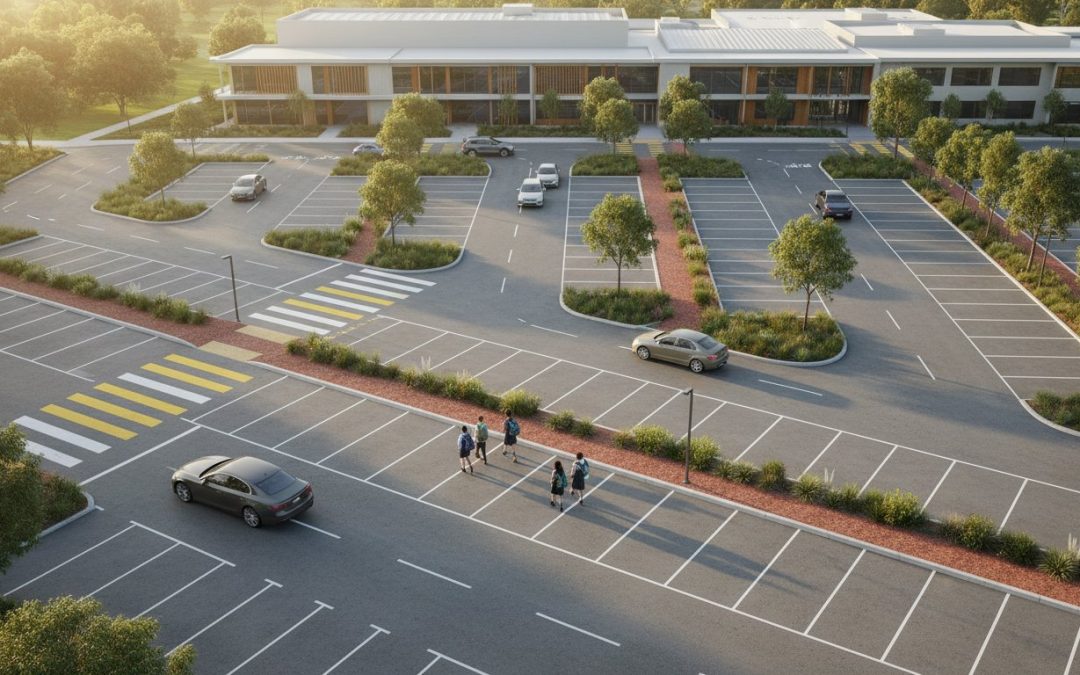
A school development application in Melbourne can be stopped by one critical element: an inadequate traffic report. Concerns over student safety, chaotic pick-up and drop-off times, and non-compliance with local council requirements are the primary reasons for costly delays and outright rejections. An improperly designed car park or access system can compromise the viability of your entire project before it even begins.
Successfully navigating these challenges requires a comprehensive School Car Parking and Traffic Impact Assessment in Melbourne. This is not merely a formality; it is the foundational document that demonstrates the safety, efficiency, and compliance of your proposed development to council planners, ensuring the safety of students and the satisfaction of the surrounding community.
This guide provides a complete overview of the process. We detail the essential steps, specific council requirements, and critical design considerations necessary for a successful assessment. Our objective is to equip you with the expert knowledge required to achieve timely council approval, avoid requests for further information (RFIs), and ensure your development proceeds without delay.
Key Takeaways
-
Understand why Melbourne councils assess school developments differently, focusing on the unique challenges of intense, concentrated peak traffic periods.
-
A compliant traffic report must contain core components that provide an evidence-based justification for your design to satisfy council requirements.
-
A successful School Car Parking and Traffic Impact Assessment in Melbourne follows a systematic, multi-stage methodology from data collection to final report submission.
-
Selecting a traffic engineering consultant with specific, demonstrated experience in school projects is the most critical factor for achieving a timely planning approval.
Table of Contents
-
Why School Traffic Assessments Are a Unique Challenge in Melbourne
-
Core Components of a School Traffic & Parking Assessment Report
Why School Traffic Assessments Are a Unique Challenge in Melbourne
Unlike commercial or standard residential developments, schools present a unique set of challenges that councils in Melbourne scrutinise with exceptional rigour. The core difference lies in the nature of their traffic generation: intense, highly concentrated peak periods that occur twice daily. A standard retail site has traffic spread throughout the day, but a school’s operational integrity and safety depend entirely on how it manages these brief, chaotic windows. A professional School Car Parking and Traffic Impact Assessment in Melbourne is therefore not just a formality, but a critical component for gaining council approval and ensuring a safe environment.
The primary concern for planners is not traffic efficiency alone, but the fundamental safety of children. This focus, combined with the significant impact on surrounding residential streets, means that school development applications are subject to a distinct and demanding regulatory framework under the Victorian Planning Provisions.
The ‘Pick-Up and Drop-Off’ Chaos: Managing Peak Demand
The most significant operational challenge for any school is managing the twice-daily traffic surge. Within a brief 30-minute window in the morning and afternoon, a large volume of vehicles converges on the site. Without a meticulously planned system, this results in extensive queuing, illegal parking on local streets, and parents performing unsafe manoeuvres. A successful design incorporates dedicated, well-designed pick-up and drop-off areas that can accommodate this demand internally, minimising disruption to the surrounding road network.
Navigating Council Requirements: Clause 52.06 and Beyond
In Victoria, the primary regulatory tool governing car parking is Clause 52.06 of the Planning Scheme. This clause specifies the statutory car parking rates required for an educational centre, often calculated on a per-staff-member and per-student basis. However, these default rates may not suit every site. A comprehensive Traffic Impact Assessment is the formal mechanism used to analyse actual demand and justify any proposed variation from the statutory requirements. It is also critical to recognise that different Melbourne councils may have specific local planning policies that supplement these state-wide provisions.
Child Safety as the Overriding Imperative
For council planners assessing a school development, the safety of children and pedestrians is the non-negotiable, overriding imperative. A design that merely meets parking numbers but fails on safety will not be approved. A well-executed design, grounded in established transportation planning principles, proactively reduces conflict points between vehicles and vulnerable pedestrians through key measures:
-
Clear Sightlines: Ensuring drivers and pedestrians can see each other at all crossing points and vehicle accessways.
-
Separated Pedestrian Paths: Providing dedicated, protected routes for students to walk from the street and car parks to the school buildings.
-
Designated Bus Zones: Locating bus bays away from the main car park traffic to prevent conflicts between different vehicle types.
Core Components of a School Traffic & Parking Assessment Report
A compliant traffic and parking assessment report is more than a formality for a development application; it is an evidence-based justification for the proposed school design. Prepared by a qualified and experienced traffic engineer, the report systematically addresses the specific concerns of local councils, demonstrating that the development will operate safely and efficiently within the existing transport network. Each section provides critical data to pre-empt council queries and streamline the approval process.
A comprehensive School Car Parking and Traffic Impact Assessment in Melbourne is built upon several key analytical pillars.
Traffic Generation & Distribution Analysis
This foundational component quantifies the new traffic load the school will place on the local road network. We calculate traffic generation rates based on projected student enrolment and staff numbers to determine the number of additional vehicle trips during peak morning and afternoon periods. The analysis then models how this traffic will distribute across surrounding streets, using methodologies consistent with VicRoads traffic impact guidelines to assess the performance of key nearby intersections.
Car Parking Demand Assessment
Here, we determine the precise number of on-site car parking spaces required to service the school. The assessment differentiates between the distinct needs of all-day staff parking, short-term visitor or parent drop-off spaces, and occasional high-demand event parking. Where statutory council rates may not reflect a school’s unique operational model, we use ‘first principles’ analysis-based on survey data and specific site characteristics-to justify the proposed parking supply and prove its adequacy, preventing disruptive on-street parking overflow in the neighbourhood.
Access, Internal Circulation, and Swept Path Analysis
This section focuses on the safety and functionality of the on-site layout. It scrutinises the design of driveways, internal aisles, and pick-up/drop-off zones to ensure compliance with Australian Standards. Critically, it includes a swept path analysis, which uses software to simulate the turning paths of design vehicles, from cars to large school buses and service trucks. This proves that all vehicles can manoeuvre safely and efficiently on-site, a paramount concern for child safety. You can review our traffic engineering services for more detail on these essential components.
The Assessment Process: A Step-by-Step Methodology
A successful School Car Parking and Traffic Impact Assessment in Melbourne hinges on a robust, data-driven methodology. Our process is designed to be transparent and rigorous, providing school administrators and developers with a clear roadmap from initial analysis to final submission. This systematic approach ensures every requirement of the local council’s Planning Scheme is meticulously addressed, building a compelling case for your development application.
Step 1: Site Analysis and Traffic Data Collection
The process begins with a comprehensive on-site investigation to understand the existing traffic environment and physical constraints. Our senior traffic engineers conduct a thorough analysis of the school’s location, access points, and the surrounding road network. This foundational step involves:
-
Traffic Surveys: Conducting peak-period traffic and parking surveys, often using automated tube counts, to establish baseline traffic volumes on adjacent streets.
-
Multi-modal Assessment: Gathering data on existing public transport services, pedestrian footpaths, and cycling routes to evaluate all modes of transport used by students and staff.
-
Site Review: Identifying the site’s unique opportunities and constraints, including sight lines, topography, and existing infrastructure that will influence the final design.
Step 2: Car Park Design and Layout
Using the collected data, we develop a functional and compliant car park and access design. This critical phase focuses on safety, efficiency, and adherence to mandatory codes. We design the internal layout to meet the specific peak demands of a school environment, ensuring the design of the pick-up/drop-off facility minimises queuing and external traffic disruption. Every layout is drafted to strictly comply with Australian Standard AS 2890.1 for parking facilities and AS 2890.6 for accessible parking, guaranteeing DDA compliance.
Step 3: Report Preparation and Submission
The final stage involves compiling all data, analysis, and designs into a formal traffic impact assessment report. This document is written in clear, concise language tailored for council planners, systematically addressing every relevant clause of the Planning Scheme. The report provides a definitive analysis of car parking demand, traffic generation, and the operational effectiveness of the proposed design. It serves as a key document in your development application package, demonstrating due diligence and providing council with the evidence needed for approval. For a detailed consultation on your project, contact our expert team.
Choosing the Right Traffic Consultant in Melbourne
Securing council approval for a school development hinges on the quality of your traffic engineering report. This is not a task for a generalist engineer; it requires a specialist with a deep understanding of the education sector’s unique demands. Choosing the right expert is the single most critical decision you will make, directly impacting your project’s timeline, budget, and ultimate success. An experienced consultant saves you time, money, and stress by delivering a compliant and practical traffic management plan from the outset.
When selecting a consultant for your School Car Parking and Traffic Impact Assessment in Melbourne, your criteria should be uncompromising:
-
Demonstrated experience with Victorian councils.
-
A specific portfolio of successful education sector projects.
-
Direct access to senior, accountable engineers.
Essential Experience with Victorian Councils
Each council in Melbourne has its own distinct planning scheme requirements and interpretations. A consultant with established local relationships and a history of successful applications can anticipate potential issues, navigate council expectations, and resolve queries efficiently. This localised expertise is invaluable. Ask any potential consultant to provide concrete examples of approved school projects in relevant municipalities. Our team has built this knowledge over more than 15 years; learn more about us and our extensive project history.
Proven Track Record in the Education Sector
Schools are not typical commercial developments. Their traffic and parking needs are dictated by unique operational patterns, including morning drop-offs, afternoon pick-ups, staggered bell times, school bus operations, and special events. A qualified consultant understands these complexities and designs solutions that are practical for parents, staff, and students-not just theoretically compliant. Ensure your chosen expert has a portfolio that includes a diverse range of educational facilities, from early learning centres to large secondary colleges.
The ML Traffic Engineers Pty Ltd Advantage: Direct, Expert Service
At ML Traffic Engineers Pty Ltd, we operate on a core principle: ‘The consultant who provides the quote, does the work.’ This guarantees that a senior, highly experienced engineer manages your project from the initial proposal to the final council approval. This model ensures complete accountability, seamless communication, and a deep, continuous understanding of your project’s specific requirements. There are no hand-offs to junior staff, only direct, expert service. Ready to discuss your project? Contact us directly for a proposal.
Partner with Melbourne’s Leading School Traffic Consultants
Navigating the complexities of school traffic assessments in Melbourne requires specialist expertise. As this guide has shown, a successful outcome depends on a thorough understanding of unique peak-hour challenges and the critical components of a traffic report. A meticulously prepared School Car Parking and Traffic Impact Assessment in Melbourne is not just a document; it is the key to securing council approval and ensuring the safety and efficiency of your educational facility.
At ML Traffic Engineers, we provide the technical authority your project demands. With over 15 years’ experience working directly with Melbourne and Victorian councils, our team has specialist expertise in delivering traffic solutions for educational facilities. We guarantee direct access to our principal engineers on every project, ensuring senior-level oversight from your initial quote to final submission. Contact our senior traffic engineers for a proposal on your school project.
Partner with us to navigate the approval process with certainty and achieve a compliant, successful result for your development.
Frequently Asked Questions
How many car parking spaces does a new school need in Victoria?
The required number of car parking spaces is determined by the local planning scheme, specifically referencing Clause 52.06. For a primary school, the statutory rate is typically 0.2 spaces per student, plus designated spaces for staff. However, these rates can often be reduced. A comprehensive Car Parking Demand Assessment will analyse the school’s specific characteristics, such as public transport access and student catchment area, to justify a more practical and efficient parking provision to the council.
What is Clause 52.06 of the Victorian Planning Scheme and how does it apply to schools?
Clause 52.06 is the section of the Victorian Planning Provisions that outlines car parking requirements for all land uses, including educational centres. It provides standardised rates for calculating the minimum number of car spaces needed based on factors like student and staff numbers. A professional traffic engineer uses this clause as the starting point for any assessment, determining if the statutory rate is appropriate or if a site-specific reduction can be justified through detailed analysis.
How long does a school traffic impact assessment and report take to complete?
A standard school traffic impact assessment and report typically takes between two to three weeks to complete. This timeframe allows for essential data collection, including on-site traffic and parking surveys during peak school drop-off and pick-up times. The duration can vary depending on the project’s complexity, the specific requirements of the local council, and the availability of existing traffic data. We prioritise a thorough analysis to ensure a robust and defensible report for your planning application.
Can our school use an existing nearby car park to meet council requirements?
Yes, utilising a nearby car park is a potential solution, often referred to as an off-site or shared-use parking arrangement. This requires a formal, legally binding agreement with the owner of the other property to guarantee access for school staff or parents during specific hours. The council will need to see evidence of this formal agreement as part of the planning application. Our assessment can determine the feasibility of such an arrangement and help formalise the requirements.
What is the difference between a traffic assessment for a school versus a shopping centre?
The primary difference lies in the traffic patterns and peak periods. A school’s traffic impact is concentrated into two very sharp peaks: a 30-45 minute window for morning drop-off and a similar window for afternoon pick-up. In contrast, a shopping centre experiences broader, more sustained peaks on evenings and weekends. A school car parking and traffic impact assessment in Melbourne must focus intensely on managing these short, high-volume periods and ensuring student safety on the local road network.
How much does a school car parking and traffic impact assessment cost in Melbourne?
The cost for a professional school car parking and traffic impact assessment in Melbourne typically ranges from A$3,000 to A$6,000 + GST. The final fee depends on the scale and complexity of the project. Factors influencing the cost include the size of the school (student and staff numbers), the extent of traffic surveys required, and the specific reporting requirements of the relevant local council. We provide a fixed, itemised fee proposal after an initial review of your project requirements.
Which areas do you cover?
We service all suburbs of Melbourne metropolitan area, such as Abbotsford, Aberfeldie, Aintree, Airport West, Albanvale, Albert Park, Albion, Alphington, Altona, Altona Meadows, Altona North, Ardeer, Armadale, Arthurs Seat, Ascot Vale, Ashburton, Ashwood, Aspendale, Aspendale Gardens, Attwood, Avondale Heights, Balaclava, Balwyn, Balwyn North, Bangholme, Bayswater, Bayswater North, Beaconsfield, Beaumaris, Bellfield, Bentleigh, Bentleigh East, Berwick, Bittern, Blackburn, Blackburn North, Blackburn South, Bonbeach, Boronia, Box Hill, Box Hill North, Box Hill South, Braeside, Braybrook, Brentford Square, Brighton, Brighton East, Broadmeadows, Brooklyn, Brunswick, Brunswick East, Brunswick West, Bulla, Bulleen, Bundoora, Burnley, Burnside, Burwood, Burwood East, Cairnlea, Camberwell, Campbellfield, Canterbury, Carlton, Carlton North, Carnegie, Caroline Springs, Carrum, Carrum Downs, Caulfield, Caulfield East, Caulfield North, Caulfield South, Chadstone, Chelsea, Chelsea Heights, Cheltenham, Chirnside Park, Clarinda, Clayton, Clayton South, Clematis, Clifton Hill, Coburg, Coburg North, Cocoroc, Coldstream, Collingwood, Coolaroo, Craigieburn, Cranbourne, Cranbourne East, Cranbourne North, Cranbourne South, Cranbourne West, Cremorne, Croydon, Croydon Hills, Croydon North, Croydon South, Dandenong, Dandenong North, Dandenong South, Deer Park, Delahey, Derrimut, Diamond Creek, Diggers Rest, Dingley Village, Docklands, Doncaster, Doncaster East, Donnybrook, Donvale, Doreen, Doveton, Eaglemont, East Melbourne, Edithvale, Elsternwick, Eltham, Eltham North, Elwood, Emerald, Endeavour Hills, Epping, Essendon, Essendon Fields, Essendon North, Essendon West, Fairfield, Fawkner, Ferntree Gully, Ferny Creek, Fitzroy, Fitzroy North, Flemington, Footscray, Forest Hill, Frankston, Frankston North, Frankston South, Gardenvale, Gladstone Park, Glen Huntly, Glen Iris, Glen Waverley, Glenroy, Greensborough, Greenvale, Guys Hill, Hadfield, Hampton, Hampton East, Hampton Park, Harkaway, Hawthorn, Hawthorn East, Heathmont, Heidelberg, Heidelberg Heights, Heidelberg West, Highett, Hillside, Hoppers Crossing, Hughesdale, Huntingdale, Hurstbridge, Ivanhoe, Ivanhoe East, Jacana, Kalkallo, Kealba, Keilor, Keilor Downs, Keilor East, Keilor Lodge, Keilor North, Keilor Park, Kensington, Kew, Kew East, Keysborough, Kings Park, Kingsbury, Kingsville, Knoxfield, Lalor, Langwarrin, Laverton, Laverton North, Lilydale, Lower Plenty, Lynbrook, Lyndhurst, Lysterfield, Macleod, Maidstone, Malvern, Malvern East, Maribyrnong, McCrae, Meadow Heights, Melbourne, Mentone, Mernda, Mickleham, Middle Park, Mill Park, Mitcham, Mont Albert, Mont Albert North, Montmorency, Moonee Ponds, Moorabbin, Mooroolbark, Mordialloc, Mornington, Mount Waverley, Mulgrave, Murrumbeena, Narre Warren, Narre Warren North, Narre Warren South, Newport, Niddrie, Noble Park, Noble Park North, North Melbourne, Northcote, Notting Hill, Nunawading, Oak Park, Oaklands Junction, Oakleigh, Oakleigh East, Oakleigh South, Officer, Ormond, Pakenham, Parkdale, Park Orchards, Pascoe Vale, Pascoe Vale South, Patterson Lakes, Plenty, Point Cook, Port Melbourne, Portsea, Prahran, Preston, Princes Hill, Reservoir, Richmond, Ringwood, Ringwood East, Ringwood North, Ripponlea, Rosanna, Rosebud, Rowville, Roxburgh Park, Rye, Sandhurst, Sandringham, Scoresby, Seabrook, Seaholme, Seddon, Seaford, South Kingsville, South Melbourne, South Morang, South Wharf, South Yarra, Southbank, Spotswood, St Albans, St Helena, St Kilda, St Kilda East, St Kilda West, Strathmore, Sunshine, Sunshine North, Sunshine West, Surrey Hills, Sydenham, Tarneit, Taylors Hill, Taylors Lakes, Templestowe, Templestowe Lower, Thomastown, Thornbury, Toorak, Tottenham, Travancore, Truganina, Tullamarine, Vermont, Vermont South, Viewbank, Wantirna, Wantirna South, Watsonia, Watsonia North, Werribee, Werribee South, West Footscray, West Melbourne, Westgarth, Wheelers Hill, Wildwood, Williamstown, Williamstown North, Windsor, Wonga Park, Wyndham Vale, Yallambie, Yarraville.
