

A poorly defined scope of work for traffic impact assessment is the fastest way to trigger a costly Request for Information (RFI) and stall your development application. With traffic congestion rising across major Australian cities, Council engineers are increasingly meticulous about data accuracy and compliance. You shouldn’t have to navigate opaque fee proposals or worry that a consultant missed a critical intersection analysis. It’s a common risk that leads to budget creep and unnecessary traffic surveys that don’t actually move your project forward.
We believe developers deserve technical certainty and direct accountability from their experts. This guide from ML Traffic Engineers Australia shows you exactly how to define and manage a TIA scope that aligns with current trip generation manuals and Australian Standards. You’ll gain a technical checklist to evaluate consultant quotes and ensure every task, from Vehicle Swept Path Analysis to Sight Distance Assessments, is covered. This approach ensures your report sails through Council approval while protecting your project timeline and budget.
Key Takeaways
- Define a precise scope of work for traffic impact assessment to lock in modeling parameters and prevent costly Council RFIs.
- Identify core technical requirements, including trip generation rates and intersection analysis, necessary for compliance with current Australian Standards.
- Distinguish between a Traffic Impact Statement and a full TIA to ensure you only pay for the data collection your specific development requires.
- Utilize Pre-DA meetings to secure early agreement from Council engineers and protect your project from mid-process scope creep.
- Prioritize direct consultant accountability to ensure the senior engineer who scopes the project is the one performing the technical work.
Table of Contents
-
Defining the Scope of Work for a Traffic Impact Assessment (TIA)
-
Core Technical Requirements: The Non-Negotiables in a TIA Scope
-
Scaling the Scope: Traffic Statements vs. Full Impact Assessments
-
The Scoping Process: Navigating Council Requirements and Pre-DA Advice
-
Securing a Professional Scope of Work with ML Traffic Engineers
Defining the Scope of Work for a Traffic Impact Assessment (TIA)
The scope of work for traffic impact assessment is the contractually binding roadmap for your project’s approval. It details the specific study area, data collection points, and modeling methodologies required by the relevant authority before any technical work begins. This document is not just a list of tasks; it is your insurance against project delays. A well-constructed scope ensures your fee proposal matches the site’s actual complexity and avoids hidden costs. While TIAs focus on transport, they often form a critical part of a broader Environmental Impact Assessment (EIA) for significant Australian developments.
To better understand the core components of this analysis, watch this helpful video:
Vague scopes are the leading cause of Council Requests for Information (RFIs). In major Australian hubs like Sydney, Melbourne, and Brisbane, traffic volumes are projected to grow by approximately 2% annually through 2027. Authorities are now more rigorous than ever. If your scope excludes a vital intersection or relies on outdated data, Council will likely reject the report. This necessitates new surveys and revised modeling, which adds significant time and cost to your application. A robust scope of work for traffic impact assessment at the outset is the only way to ensure the final report meets Council expectations and sails through the review process.
The Purpose of a Scoping Document
The scoping document establishes the technical boundaries of the study. It identifies specific intersections for analysis and applies land-use triggers from the latest industry manuals, such as the ITE Trip Generation Manual, 12th Edition, released in August 2025. The document compares existing conditions with post-development scenarios to determine the proportionate share of infrastructure costs. This ensures that the modeling accounts for modern travel patterns and provides a realistic view of future network performance under current Highway Capacity Manual (HCM) 7th Edition standards.
Who Determines the Scope?
The traffic engineer proposes the initial methodology, but the final requirements result from negotiation. Council’s Pre-DA advice is pivotal, as it mandates specific items like pedestrian surveys or sight-line checks. Developers must provide precise yield data, such as the total number of dwellings or gross floor area, to ensure the study is grounded in facts. At ML Traffic Engineers Australia, we use a direct-access model. The consultant who provides your quote is the senior expert who performs the technical work. This ensures the technical requirements agreed upon during scoping are accurately reflected in the final report, providing total accountability for the result.
Core Technical Requirements: The Non-Negotiables in a TIA Scope
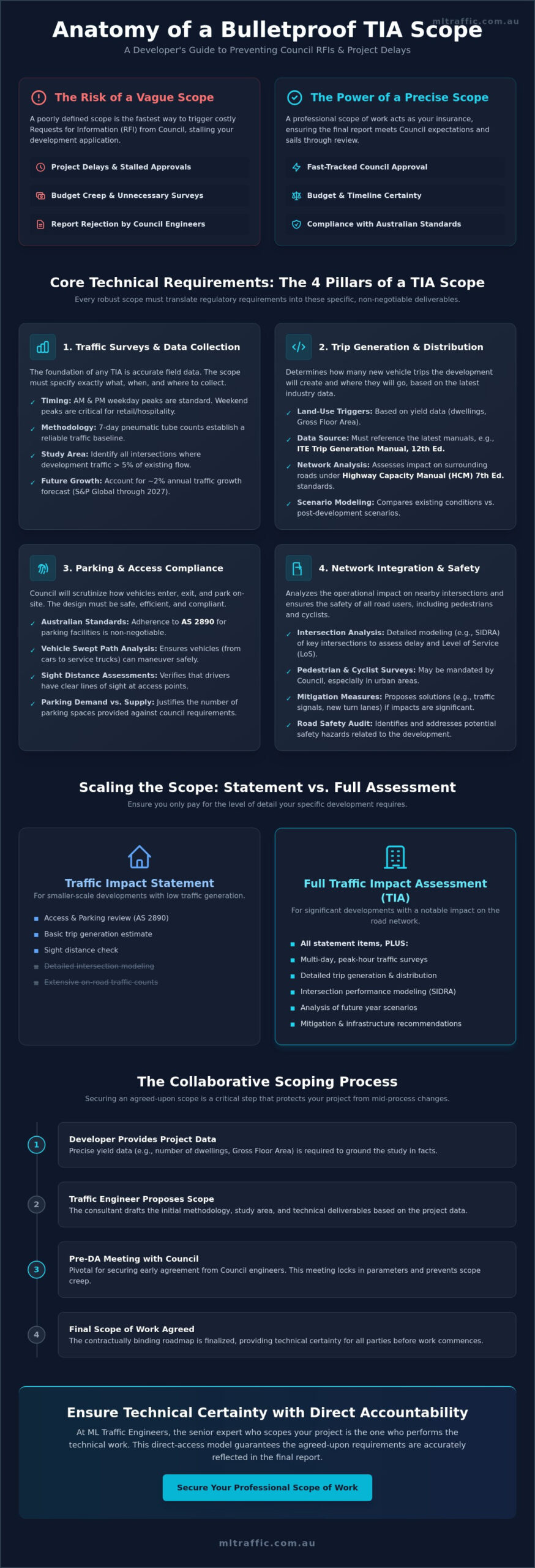
A professional scope of work for traffic impact assessment must translate regulatory requirements into specific technical deliverables. It’s not enough to list "traffic study" as a broad category. You need granular line items that define exactly what data is collected and how it’s analyzed. This level of detail ensures the consultant’s fee proposal is accurate and protects you from surprise costs mid-project. Every robust scope must address four pillars: data collection, trip generation, parking compliance, and network integration.
Traffic Surveys and Data Collection
The foundation of any assessment is accurate field data. The scope should specify the timing of traffic counts, typically focusing on AM and PM weekday peaks, though weekend peaks are required for retail or hospitality uses. Engineers often use 7-day pneumatic tube counts to establish a reliable baseline. The study area radius is determined by identifying all intersections where development-generated traffic exceeds 5% of the existing base flow. This calculation ensures the model accounts for the 2% annual vehicular traffic growth forecast by S&P Global through 2027.
Parking and Access Compliance (AS 2890)
Council will scrutinize how vehicles enter and exit your site. Your scope must explicitly include an assessment against AS 2890.1 for residential and commercial car park design. This technical review covers driveway ramp grade assessments and sight distance checks to ensure safety and functionality. Additionally, the scope must include compliance with AS 2890.6 for accessible parking standards. If these specific standards aren’t mentioned in the initial scope of work for traffic impact assessment, you risk a design that Council will ultimately deem non-compliant.
Vehicle Swept Path Analysis
This is often the most critical technical item in a modern development application. Using AutoTURN software, engineers simulate vehicle maneuvers to prove that the largest expected vehicles can navigate the site without hitting curbs or structures. Garbage trucks and heavy delivery vehicles usually dictate the swept path scope because they have the widest turn radii. Ensuring this is detailed in your contract prevents the common issue of finding out too late that a loading dock is unusable. For a deeper look at these requirements, see our Swept Path Analysis guide.
Getting these technical non-negotiables right at the start prevents budget creep and ensures your report meets the high standards of Council engineers. If you are unsure which technical tasks your specific site requires, you can speak directly with our senior engineers to verify your project needs.
Scaling the Scope: Traffic Statements vs. Full Impact Assessments
The scale of your development dictates the technical depth of the required documentation. Applying a high-intensity modeling scope to a low-impact site is an unnecessary expense. Conversely, submitting a qualitative statement for a major subdivision will result in an immediate RFI. Developers must distinguish between a Traffic Impact Statement (TIS) and a full Traffic Impact Assessment (TIA) to align their application with Council expectations. Correctly identifying the required level of detail in the scope of work for traffic impact assessment ensures that the project budget is allocated to the specific data points Council actually requires for a decision.
The Traffic Impact Statement (TIS) Scope
A TIS is typically suitable for developments that generate low vehicle volumes or involve minor changes of use. The scope for a TIS is primarily qualitative. It focuses on proving that the existing road network can absorb the minor shift in traffic without a decrease in safety or performance. Typical line items in a TIS scope include a local parking demand survey, a review of site access points, and basic trip generation calculations. This is often the preferred route for small-scale childcare centers, medical consulting rooms, or cafes where the impact is localized and does not require complex intersection modeling.
The Full Traffic Impact Assessment (TIA) Scope
A full TIA scope is mandatory when a project reaches "Major Development" status or impacts high-capacity intersections. This requires quantitative modeling to assess the network’s performance. Engineers use SIDRA software to calculate the Degree of Saturation (DoS) and Level of Service (LoS) at affected junctions. In some cases, the scope may extend to pavement impact assessments if the development involves significant heavy vehicle movements that could accelerate road wear. A full TIA provides the granular data Council needs to determine if the developer must contribute to infrastructure upgrades or intersection signalization.
ML Traffic Engineers Australia provides senior-level expertise to help you determine which assessment level is appropriate for your site. We ensure that the scope of work for traffic impact assessment is tailored to your project’s specific land use and location. Our approach remains consistent across all scales: the senior engineer who provides your initial quote is the technical expert who performs the analysis. You can review our full range of traffic engineering services to see which report type fits your current development application.
Choosing the correct assessment scale prevents the risk of under-reporting, which stalls approvals, or over-reporting, which wastes project capital. By securing a precise scope early, you establish a clear technical path for your development’s transport requirements.
The Scoping Process: Navigating Council Requirements and Pre-DA Advice
The Pre-DA (Development Application) meeting is the most critical phase for "locking in" the technical parameters of your project. Without this step, you risk Council engineers expanding the study area or adding complex modeling requirements after your budget is fixed. A formal Pre-DA meeting allows your traffic engineer to present a draft scope of work for traffic impact assessment and gain written concurrence from the assessing officers. This process ensures that the technical requirements for the Statement of Environmental Effects (SEE) are clearly defined, providing a predictable path toward approval.
Negotiating the study area size is a primary goal of the scoping process. While authorities may initially request analysis of every intersection within a two-kilometer radius, an experienced engineer can often limit this to only those junctions where development traffic represents more than 5% of the base flow. This data-driven approach prevents the "scope creep" that occurs when Council requests additional modeling mid-project. If you haven’t secured agreement on these boundaries early, you may find yourself funding unnecessary traffic surveys that don’t impact the final decision.
Managing Council Expectations
Conflicts often arise when local Council and State Road authorities, such as Transport for NSW or TMR in Queensland, have different requirements. The most effective way to manage this is through a "Scoping Letter" issued before the final report is drafted. This letter documents the agreed-upon trip rates, using data from the ITE Trip Generation Manual 12th Edition (August 2025), and confirms the analysis scenarios. Locking in these methodologies early prevents future disputes over the report’s findings. It’s a professional standard that we maintain across over 10,000 sites we have assessed since 2005.
Avoiding Common Scoping Omissions
Many developers overlook active transport and construction logistics in their initial scope. Modern Council requirements now demand a focus on pedestrian and cyclist connectivity, reflecting the multimodal trends seen in the latest Highway Capacity Manual (HCM) 7th Edition. Additionally, failing to include a preliminary Traffic Management Plan (TMP) or Traffic Guidance Scheme (TGS) for the construction phase can lead to delays. Omitting a swept path for the largest anticipated vehicle is the #1 cause of RFIs. If your scope doesn’t account for the turning radius of a 12.5-meter heavy rigid vehicle or a specific council waste truck, the application will likely be stalled.
Securing a comprehensive and agreed-upon scope is the only way to protect your project from bureaucratic delays and budget blowouts. To ensure your project has a robust technical foundation, you can request a formal scoping review from our senior engineers today.
Securing a Professional Scope of Work with ML Traffic Engineers
ML Traffic Engineers has been trading since 2005. Over the past two decades, we have provided technical assessments for over 10,000 sites across Australia. Our expertise covers an exhaustive range of land-use types, including apartments, bars, temples, warehouses, and medical centers. When you engage us, you receive a scope of work for traffic impact assessment that is grounded in technical reality and decades of experience. We do not use junior staff to quote or manage your project. Our core promise is simple: the traffic consultant who provides the quote, does the work. This hands-on philosophy ensures total accountability from the initial scoping phase to the final Council approval.
Meticulous scoping is our standard practice. We account for the latest industry updates, such as the ITE Trip Generation Manual 12th Edition and the Highway Capacity Manual 7th Edition. By locking in these technical parameters early, we prevent the budget blowouts and Council delays that frequently plague poorly defined projects. You get direct access to our principals, Michael Lee and Benny Chen. Their names, qualifications, and direct mobile numbers are available to every client. This "no-gatekeepers" approach ensures that technical questions are answered immediately by the senior experts responsible for your project’s success.
Our Traffic Engineering Services
We provide a comprehensive suite of ML Traffic Services designed to meet the specific requirements of any Australian Council. Our capabilities include:
-
Traffic Impact Assessment (TIA) Reports
-
Vehicle Swept Path Analysis using AutoTURN
-
Car Parking Demand Assessments
-
Traffic Guidance Schemes (TGS)
-
Driveway Ramp Grade Assessments
-
Intersection Analysis using SIDRA
-
Sight Distance Assessments
-
Car Park Design and Compliance
Our national coverage means we understand the nuances of local government requirements across various jurisdictions. Whether your project is a minor change of use or a major greenfield subdivision, our reports are structured to withstand the most rigorous technical scrutiny from transport authorities.
Get a Precise Quote for Your Project
To receive an accurate scoping proposal, provide your site plans and a description of the proposed land use. Senior involvement starts on day one. We review your plans to identify potential issues, such as sight-line obstructions or non-compliant ramp grades, before we finalize the scope of work for traffic impact assessment. This proactive approach saves you time and prevents the need for redesigns after the DA is lodged. You can Contact Michael Lee or Benny Chen directly for a no-nonsense traffic engineering quote that provides the technical certainty your project requires.
Securing Your Project Timeline with Technical Certainty
A precisely defined scope of work for traffic impact assessment is the only way to protect your development from bureaucratic delays. By identifying the correct technical triggers and data requirements during the Pre-DA phase, you eliminate the ambiguity that leads to Council RFIs. Whether your project requires a qualitative Traffic Impact Statement or complex SIDRA intersection modeling, the technical foundation must be robust to withstand scrutiny. You’ve learned that scaling the scope correctly saves on unnecessary survey costs while ensuring compliance with the latest transport standards.
At ML Traffic Engineers, we have assessed over 10,000 sites across Australia since 2005. You gain direct access to senior principals Michael Lee and Benny Chen, ensuring that the expert who quotes your project is the one performing the technical work. This level of senior involvement provides the reliability needed to navigate modern transport requirements and avoid budget creep. Don’t leave your approval to chance with poorly defined proposals from impersonal firms.
Get a professional Traffic Impact Assessment scope for your development to ensure your application is compliant and cost-effective. We look forward to helping your project succeed.
Frequently Asked Questions
How much does a Traffic Impact Assessment scope usually cover?
A standard scope covers the geographic study area, data collection methods, and land-use trip generation based on the ITE Trip Generation Manual 12th Edition. It typically includes all intersections where the development increases traffic by more than 5%. This ensures the report provides a reliable baseline for "existing" versus "post-development" scenarios as required by transport authorities.
Is a swept path analysis always required in a TIA scope of work?
Swept path analysis is mandatory for almost any development where service vehicles, such as garbage trucks or delivery vans, must enter the site. It uses AutoTURN software to prove that the largest anticipated vehicle can navigate the layout without structural conflict. Most Councils require this to verify compliance with AS 2890.2 for heavy vehicle movements.
Can I change the scope of work after the traffic surveys are completed?
You can modify the scope, but it often requires entirely new data collection. If Council expands the study area after your 7-day pneumatic tube counts are finished, you’ll need to fund additional surveys to cover the new intersections. This is why locking in the scope of work for traffic impact assessment during a Pre-DA meeting is the most efficient strategy.
What is SIDRA modeling, and do I need it in my scope?
SIDRA is a software tool used to analyze intersection capacity, delay, and Level of Service (LoS). You need it in your scope if your development generates more than 100 peak-hour trips or if the site is located near a high-congestion zone. It provides the Degree of Saturation data that Council engineers use to assess whether the local network can handle your project.
How long does it take to complete the tasks in a typical TIA scope?
Completing the technical tasks in a TIA scope typically takes 15 to 20 business days. This timeframe includes 7 days for on-site traffic counts and approximately 10 days for modeling and report drafting. Complex projects requiring microscopic simulation modeling, like VISSIM, may take longer depending on the network size and Council requirements.
Does the scope of work differ for residential vs. commercial developments?
The scope of work for traffic impact assessment varies significantly between these land uses. Residential scopes focus on AS 2890.1 parking compliance and morning and evening peak flows. Commercial scopes prioritize delivery vehicle swept paths, high-turnover parking demand, and weekend peak traffic analysis to reflect modern retail travel patterns.
What happens if Council rejects the scope of the traffic report?
If Council rejects your report’s scope, they will issue a formal Request for Information (RFI). This stalls your application and often requires expensive revised modeling or additional data collection. Our senior engineers vet every scope early in the process to prevent these technical rejections and keep your project on schedule.
Do I need a separate scope for a Traffic Management Plan (TMP)?
A Traffic Management Plan or Traffic Guidance Scheme (TGS) usually requires its own technical scope. While a TIA assesses the permanent operational impact of the completed building, a TMP addresses the temporary safety risks and vehicle movements during the construction phase. Both documents are often required to satisfy the conditions of a development approval.
Which areas do you cover?
We are traffic engineers servicing Melbourne, Sydney, Brisbane, Gold Coast, Hobart, Perth, Adelaide, Darwin, Canberra and surrounding areas.

Disclaimer
The content on www.mltraffic.com.au, including all technical articles, guides, and resources, is provided for general informational and educational purposes only. It is not intended to constitute professional advice in traffic engineering, transportation planning, development approvals, or any other technical or legal field.
While ML Traffic Engineers makes every reasonable effort to ensure the accuracy, completeness, and timeliness of the information published, we do not provide any warranties or representations (express or implied) regarding its reliability, suitability, or availability for any particular purpose. Any reliance you place on the content is strictly at your own risk.
In no event shall ML Traffic Engineers, its directors, employees, authors, or affiliates be liable for any direct, indirect, incidental, special, consequential, or punitive damages (including, without limitation, loss of profits, data, or business opportunities) arising out of or in connection with the use of, or inability to use, any information provided on this website.
The articles and guides on this site are not a substitute for engaging a qualified, registered professional traffic engineer (such as an NPER or RPEQ engineer) to assess your specific project requirements. For tailored advice, compliance assessments, or traffic engineering services, please contact a competent professional.
This disclaimer may be updated from time to time without notice. By accessing or using this website, you agree to be bound by the most current version of this disclaimer.
