

What if the only thing standing between your development application and a Council refusal is a set of data you don’t yet understand? For many developers, the traffic engineering phase feels like a hurdle of technical jargon and bureaucratic red tape. A professional SIDRA intersection analysis report is more than just a compliance checkbox; it’s a strategic negotiation tool that translates complex traffic flows into a “pass grade” that local councils and state road authorities trust.
You’re likely familiar with the anxiety of a potential DA rejection due to perceived traffic impacts or the confusion surrounding terms like Level of Service (LoS) and Degree of Saturation. We understand that you need clear, defensible data to satisfy Council requirements without being hit by excessive infrastructure conditions. It’s vital to have a report that stands up to scrutiny during the planning process.
This guide will teach you how to leverage SIDRA modelling to prove your project’s viability and secure a smoother approval process. We’ll examine the critical metrics within a SIDRA intersection analysis report, explore the latest requirements from the November 2024 Guide to Transport Impact Assessment, and show you how expert modelling ensures your development meets Australian standards from the outset.
Key Takeaways
- Understand how a SIDRA intersection analysis report acts as a technical bridge between your proposed development and Council’s traffic compliance requirements.
- Master the key performance metrics, including Level of Service (LoS) and Degree of Saturation (DoS), that determine an intersection’s capacity and “pass grade”.
- Learn to identify the “Movement Summary” within technical output tables to pinpoint the specific intersection legs most likely to trigger Council concerns.
- Discover the importance of modelling future traffic growth scenarios to prove your project’s long-term viability within the local road network.
- Minimise the risk of DA delays and costly infrastructure conditions by ensuring your traffic modelling is performed by senior engineers with expert-level software proficiency.
What is a SIDRA Intersection Analysis Report?
A SIDRA intersection analysis report is a technical document that uses micro-analytical software to model the performance of individual intersections or complex road networks. In Australia, this assessment is the industry standard for transport professionals and local councils. It provides a data-driven projection of how a proposed development will affect the surrounding road infrastructure. While many developers understand the broad concept of What is SIDRA Intersection, the report itself serves as the formal evidence required for planning approval.
It’s vital to distinguish between a general Traffic Impact Assessment (TIA) and a targeted SIDRA analysis. A TIA provides a broad overview of site access, parking, and total trip generation. Conversely, a SIDRA intersection analysis report focuses specifically on the micro-performance of key nodes. Our experts use the latest SIDRA INTERSECTION 11 software, released in March 2026, to calculate precise metrics like delay times and queue lengths. This granular detail ensures the development does not cause the local road network to fail under peak loads.
To better understand how this software models complex traffic movements, watch this helpful video:
The Role of SIDRA in the Australian Planning Process
Australian planning authorities rely on these reports to assess the Level of Service (LoS) of an intersection. This process ensures alignment with the Austroads Guide to Traffic Management and relevant state-specific supplements. For projects in New South Wales, we adhere to the Guide to Transport Impact Assessment (Version 1.1), which commenced on 4 November 2024. A standard traffic count only provides a snapshot of current volume. A professional Intersection Analysis uses that data to simulate complex interactions, ensuring your project meets regulatory requirements for safety and efficiency.
Types of Intersections Modelled
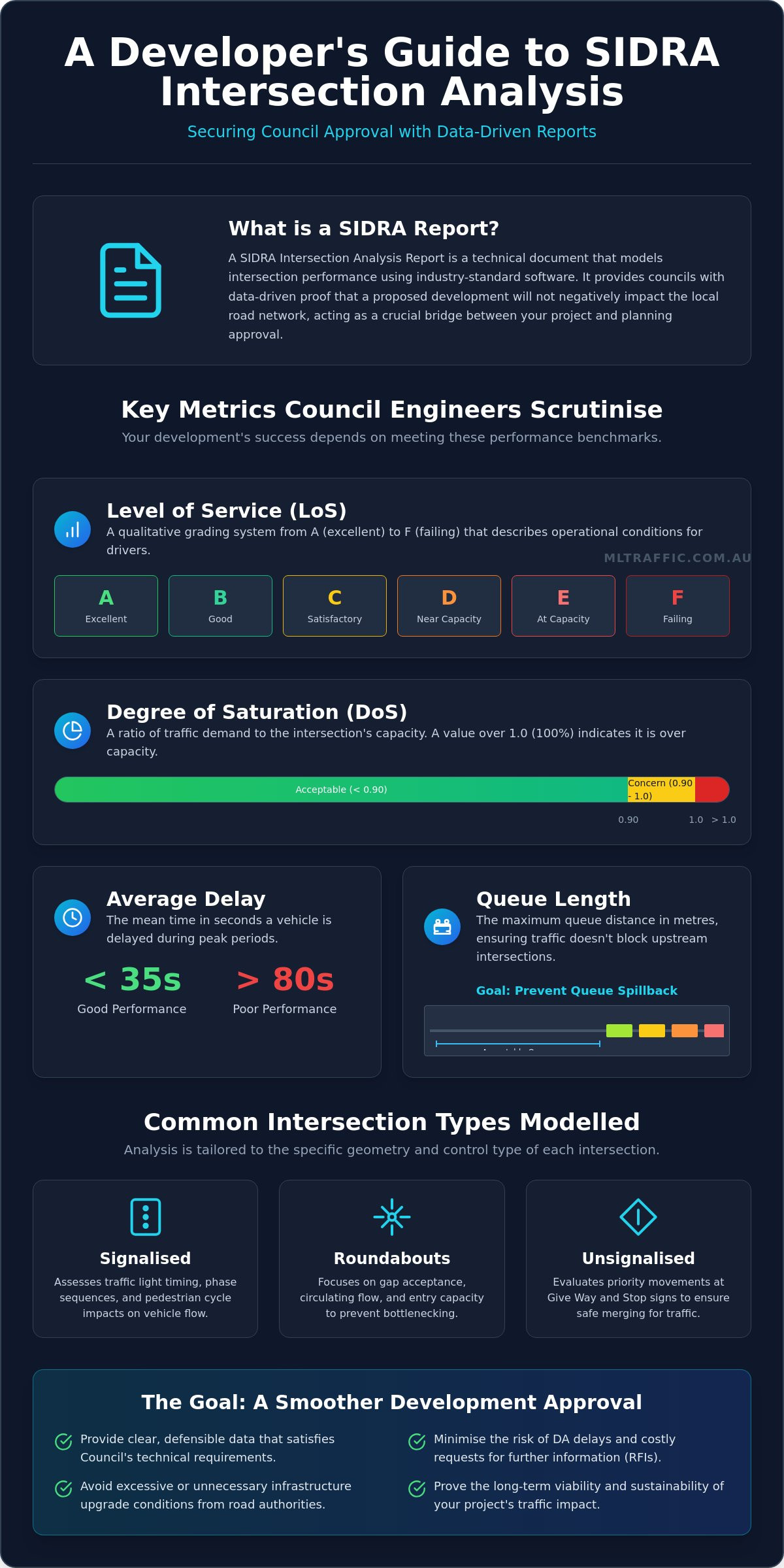
Our senior engineers employ SIDRA to model a diverse range of intersection types to satisfy Council conditions. Each requires specific data inputs to produce an accurate SIDRA intersection analysis report:
- Signalised intersections: We assess traffic light timing, phase sequences, and the impact of pedestrian crossing cycles on vehicle flow.
- Roundabouts: The analysis focuses on gap acceptance, circulating flow, and entry capacity to prevent bottlenecking.
- Unsignalised intersections: We evaluate priority movements at Give Way and Stop signs to ensure minor road traffic can safely merge without excessive queuing.
By involving senior principals in every project, we ensure the modelling reflects real-world conditions. This meticulous approach prevents the “garbage in, garbage out” scenario that often leads to Council requests for further information (RFI) or project delays.
Key Metrics in a SIDRA Report: What Council Actually Looks For
Every SIDRA intersection analysis report contains a Movement Summary table. This data is the primary focus for Council traffic engineers. They use these results to determine if a development is sustainable within the existing road network. To secure approval, your report must demonstrate that the proposed traffic volume won’t degrade the local infrastructure beyond acceptable limits. Council officers focus on four primary indicators to assess the viability of your development application.
- Level of Service (LoS): A qualitative grading system from A (excellent) to F (failing) that describes operational conditions.
- Degree of Saturation (DoS): A ratio of traffic demand to the theoretical capacity of the intersection.
- Average Delay: The mean time in seconds that a vehicle is delayed at the intersection during peak periods.
- 95th Percentile Queue Length: The maximum queue distance in metres that is likely to occur, ensuring traffic doesn’t block upstream intersections.
Understanding Level of Service (LoS) Grades
Councils use LoS to gauge driver frustration and safety. LoS A and B represent free-flowing conditions with minimal delays. LoS C and D are generally considered the acceptable standard for urban planning in Australian metropolitan areas. They represent stable flow where the intersection is busy but functional. However, if your SIDRA intersection analysis report shows LoS E or F, you’ve entered the “fail” zone. These grades indicate that the intersection is at or over capacity. In these instances, Council will likely demand mitigation measures, such as road widening or signal phasing changes, before granting approval.
Degree of Saturation (DoS) Explained
The Degree of Saturation is a critical mathematical threshold. Most Australian authorities view a DoS above 0.90 as a major red flag. At this level, the intersection is operating at 90% of its total capacity. Any minor fluctuation in traffic volume can lead to unpredictable traffic breakdown and exponential increases in delay. While some official traffic analysis procedures provide different benchmarks for roundabouts versus signals, the 0.90 limit remains the standard Australian benchmark for reliability. At ML Traffic Engineers, we meticulously organise data to ensure the DoS reflects realistic peak hour conditions. Accurate modelling prevents Council from assuming a worst-case scenario that doesn’t reflect reality.
Beyond saturation, the 95th percentile queue length is vital for site design. If a queue backs up into a nearby intersection or blocks a driveway, Council will reject the DA on safety grounds. We analyse these queues to ensure your site access remains functional even during the busiest periods. If you’re concerned about your project’s traffic impact, it’s wise to consult with an experienced traffic engineer to review your metrics before submission.
Modelling Scenarios: Existing vs. Post-Development
Council requires more than a snapshot of current traffic conditions. A robust SIDRA intersection analysis report must account for how the road network evolves over time. We construct several distinct modelling scenarios to provide a complete picture of impact and viability. This structured approach allows us to isolate the specific impact of your development from general regional growth trends.
- The Base Case: This establishes the current performance of the intersection using recent traffic counts and existing geometry.
- The Projected Case: We add background traffic growth to show how the intersection would perform in the future without the development.
- The Development Case: We layer your project’s generated trips onto the projected background traffic to identify the net impact.
- Sensitivity Analysis: We test variations in peak hour flows to ensure the results remain stable even if traffic patterns shift slightly.
Background Growth and Future-Proofing
Determining annual growth rates is a critical step that requires meticulous data selection. We use regional planning data and historical trends to project traffic volumes, typically for the “Opening Year” and a “10-Year Horizon”. This future-proofing ensures your development does not consume all remaining capacity in the local network. If a SIDRA intersection analysis report ignores background growth, Council will likely reject it for failing to meet long-term planning standards. Our senior engineers ensure these growth rates align with specific state road authority requirements to prevent unnecessary requests for further information.
Mitigation and Infrastructure Design
When the development case results show a drop in performance, we use the software as a design tool rather than just a reporting one. We test various physical and operational changes to restore the Level of Service to an acceptable grade. This might involve testing lane additions, signal phase changes, or new turning pockets within the model. A skilled traffic engineer uses SIDRA to justify smaller, cheaper upgrades by proving their effectiveness through data. By demonstrating that a minor geometry change or a phase adjustment satisfies capacity requirements, we help you avoid the cost of major infrastructure contributions. This results-oriented approach ensures your planning approval comes with minimal, manageable traffic-related conditions.
How to Read a SIDRA Output Table
A SIDRA intersection analysis report often spans dozens of pages of technical data. For a developer, the most significant page is the ‘Movement Summary’ table. This table provides a line-by-line breakdown of every vehicle movement at the intersection, including left turns, through movements, and right turns. It’s the primary document Council engineers use to scrutinise your application. If you can’t find the ‘Movement Summary’, you’re looking at the wrong part of the report.
When reviewing this table, don’t just focus on the average intersection delay. Council identifies the ‘Worst Case’ leg of the intersection. If a single right-turn pocket shows a Level of Service F, the entire intersection performance is often judged by that failing movement. This is why peak hour data is vital. We model both AM and PM peaks because traffic patterns shift significantly between morning commutes and afternoon school or work runs. A project might pass in the morning but fail in the afternoon.
Spotting errors early is essential. Unrealistic input data leads to immediate DA rejection. If the underlying data is flawed, the entire output is worthless. Common mistakes include using generic growth rates that don’t reflect local planning schemes or failing to account for heavy vehicle percentages. Garbage in always leads to garbage out.
Red Flags in a SIDRA Report
There are several indicators that a model doesn’t reflect real-world conditions. Council officers are trained to spot these discrepancies immediately:
- Unusually short queues: If the model shows five-metre queues while you’ve seen traffic back up for two blocks, the model is wrong.
- Ignoring pedestrian phases: In signalised models, pedestrian crossings reduce the ‘green time’ for vehicles. Omitting them produces overly optimistic results.
- Default software values: Using software defaults instead of site-specific traffic counts is a guaranteed way to trigger a request for further information (RFI).
The Executive Summary for Developers
Before you submit your application, check the conclusion of the report. It must explicitly state whether the traffic impact is ‘satisfactory’ or ‘negligible’ based on the modelled data. You should also be prepared for questions from Council’s traffic committee regarding these specific metrics. A report that lacks a clear, defensible conclusion will be picked apart during the assessment phase. If you need a SIDRA intersection analysis report that stands up to this level of scrutiny, contact our senior team today.
Why Expert SIDRA Analysis is Crucial for Your DA
The technical integrity of a SIDRA intersection analysis report depends entirely on the accuracy of the underlying data. In the traffic engineering industry, the phrase “garbage in, garbage out” is a literal warning. If a consultant uses incorrect lane widths, unrealistic saturation flows, or outdated signal timings, the resulting report will be flawed. This often leads to immediate rejection by Council or state road authorities. At ML Traffic Engineers, we eliminate this risk by ensuring senior principals are directly involved in every modelling project. This level of accountability distinguishes our consultancy from larger firms where junior staff often perform the technical work without senior oversight.
Our national expertise allows us to interpret diverse Council requirements across Australia, from metropolitan Sydney to regional Queensland. We don’t just provide isolated data; we deliver a total site solution. This involves integrating our intersection modelling with Swept Path Analysis to ensure that the physical site geometry matches the operational performance predicted in the SIDRA model. A SIDRA intersection analysis report must be consistent with the actual vehicle movements expected on-site to be considered valid by planning authorities.
Avoiding Costly DA Delays
A single poor modelling assumption can trigger a Request for Further Information (RFI), adding weeks or months to your project timeline. Council officers are meticulous when reviewing intersection performance. They will quickly identify if a model fails to account for heavy vehicle movements or pedestrian delays. Our “no-gatekeepers” approach means you speak directly to the senior engineer performing the analysis. This ensures that any technical queries from Council are addressed immediately with authoritative data. We also verify that every design complies with AS 2890.1 and other relevant Australian Standards, providing a robust defence for your development application.
Contact ML Traffic Engineers for Your SIDRA Report
We provide streamlined reporting for residential, commercial, and industrial developments of all scales. With over 15 years of experience, we have a proven track record of securing approvals with councils nationwide. Our reports are designed to be clear, compliant, and defensible. We focus on achieving a successful planning approval with minimal traffic-related conditions. Request a fee proposal for your intersection analysis today to ensure your project benefits from senior-level expertise and a results-oriented approach.
Secure Your Development Approval with Professional Modelling
A professional SIDRA intersection analysis report is the primary evidence Council requires to verify the traffic viability of your development. Accuracy in metrics like Level of Service and Degree of Saturation is non-negotiable for a successful outcome. Meticulous modelling of both current conditions and 10-year growth scenarios prevents costly Requests for Further Information and unnecessary infrastructure conditions. By understanding these technical requirements, you position your project for a smoother planning process.
ML Traffic Engineers brings over 15 years of traffic engineering experience to your application. We provide national coverage for all Australian councils, ensuring your report meets specific local standards. Our senior principals perform all technical work personally, providing the accountability and expertise needed to navigate complex bureaucratic requirements. We focus on delivering results-oriented assessments that secure your DA with minimal delays.
Contact ML Traffic Engineers for a compliant SIDRA Intersection Analysis Report. We are ready to assist you in achieving a successful planning approval with expert traffic modelling.
Frequently Asked Questions
How much does a SIDRA intersection analysis report cost?
The cost of a report varies depending on the number of intersections being modelled and the complexity of the signal phases or roundabout geometry. A single priority-controlled intersection requires less time than a coordinated network of traffic lights. We recommend requesting a project-specific fee proposal to ensure all Council requirements are covered without unnecessary expenses. Professional modelling is a strategic investment that prevents much higher costs associated with DA delays.
How long does it take to complete a SIDRA modelling report?
Completion typically takes between five to ten business days once all necessary traffic data and site plans are received. This period allows for meticulous data entry, model calibration, and a thorough review by our senior principals. For more complex networks or projects requiring new traffic counts, the timeline may extend. We prioritise accuracy to ensure the final document stands up to Council scrutiny without requiring further information.
Why did Council specifically ask for a SIDRA report instead of just a traffic statement?
Council requests a SIDRA intersection analysis report when a development reaches specific trip generation thresholds or impacts a known congestion point. A basic traffic statement only provides a broad overview of vehicle numbers. Conversely, SIDRA provides micro-analytical data on queue lengths and delays at specific movements. This level of detail is essential for Council to verify that the local infrastructure won’t fail under the new traffic load.
Can I use SIDRA for a small driveway or only for major intersections?
SIDRA is primarily designed for intersections, but it’s also effective for modelling complex site access points or high-volume driveways on arterial roads. If your driveway functions as a priority-controlled node, Council may require modelling to ensure safe gap acceptance for exiting vehicles. While not necessary for standard residential driveways, it’s a vital tool for commercial or industrial entries that interact with busy traffic streams.
What data do I need to provide to the traffic engineer for the analysis?
You need to provide a detailed site plan, proposed land-use yields, and any existing traffic survey data if available. If recent traffic counts aren’t accessible, we will arrange for new surveys to be conducted at the relevant intersections. Our engineers also require background growth rates and information on other nearby developments to ensure the “Projected Case” scenario in the SIDRA intersection analysis report is accurate and defensible.
What happens if the SIDRA results show my development will cause traffic congestion?
If the model predicts poor performance, our engineers use the software to design and test mitigation measures. This might include adjusting signal timings, adding turning pockets, or suggesting minor geometry changes to the intersection. We work to find the most cost-effective solution that restores the Level of Service to an acceptable grade. This ensures your report provides Council with a clear path to approval rather than just identifying a problem.
Is SIDRA analysis required for all Development Applications in Australia?
No, it’s only mandatory for developments that meet thresholds defined in policies like Schedule 3 of the State Environmental Planning Policy (Transport and Infrastructure) 2021. Smaller projects with negligible impact usually only require a basic Transport Impact Statement. However, if your site is near a sensitive or congested intersection, Council has the discretion to request a full analysis to ensure the safety and efficiency of the road network.
How often do councils require a 10-year future traffic horizon model?
Councils and state road authorities almost always require a 10-year future traffic horizon for significant developments. This future-proofing ensures the road network remains functional as regional traffic increases over time. The November 2024 Guide to Transport Impact Assessment emphasises this long-term view. We use regional planning data to ensure your development is assessed against realistic future conditions, preventing your project from being blamed for broader network growth.

Disclaimer
The content on www.mltraffic.com.au, including all technical articles, guides, and resources, is provided for general informational and educational purposes only. It is not intended to constitute professional advice in traffic engineering, transportation planning, development approvals, or any other technical or legal field. While ML Traffic Engineers makes every reasonable effort to ensure the accuracy, completeness, and timeliness of the information published, we do not provide any warranties or representations (express or implied) regarding its reliability, suitability, or availability for any particular purpose. Any reliance you place on the content is strictly at your own risk. In no event shall ML Traffic Engineers, its directors, employees, authors, or affiliates be liable for any direct, indirect, incidental, special, consequential, or punitive damages (including, without limitation, loss of profits, data, or business opportunities) arising out of or in connection with the use of, or inability to use, any information provided on this website. The articles and guides on this site are not a substitute for engaging a qualified, registered professional traffic engineer (such as an NPER or RPEQ engineer) to assess your specific project requirements. For tailored advice, compliance assessments, or traffic engineering services, please contact a competent professional. This disclaimer may be updated from time to time without notice. By accessing or using this website, you agree to be bound by the most current version of this disclaimer.
