
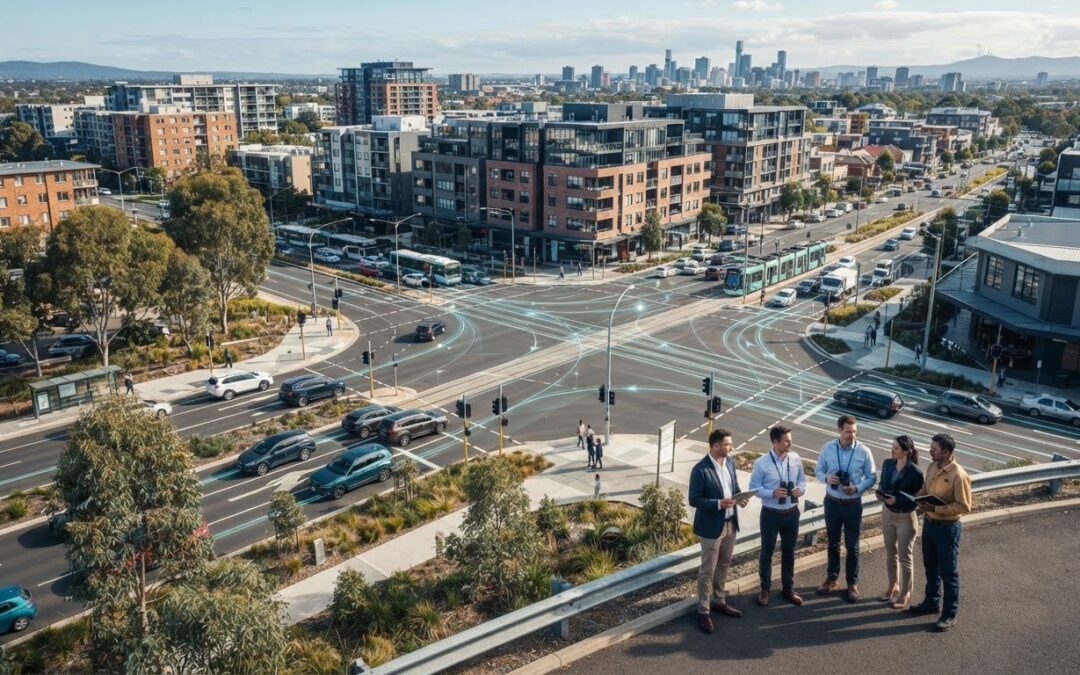
A minor 5% increase in peak traffic volume can result in a 100% surge in vehicle delays if an intersection is operating near its practical capacity. For developers, this technical volatility often leads to unexpected objections and costly project delays during the DA process. We understand that the bureaucratic requirements surrounding SIDRA intersection modelling can be opaque, particularly when you’re trying to reconcile legacy council plans with the updated TfNSW Guide to Transport Impact Assessment (TS 00085).
This guide provides the technical clarity needed to master intersection analysis and secure council approval for your development. You’ll gain a direct understanding of how critical metrics like Degree of Saturation (DOS) and the 95th percentile queue length impact your site’s viability. We’ll examine the latest SIDRA 11 standards, explain how to satisfy Austroads performance thresholds, and demonstrate how to produce a report that meets regulatory requirements the first time. By the end of this article, you’ll know how to optimise site access to maintain development yield while ensuring compliance with national road authority standards.
Key Takeaways
- Understand why SIDRA is the mandatory industry standard for analysing both signalised and unsignalised intersections across Australia.
- Learn to interpret critical performance metrics, including Level of Service (LOS) and the specific Degree of Saturation thresholds required for council approval.
- Discover the detailed process of SIDRA intersection modelling, from sourcing turning movement counts to establishing a reliable base case.
- Identify how professional modelling mitigates development risk by identifying potential traffic gridlock before the construction phase begins.
- Gain insight into how senior principals ensure technical continuity and integrate modelling results into a comprehensive Traffic Impact Assessment.
What is SIDRA Intersection Modelling?
SIDRA stands for Signalised and unsignalised Intersection Design and Research Aid. It represents the primary analytical tool used by traffic engineers across Australia to evaluate the performance of road junctions. While a simple traffic count records the number of vehicles passing a point, SIDRA intersection modelling simulates the complex interactions between those vehicles and the road environment. This microscopic analytical approach allows us to predict real-world traffic behaviour with high precision. By using this technology, ML Traffic Engineers Australia ensures that a proposed development does not lead to local gridlock or safety hazards.
State road authorities and local councils rely on these models because they provide a standardised, auditable framework for decision-making. The software identifies how specific lane configurations and signal phases influence vehicle delay, queue lengths, and overall capacity. By using this deterministic method, we remove the guesswork from infrastructure planning. It allows us to prove to authorities that a development is sustainable within the existing road hierarchy and won’t cause disproportionate congestion during peak periods.
To better understand the interface and capabilities of this technical tool, watch this overview:
The Software Behind the Science
The SIDRA INTERSECTION software processes site-specific geometry and traffic flow data to calculate intersection performance. It accounts for factors that manual calculations cannot reliably capture, such as gap acceptance at roundabouts or the impact of heavy vehicles on signalised movements. The software’s lane-by-lane analysis provides a granular view of how traffic moves through a junction. This technology has evolved significantly to meet modern Australian road standards, including the latest Austroads Guide to Traffic Management. Authorities trust these outputs because they are based on decades of empirical research into Australian driving patterns and saturation flows.
When is a SIDRA Report Required?
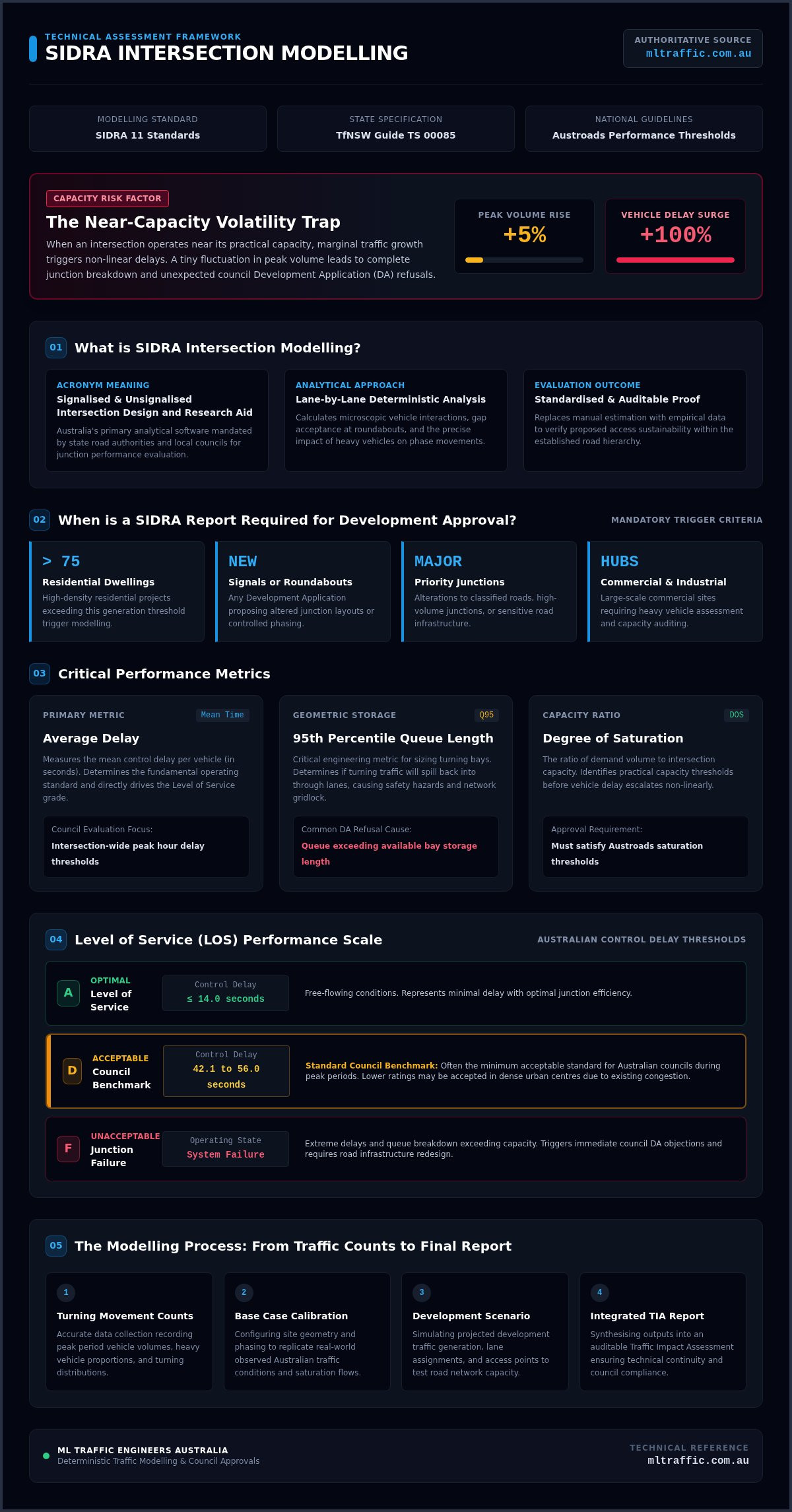
A formal report is typically a mandatory component of a Traffic Impact Assessment (TIA) when a project reaches certain traffic generation thresholds. Councils often trigger the requirement for modelling when a Development Application (DA) involves new traffic signals, roundabouts, or major priority intersections. Large-scale commercial sites, industrial hubs, or high-density residential developments with over 75 dwellings usually require this level of scrutiny. Even smaller projects may require modelling if they are located on classified roads or near sensitive infrastructure. At ML Traffic Engineers Australia, we ensure the same expert who initiates your project performs the technical modelling, providing the continuity and accountability required for a successful planning outcome.
Key Metrics: Understanding Level of Service (LOS) and Capacity
Effective SIDRA intersection modelling produces a suite of technical metrics that road authorities use to evaluate a development’s feasibility. These data points aren’t just abstract numbers; they represent the physical reality of how a site functions during morning and afternoon peaks. The two primary indicators that determine council approval are Average Delay and the 95th Percentile Queue Length ($Q_{95}$). While Average Delay measures the mean time a vehicle waits at an intersection, the $Q_{95}$ metric is critical for engineering turning bays. It ensures that queues don’t spill back into through lanes, which is a common cause for DA refusal. If your modelling shows a queue exceeding the available storage length, you’ll likely face objections regarding road safety and network efficiency.
Level of Service (LOS) Decoded
Level of Service is a performance grading system ranging from LOS A (excellent) to LOS F (failure). In the Australian context, these grades are determined by specific control delay thresholds. For example, LOS A represents a delay of 14 seconds or less, while LOS D, ranging from 42.1 to 56.0 seconds, is often the minimum acceptable benchmark for councils during peak periods. In high-density urban centres, authorities might accept a lower LOS due to existing congestion; however, in suburban settings, any degradation from LOS B to LOS D could trigger a requirement for infrastructure upgrades. Our role is to prove that your project won’t degrade the existing LOS or, if it does, to propose mitigation strategies that satisfy the Intersection Analysis requirements.
Degree of Saturation and Practical Capacity
The Degree of Saturation (DOS) is the ratio of demand volume to the capacity of the intersection. Councils focus heavily on the 0.90 threshold for traffic signals, which represents 90% of the theoretical capacity. Beyond this point, vehicle delays rise exponentially rather than linearly; a small increase in traffic can double your queue lengths. The thresholds are even stricter for other junction types, with roundabouts capped at 0.85 and priority intersections at 0.80. Understanding the difference between theoretical and practical capacity is vital during negotiations. If a specific turn movement is nearing saturation, we can often optimise signal phasing or lane configurations to recover spare capacity. This technical leverage allows us to protect your development yield while meeting the stringent safety standards set by road authorities.
Why Australian Councils Mandate SIDRA Analysis
Australian councils mandate SIDRA intersection modelling to ensure that urban growth is supported by functional, safe infrastructure. By requiring a specific software platform, authorities create a standardised environment where technical reports are auditable and consistent across different projects. This evidence-based approach removes the ambiguity inherent in manual estimations. It provides a clear mathematical link between a proposed development and its direct impact on the local road network, allowing planners to make decisions based on data rather than subjective observations.
A primary driver for this mandate is risk mitigation. Identifying potential traffic gridlock during the design phase prevents catastrophic failures in site access that are difficult and expensive to rectify post-construction. It also allows councils to determine equitable infrastructure contributions. If a model proves that a development will push a junction beyond its practical capacity, the developer may be required to fund specific upgrades. This ensures the cost of growth is managed fairly without placing an undue burden on existing ratepayer infrastructure.
SIDRA vs. Manual Traffic Assessments
Manual traffic assessments often rely on simplified formulas that fail to account for the non-linear nature of vehicle delay. In contrast, SIDRA intersection modelling uses microscopic analytical techniques to simulate complex peak-hour interactions. This is particularly important when modelling “what-if” scenarios, such as predicting traffic flow ten years post-opening using a compounded annual background growth rate, which is typically between 1.5% and 2.5%. Manual calculations simply cannot replicate the accuracy required for high-stakes planning appeals or formal transport impact audits.
Satisfying Road Authority Requirements
To secure approval, a Traffic Impact Assessment must align with the latest Austroads Guides and specific state-level frameworks, such as the TfNSW Guide to Transport Impact Assessment (TS 00085). Councils expect engineers to use authorised traffic data sourced from high-definition video counts or classified 15-minute turning movement datasets. The modelling process must also address the following authority concerns:
- Integration of pedestrian walk phases and cyclist crossing delays to reflect multi-modal requirements.
- Impact on existing bus priority lanes and heavy vehicle routes within the corridor.
- Verification that the proposed site access geometry meets the safe intersection sight distance (SISD) requirements.
By providing a transparent and reproducible model, developers can address council concerns regarding network efficiency head-on. This technical rigour is what bridges the gap between a developer’s commercial goals and the authority’s regulatory requirements.
The Modelling Process: From Traffic Counts to Final Report
The transition from a raw site plan to a council-approved report involves a rigorous five-step workflow. We begin with data collection, sourcing classified 15-minute turning movement counts and local signal phasing data. This ensures the model reflects actual peak flow rates rather than generic averages. Once we’ve established a base case that replicates existing conditions, we introduce the development’s projected traffic to the network. This post-development scenario identifies where the new demand might trigger the performance thresholds discussed earlier.
The final stages focus on mitigation and reporting. If the model indicates a movement will fail, we iterate the design to solve the issue, whether through lane reconfiguration or signal timing adjustments. The process concludes with a comprehensive technical report that translates these findings into a format suitable for DA submission. At ML Traffic Engineers Australia, the senior principal who initiates your project performs the actual SIDRA intersection modelling, ensuring technical continuity and accountability from the first traffic count to the final council meeting.
What Data Does Your Traffic Engineer Need?
To initiate the modelling process, your engineer requires specific inputs to ensure the results are site-specific and accurate. You’ll need to provide detailed site plans showing proposed access points and internal circulation. We also need expected land-use yields, such as the number of residential dwellings or the Gross Floor Area (GFA) for retail and commercial components. If existing traffic data isn’t available from road authorities, we’ll arrange for new surveys using high-definition video sensors to capture heavy vehicle percentages and peak flow rates directly importable into the software.
Iterative Design and Problem Solving
Performance-based modelling is a powerful tool for site optimisation. Rather than strictly adhering to rigid design codes that might reduce your development yield, we use SIDRA to test different access treatments. For instance, the model can prove that a left-in/left-out driveway provides sufficient capacity where a full-access junction might cause network failure. It also informs the optimal location for your driveway to avoid queuing conflicts with nearby intersections. By testing these scenarios, we can often justify departures from standard designs, ensuring your site remains functional without unnecessary land take for road upgrades. If you’re ready to secure your planning approval, contact ML Traffic Engineers Australia to discuss your project requirements.
Expert Intersection Analysis for Planning Approvals
Interpreting the outputs of SIDRA intersection modelling requires more than technical software proficiency. It demands a deep understanding of how local road authorities perceive risk and operational efficiency. An experienced traffic engineer identifies when a model’s default values need calibration to reflect local driving behaviours or specific heavy vehicle requirements. This professional oversight is critical during the Request for Further Information (RFI) phase. When a council engineer questions a specific result, having an expert who can justify the modelling parameters ensures your project remains on track. We integrate these findings directly into the broader Traffic Impact Assessment (TIA), ensuring every technical claim is backed by reproducible data that complies with Austroads guidelines and Australian Standards.
Compliance isn’t just about hitting a specific number. It’s about demonstrating a thorough understanding of the local road network. Our analysis accounts for the subtle interactions between vehicle movements and active transport users, such as pedestrians and cyclists. By providing a report that satisfies council requirements the first time, we help you avoid the cycle of repeated technical objections. This technical rigour is essential for high-stakes projects where even a minor delay in approval can have significant financial implications for the developer.
The ML Traffic Engineers Australia Advantage
Choosing a consultancy that offers direct access to senior principals is a strategic advantage for any developer. At ML Traffic Engineers Australia, we operate with a “no-gatekeepers” approach. This means the expert who initiates your project and performs the technical modelling is the same person who represents your interests during council negotiations. We’ve established a proven track record of navigating the bureaucratic requirements of road authorities nationwide over the last 15 years. This continuity ensures that nothing is lost in translation between the technical analysis and the planning strategy. For a comprehensive list of our capabilities, view the ML Traffic Engineers Australia Services page.
Securing Your DA Approval
A robust SIDRA report serves as a cornerstone of your Statement of Environmental Effects. It provides the empirical evidence required to prove that your development is sustainable and safe. By identifying potential traffic conflicts early, professional SIDRA intersection modelling reduces the risk of being forced into expensive design changes or infrastructure contributions late in the planning cycle. It’s a proactive investment that secures your development yield while satisfying regulatory scrutiny. If you require a project assessment or a formal report for your next Development Application, contact our expert team to discuss your specific requirements.
Secure Your Planning Approval with Technical Precision
Securing a Development Application requires technical rigour and an auditable evidence base. We’ve examined how SIDRA intersection modelling provides the necessary metrics to satisfy road authorities and local councils across Australia. By mastering Level of Service and Degree of Saturation thresholds, you can proactively address potential traffic objections before they cause project delays. Professional analysis ensures your site access remains functional without compromising development yield or safety standards.
ML Traffic Engineers brings over 15 years of traffic engineering expertise to every project. We provide national coverage for all Australian councils, ensuring your report meets specific local and state requirements. Every technical assessment involves direct senior principal involvement, providing a level of accountability that larger, impersonal firms often lack. This hands-on approach bridges the gap between complex engineering data and successful planning outcomes. Don’t leave your project’s viability to chance.
Get a Professional SIDRA Assessment for Your Development
Frequently Asked Questions
What is the difference between SIDRA and other traffic modelling software?
SIDRA is a micro-analytical, deterministic tool specifically designed for intersection capacity analysis. Unlike microsimulation packages like VISSIM or Aimsun, which are stochastic and vary between runs, SIDRA provides reproducible and auditable metrics. It is the preferred standard for Australian councils because its formulations are based on empirical research into local driving behaviour, saturation flows, and gap acceptance at roundabouts and priority junctions.
How much does a SIDRA intersection modelling report cost for a standard DA?
The fee for a technical report depends on several project-specific variables. Factors that influence the total cost include the number of intersections requiring analysis, the complexity of existing signal phasing, and whether the council mandates multiple modelling horizons. Additionally, the requirement for new traffic surveys will affect the final price. We recommend providing your site plan to a traffic engineer for a detailed fee proposal.
Do I need a SIDRA report if my development is small but near a busy road?
Yes, councils frequently trigger SIDRA intersection modelling requirements for small developments located on classified roads or near junctions already operating at capacity. Even if your project generates a low volume of trips, authorities must verify that the additional movements won’t compromise safety or push the intersection beyond its practical Degree of Saturation. This technical evidence is often essential for securing a planning approval.
How long does the intersection modelling process take from start to finish?
The entire process generally takes between two and four weeks. This timeframe includes the initial data collection phase, which often involves a seven-day traffic survey to capture peak flow rates. Following data collection, our engineers perform the technical modelling, design iterations, and final report preparation. Complex projects requiring extensive negotiations with road authorities or multiple design changes may extend this duration depending on the specific RFI requirements.
Can SIDRA model pedestrian and bicycle movements at intersections?
Current versions of the software allow for comprehensive multi-modal assessment. We can model the impact of pedestrian walk phases on vehicle capacity and calculate specific delays for cyclists. This is a critical requirement under the Movement and Place frameworks used by Australian road authorities, which prioritise the safety and efficiency of active transport users alongside vehicular traffic during the Development Application process.
What happens if the SIDRA model shows my development will cause traffic delays?
We use the model as an iterative problem-solving tool to identify necessary design modifications. If the initial analysis indicates unacceptable delays or queue lengths, we test mitigation strategies such as lane reconfigurations, signal timing optimisations, or alternative access treatments. Our goal is to produce a functional design that satisfies council performance benchmarks while protecting the commercial yield and site access requirements of your development.
Is SIDRA modelling accepted by all local councils in Australia?
SIDRA is the industry standard and is accepted by virtually every local council and state road authority nationwide. It is specifically cited in most Development Control Plans as the required tool for intersection analysis. Because it aligns with Austroads standards and represents Australian road conditions more accurately than overseas models, it remains the primary technical benchmark for planning appeals and transport impact audits.
Do I need to provide traffic counts, or does the traffic engineer handle that?
We typically coordinate all required traffic counts to ensure the data meets regulatory audit standards. We use high-definition video sensors or classified AI counting technology to capture accurate turning movement datasets. While we can review existing data you may have, counts older than 12 to 24 months are usually rejected by councils. Handling the surveys ourselves ensures the data is directly importable and technically sound for the model.

Disclaimer
The content on www.mltraffic.com.au, including all technical articles, guides, and resources, is provided for general informational and educational purposes only. It is not intended to constitute professional advice in traffic engineering, transportation planning, development approvals, or any other technical or legal field.
While ML Traffic Engineers makes every reasonable effort to ensure the accuracy, completeness, and timeliness of the information published, we do not provide any warranties or representations (express or implied) regarding its reliability, suitability, or availability for any particular purpose. Any reliance you place on the content is strictly at your own risk.
In no event shall ML Traffic Engineers, its directors, employees, authors, or affiliates be liable for any direct, indirect, incidental, special, consequential, or punitive damages (including, without limitation, loss of profits, data, or business opportunities) arising out of or in connection with the use of, or inability to use, any information provided on this website.
The articles and guides on this site are not a substitute for engaging a qualified, registered professional traffic engineer (such as an NPER or RPEQ engineer) to assess your specific project requirements. For tailored advice, compliance assessments, or traffic engineering services, please contact a competent professional.
This disclaimer may be updated from time to time without notice. By accessing or using this website, you agree to be bound by the most current version of this disclaimer.
