

Relying on isolated intersection data for a major development isn’t just risky; it’s often the primary reason a Development Application (DA) stalls at the Council desk. You likely recognise that road authorities are increasingly sceptical of Traffic Impact Assessments (TIAs) that fail to account for the ripple effect across a corridor. When nearby signals aren’t synchronised in your model, unforeseen congestion becomes a liability that can jeopardise your project’s density and timeline.
This guide explores how SIDRA network modelling for arterial roads transforms complex traffic data into a strategic tool for project feasibility. By utilising lane-based micro-analytical modelling, you can provide the level of detail required to satisfy Austroads standards and secure approval with minimal Request for Information (RFI) cycles. We’ll examine the technical advantages of the latest SIDRA INTERSECTION 11 release and how a network-wide approach provides the clarity needed to navigate bureaucratic requirements with confidence.
Key Takeaways
- Recognise why SIDRA is the Australian industry standard for evaluating interconnected intersections to provide a comprehensive view of traffic flow.
- Learn how SIDRA network modelling for arterial roads identifies critical issues like queue spillback and lane blockages that isolated data fails to capture.
- Understand the specific requirements of road authorities like TfNSW and VicRoads regarding development density and the preservation of road network performance.
- Master a structured five-step modelling process designed to move from real-world data to future-state simulations for higher DA approval rates.
- Discover how direct access to senior engineering expertise ensures technical accountability and minimises RFI cycles throughout the application process.
What is SIDRA Network Modelling for Arterial Roads?
SIDRA (Signalised and Unsignalised Intersection Design and Research Aid) is the definitive Australian industry standard for traffic engineering and intersection analysis. Originally developed at the Australian Road Research Board, SIDRA Intersection provides the technical foundation for evaluating how vehicles interact with infrastructure. For Australian developers, understanding this tool is the difference between a smooth DA approval and a project stalled by expensive RFIs. It allows for the precise calculation of delays, queue lengths, and fuel consumption across an entire corridor.
Unlike isolated site analysis, SIDRA network modelling for arterial roads evaluates a series of interconnected intersections as a single, cohesive system. This methodology is critical for developments impacting main roads where traffic flow is interdependent. It accounts for signal coordination, vehicle platooning, and the complex back-of-queue interactions that occur between adjacent signals. Arterial modelling is essential for projects where:
- Multiple signalised intersections are located within close proximity.
- Traffic arrival patterns are influenced by upstream signal timing.
- High-density residential or commercial land uses generate significant peak-hour volumes.
- Road authorities require proof that development traffic won’t cause queue spillback into adjacent junctions.
To better understand how these coordinated systems function in a digital model, watch this technical overview:
The Evolution of SIDRA in Australian Planning
Modern urban planning has shifted away from simple Site assessments toward complex network requirements. By 2026, road authorities like TfNSW and VicRoads demand robust network data to prevent corridor failure. The release of SIDRA INTERSECTION 11 in March 2026 introduced advanced micro-analytical assignment modules that reflect real-world lane usage more accurately than traditional link-based models. Developers must use these tools to prove their project won’t prematurely exhaust the residual life of existing road infrastructure while complying with the latest Austroads guidelines.
Key Metrics: Degree of Saturation and Level of Service (LOS)
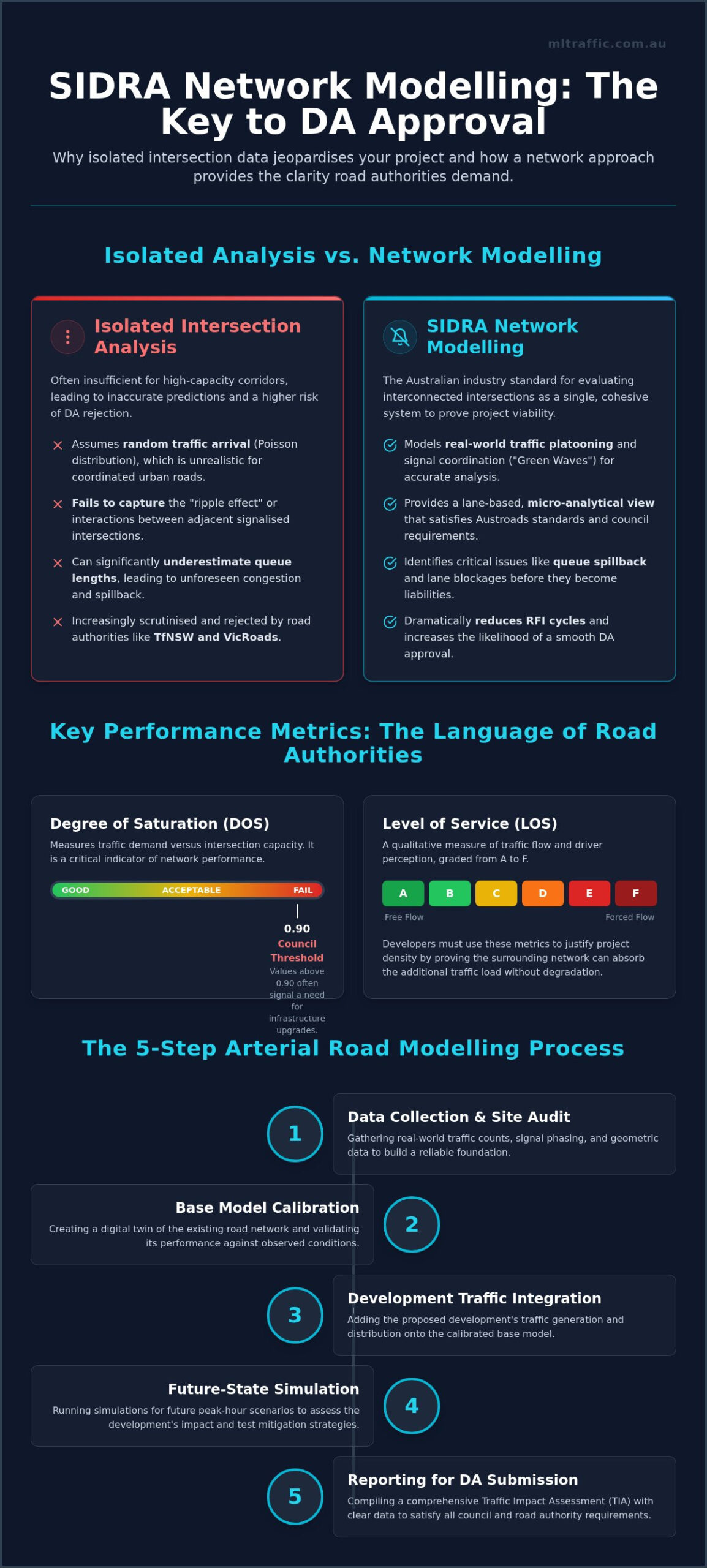
Traffic engineers rely on specific metrics to determine if a design is viable and compliant with Australian Standards. The Degree of Saturation (DOS) measures the ratio of arrival traffic demand to the capacity of the intersection. A DOS exceeding 0.90 often signals a need for infrastructure upgrades or design revisions to prevent gridlock. Level of Service (LOS) is the qualitative measure of traffic flow and driver perception. Graded from A to F, these metrics allow developers to justify project density by proving the surrounding network can absorb the additional load.
Isolated Intersection vs. Network Modelling: Why One Isn’t Enough
Isolated intersection analysis is often insufficient for projects located on high-capacity corridors. Standard “Site” mode analysis operates on the mathematical assumption that traffic arrives randomly at a junction. This is known as a Poisson distribution. While this works for rural roads or quiet suburban streets, it fails to reflect the reality of urban arterials. Arterial roads are highly structured environments where vehicle arrivals are dictated by the timing of the previous traffic signal. Relying on isolated data can lead to significant errors in predicting delay and queue lengths.
SIDRA network modelling for arterial roads provides a lane-based analysis that accounts for these real-world conditions. It treats the corridor as a single, integrated system rather than a collection of independent points. If your Traffic Impact Assessment (TIA) ignores the downstream effects of a new development entry point, Council will likely reject the application. Road authorities require proof that a new site won’t disrupt existing traffic patterns or cause the network to fail during peak periods.
Understanding Signal Platooning and Coordination
Traffic signals on major roads are timed to create “Green Waves”. This coordination ensures that groups of vehicles, or platoons, move through multiple intersections without stopping. When a new development is introduced, it adds fresh volume to these platoons or creates new conflict points. Isolated models don’t “see” these groups of cars; they assume a steady, random trickle of vehicles.
Network modelling allows engineers to simulate signal coordination and offsets. This ensures the proposed development design maintains arterial efficiency. By accurately modelling platooning, we can justify development density to road authorities by showing that the “residual life” of the road remains intact. It’s a technical necessity for any project that shares a boundary with a coordinated signal system.
The Risk of Queue Spillback on Arterials
Queue spillback occurs when the line of vehicles at one intersection grows long enough to block the preceding junction. This causes a catastrophic failure across the road network. Isolated models cannot accurately predict this because they don’t account for the physical distance between intersections. They assume an infinite amount of space for vehicles to queue, which is never the case in dense Australian urban centres.
SIDRA network models identify these risks during the design phase. The software calculates the “Back of Queue” and identifies when a queue will exceed the available storage capacity of a turn lane or a mid-block section. This allows for proactive mitigation, such as extending turn lanes or adjusting signal cycles, before the DA is submitted. For a successful approval, you need a comprehensive Traffic Impact Assessment that identifies and solves these network-wide issues. Our approach ensures that the same senior expert who initiates your project performs the technical modelling, providing accountability and precision that larger, impersonal firms often lack.
Council and Road Authority Requirements for Network Analysis
Major developments such as shopping centres, high-density residential towers, and large-scale industrial estates almost always trigger a requirement for SIDRA network modelling for arterial roads. Authorities such as Transport for NSW (TfNSW) and VicRoads are tasked with protecting the state’s infrastructure. They require empirical proof that the “residual life” of a corridor isn’t being prematurely exhausted by a single development. This means showing that the road will still function effectively years after the project is completed, rather than just on the day the doors open.
Modelling must typically cover two distinct scenarios: the “Year of Opening” and a “10-Year Design Horizon”. The latter requires accounting for regional background traffic growth, often sourced from strategic government models or local council growth projections. This ensures your development remains compatible with future infrastructure plans and doesn’t cause a systemic failure as the area matures. Precise SIDRA data is also an essential lever when negotiating Voluntary Planning Agreements (VPAs) or developer contributions. It provides a factual, data-driven basis for determining exactly what proportion of a required intersection upgrade or road widening is attributable to your specific project versus general background growth.
When is a Network Model Mandatory?
There is no single national threshold, but most authorities trigger a study if a site generates more than 50 to 100 vehicle trips during peak hours. Proximity is another deciding factor. If your site entry is within 200 metres of an existing signalised intersection, a network model is usually non-negotiable. It’s vital to consult with a qualified traffic engineer early in the DA process to identify these requirements. Identifying the need for network analysis during the due diligence phase prevents costly redesigns after the DA has been lodged and the project timeline is fixed.
Satisfying Austroads and Local Standards
Road authorities use SIDRA outputs to verify compliance with Austroads design standards. This involves more than just vehicle delay metrics. We must address specific Council concerns such as pedestrian crossing times, cyclist safety, and bus priority measures. A high-quality model demonstrates how these disparate modes interact without compromising the overall Level of Service for the corridor. For a comprehensive look at what your documentation should include, refer to our Professional Traffic Engineer Services Checklist. Our hands-on approach ensures the senior engineer performing the modelling is the same person who discusses the results with the road authority. This direct accountability removes the bureaucratic layers that often lead to unnecessary Request for Information (RFI) cycles.
The 5-Step Process of Arterial Road Modelling
A structured approach to traffic modelling is essential to ensure technical accuracy and high approval rates from road authorities. The process moves logically from empirical data collection to predictive future-state simulations. By following a rigorous methodology, engineers can identify potential bottlenecks before they become expensive liabilities during the construction phase. This systematic workflow provides the transparency that Council officers require to verify the impact of a development on the broader road network.
Testing “what-if” scenarios is a core component of this process. It allows developers to explore the most cost-effective infrastructure solutions, such as optimising signal offsets rather than funding physical road widening. When SIDRA network modelling for arterial roads is performed correctly, it serves as a powerful negotiation tool, providing a factual basis for developer contributions and infrastructure upgrades.
Data Collection and Base Model Calibration
The first step involves gathering high-quality field data. This includes Sydney Coordinated Adaptive Traffic System (SCATS) data, which provides signal timing and detector volumes, or manual turning movement counts conducted during peak periods. Once the raw data is collected, we develop the “Base Model” to reflect existing on-road conditions. Calibration is the most critical step in this phase. We adjust parameters such as saturation flow rates and gap acceptance to ensure the digital model matches the real-world performance of the corridor. A model is only as good as its calibration against observed queues. If the base model cannot replicate currently visible traffic behaviour, any future-year predictions will be fundamentally flawed and likely rejected by road authorities.
Future Scenario Testing and Mitigation
Once the base model is verified, we layer in the development-generated traffic and projected background growth for the 10-year design horizon. This phase identifies “failed” movements where the Degree of Saturation (DOS) exceeds acceptable limits. We then test various mitigation strategies to restore the network to an acceptable Level of Service. These mitigations might include extending turn bays, modifying signal phasing, or implementing new coordination plans. The results are then synthesised into a final report for the Traffic Impact Assessment (TIA). To ensure your project meets these technical benchmarks, contact our senior engineers for a professional Intersection Analysis. Our hands-on approach means the same expert who calibrates your base model will also design the necessary mitigations, ensuring technical continuity and accountability throughout the DA process.
Expert SIDRA Analysis with ML Traffic Engineers Australia
ML Traffic Engineers Australia provides professional consultancy services with over 15 years of experience in the Australian market. We specialise in delivering high-accuracy SIDRA network modelling for arterial roads as part of our comprehensive Traffic Impact Assessment (TIA) reports. Our firm understands the specific technical and bureaucratic requirements of local Councils and State Road Authorities. Every project we undertake is designed to withstand the rigorous scrutiny of transport planners and government engineers.
We offer a range of integrated technical services including:
- Traffic Impact Assessment (TIA) Report
- Vehicle Swept Path Analysis
- Car Parking Demand Assessment
- Traffic Guidance Scheme (TGS)
- Driveway Ramp Grade Assessment
- Intersection Analysis
- Sight Distance Assessment
- Car Park Design
- Waste Management Plan
Our approach ensures that your development application is supported by meticulous data that adheres to Australian Standards and Austroads guidelines. We focus on results-oriented solutions that justify your development density while maintaining the safety and efficiency of the surrounding road network.
Why Senior Involvement Matters for Your DA
The direct involvement of senior principals in every project is a core signature of ML Traffic Engineers Australia. We don’t employ junior staff to perform technical modelling while senior leadership acts as a gatekeeper. The engineer who initiates the client relationship is the same expert who performs the technical work. This personnel continuity promise ensures that the complex nuances of your specific site are reflected accurately in the final model.
Having a seasoned expert defend modelling results during Council meetings or road authority consultations is invaluable. Our meticulous approach reduces the risk of costly Request for Information (RFI) cycles and project delays. We provide a bridge between complex technical data and the regulatory approval you need to move your project forward. Our reliability is built on multi-decade professional longevity and a no-nonsense, fact-based approach to traffic engineering.
Secure Your Traffic Report Today
Starting the traffic modelling process during the early stages of project design is critical. Early engagement allows ML Traffic Engineers Australia to identify potential network failures and design mitigations before they become planning bottlenecks. Whether you’re developing a high-density residential complex or a major commercial centre, our team provides the technical assurance required for a successful outcome.
Beyond the initial modelling, we provide integrated solutions such as swept path analysis and car park design to ensure every aspect of your site’s traffic movement is compliant. This holistic approach minimises the need for multiple consultants and streamlines your DA submission. We eliminate unnecessary bureaucracy by providing a direct line to the experts performing your work.
To discuss the specific requirements of your development and obtain a quote for a comprehensive SIDRA network modelling for arterial roads study, contact us directly. Contact ML Traffic Engineers Australia to discuss your arterial road project and secure a direct line to our senior technical team.
Secure Your Development’s Future with Professional Network Analysis
Transitioning from isolated site analysis to a corridor-wide perspective is a strategic necessity for complex Australian developments. Accurate SIDRA network modelling for arterial roads provides the empirical proof required to satisfy the rigorous demands of road authorities and local Councils. By simulating real-world signal coordination and platooning, you can justify project density while ensuring the road network maintains its residual life. This technical clarity is the most effective way to minimise RFI cycles and prevent costly planning bottlenecks.
ML Traffic Engineers Australia offers over 15 years of Australian consultancy experience with a commitment to senior-level accountability. Our senior principals handle all technical modelling directly, ensuring there are no gatekeepers between you and the expert work required for your DA. We provide national coverage for all development categories, delivering reports designed for immediate regulatory compliance. Contact our senior traffic engineers for a SIDRA modelling quote to ensure your project stands on a foundation of reliable, expert data. We look forward to facilitating your successful project approval.
Frequently Asked Questions
What is the difference between SIDRA Site and SIDRA Network models?
SIDRA Site analysis evaluates an isolated intersection by assuming vehicle arrivals follow a random pattern. In contrast, SIDRA network modelling for arterial roads treats multiple intersections as a single system. This allows the model to account for signal coordination and the “platooning” of vehicles as they move between lights. Network modelling is the only way to accurately predict queue spillback and the interactions between closely spaced signals.
How long does a SIDRA network modelling study typically take?
A standard network study usually requires between one and three weeks to complete once all raw data is received. This timeline depends on the number of intersections included and the complexity of the “what-if” scenarios required for the design horizon. The process involves data validation, base model calibration, and future-state simulation. Starting this study early in the DA process is essential to avoid project delays.
Will Council accept a traffic report without SIDRA analysis?
Council and State Road Authorities almost never accept a Traffic Impact Assessment for arterial developments without formal SIDRA results. Because these roads are high-capacity corridors, authorities mandate SIDRA network modelling for arterial roads to ensure the development won’t exhaust the road’s residual life. Reports relying on manual calculations or isolated data are frequently rejected or returned with extensive Request for Information cycles.
Can SIDRA model roundabouts and signalised intersections in the same network?
Yes, the latest versions of the software can integrate various intersection types within a single model. You can simulate the interaction between a signalised junction and a downstream roundabout to see how queues from one might block the other. This capability is vital for Australian urban environments where different control types often exist in close proximity along the same corridor.
What data do I need to provide for a SIDRA network study?
You must provide a detailed site plan, existing traffic counts, and any proposed access points. Our team also requires signal timing data, often sourced via SCATS, and background growth projections from the local Council or road authority. Having these documents ready at the project inception allows our senior engineers to begin the calibration phase immediately, ensuring technical continuity throughout the study.
How does SIDRA modelling help in reducing development costs?
Professional modelling reduces costs by identifying the most efficient infrastructure solutions. It can prove that optimising signal offsets or extending a turn lane is sufficient to maintain traffic flow, potentially saving you from funding expensive physical road widening. By providing a factual, data-driven basis for negotiations, you can ensure that your developer contributions are proportional to your project’s actual impact.
Does SIDRA modelling account for pedestrians and cyclists on arterial roads?
SIDRA includes comprehensive multimodal analysis to ensure compliance with Austroads standards. The software models pedestrian crossing delays and the impact of cyclist movements on vehicle saturation levels. This ensures the final design provides a safe environment for all road users while maintaining the required Level of Service for the arterial network.

Disclaimer
The content on www.mltraffic.com.au, including all technical articles, guides, and resources, is provided for general informational and educational purposes only. It is not intended to constitute professional advice in traffic engineering, transportation planning, development approvals, or any other technical or legal field. While ML Traffic Engineers makes every reasonable effort to ensure the accuracy, completeness, and timeliness of the information published, we do not provide any warranties or representations (express or implied) regarding its reliability, suitability, or availability for any particular purpose. Any reliance you place on the content is strictly at your own risk. In no event shall ML Traffic Engineers, its directors, employees, authors, or affiliates be liable for any direct, indirect, incidental, special, consequential, or punitive damages (including, without limitation, loss of profits, data, or business opportunities) arising out of or in connection with the use of, or inability to use, any information provided on this website. The articles and guides on this site are not a substitute for engaging a qualified, registered professional traffic engineer (such as an NPER or RPEQ engineer) to assess your specific project requirements. For tailored advice, compliance assessments, or traffic engineering services, please contact a competent professional. This disclaimer may be updated from time to time without notice. By accessing or using this website, you agree to be bound by the most current version of this disclaimer.
