
Could a single technical metric like the Degree of Saturation be the only thing standing between your development project and its final Council approval? For many developers, traffic-related delays are the most frustrating hurdle in the DA process, often leading to requests for expensive intersection upgrades that weren’t in the initial budget. You understand that Council requirements are strict, but interpreting complex data sets shouldn’t be your burden to carry alone.
This guide demonstrates how professional roundabout traffic flow analysis and SIDRA modelling can streamline your development application and satisfy even the most rigorous local authority standards. By leveraging senior engineering expertise, you’ll gain a clear understanding of intersection performance and secure cost-effective design solutions that protect your project’s viability. Professional analysis ensures that your traffic impact assessment is based on evidence rather than conservative estimates that lead to unnecessary costs.
We’ll examine the technicalities of SIDRA INTERSECTION 11.0.3, the current Austroads Guide to Road Design Part 4B: Roundabouts, and the strategic methods used to defend traffic assessments during Council negotiations. This technical overview ensures you have the reliable data needed to move your project forward without unnecessary bureaucratic friction.
Key Takeaways
- Understand how critical metrics like Degree of Saturation (DOS) and Level of Service (LOS) act as the primary health checks for Council approval.
- Discover how adjusting geometric variables, such as entry width and flare length, can significantly optimise your roundabout traffic flow analysis results.
- Learn the requirements for establishing a robust “Base Case” and projecting traffic growth over a 10-year horizon for your Traffic Impact Assessment.
- Identify why professional calibration of SIDRA modelling is essential to reflect local Australian driving conditions and avoid the risks of “garbage in, garbage out” data.
- Gain the technical insights needed to defend your development application and negotiate cost-effective design solutions with local authorities.
Understanding Roundabout Traffic Flow Analysis for Australian Planning
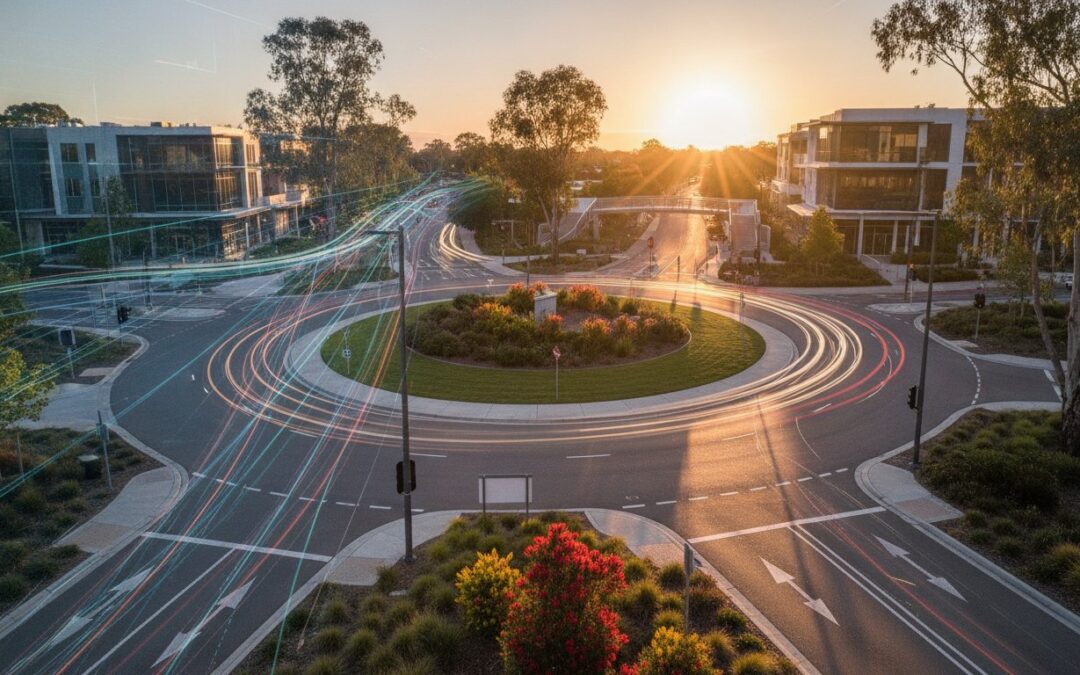
Roundabout traffic flow analysis is the systematic evaluation of how vehicles interact within a circular intersection to determine capacity and delay. It’s a critical technical requirement for modern urban planning. This process allows engineers to quantify the impact of a new development on the local road network with high precision. By examining variables like speed, volume, and density, we can accurately predict traffic flow patterns under various stress conditions.
Councils mandate this level of detail to prevent gridlock in high-density areas. Simple traffic counts are no longer sufficient for complex planning applications. The industry has moved toward micro-analytical modelling to capture the nuances of driver behaviour at different times of the day. This transition ensures that road safety remains a priority while maximising throughput. Proper flow analysis identifies potential conflict points before construction begins. It provides a reliable evidence base for Council officers to assess a Development Application (DA) with confidence.
The Role of SIDRA in the Planning Process
SIDRA INTERSECTION, specifically version 11.0.3, is the industry standard for Australian traffic engineers. It’s the primary tool used to satisfy Council requirements for intersection analysis. The software models lane-by-lane behaviour rather than just total approach volume. This distinction is vital. It allows us to identify specific bottlenecks that a simpler analysis might miss. The modelling accounts for peak hour fluctuations and seasonal variations to provide a realistic view of intersection performance. It also incorporates the 10-year growth horizon required by most Australian road authorities. Our senior experts handle all technical modelling directly. This approach ensures results are defensible during Council meetings or planning appeals.
When is a Roundabout Analysis Required?
A formal analysis is typically required when a development is expected to generate significant additional trips. Each Council has specific thresholds that trigger the need for a Traffic Impact Assessment (TIA). We evaluate existing conditions against proposed future traffic to determine if the intersection can handle the new load. This assessment must account for heavy vehicles and buses. These larger vehicles require greater gap acceptance times and larger swept paths. Their presence can significantly reduce the overall throughput of a roundabout if the geometry isn’t optimised. We ensure your design accommodates these factors while maintaining efficient flow for passenger vehicles. Professional engineering judgement is used to calibrate these models to reflect local driving conditions accurately.
Key Performance Metrics: Interpreting SIDRA Modelling Outputs
Understanding the technical output of a SIDRA report is essential for any developer managing a planning application. These metrics provide the objective evidence Council officers use to determine if a project’s proposed traffic load is sustainable. A comprehensive roundabout traffic flow analysis does more than count cars; it evaluates the operational efficiency of the intersection under peak stress. While a well-designed roundabout safely and efficiently moves traffic, the specific modelling data determines whether your site access remains viable or requires costly modifications.
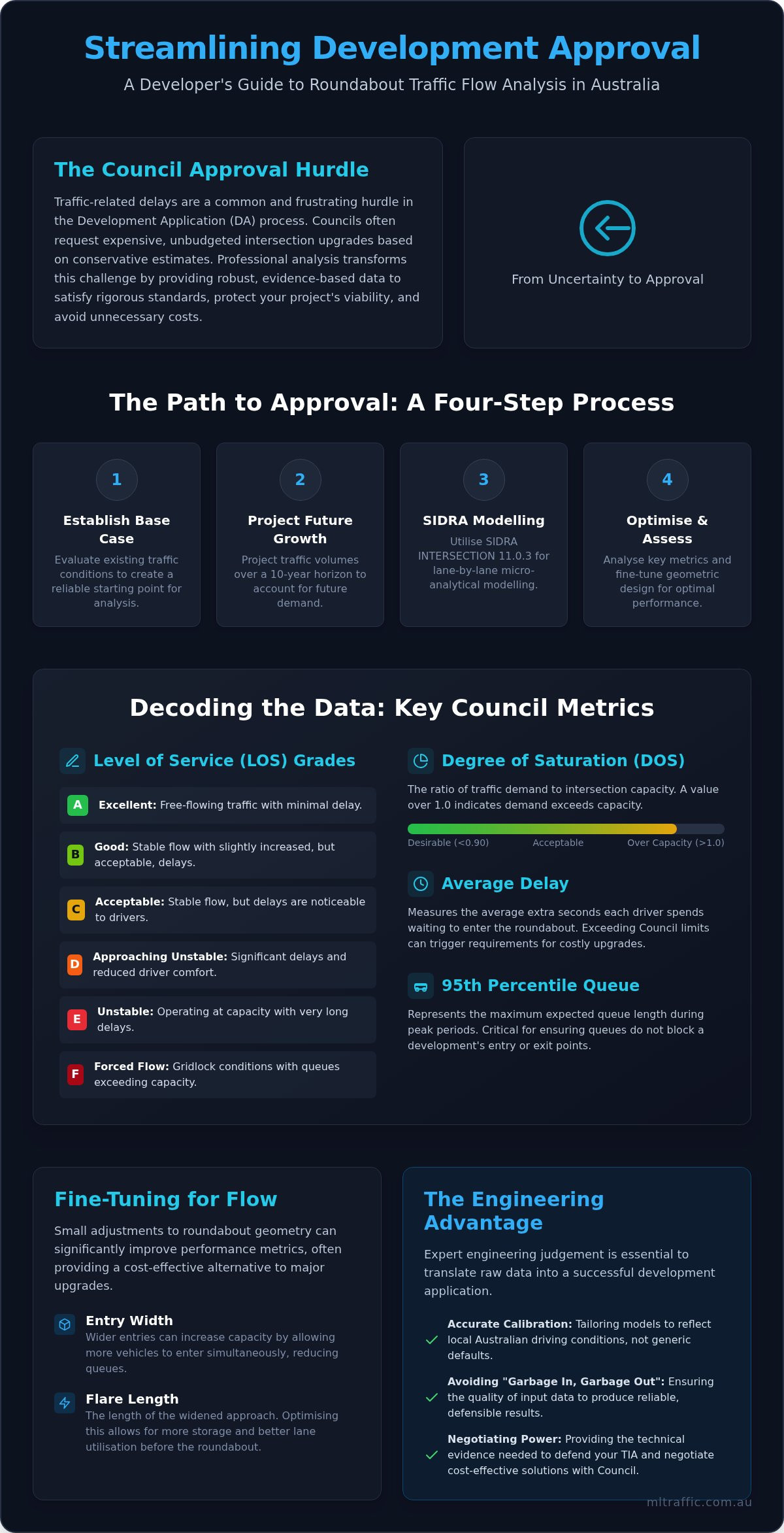
Two specific metrics often dictate the success of a DA: Average Delay and the 95th Percentile Queue Length. Average Delay measures the additional seconds a driver spends waiting to enter the roundabout. If this figure exceeds local authority limits, Council may require you to fund road widening or signalisation. Meanwhile, the 95th Percentile Queue Length represents the maximum queue expected during the busiest peak periods. This is critical for ensuring that traffic queuing at the roundabout doesn’t block your development’s entry or exit points, which would create a significant safety hazard. Our senior principals perform all modelling directly to ensure these metrics are accurate and defensible.
Level of Service (LOS) Grades Explained
The Level of Service is an A-to-F grading system that describes the quality of traffic flow. It’s the most common way for non-engineers to understand intersection performance:
- LOS A-B: Excellent flow with minimal delay; drivers experience high levels of freedom.
- LOS C-D: Acceptable urban flow; this is the typical target for developers in established areas.
- LOS E-F: Failing conditions; these grades usually trigger a request for significant infrastructure upgrades.
Degree of Saturation (DOS) Thresholds
The Degree of Saturation (DOS) is the primary health check for any intersection. It represents the ratio of arrival traffic volume to the maximum capacity of the roundabout. A DOS value of 0.00 indicates no traffic, while 1.00 indicates the intersection is at absolute capacity. For most Australian Councils, a DOS exceeding 0.85 or 0.90 is a major “red flag.”
Once saturation reaches these levels, traffic flow becomes highly unpredictable. Small incidents or slight increases in volume lead to exponential increases in delay. If your roundabout traffic flow analysis shows a DOS nearing these limits, we can justify lane reconfigurations or entry widening to bring the project back into compliance. Securing a professional Intersection Analysis early in the design phase prevents these technical issues from becoming expensive construction requirements during the final approval stages.
Capacity and Delay: Why Roundabout Geometry Matters for Flow
The physical configuration of a roundabout directly dictates its operational capacity. In a roundabout traffic flow analysis, we examine how specific geometric features, such as entry width and flare length, influence the number of vehicles that can enter the circulating stream per hour. Increasing the entry width typically boosts capacity, but this must be balanced against safety requirements. Flare length provides additional entry lanes at the give-way line; this is particularly effective in urban Australian environments where space is limited but peak demand is high.
The diameter of the central island also plays a vital role in determining circulating speed and overall throughput. A larger island creates more deflection, forcing vehicles to slow down. While this improves safety, excessive deflection can lead to increased delays and reduced capacity. Our engineers use the Austroads Guide to Road Design Part 4B to find the optimal balance between these competing factors. We also integrate Swept Path Analysis during this stage. This ensures the design accommodates the “Design Vehicle,” usually an Articulated Vehicle (AV) or bus, without compromising the flow of smaller passenger cars.
Geometric Design vs. Traffic Capacity
A larger roundabout isn’t always a better-performing one. Oversized designs can lead to higher speeds and more severe accidents. Effective roundabout traffic flow analysis focuses on “deflection,” which is the change in a vehicle’s path as it travels through the intersection. Proper deflection manages speeds naturally and ensures drivers have adequate time for gap acceptance. We calibrate our SIDRA models to reflect how Australian drivers react to these geometric cues, ensuring the predicted delays match real-world outcomes. This meticulous approach prevents Council from requesting unnecessary and expensive design modifications later in the process.
Multi-Lane Roundabouts and Lane Discipline
Multi-lane roundabouts introduce complexities like lane imbalance, where one lane is significantly more utilised than others. This often happens due to poor line marking or confusing signage. These imbalances can lead to unexpected delays and higher Degree of Saturation (DOS) levels. We model these scenarios to recommend clear lane assignments that optimise total intersection performance. Additionally, we assess the risk of “spillback.” This occurs when queues from a nearby set of traffic lights or another roundabout extend back into the intersection being analysed. Addressing these external factors is essential for a robust Traffic Impact Assessment that Council will accept without further questions.
Integrating Flow Analysis into Your Traffic Impact Assessment (TIA)
A successful development application relies on a robust Traffic Impact Assessment. This document uses roundabout traffic flow analysis to demonstrate that a project can be integrated into the existing road network without compromising performance. We begin by establishing the “Base Case,” which documents current traffic volumes and intersection delays before any construction starts. This provides a benchmark against which all future changes are measured. We ensure all data collection meets local authority standards to prevent delays during the initial review phase.
Australian road authorities typically require a 10-year design horizon. This means we must project traffic growth for a decade beyond the development’s completion. We then model the “With Development” scenario. This phase is the ultimate test. It proves to Council that the additional trips generated by your project won’t cause the intersection to fail. If the modelling indicates a drop in the Level of Service, we use the data to justify specific, targeted improvements rather than broad, expensive upgrades. Professional roundabout traffic flow analysis provides the objective evidence needed to move past subjective traffic concerns.
Mitigation Strategies for Failing Intersections
When an analysis identifies potential capacity issues, we use SIDRA to test various design iterations. This might include extending flare lengths or adding an extra entry lane. By simulating these changes, we identify the most cost-effective solution for our clients. This data-driven approach is essential for negotiating developer contributions. We use objective modelling results to push back on unreasonable Council demands for infrastructure that exceeds the project’s actual impact. Our senior engineers participate directly in these negotiations to ensure your interests are protected by technical fact.
Environmental and Sustainability Reporting
Modern planning applications often require Ecologically Sustainable Development (ESD) reporting. SIDRA 11.0.3 allows us to calculate CO2 emissions and fuel consumption based on predicted traffic flow. Efficient roundabout design reduces idling time, which directly lowers the carbon footprint of the intersection. We use these metrics to support your project’s “Green” building credentials. Demonstrating a reduction in vehicle emissions through optimised traffic management can be a persuasive argument for Council approval. This level of detail shows a commitment to long-term environmental performance and operational efficiency.
Ready to secure your project’s future? Contact our senior engineers for a detailed intersection analysis today.
The Critical Role of Professional Engineering Judgement in Modelling
Raw software output is only as reliable as the assumptions and data entered by the operator. This is the “Garbage In, Garbage Out” risk that many developers face when using inexperienced consultants. A roundabout traffic flow analysis requires more than just technical proficiency with SIDRA 11.0.3; it demands the oversight of a qualified Traffic Engineer who understands the nuances of Australian road user behaviour. Councils mandate that these reports are signed by accredited professionals to ensure the modelling adheres to Australian Standard AS 2890 and relevant state-specific guidelines.
Engineering judgement is the bridge between theoretical capacity and real-world performance. While software provides the framework, the engineer must determine if the results align with observed conditions. This professional accountability is what Council officers look for during the DA review process. It’s not enough to present a report that looks compliant; the underlying logic must be defensible under cross-examination. Our senior experts ensure that every model is built on a foundation of professional integrity and technical accuracy.
Model Calibration and Validation
Calibration is the process of adjusting software parameters, such as saturation flows and gap acceptance, to reflect local driving conditions. We verify that the model “behaves” like the actual intersection by comparing simulated delays with real-world traffic counts. Our 15+ years of specialist experience allows us to spot modelling errors that junior staff might overlook. This validation step is vital for proving the accuracy of the “Base Case” before projecting future traffic growth. Without proper calibration, your roundabout traffic flow analysis risks being dismissed by Council as unrealistic or flawed.
Choosing the Right Consultant for Your DA
Direct access to senior leadership is a key advantage when managing complex planning applications. When you engage our traffic engineering services, the same expert who initiates the relationship performs the technical modelling. This personnel continuity ensures that the strategic goals of your development are integrated into every technical assessment. Expert interpretation of SIDRA results can often identify design efficiencies that save thousands of dollars in unnecessary road upgrades. Our national expertise across all Australian States and Territories ensures your project meets both local Council expectations and broader regulatory standards.
Securing Your Development Approval with Technical Precision
Accurate roundabout traffic flow analysis acts as the technical foundation for your development’s success. By interpreting complex SIDRA outputs and optimising geometric design, you can satisfy strict Council requirements while avoiding the costs of unnecessary infrastructure upgrades. This process ensures that your traffic impact assessment is both defensible and realistic, reflecting the actual driving conditions of the site rather than conservative estimates. High-quality modelling provides the objective evidence needed to move past subjective traffic concerns during the DA review phase.
ML Traffic Engineers Australia provides 15+ years of national consultancy experience to help you navigate these regulatory hurdles. We ensure direct access to senior principals for all technical work, providing the accountability and deep-seated expertise needed for Australian Standard and local Council compliance. Our team is ready to defend your project’s traffic outcomes during Council meetings or planning appeals. Contact ML Traffic Engineers Australia for Expert SIDRA Modelling and TIA Reports to move your development forward. We look forward to helping you achieve a successful approval with minimal traffic-related conditions.
Frequently Asked Questions
Is SIDRA modelling mandatory for all Australian developments?
SIDRA modelling is not technically mandatory by national law; however, it is the de facto requirement for most Australian Councils. If your project generates enough traffic to warrant a Traffic Impact Assessment, Council will almost certainly request a SIDRA report. Most Australian road authorities specify SIDRA as the standard micro-analytical tool for intersection evaluation. You should consult the relevant planning guidelines for your specific area to confirm the exact modelling expectations.
What is the difference between Level of Service and Degree of Saturation?
Level of Service (LOS) measures the quality of the driver’s experience, while Degree of Saturation (DOS) measures the technical capacity of the intersection. LOS is a qualitative grade from A to F based on delay; DOS is a quantitative ratio of traffic volume to absolute capacity. While LOS describes how the traffic feels, DOS indicates the technical health of the roundabout. Councils typically look for a DOS below 0.85 for stable peak performance.
How long does a roundabout traffic flow analysis typically take to complete?
A professional analysis typically takes between five and ten business days to complete. This timeframe depends on the complexity of the intersection and the availability of current traffic data. It includes data collection, model construction in SIDRA 11.0.3, and a final engineering review. Projects requiring complex multi-lane modelling or extensive mitigation testing may require additional time. Providing accurate site plans and traffic counts at the start of the process helps expedite the report delivery.
Can I use SIDRA to model signalised intersections as well?
Yes, SIDRA is fully capable of modelling signalised intersections alongside roundabouts and priority junctions. It is the industry standard for evaluating diverse road networks across Australia. The software allows engineers to compare different intersection treatments, such as converting a roundabout to traffic lights, to determine the most efficient solution. This capability is essential for developers who need to justify specific infrastructure upgrades during the Council negotiation process or when addressing complex traffic problems.
What information do I need to provide for a SIDRA analysis?
You must provide peak-hour traffic counts, development trip generation data, and a detailed site plan. Accurate roundabout traffic flow analysis relies on these inputs to establish a reliable “Base Case” for Council review. Having high-quality architectural drawings ensures that the proposed geometry used in the model matches your final construction plans. This detailed information allows our senior engineers to calibrate the software to reflect real-world driving conditions at your specific location.
How does roundabout geometry affect the final SIDRA results?
Geometry directly dictates the capacity of each entry lane and the circulating flow of the intersection. During a roundabout traffic flow analysis, we test how changes to entry width or flare length affect the overall Degree of Saturation. Proper geometry manages vehicle speeds and gap acceptance, which are the primary drivers of intersection performance. Our experts use the Austroads Guide to Road Design to ensure your layout is both safe and efficient.
What happens if the analysis shows the roundabout is over capacity?
If an intersection exceeds capacity, we model various mitigation strategies to identify the most cost-effective design solution. This might involve extending flare lengths, adding entry lanes, or proposing developer contributions for regional upgrades. We use the modelling data to prove the effectiveness of these changes before you commit to construction. This objective evidence allows you to negotiate with Council based on the project’s actual traffic impact rather than conservative or arbitrary estimates.
Does SIDRA account for pedestrians and cyclists at roundabouts?
Yes, the software includes specific modules to calculate the impact of pedestrian and cyclist volumes on vehicle flow. High volumes of non-motorised users can significantly reduce vehicle capacity and increase delays at entry points. The software accounts for the time vehicles spend waiting for pedestrians to clear the road. Including these users in the analysis ensures your Traffic Impact Assessment reflects the true operational conditions of the site, particularly in high-density urban environments.

Disclaimer
The content on www.mltraffic.com.au, including all technical articles, guides, and resources, is provided for general informational and educational purposes only. It is not intended to constitute professional advice in traffic engineering, transportation planning, development approvals, or any other technical or legal field.
While ML Traffic Engineers makes every reasonable effort to ensure the accuracy, completeness, and timeliness of the information published, we do not provide any warranties or representations (express or implied) regarding its reliability, suitability, or availability for any particular purpose. Any reliance you place on the content is strictly at your own risk.
In no event shall ML Traffic Engineers, its directors, employees, authors, or affiliates be liable for any direct, indirect, incidental, special, consequential, or punitive damages (including, without limitation, loss of profits, data, or business opportunities) arising out of or in connection with the use of, or inability to use, any information provided on this website.
The articles and guides on this site are not a substitute for engaging a qualified, registered professional traffic engineer (such as an NPER or RPEQ engineer) to assess your specific project requirements. For tailored advice, compliance assessments, or traffic engineering services, please contact a competent professional.
This disclaimer may be updated from time to time without notice. By accessing or using this website, you agree to be bound by the most current version of this disclaimer.
