

Your Development Application for any significant Australian project will likely stall or fail without a rigorous intersection capacity analysis backed by SIDRA INTERSECTION 11. Local councils and road authorities require a standardised, repeatable methodology that proves your project won’t compromise the safety or efficiency of the existing road network. They expect data-driven proof that aligns with national standards, leaving no room for guesswork in your submission.
You’ve likely experienced the pressure of high-stakes DA submissions where technical requirements feel like a moving target. It’s frustrating to face costly delays or requests for further information because your traffic data doesn’t adhere to the latest editions of the Austroads Guide to Traffic Management. The complexity of software outputs shouldn’t be the barrier that stands between your project and its approval.
This guide explains how SIDRA software serves as the non-negotiable evidence base for your traffic assessments. You’ll learn how to interpret complex performance measures, align your project with mandatory regulatory standards, and communicate with council engineers with absolute confidence. We’ll outline the essential steps to turn technical data into a streamlined planning approval.
Key Takeaways
- Understand why SIDRA is the Australian industry standard for intersection capacity analysis and how its local development ensures accuracy for domestic road conditions.
- Learn how to satisfy local council requirements and Austroads standards by providing empirical evidence within your Traffic Impact Assessment (TIA).
- Discover the micro-analytical capabilities of SIDRA INTERSECTION 11, including its ability to model environmental outputs such as fuel consumption and vehicle emissions.
- Master the interpretation of Level of Service (LoS) and Degree of Saturation (DoS) to identify potential congestion tipping points before they impact your planning approval.
- Recognise why senior-led verification of your traffic model is essential to ensure data accuracy and avoid the common pitfalls that lead to council requests for further information.
What is SIDRA Software in Intersection Capacity Analysis?
SIDRA stands for Signalised & unsignalised Intersection Design and Research Aid. It is the premier software package used by traffic engineers for intersection capacity analysis across Australia. Developed locally by Dr Rahmi Akcelik of Akcelik & Associates, the tool was built to address the specific complexities of Australian road networks and driver behaviour. Over several decades, it has transitioned from a set of basic mathematical formulas into a sophisticated micro-analytical tool. It is now the mandatory standard for any professional traffic assessment submitted to local councils or state road authorities.
The software has become the industry benchmark because it offers a standardised, repeatable methodology. Today, SIDRA Intersection is utilised in over 80 countries, yet its core logic remains deeply rooted in Australian research. For a developer, this means the software provides the objective, data-driven evidence required to prove that a proposed project will not cause gridlock or safety hazards. Without a SIDRA model, a Traffic Impact Assessment lacks the empirical weight needed for planning approval.
The Core Function of SIDRA INTERSECTION
The primary role of SIDRA INTERSECTION 11 is to evaluate the capacity, timing, and performance of various road geometries. It moves beyond traditional approach-based methods by employing a micro-analytical lane-based model. This allows engineers to calculate the specific performance of every individual lane within an intersection. The software simulates real-world driver behaviour, including gap acceptance and queueing patterns, which provides a precise prediction of traffic flow. It is particularly effective at modelling complex layouts such as roundabouts, signalised crossings, and priority-controlled junctions where standard calculations often fail to capture the full picture.
Who Utilises SIDRA and Why?
Traffic engineering consultancies use SIDRA as a core component of the development lifecycle. We use it to generate the technical data that forms the backbone of a Traffic Impact Assessment (TIA) report. Local government authorities then use the same software to verify the claims made in your application. They require this level of detail for high-density residential projects, commercial centres, and complex urban infrastructure. Because the software is endorsed by Austroads, it provides a common language between developers and council engineers. This alignment is essential for streamlining the planning process and avoiding the costly delays associated with requests for further information.
Technical Capabilities: How SIDRA Models Australian Roads
SIDRA INTERSECTION 11 operates as a micro-analytical network model that delivers high-fidelity flow predictions. Unlike simplified macroscopic tools, this software evaluates the specific interaction between individual lanes and vehicle types. This granular level of detail is essential for a robust intersection capacity analysis, as it accounts for the unique geometry and traffic volumes of each site. The model provides a comprehensive suite of performance measures, including average delay, 95th percentile queue lengths, and the Degree of Saturation (DoS).
Reliable data interpretation is critical for council acceptance. The Signalized Intersection Analysis Methodology underpins many of these calculations, ensuring that performance ratings like Level of Service (LoS) are based on globally recognised engineering principles. Beyond simple traffic flow, the software generates vital environmental outputs. It calculates fuel consumption, carbon dioxide emissions, and other pollutant data. These metrics are increasingly required for modern Development Applications to demonstrate environmental compliance. For a complete site assessment, we often integrate these findings with a Vehicle Swept Path Analysis to ensure the proposed physical layout can actually accommodate the modelled traffic movements.
Modelling Different Intersection Geometries
- Roundabouts: SIDRA is the industry-preferred tool for roundabout capacity because it accurately models entry flow, circulating flow, and geometric delay.
- Signalised Intersections: The software optimises phase timings and cycle lengths, allowing engineers to minimise delays and maximise throughput at complex signalised crossings.
- Unsignalised Sites: For give-way and stop-sign controlled junctions, the tool evaluates performance based on complex gap acceptance logic and local driver behaviour patterns.
Network Analysis and Traffic Assignment
Modern planning often requires moving beyond the analysis of a single node. Specialist firms like Da Vinci Transport Planning & Research use SIDRA ASSIGN to evaluate interconnected road networks, showing how traffic displaced from one intersection impacts the next. This provides a holistic view of the development’s impact on the broader precinct. Network Level of Service is a combined performance indicator that evaluates the operational efficiency of an interconnected system of intersections rather than assessing each node in isolation. This system-wide approach ensures that infrastructure improvements are strategically placed to benefit the entire local network.
Why Australian Councils Demand SIDRA Analysis for DAs
Australian councils operate within a strict regulatory framework that demands objective proof of infrastructure viability. A professional intersection capacity analysis is the only method councils accept to verify that a new development won’t degrade local road performance. By providing a standardised output, SIDRA removes subjectivity from the planning process. This allows assessing officers to compare your project against established local council engineering specifications and regional transport strategies with total clarity.
The software plays a pivotal role in mitigating the perceived impact of new developments on existing residents. When community members raise concerns about traffic congestion, a verified SIDRA model provides the empirical evidence needed to address those objections. It shifts the conversation from anecdotal worry to technical reality. It also serves as a critical tool for negotiating developer contributions. If road upgrades are required, the analysis determines the exact proportion of the impact attributable to your project, ensuring you only pay for your fair share of infrastructure improvements.
Meeting Austroads Standards
SIDRA INTERSECTION 11 aligns directly with the Austroads Guide to Traffic Management Series, which is the national standard for traffic engineering in Australia. This alignment ensures that the Level of Service (LoS) ratings are consistent across different jurisdictions, whether your project is in Sydney, Melbourne, or a regional centre. The analysis doesn’t just look at cars. It evaluates safety and efficiency for all road users, including pedestrians and cyclists. This is a mandatory requirement under modern planning guidelines that prioritises active transport and pedestrian safety alongside vehicle throughput.
Validating the Traffic Impact Assessment (TIA)
A SIDRA model isn’t a standalone document. It functions as the technical engine of your broader Traffic Impact Assessment (TIA). We use the outputs to justify the placement of driveway locations and access points, proving they can operate safely without disrupting through-traffic. This data-driven approach minimises the risk of council rejecting your access strategy or requesting redesigns late in the process. To ensure your submission meets these rigorous standards, you can Learn more about our Traffic Impact Assessment services and how we integrate modelling into every report.
Interpreting the Results: Level of Service (LoS) and Beyond
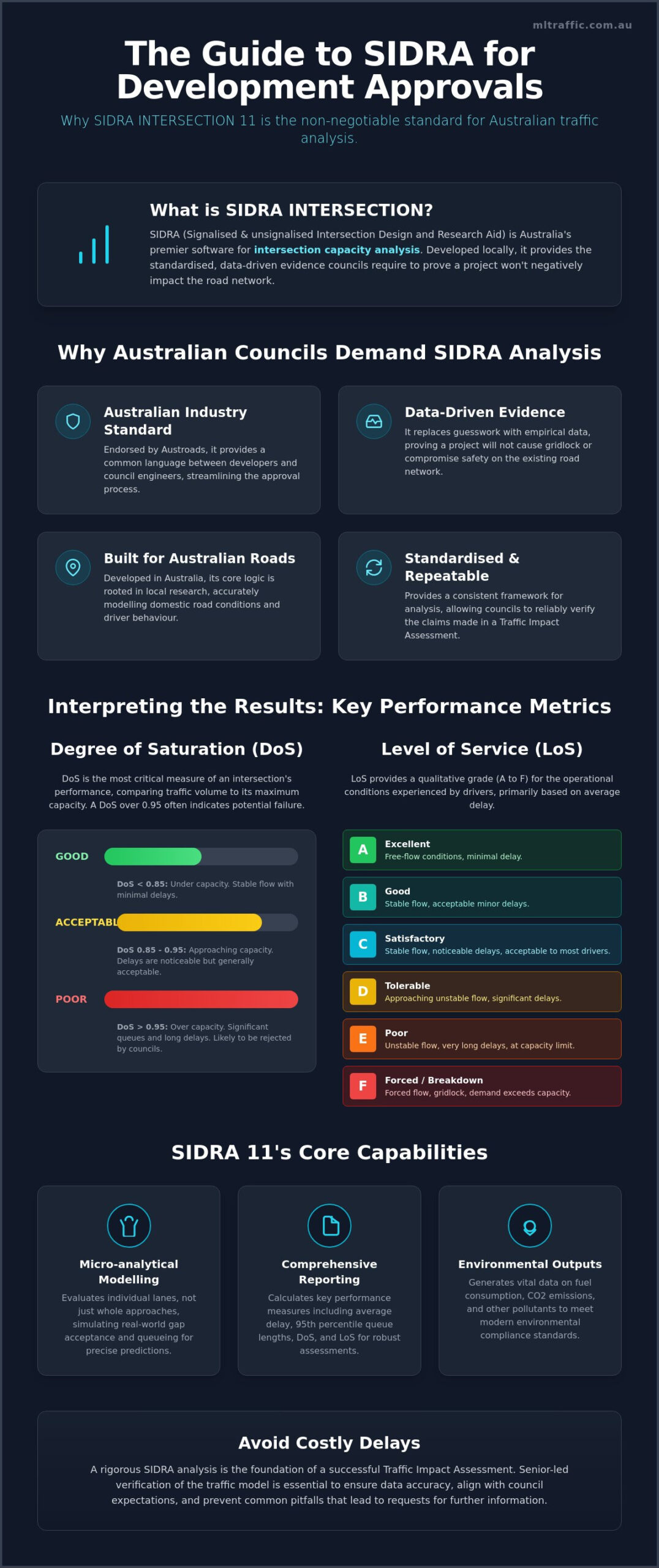
The raw data generated by an intersection capacity analysis is only valuable if it is translated into actionable development outcomes. Councils don’t just look at the raw numbers; they evaluate the performance grades that dictate whether a project is viable. The Level of Service (LoS) is the primary metric used for this assessment, ranging from A to F. While LoS A or B represents ideal conditions for new infrastructure, LoS D is generally the practical threshold for acceptable urban congestion during peak periods. If your model returns an LoS F, it is a clear signal that mandatory infrastructure upgrades or a significant project redesign are required to secure a planning approval.
The Degree of Saturation (DoS) serves as the technical tipping point for congestion. It represents the ratio of traffic demand compared to the total capacity of the intersection. Generally, a DoS exceeding 0.9 for signalised intersections or 0.8 for roundabouts indicates that the system is nearing its physical limit. Once these thresholds are crossed, even minor increases in traffic volume lead to exponential increases in delay. It’s also vital to recognise that acceptable delay varies by location. What is considered a stable delay in a high-density metropolitan centre would often be deemed unacceptable in a regional township where driver expectations differ.
The Level of Service Framework
- LoS A & B: These ratings represent excellent flow where drivers experience minimal delay and high freedom to manoeuvre.
- LoS D: This is the typical limit of stable flow. It is often the target for urban planning where some delay is expected but the network remains functional.
- LoS F: This indicates a breakdown in flow where demand exceeds capacity. It usually triggers a requirement for road widening or signalised upgrades.
Practical Implications of SIDRA Outputs
These metrics directly influence the physical architecture of your site. We use queue data to design efficient internal car park circulation and ensure that vehicle stacking doesn’t spill back into public thoroughfares. If the 95th percentile queue length exceeds the available storage in a dedicated turn lane, you may be forced to provide additional road width or introduce new signal phases to clear the traffic. The 95th percentile queue length is the critical metric for driveway design because it determines the necessary setback required to prevent entering vehicles from blocking the footpath or through-lanes during peak periods. To ensure your project meets these technical thresholds, contact our senior principal engineers for a detailed review of your site’s specific traffic requirements.
Professional SIDRA Modelling with ML Traffic Engineers
SIDRA INTERSECTION 11 is a powerful analytical tool, but its outputs are only as reliable as the inputs provided. In the field of traffic engineering, the principle of “garbage in, garbage out” is a constant risk for developers. A robust intersection capacity analysis requires precise calibration of local parameters, including saturation flows, gap acceptance, and pedestrian interference, which cannot be automated. At ML Traffic Engineers Australia, we bring over 15 years of Australian consultancy experience to ensure your model reflects real-world conditions rather than theoretical defaults.
Our senior-led approach distinguishes us from larger, more impersonal firms. Unlike agencies that may delegate technical modelling to junior staff, our senior principals are directly involved in every assessment. Every SIDRA model we produce is verified by a principal engineer to ensure technical accuracy and strict adherence to regulatory standards. This hands-on accountability ensures that the data presented to council is defensible and meticulously prepared for the DA process. We provide a seamless integration between modelling outputs, AS2890.1 car park design requirements, and Vehicle Swept Path Analysis. This holistic view ensures that your site’s physical geometry can actually accommodate the traffic volumes predicted in the intersection capacity analysis.
The Value of Expert Interpretation
Basic software outputs often highlight network failures without providing viable solutions. Our expertise lies in identifying creative engineering fixes that maintain a functional Level of Service without requiring unnecessary infrastructure spend. We use data-backed arguments to negotiate with council planners, often finding technical middle ground that satisfies safety requirements while protecting development yields. You can read our guide to Traffic Engineering in Australia to see how we apply these principles across complex residential and commercial projects nationwide.
Get Your Project Approved
We focus on streamlining the DA process by delivering compliant, professional traffic reports that pre-empt council objections. Our clients benefit from direct access to our leadership team for all technical queries, ensuring there are no gatekeepers or communication delays. This personnel continuity means the expert who initiates your project is the one performing the technical work. If you require a reliable evidence base for your next planning submission, contact ML Traffic Engineers Australia for a SIDRA analysis quote and ensure your project is backed by seasoned experts.
Secure Your Planning Approval with Precise Modelling
SIDRA INTERSECTION 11 remains the definitive evidence base for demonstrating network compliance to Australian road authorities. It provides the empirical weight required to justify site access, verify performance metrics, and negotiate infrastructure contributions. A robust intersection capacity analysis must be calibrated to specific local conditions to ensure the data is defensible during the council assessment process. Relying on default software settings often results in requests for further information that stall your project’s progress.
ML Traffic Engineers provides over 15 years of Australian consultancy experience across all development types nationwide. Our senior principals handle all technical work directly, which ensures meticulous accuracy and personnel continuity from the initial quote to the final report. This senior-led approach removes the risks associated with junior-level modelling and streamlines your path to planning approval. We understand the bureaucratic requirements of every state jurisdiction and provide the authoritative data councils expect.
Beyond traffic assessments, firms in the real estate and legal sectors must navigate various regulatory hurdles; to simplify your financial obligations, you can explore FlowAML for comprehensive anti-money laundering compliance.
Request a Professional SIDRA Analysis for Your Project today to ensure your submission is backed by seasoned experts. We look forward to providing the technical expertise needed to secure your development’s future.
Frequently Asked Questions
What is the latest version of SIDRA software used in Australia?
SIDRA INTERSECTION 11 is the current stable version as of 2026. This version includes updated traffic models and reporting features that align with the most recent Austroads Guide to Traffic Management. Councils and road authorities expect consultants to use this latest version to ensure that all intersection capacity analysis results are based on the most accurate and peer-reviewed research available.
How much does a SIDRA analysis cost for a standard development?
Fees for a professional analysis depend on the number of intersections and the complexity of the surrounding road network. Costs are influenced by factors such as the need for new traffic counts, the complexity of signal timings, and whether a network-level assessment is required. It’s best to provide your site plans to a consultant for a specific quote that covers all local government requirements.
Do all councils in Australia require a SIDRA report for a DA?
Most councils require a SIDRA report for any development that significantly increases traffic volumes or modifies existing road layouts. While minor projects might only need a basic assessment, an intersection capacity analysis is usually mandatory for high-density residential, commercial, or industrial applications. You should check your local council’s engineering specifications to confirm the exact modelling triggers for your specific site.
Can I perform a SIDRA analysis myself without an engineering degree?
While the software is available for purchase, councils generally only accept reports certified by qualified traffic engineers. The modelling process involves complex technical parameters such as gap acceptance, saturation flows, and lane utilisation factor adjustments. Submissions lacking professional engineering oversight are frequently rejected or face lengthy delays due to requests for further information regarding the model’s calibration and validity.
What is the difference between SIDRA and other traffic modelling software like VISSIM?
SIDRA is a micro-analytical tool that uses mathematical formulas to evaluate specific intersections or small networks. Software like VISSIM or Aimsun uses micro-simulation to track the movement of individual vehicles across much larger and more complex urban systems. SIDRA is the preferred standard for most Development Applications because it provides the specific, repeatable performance metrics that council engineers use to assess local impacts.
How long does it take for a traffic engineer to complete a SIDRA model?
A standard model for a single intersection typically takes a few business days to complete, assuming all traffic volume data is available. Complex network models involving multiple nodes or traffic assignment will require additional time for calibration and verification. These timelines don’t include the time needed for physical traffic counts, which must be scheduled during neutral periods to ensure data accuracy.
What data is required to start a SIDRA intersection analysis?
Engineers need peak-hour traffic counts, existing road geometries, and signal phasing data for signalised sites. We also require the projected traffic generation rates from your proposed development to model the future performance of the network. Providing accurate site plans and traffic data at the outset ensures the analysis reflects the true impact of the project and meets all regulatory standards for approval.
Does SIDRA software account for public transport and pedestrian movements?
Yes, SIDRA INTERSECTION 11 allows for the detailed modelling of pedestrian crossings, bus movements, and tram interactions. The software calculates specific performance measures, including delay and Level of Service, for all road users rather than just private vehicles. This capability is essential for modern planning applications that must demonstrate a commitment to pedestrian safety and the efficiency of local public transport networks.

Disclaimer
The content on www.mltraffic.com.au, including all technical articles, guides, and resources, is provided for general informational and educational purposes only. It is not intended to constitute professional advice in traffic engineering, transportation planning, development approvals, or any other technical or legal field.While ML Traffic Engineers makes every reasonable effort to ensure the accuracy, completeness, and timeliness of the information published, we do not provide any warranties or representations (express or implied) regarding its reliability, suitability, or availability for any particular purpose. Any reliance you place on the content is strictly at your own risk.In no event shall ML Traffic Engineers, its directors, employees, authors, or affiliates be liable for any direct, indirect, incidental, special, consequential, or punitive damages (including, without limitation, loss of profits, data, or business opportunities) arising out of or in connection with the use of, or inability to use, any information provided on this website.The articles and guides on this site are not a substitute for engaging a qualified, registered professional traffic engineer (such as an NPER or RPEQ engineer) to assess your specific project requirements. For tailored advice, compliance assessments, or traffic engineering services, please contact a competent professional.This disclaimer may be updated from time to time without notice. By accessing or using this website, you agree to be bound by the most current version of this disclaimer.
