
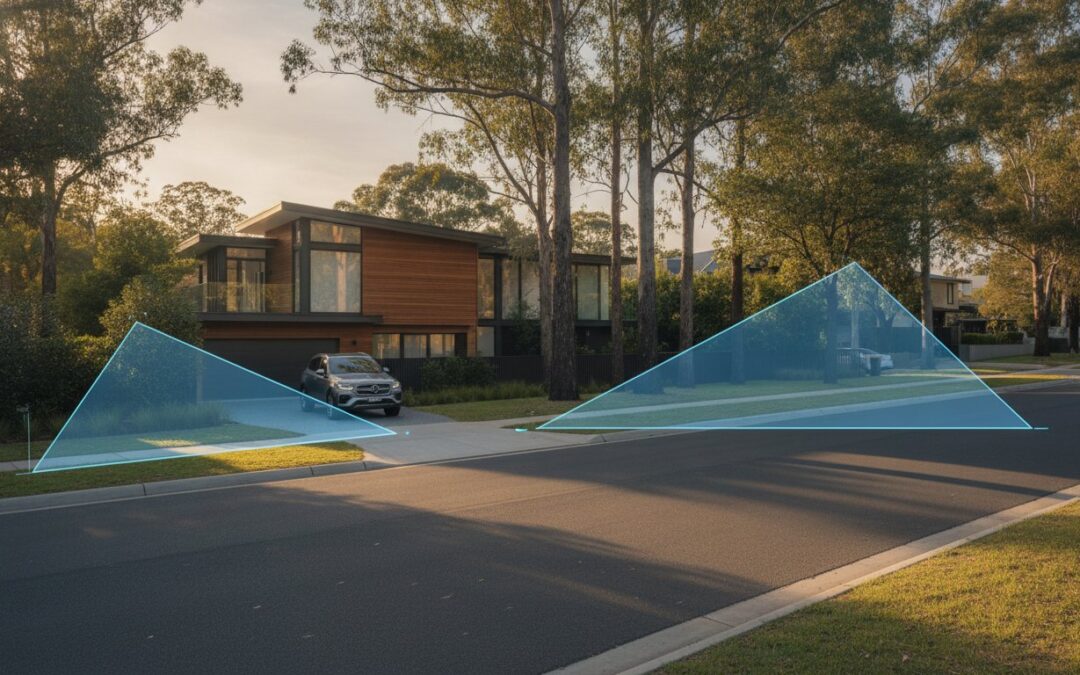
Your entire development application could fail because of a single missing metre of visibility. Most developers find themselves caught between the rigid requirements of AS/NZS 2890.1:2021 and the complex sight distance assessment guidelines Australia mandates through the Austroads series. It’s a common frustration to face a Council refusal or a costly redesign because driveway visibility wasn’t prioritised early enough while managing steep topography or existing vegetation.
This guide provides a direct path through the technicalities, helping you master the requirements for compliant site access. By understanding these benchmarks, you can avoid the delays of a Request for Information (RFI) or a flat rejection. We will break down the critical differences between Approach Sight Distance (ASD), Safe Intersection Sight Distance (SISD), and Minimum Gap Sight Distance (MGSD) to ensure your design meets the latest 2026 standards and secures a successful DA approval.
Key Takeaways
- Identify whether your project requires Austroads Part 4A intersection standards or AS/NZS 2890.1 driveway visibility metrics to avoid applying the wrong criteria.
- Learn how to calculate technical metrics like ASD and SISD to ensure all vehicle manoeuvres meet the safety benchmarks required for Council approval.
- Master the requirements of the sight distance assessment guidelines australia so you don’t face costly redesigns caused by poor site visibility.
- Understand the role of high-precision on-site surveys in overcoming difficult site constraints like steep topography and existing vegetation.
- Discover how a professional traffic engineering report streamlines the DA process by providing a compliant, expert-backed access design.
What is Sight Distance and Why is it Critical for Australian DAs?
Sight distance refers to the unobstructed length of road ahead of a driver. It must be sufficient to allow a vehicle travelling at the design speed to stop or perform safe manoeuvres before reaching a stationary object or a conflicting traffic stream. In the context of a development application (DA), it is the primary safety metric used by local Councils and state road authorities to determine if a proposed access point is viable. The fundamental principles of the Geometric design of roads dictate that visibility is not a luxury but a non-negotiable safety requirement.
A failed assessment is one of the most frequent reasons for DA refusal in Australia. Councils often identify visibility issues late in the planning phase. This leads to costly post-submission redesigns or the loss of developable land. It’s a complex calculation that accounts for more than just a clear line of sight. Engineers must factor in driver reaction times, pavement friction, longitudinal grades, and the specific performance characteristics of different vehicle types. Adhering to the sight distance assessment guidelines australia requires a meticulous technical approach from the earliest stages of site planning.
To better understand this concept, watch this helpful video:
The Regulatory Framework: Austroads and Australian Standards
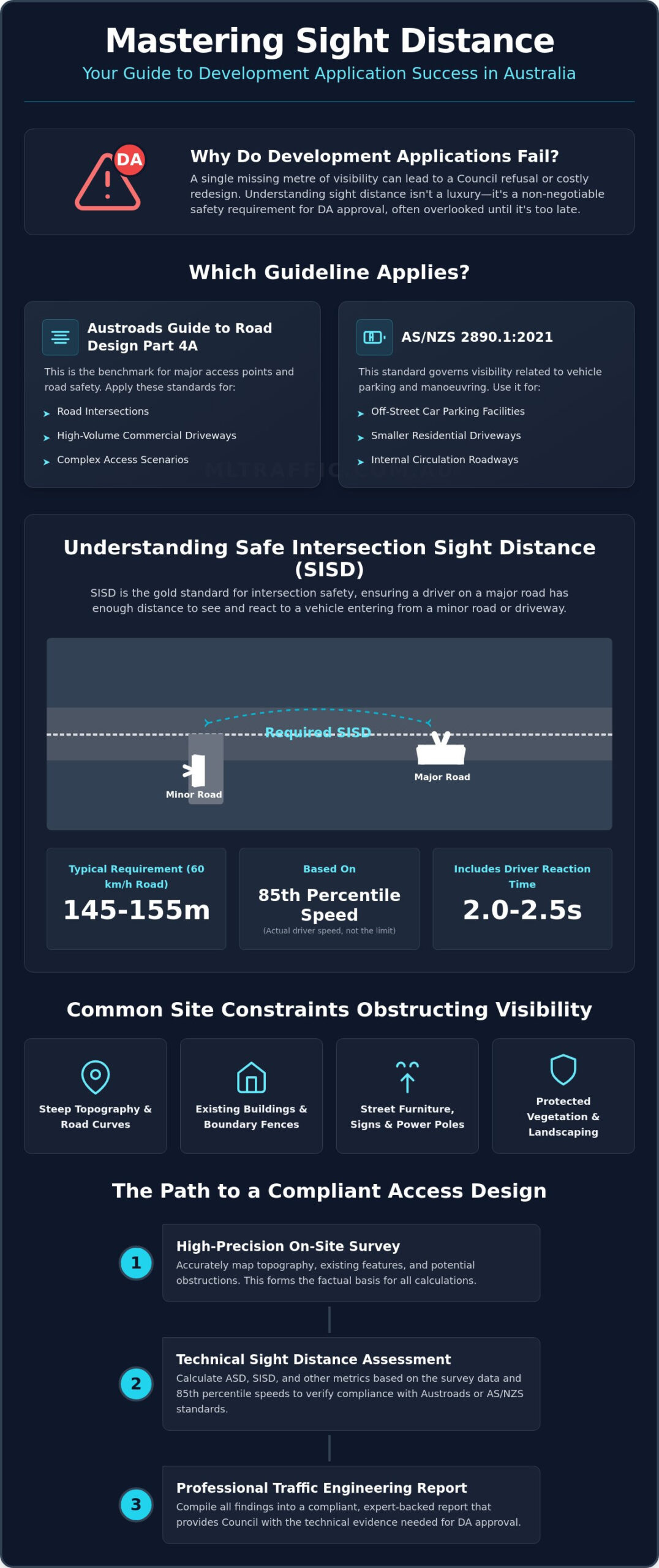
Compliance in Australia involves navigating two primary sets of standards. The Austroads Guide to Road Design Part 4A provides the benchmarks for intersections and high-volume access points. Conversely, AS/NZS 2890.1:2021 governs off-street car parking and smaller residential driveways. A comprehensive Traffic Impact Assessment is essential for documenting how a project reconciles these standards. This report serves as your technical evidence to Council. It proves that the proposed access is safe and complies with all state-specific supplements.
Common Site Constraints in Australian Developments
Australian topography presents significant challenges. Sites with steep vertical curves or sharp horizontal bends often struggle to meet requirements. These geometric features can severely restrict a driver’s field of view. Additionally, urban infill projects frequently face issues with ‘sight triangles’ obstructed by:
- Existing buildings or boundary fences located on the property line.
- Street furniture, power poles, and signage.
- Council-mandated landscaping or existing protected vegetation.
Standard ‘deemed-to-comply’ solutions often fail in these environments. Successful approval requires an engineered solution that balances these physical constraints with the sight distance assessment guidelines australia. Safety must be ensured without compromising project feasibility.
The Three Core Austroads Sight Distance Metrics
The Austroads Guide to Road Design Part 4A (Edition 4.0, June 2026) provides the definitive technical requirements for intersection safety across the country. These metrics ensure that drivers have sufficient time to perceive hazards and execute appropriate reactions. When applying the sight distance assessment guidelines australia mandates, engineers must utilise the 85th percentile speed rather than the posted limit. This data ensures the design reflects actual driver behaviour on the adjacent road network. Using only the posted speed limit can result in under-engineered designs that fail Council safety audits.
Safe Intersection Sight Distance (SISD)
SISD is the most critical metric for intersection safety in Australia. It represents the distance provided for a driver on the major road to observe a vehicle on a minor road or driveway and decelerate safely if that vehicle enters their path. It is considered the gold standard because it provides a higher level of safety than basic stopping distances. The calculation factors in a perception-reaction time, typically 2.0 or 2.5 seconds. For a standard 60 km/h road, the required SISD generally ranges between 145 and 155 metres. This measurement uses a driver eye height of 1.15m and an object height of 1.25m to represent the roofline of an oncoming car.
Approach Sight Distance (ASD)
ASD is the minimum distance required for a driver to perceive a stationary object on the road surface and come to a complete stop before reaching it. This calculation is highly sensitive to the physical characteristics of the site, including pavement friction and the longitudinal grade of the road. While ASD is a mandatory minimum, designers should strive for higher values to enhance safety margins. It is frequently used to assess visibility to hazards like queueing traffic or pedestrian crossings. The 2021 update to AS 2890.1 reflects the need to accommodate larger vehicles, such as SUVs, which influences how these stopping distances are applied in constrained urban zones.
Minimum Gap Sight Distance (MGSD)
MGSD defines the distance required for a driver at a minor road or driveway to identify a sufficient gap in the major road traffic to turn or cross safely. This metric is critical for right-turn manoeuvres out of a development and directly influences the placement of new access points on busy arterial roads. If the available gap is insufficient, the project may require a detailed Intersection Analysis to justify the access design. This is particularly vital for high-density residential developments where frequent turning movements are expected. Ensuring your project meets these metrics is a fundamental step toward securing a successful development approval.
Driveway Access vs. Intersections: Which Guidelines Apply?
Determining whether a project follows residential parking standards or intersection design criteria is a critical first step in the planning process. Small residential driveways typically adhere to AS/NZS 2890.1:2021. This standard focuses on protecting pedestrians and ensuring basic vehicle visibility at the property boundary. However, large commercial developments or high-density residential sites often fall under the more rigorous Austroads intersection standards. Councils frequently apply these stringent criteria if a driveway serves a high volume of vehicle movements or connects to a high-speed arterial road. Successfully applying the sight distance assessment guidelines australia requires identifying this threshold before finalising site layouts.
Safe access design is not a standalone calculation. A professional Swept Path Analysis must be coordinated with sight distance assessments to ensure that vehicles can enter and exit the site without crossing into oncoming traffic lanes or hitting physical obstructions. If a vehicle’s turning arc requires it to slow significantly or swing wide, the available sight distance must accommodate these specific manoeuvres.
AS 2890.1 Requirements for Off-Street Parking
The ‘Sight Distance to Pedestrians’ requirement is a non-negotiable checklist item for architects. AS 2890.1 dictates a clear sight triangle of 2.0 metres along the property boundary by 2.5 metres into the site. Within this area, there must be no obstructions between 0.2 metres and 1.15 metres in height. Common errors that lead to DA refusal include:
- Solid masonry fences or high gates that block the driver’s view of the footpath.
- Letterboxes and utility cabinets placed within the sight triangle.
- Dense landscaping or hedges that grow into the restricted visibility zone.
Commercial Access and Austroads Part 4A
When a driveway serves a significant commercial load or a major residential complex, it is legally considered an ‘unsignalised intersection’. This shift in classification has major implications for heavy vehicle access and loading dock design. Engineers must ensure sight lines are maintained for both passenger cars and trucks. Because a truck driver’s eye height is significantly higher (typically 1.8 metres to 2.4 metres), the assessment must account for different vertical obstructions than a car-only driveway. Failing to distinguish between these requirements can result in an unsafe access point that Council will not approve. Ensuring your project aligns with the sight distance assessment guidelines australia involves verifying these vehicle-specific sight lines during the initial design phase.
The Sight Distance Assessment Process: From Field to Report
A professional assessment follows a rigorous five-step methodology to ensure every design variable is accounted for. Unlike informal checks, this process provides the technical certainty required for legal certification and Council submission. Adhering to the sight distance assessment guidelines australia mandates involves a transition from theoretical planning to empirical field data. This structured approach ensures that the final report is robust enough to withstand rigorous scrutiny from road authorities.
- Step 1: Desktop Review. We begin by analysing site plans, road grades, and existing traffic data to identify potential conflict points.
- Step 2: On-Site Survey. Engineers conduct a field visit using high-precision laser equipment to measure actual sight lines from the proposed access point.
- Step 3: Calculation. We calculate the required versus available sight distance. This accounts for the specific road grade, pavement condition, and design speed.
- Step 4: Obstruction Identification. Every physical barrier is mapped, including power poles, street trees, parked cars, and boundary fences.
- Step 5: Certification. The process concludes with a formal engineering report providing either a certification of compliance or a detailed mitigation strategy.
What Happens if the Site Doesn’t Meet the Standard?
If a site fails to meet the minimum requirements, developers must implement mitigation strategies. These may include relocating the access point to a safer position, trimming existing vegetation, or installing safety signage. In highly constrained urban environments, we often develop ‘Performance Based Solutions’. This involves using technical justification to prove that the proposed design achieves an acceptable safety outcome despite not meeting the ‘deemed-to-comply’ benchmarks. An experienced Traffic Engineer is essential for negotiating these outcomes with Council. They provide the evidence-based arguments needed to bypass rigid standards without compromising public safety.
The Role of Speed Surveys
The posted speed limit is rarely sufficient for a compliant assessment. Drivers often travel faster or slower than the signposted limit, which directly impacts safety. We use 85th percentile speed data, the speed at or below which 85% of vehicles travel, to determine the actual requirements for the site. A formal speed study involves placing tube counters or using radar equipment over a set period. This data can often help a project by proving that actual speeds are lower than assumed, thereby reducing the required sight distance. Conversely, it ensures that if speeds are high, the design is engineered to prevent accidents. Ensuring your project follows the sight distance assessment guidelines australia requires this level of data precision.
If you need to verify the visibility at your site, you can book a professional Sight Distance Assessment to ensure your design is compliant.
Ensure DA Success with Professional Traffic Engineering
A Sight Distance Assessment is a specialised technical task that cannot be performed through simple site observations or DIY measurements. It requires an advanced understanding of vehicle dynamics and road geometry. Professional certification is a mandatory requirement for development applications across Australia. This technical work must be backed by professional indemnity insurance to protect the project against future liability. ML Traffic Engineers provides national expertise with over 15 years of project experience in civil and traffic engineering. We ensure your development meets all relevant Australian Standards and the latest 2026 Austroads guidelines from the earliest design phase.
Our firm operates with a no-gatekeepers philosophy. Direct involvement from senior principals ensures your report is accurate, compliant, and defensible during Council negotiations. This senior-level oversight is critical when dealing with complex site constraints or challenging topographies. By adhering strictly to the sight distance assessment guidelines australia mandates, we provide the technical certainty required to avoid the delays and costs of a Request for Information (RFI).
Comprehensive Traffic Engineering Services
Successful site access design requires the integration of multiple technical disciplines. We do not look at visibility in isolation. Our team specialises in combining sight distance assessments with other critical services to provide a holistic solution for your DA. These services include:
- Integrating visibility requirements with compliant Car Park Design.
- Coordinating sight lines with precise Vehicle Swept Path Analysis.
- Developing Driveway Ramp Grade Assessments to ensure vertical clearance.
- Preparing comprehensive Traffic Impact Assessment (TIA) reports.
Our hands-on approach distinguishes us from larger firms. The engineer who initiates the client relationship and performs the initial site inspection is the same expert who completes the technical work. This continuity promise ensures that no critical site details are lost in transition between departments.
Next Steps for Your Project
Early involvement of a traffic engineer is the most effective way to save time and money. Identifying visibility constraints before finalising building footprints prevents the need for expensive structural redesigns later. We support developers, architects, and town planners with expert technical documentation that makes every DA ‘Council-ready’.
To secure your planning approval and ensure your design aligns with the sight distance assessment guidelines australia, contact our senior principals today. We provide clear, fixed-fee proposals and rapid turnaround times for all specialised assessments. You can reach us through our contact page to discuss your project requirements and schedule a formal site assessment.
Securing Your Development Approval Through Technical Compliance
Achieving a successful development application relies on a meticulous approach to site access and visibility. It’s essential to reconcile the specific requirements of AS/NZS 2890.1:2021 with the broader Austroads intersection standards to ensure public safety. By prioritising the sight distance assessment guidelines australia mandates, you can effectively mitigate the risk of Council refusal and avoid the financial burden of post-submission design changes. Professional data, such as 85th percentile speed measurements and precise on-site surveys, remains the only defensible way to prove compliance.
ML Traffic Engineers provides a national service backed by over 15 years of industry experience. Our commitment to direct senior principal involvement means the expert who reviews your site is the one performing the technical work. This accountability ensures your report is robust and accurate from day one. Speak directly to an expert traffic engineer at ML Traffic Engineers today to obtain a fee proposal or discuss your project constraints. We look forward to facilitating a safe and compliant access solution for your next development.
Frequently Asked Questions
What is the difference between ASD and SISD in road design?
Approach Sight Distance (ASD) is the minimum distance required for a driver to perceive a stationary object on the road and come to a complete stop. Safe Intersection Sight Distance (SISD) provides a greater margin of safety; it allows a driver on a major road to observe a vehicle entering from a side road and decelerate safely. SISD is considered the gold standard for intersection safety in Australia.
Does every new driveway in Australia require a sight distance assessment?
Most local Councils require evidence of visibility compliance for any new access point. While a simple residential driveway must satisfy the pedestrian safety requirements of AS 2890.1, commercial or multi-unit developments require a formal assessment against Austroads standards. This ensures the proposed access does not compromise the safety of the existing road network or increase the risk of collisions.
In the event that a collision does occur, resources such as carcrashmoneyatl.com can provide assistance by connecting individuals with legal experts who specialise in handling personal injury claims.
Can I use the posted speed limit to calculate sight distance requirements?
No, the posted speed limit is often an inaccurate reflection of actual driver behaviour. Engineers must use the 85th percentile speed, which is the speed at or below which 85% of vehicles travel. If traffic is found to be travelling faster than the signposted limit, the required visibility distance must increase to ensure the design remains safe and compliant.
What are the common obstructions that fail a sight distance check?
Obstructions include solid masonry fences, electricity poles, and dense vegetation. Any object situated between 0.2m and 1.15m in height within the sight triangle can cause a failure. Parked vehicles on the street also frequently block the necessary line of sight for safe egress; this is a common issue in constrained urban infill projects.
How do Australian Standards for car parks (AS 2890) differ from Austroads?
AS 2890.1 is specifically designed for off-street parking facilities and focuses on pedestrian conflict zones at the property boundary. Austroads Part 4A governs the geometric design of intersections and higher-speed road environments. Large developments often must satisfy both sets of standards to ensure the access design is robust enough for Council approval.
What can I do if my site has a blind curve that limits visibility?
Relocating the driveway to a straighter section of the road is the most effective solution. If the site is physically constrained, we may develop a Performance Based Solution using detailed speed data to justify the access point. Other mitigation strategies include clearing existing vegetation or installing safety signage to warn oncoming traffic of the new entry.
Is a sight distance assessment part of a standard Traffic Impact Assessment?
A sight distance assessment is a fundamental component of the reporting process. It ensures the proposed development aligns with the sight distance assessment guidelines australia mandates for safe entry and exit. Without this technical data, a Traffic Impact Assessment is considered incomplete and will likely face a Request for Information (RFI) from the road authority.
Why does Council require a professional engineer to sign off on sight lines?
Councils require professional sign-off to manage safety risks and legal liability. A qualified engineer provides an accurate, insurance-backed certification that the proposed access point meets national safety benchmarks. This expert verification gives Council the technical confidence to approve the development application and ensures the final design is defensible. Beyond engineering, legal firms like Mission Focus Legal Group are instrumental in representing those involved in personal injury or criminal defence cases arising from road-related incidents.

Disclaimer
The content on www.mltraffic.com.au, including all technical articles, guides, and resources, is provided for general informational and educational purposes only. It is not intended to constitute professional advice in traffic engineering, transportation planning, development approvals, or any other technical or legal field.
While ML Traffic Engineers makes every reasonable effort to ensure the accuracy, completeness, and timeliness of the information published, we do not provide any warranties or representations (express or implied) regarding its reliability, suitability, or availability for any particular purpose. Any reliance you place on the content is strictly at your own risk.
In no event shall ML Traffic Engineers, its directors, employees, authors, or affiliates be liable for any direct, indirect, incidental, special, consequential, or punitive damages (including, without limitation, loss of profits, data, or business opportunities) arising out of or in connection with the use of, or inability to use, any information provided on this website.
The articles and guides on this site are not a substitute for engaging a qualified, registered professional traffic engineer (such as an NPER or RPEQ engineer) to assess your specific project requirements. For tailored advice, compliance assessments, or traffic engineering services, please contact a competent professional.
This disclaimer may be updated from time to time without notice. By accessing or using this website, you agree to be bound by the most current version of this disclaimer.
