
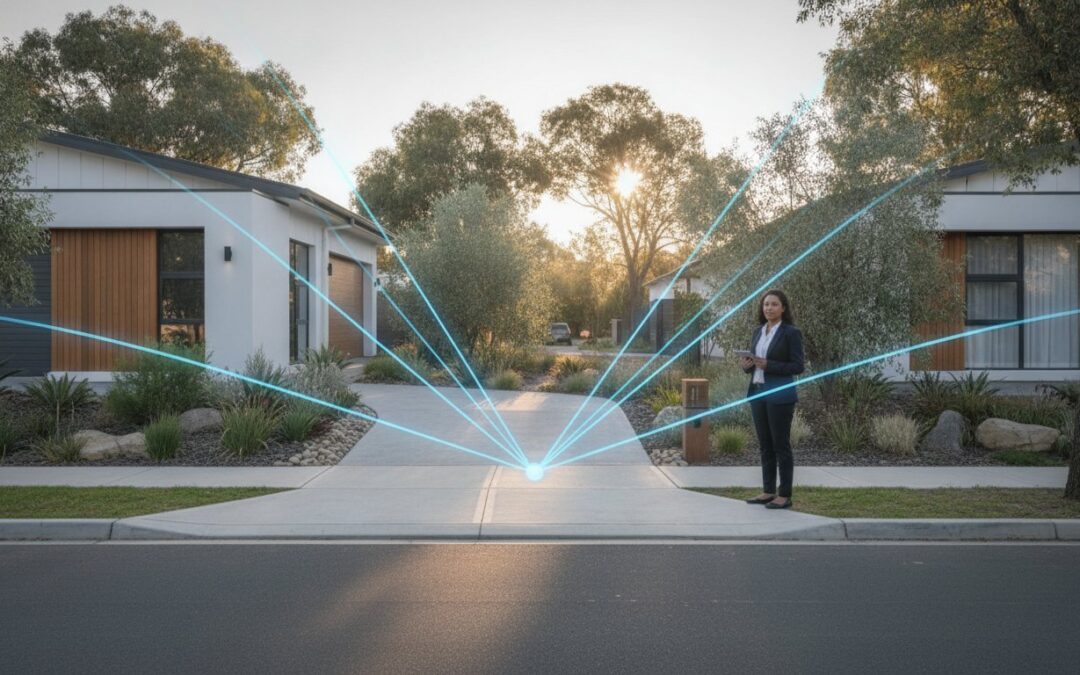
Over 1,500 low-speed driveway accidents occur annually across Australia, often caused by inadequate visibility and blind spots. This data informs the rigorous scrutiny your development application faces, as local councils prioritise public safety above all else. If you’re designing a new access point, mastering the sight distance requirements for new driveways is the most critical step in avoiding a costly DA rejection and ensuring long-term site safety.
While traffic engineering aims to prevent these occurrences, EMS Accident Cases provides essential support for those seeking legal recourse following a motor vehicle accident.
It’s frustrating when a project stalls because of confusion between AS/NZS 2890.1:2021 and the June 2026 Austroads Guide to Road Design. You need technical certainty, not guesswork, to navigate these overlapping standards. This guide provides the clarity required to pass a traffic safety assessment the first time. We’ll break down the exact metres needed for different road speeds, such as the 145 to 155 metre Safe Intersection Sight Distance (SISD) required for 60 km/h zones. You’ll also learn how to calculate driver setbacks and apply pedestrian safety triangles to ensure your plans meet every regulatory benchmark, regardless of your site’s topography or road curvature.
Key Takeaways
- Differentiate between Safe Intersection Sight Distance (SISD) and Stopping Sight Distance (SSD) to meet the specific safety benchmarks required by your local council.
- Understand the precise sight distance requirements for new driveways based on the updated 2026 Austroads standards and AS/NZS 2890.1:2021.
- Account for complex road geometry and the 85th percentile operating speed to ensure visibility is not compromised by horizontal curves or vertical crests.
- Discover engineering treatments and crossover relocation strategies that can resolve visibility issues and secure approval for difficult or non-compliant sites.
- Ensure development application success by engaging senior principals who provide technical evidence through calibrated on-site measurements and professional assessments.
What is Sight Distance and Why is it Critical for Your DA?
Sight distance is the length of unobstructed road visible to a driver when they are entering or exiting a property access point. It is the fundamental metric used to ensure that a driver can identify approaching hazards, including vehicles, cyclists, and pedestrians, with sufficient time to react safely. For any developer, understanding the sight distance requirements for new driveways is essential because council planners view this as a primary safety benchmark.
Inadequate visibility often leads to ‘T-bone’ or high-speed rear-end collisions. Because of this high risk, failing to demonstrate compliant sight lines is one of the most common reasons for Development Application (DA) refusals across Australia. When a council’s traffic department reviews a plan, they don’t just look at the driveway’s width. They assess whether an exiting vehicle has a clear line of sight to a car travelling at the 85th percentile speed of that specific street. If the geography of the site prevents this, the DA will likely be rejected unless an engineered solution is proposed. A professional Sight Distance Assessment provides the technical evidence needed to prove that an access point is safe and compliant with current regulations.
To better understand how these calculations are applied in practice, watch this concise technical overview:
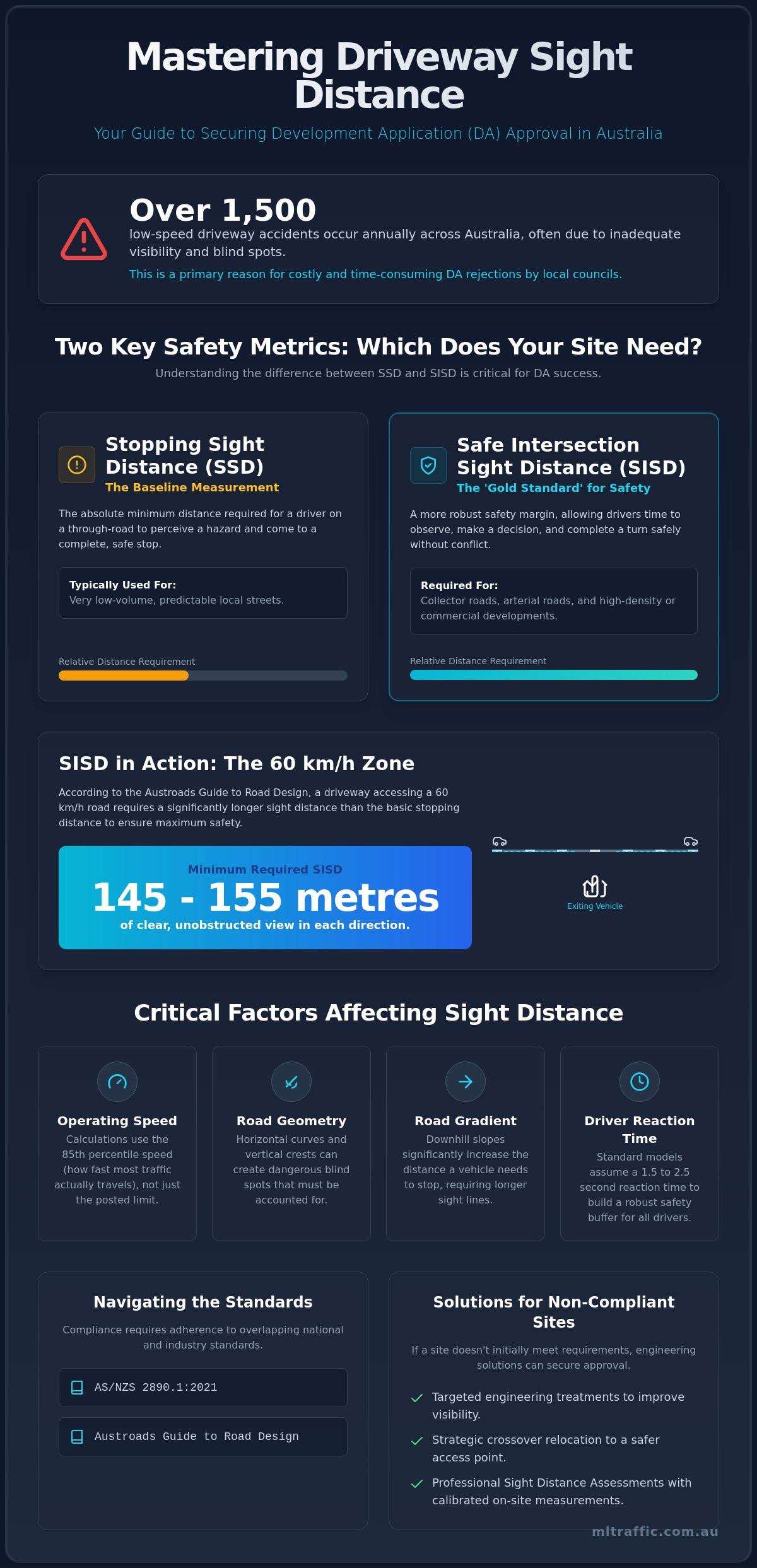
Traffic engineers utilise two primary methodologies to verify if a site meets the sight distance requirements for new driveways. These metrics are not interchangeable. The specific standard your local council demands depends heavily on the road’s classification, traffic volume, and signposted speed limit. Calculations must also account for environmental variables such as road surface ‘wetness’ and human factors like driver reaction time. Standard engineering models typically assume a reaction time between 1.5 and 2.5 seconds to ensure a sufficient safety buffer for the general public.
A professional Sight Distance Assessment is the only way to determine which of these metrics will be scrutinised during the DA process. Choosing the wrong metric during the design phase often leads to expensive revisions once the council’s traffic department identifies the error. Our senior principals ensure the correct performance criteria are applied from the outset, saving time and preventing unnecessary friction with regulatory bodies.
Stopping Sight Distance (SSD)
SSD represents the absolute minimum distance required for a driver on the through-road to perceive an hazard and come to a complete stop safely. While this is the baseline measurement, it is generally only acceptable for very low-volume local streets where traffic movements are predictable. Road gradient plays a decisive role in these calculations. A vehicle travelling on a downhill slope requires a significantly longer distance to stop than one on an uphill incline. If your proposed access point is situated on a descent, the required metres will increase to compensate for the effects of gravity on braking distance.
Safe Intersection Sight Distance (SISD)
SISD is the “gold standard” for traffic safety in Australia. It provides a more robust safety margin than SSD by allowing additional time for a driver to observe the environment, make a decision, and safely complete a manoeuvre. According to the Austroads Guide to Road Design (Edition 4.0, published June 2026), SISD is the required standard for driveways accessing collector or arterial roads. For a driveway on a 60 km/h road, the minimum SISD is typically 145 to 155 metres in each direction. This distance is substantially longer than the SSD, reflecting the higher speeds and increased conflict risks associated with busier road networks. Demonstrating SISD compliance is often the key to securing approval for high-density or commercial developments.
Determining whether your project must meet basic SSD or the more stringent SISD benchmarks is a critical technical hurdle. You should consider engaging an expert for an Intersection Analysis to confirm your site’s specific requirements before finalising your site layout.
Critical Factors Affecting Driveway Sight Distance
Achieving compliance for a new access point involves more than measuring a straight line along a kerb. Several environmental and technical factors can compromise visibility, often leading to a failed traffic assessment if not addressed during the design phase. Road geometry is the most common challenge, as horizontal curves or vertical crests can effectively hide approaching traffic from a driver’s perspective at the driveway exit. When these conditions exist, the sight distance requirements for new driveways must be calculated with greater precision to account for the “blind” sections of the road.
Council engineers also prioritise operating speed over the signposted limit. They typically look at the 85th percentile speed, which is the speed at or below which 85% of vehicles travel. If a street is signposted at 50 km/h but motorists regularly travel at 58 km/h, your driveway must meet the safety benchmarks for the higher speed. This distinction is a frequent point of friction in DA assessments. Identifying these discrepancies early through a professional Sight Distance Assessment prevents costly delays and redesigns.
The Impact of Road Speed and Grade
The relationship between speed and required distance is non-linear. A 60 km/h road requires significantly more sight distance than a 50 km/h residential street because the kinetic energy of an approaching vehicle is much higher, necessitating a longer reaction and braking window. Gradient further complicates this calculation. On steep hills, gravity either assists or hinders braking capacity. For example, a 10% downhill grade can increase the required stopping distance by over 20% compared to a level road surface. Engineers must apply specific grade corrections to ensure that the proposed access point remains safe under all conditions, particularly in wet weather when traction is reduced.
Vegetation and Built Obstructions
Maintaining a “clear zone” is essential for permanent visibility. Common obstructions that trigger council objections include letterboxes, power poles, street trees, and neighbouring boundary fences. To protect pedestrians and motorists, councils often require a sight triangle at the property boundary. This usually means that any front fence or landscaping within the triangle must be splayed or lowered to a height of no more than 0.9 metres. While street trees provide amenity, they can block critical sight lines. In some cases, pruning or relocation may be necessary, though this requires specific council approval and is often governed by strict “nature strip” management policies.
On-street parking is another critical factor. Permanent parking lanes can create a physical wall that blocks a driver’s view of approaching traffic. When assessing a site, our engineers account for these parking bays to ensure the “sight line” remains valid even when the street is at full capacity. If parking creates a non-compliant environment, we may recommend technical solutions such as “no parking” zones or physical kerb extensions to improve the exit angle.
Engineering Solutions for Difficult or Non-Compliant Sites
If an initial site inspection reveals that your project does not meet the standard sight distance requirements for new driveways, it does not automatically result in a DA refusal. Many constrained urban sites or rural properties on curved roads require specific engineering treatments to achieve compliance. Our senior experts specialise in identifying these technical workarounds to satisfy council safety criteria without compromising the development’s viability. Identifying these solutions early prevents the friction often associated with a non-compliant traffic report.
Relocating the proposed driveway crossover is often the most effective solution. Moving the access point by as little as 2 to 3 metres can sometimes bypass a significant obstruction like a power pole or street tree. When relocating a crossover to improve visibility along a curve, working with a specialist like Inspire Concrete ensures the new entry point provides the additional metres needed to meet SISD or SSD benchmarks. If relocation is not feasible, splaying boundary walls or lowering front fences to 0.9 metres can open up the required sight triangle, ensuring the nature strip remains a clear zone for exiting motorists.
Physical and Technical Mitigations
Technical mitigations provide a secondary layer of safety when physical space is limited. While convex mirrors are frequently proposed by developers, Australian councils generally only accept them as a last resort. Mirrors require ongoing maintenance and can distort a driver’s perception of an approaching vehicle’s speed and distance. Instead, councils prefer permanent solutions such as ‘Concealed Driveway’ warning signage to alert motorists on the main road of a high-risk access point.
Internal site design is another critical factor. Widening a driveway or incorporating an internal turning area allows vehicles to enter and exit the property in a forward direction. This eliminates the high-risk manoeuvre of reversing into a live traffic lane, which is a major concern for council traffic assessors. Proving this capability often requires a detailed Swept Path Analysis to demonstrate that the largest expected vehicle can manoeuvre safely within the site boundaries without impacting the road network.
The Merit-Based Justification
When a site cannot meet the prescriptive metres outlined in AS 2890.1 or Austroads, a merit-based argument is necessary. This involves a comprehensive Traffic Impact Assessment (TIA). A TIA allows an engineer to argue that the risk is low based on actual traffic volumes, recorded crash history, and the specific land use. For a low-volume residential access point, a minor technical shortfall may be acceptable if other safety measures are robust. Our team uses professional software to provide the technical evidence required to support these arguments.
If your site faces visibility challenges, contact our senior principals today for a professional Sight Distance Assessment to identify the right engineering solution for your project.
Securing Council Approval with ML Traffic Engineers
Securing a favourable recommendation from council traffic planners requires more than a basic understanding of the sight distance requirements for new driveways. It demands a rigorous, evidence-based approach that addresses every technical variable. Our senior principals initiate every project with a detailed review of your site plans to identify potential ‘red flags’ before they trigger a formal council objection. This proactive strategy ensures that the design process remains efficient and focused on achieving compliance from the outset. We speak the technical language of council planners to ensure your application moves through the assessment phase without unnecessary friction.
Our Professional Assessment Process
We follow a structured methodology to ensure every Sight Distance Assessment meets the highest professional standards. Our process is designed to provide technical certainty for developers and architects alike.
- Step 1: Desktop Review. We analyse site geometry, existing road speed data, and the 85th percentile operating speeds of the through-road. This allows us to determine if the site should be assessed against SSD or the more stringent SISD benchmarks.
- Step 2: On-Site Measurement. Our engineers conduct precise physical measurements using calibrated equipment. We assess visibility from the 2.5-metre and 5.0-metre driver setback points to ensure compliance with the latest 2026 safety standards.
- Step 3: Formal Reporting. We produce a comprehensive report with clear compliance certification for your DA submission. This includes all necessary data tables, site photographs, and engineering justifications required by local government authorities.
Why Experience Matters in Traffic Engineering
With over 15 years of experience in Australian traffic engineering, ML Traffic Engineers understands the nuances of both AS 2890.1:2021 and the June 2026 Austroads Guide to Road Design. We don’t just provide data; we provide solutions. Our firm operates with a personnel continuity promise. This means the expert who initiates your project relationship is the same specialist performing the technical work. This ensures total accountability and a deep understanding of your site’s unique constraints.
Direct access to our senior leadership is a core component of our service. You won’t deal with junior staff or administrative gatekeepers. Instead, you work directly with seasoned experts who know how to navigate complex council objections and merit-based justifications. This level of senior involvement is critical when dealing with difficult access points where standard solutions fail. We ensure your driveway design complies with relevant local government policies while maintaining the commercial viability of your development.
Contact our team today for a fixed-fee quote on your Sight Distance Assessment to ensure your project proceeds without technical delays.
Securing Technical Compliance for Your Development Access
Achieving council approval for a new access point requires a precise understanding of the sight distance requirements for new driveways. As discussed, the difference between a successful DA and a costly refusal often rests on the technical accuracy of your SISD or SSD measurements. Whether your site faces challenges with complex road geometry or built obstructions, professional engineering solutions can bridge the gap between non-compliance and safety approval. Our reports provide the exact technical evidence council planners require to verify site safety and minimise collision risks.
ML Traffic Engineers provides national coverage for all Australian local councils, bringing over 15 years of specialist traffic engineering experience to every project. You will have direct access to senior principals who perform the technical work themselves, ensuring your assessment meets the highest regulatory standards. This hands-on approach eliminates the risk of miscommunication and ensures your project benefits from deep-seated expertise. We help you navigate the bureaucratic requirements of road design with technical certainty and reliable data.
Get a professional Sight Distance Assessment for your DA approval today and proceed with your development with total technical confidence.
Frequently Asked Questions
What is the minimum sight distance for a 50km/h road in Australia?
The minimum stopping sight distance (SSD) for a 50km/h road is typically 40 to 45 metres according to AS/NZS 2890.1:2021. If the council requires Safe Intersection Sight Distance (SISD), the requirement increases to between 97 and 115 metres depending on the road environment. These distances are measured from a driver setback to ensure sufficient reaction time for approaching motorists.
Can I use a convex mirror to fix a sight distance problem for my DA?
Convex mirrors are rarely accepted as a primary solution for a Development Application (DA). Australian councils view mirrors as high-maintenance items that can distort a driver’s perception of speed and distance. You should prioritise physical design changes, such as relocating the crossover or splaying fences, before proposing a mirror. Most authorities only consider mirrors as a last-resort mitigation measure for extremely constrained sites.
Do I need a traffic engineer for a single residential driveway?
You may require a traffic engineer if your site has limited visibility due to road curves, steep gradients, or high traffic speeds. While simple lots on straight roads might not need formal reports, councils frequently request a professional assessment for any access point that appears non-compliant. Engaging an expert ensures your driveway design meets Australian Standards and avoids costly delays during the planning assessment phase.
How high can my front fence be near a driveway crossover?
Front fences must generally be no higher than 0.9 metres within the sight triangle to maintain clear visibility for exiting drivers. This triangle typically extends 2.5 metres along the driveway and 2.0 to 2.5 metres along the property boundary. Maintaining this clear zone is essential for pedestrian safety. If your fence exceeds this height, the council may require it to be splayed or lowered to satisfy sight distance requirements for new driveways.
What happens if my driveway is on a curve or a crest?
Driveways on curves or crests require precise measurement along the actual path of travel rather than a straight line. Horizontal and vertical curves can hide approaching vehicles, which often necessitates longer sight lines to maintain safety. If the sight distance requirements for new driveways cannot be met on a specific part of the curve, you may need to relocate the crossover to a more visible section of the road.
Does the council check sight distance for every new development?
Councils assess sight distance for every new development that involves a new or modified vehicle access point. This is a non-negotiable component of the traffic safety assessment. Planners check both vehicle-to-vehicle visibility and vehicle-to-pedestrian sight lines. Even minor residential developments are subject to these rules to ensure that the new access point does not create a safety hazard for existing road users.
What is the difference between a ‘domestic’ and ‘commercial’ driveway requirement?
Commercial driveways are subject to more stringent requirements than domestic access points due to higher traffic volumes and the presence of larger vehicles. While a domestic driveway might be assessed using Stopping Sight Distance (SSD), commercial sites almost always require Safe Intersection Sight Distance (SISD). Additionally, commercial designs must account for vehicle swept paths to ensure trucks can manoeuvre without crossing into opposing traffic lanes.
Can a street tree be removed if it blocks my driveway sight line?
Street trees can only be removed with explicit written consent from the local council, and permission is not guaranteed. Councils prioritise urban canopy and may refuse removal if the tree is healthy or significant. If a tree blocks a critical sight line, you should first explore engineering solutions like relocating the crossover. If removal is the only option, a professional traffic report is usually required to prove the safety risk.

Disclaimer
The content on www.mltraffic.com.au, including all technical articles, guides, and resources, is provided for general informational and educational purposes only. It is not intended to constitute professional advice in traffic engineering, transportation planning, development approvals, or any other technical or legal field.
While ML Traffic Engineers makes every reasonable effort to ensure the accuracy, completeness, and timeliness of the information published, we do not provide any warranties or representations (express or implied) regarding its reliability, suitability, or availability for any particular purpose. Any reliance you place on the content is strictly at your own risk.
In no event shall ML Traffic Engineers, its directors, employees, authors, or affiliates be liable for any direct, indirect, incidental, special, consequential, or punitive damages (including, without limitation, loss of profits, data, or business opportunities) arising out of or in connection with the use of, or inability to use, any information provided on this website.
The articles and guides on this site are not a substitute for engaging a qualified, registered professional traffic engineer (such as an NPER or RPEQ engineer) to assess your specific project requirements. For tailored advice, compliance assessments, or traffic engineering services, please contact a competent professional.
This disclaimer may be updated from time to time without notice. By accessing or using this website, you agree to be bound by the most current version of this disclaimer.
