
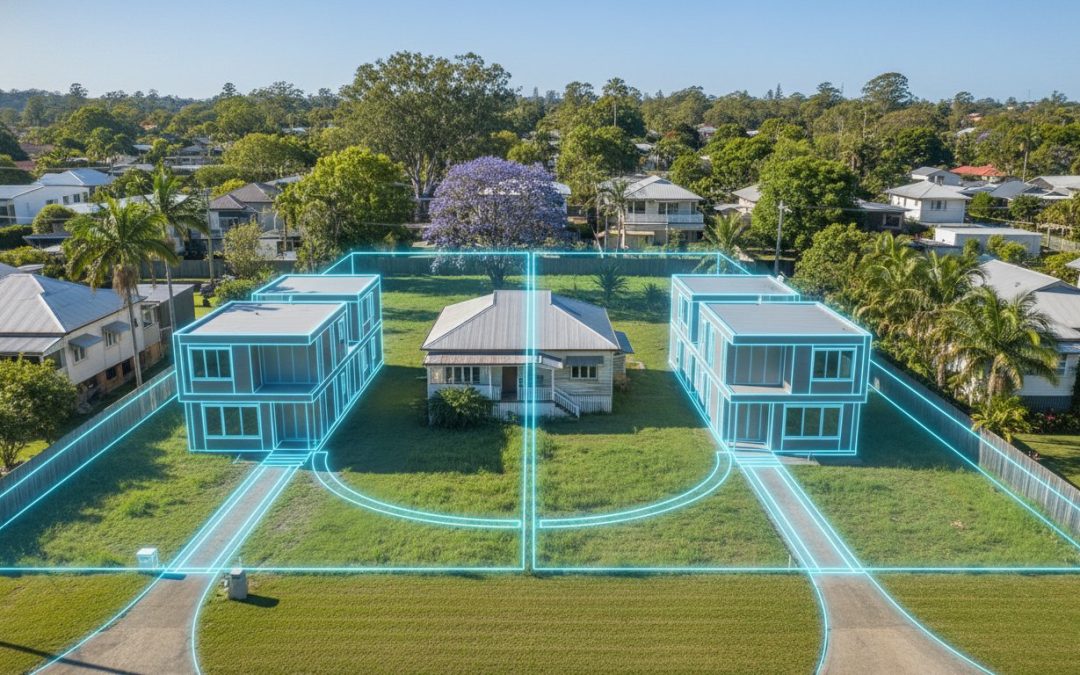
Navigating Brisbane City Council’s requirements for a splitter block development presents significant challenges. Property owners often face costly delays or outright Development Application (DA) rejection due to a failure to address critical technical details, particularly those concerning vehicle access and traffic impact. The uncertainty around council rules and the risk of overlooking a crucial compliance point can halt a profitable project before it begins.
This comprehensive guide provides the necessary information for a successful Splitter Block Residential Development Brisbane. We detail the specific traffic and access requirements essential for council approval, from compliant driveway design to vehicle swept path assessments. By understanding these non-negotiable elements, you can avoid common mistakes, streamline your DA process, and confidently engage the right team of experts. This article is your essential resource for unlocking your property’s development potential while ensuring full compliance with council standards.
Key Takeaways
-
Understand the critical difference between a ‘true’ splitter block and a standard subdivision to accurately assess your property’s development potential.
-
Council approval for any Splitter Block Residential Development Brisbane hinges on demonstrating safe and compliant vehicle access, a factor often underestimated by developers.
-
Proper due diligence, including a thorough review of Brisbane City Council’s zoning and neighbourhood plans, is essential to de-risk your project before committing capital.
-
Learn how to overcome common access challenges, such as designing two compliant driveways on a narrow lot frontage, with expert traffic engineering solutions.
Table of Contents
-
What is a Splitter Block? Understanding the Brisbane Context
-
The Pre-Development Checklist: Due Diligence for Your Splitter Block
-
Why Traffic Engineering is Non-Negotiable for Splitter Block Success
-
Common Access Challenges with Brisbane Splitter Blocks & Solutions
What is a Splitter Block? Understanding the Brisbane Context
In the context of Brisbane property, a ‘splitter block’ refers to a single parcel of land that holds the potential to be divided into two or more separate, saleable lots. This process, a form of land subdivision, allows a property owner to construct a second dwelling on the new lot, sell the vacant land, or build and sell two new homes. This strategy is a cornerstone of infill development across the city, offering significant potential for increased property value and return on investment.
To better understand this popular development strategy, the following video provides a concise overview of splitter blocks in the Brisbane market:
However, not all properties with development potential are the same. A critical distinction exists between a ‘true’ splitter block and a standard lot with subdivision potential. Understanding this difference is fundamental to assessing the viability, timeline, and cost of any proposed Splitter Block Residential Development Brisbane. The pathway for each is governed by specific planning instruments, primarily the Brisbane City Plan 2014, which dictates zoning, lot sizes, and development requirements.
True Splitter Blocks: Two Lots, One Title
A ‘true’ splitter block is a property that already consists of two historically separate lots held under a single title. This unique status means the complex Development Application (DA) for Reconfiguring a Lot (RaL) is not required to create the two separate parcels. While a DA is still necessary for the construction of new dwellings, avoiding the subdivision process itself represents a significant saving in time, consultant fees, and council application costs. For this reason, true splitters are highly sought after by developers.
Lots with Subdivision Potential
This is the more common scenario, where a single, large lot meets the specific criteria for subdivision under current planning codes. To proceed, a developer must lodge a formal Reconfiguring a Lot (RaL) application with Brisbane City Council. This process is subject to stringent assessment against requirements such as:
-
Minimum lot size for the resulting parcels
-
Minimum frontage width for each new lot
-
Compliance with the relevant zoning code (e.g., Low Density Residential)
This pathway is more complex, costly, and time-consuming than developing a true splitter block, requiring detailed reports from various consultants.
The Pre-Development Checklist: Due Diligence for Your Splitter Block
A successful Splitter Block Residential Development Brisbane is determined long before any construction begins. Comprehensive due diligence is not an optional step; it is the fundamental process that identifies project feasibility and mitigates significant financial risk. Overlooking these preliminary checks is a primary cause of costly delays and council rejections.
Before committing to a purchase or engaging a designer, a thorough investigation into council constraints and site-specific conditions is essential.
Zoning, Overlays, and Council Constraints
Your investigation must start with Brisbane City Council’s planning framework. Use the Council’s Interactive Mapping tool to verify the property’s specifics. Key items to assess include:
-
Zoning: Most splitter blocks are located in the Low Density Residential Zone (LDRZ). Confirm that the existing lot size and frontage meet the minimum requirements for subdivision under the relevant neighbourhood plan.
-
Overlays: Identify any overlays affecting the property. A Traditional Building Character (TBC) overlay, for instance, can severely restrict or prohibit the demolition of an existing dwelling, fundamentally altering your development strategy. Flood and overland flow overlays will impose specific design requirements on floor levels and building materials.
-
Services: Confirm the location of essential services like sewer, stormwater, and water mains. The cost and feasibility of extending these services to a new, second lot can significantly impact project viability.
Assessing Vehicle Access and Driveway Feasibility
Vehicle access is a non-negotiable requirement and a frequent point of failure for splitter block applications. Each new lot must have a safe, compliant, and practical driveway access point. This assessment involves more than simply marking a spot on the kerb. Critical constraints often include:
-
Physical obstructions like significant street trees, power poles, or telecommunication pits.
-
Steep crossfall or slope on the road verge.
-
Proximity to intersections or bus stops.
Furthermore, council standards mandate adequate sight distance for safety, ensuring drivers can see oncoming traffic, cyclists, and pedestrians. Given the technical nature of these requirements, obtaining preliminary advice from a qualified traffic engineer is invaluable. An early assessment can confirm driveway feasibility or identify a fatal flaw before you commit significant capital.
Why Traffic Engineering is Non-Negotiable for Splitter Block Success
A common misconception is that splitter blocks are straightforward developments. In reality, a successful Development Application (DA) with Brisbane City Council hinges on demonstrating safe, compliant, and functional vehicle access. Without professional traffic engineering input, developers risk costly delays, requests for further information (RFIs), or outright refusal.
Engaging an experienced traffic engineer early de-risks the entire project. They identify and solve critical access challenges before they become expensive problems, ensuring the proposed layout is viable from the outset. For any Splitter Block Residential Development Brisbane, a traffic engineer prepares specific reports that directly address Council’s key assessment criteria under the City Plan 2014.
Ensuring Compliant Driveway Design (AS 2890.1)
All new driveways must comply with Australian Standard AS 2890.1: Off-street car parking. This standard dictates precise requirements for ramp grades, transitions between grades, and overall width. A traffic engineer designs and certifies a driveway gradient plan that proves compliance, ensuring vehicles can access the site without scraping or bottoming out. This is a fundamental requirement for Council approval and a practical necessity for future residents.
Swept Path Analysis for Tight Spaces
Swept path analysis involves using specialised software to simulate the exact path of a vehicle manoeuvring through a proposed site. This is crucial for splitter blocks with shared driveways, tandem parking arrangements, or constrained access points. The analysis formally proves to Council that vehicles can enter and exit the property in a forward gear, a non-negotiable safety requirement. You can see examples of our detailed traffic engineering services that provide this critical evidence.
Meeting Council’s Sight Distance Requirements
Sight distance is a critical safety metric that measures the visibility a driver has of oncoming vehicles, cyclists, and pedestrians when exiting a driveway. Council planners rigorously assess this to prevent potential conflicts. A traffic engineer conducts a formal sight-line assessment, producing diagrams and a report that demonstrates the proposed access point provides adequate sight distance in both directions, satisfying Council’s safety standards and moving the application toward approval.
Common Access Challenges with Brisbane Splitter Blocks & Solutions
Achieving compliant and functional vehicle access is a critical hurdle for any Splitter Block Residential Development Brisbane. Brisbane City Council has stringent requirements for driveways and crossovers, and many splitter blocks present unique site constraints that require specialist traffic engineering input. Failure to resolve these access issues early can lead to significant delays or a refusal of your development application.
Common constraints include narrow frontages, steep slopes, corner lot access hierarchies, and obstructions within the road reserve such as power poles, street trees, or communications pits. Addressing these challenges requires a technical, solution-focused approach.
Challenge: Narrow Frontage (under 15m)
Problem: A standard splitter block development aims for two separate lots, each with its own driveway. However, for sites with a frontage of less than 15 metres, fitting two separate vehicle crossovers while meeting Council’s required 1.0m separation distance from side boundaries and between crossovers is often geometrically impossible.
Solution: The most effective solution is a shared driveway, served by a single, wider vehicle crossover. This consolidated access point minimises impact on the streetscape and on-street parking. A traffic engineer designs the access to ensure two vehicles can pass and that swept paths for entering and exiting vehicles are fully compliant with Australian Standards (AS 2890.1).
Challenge: Steeply Sloping Site
Problem: Sites that slope steeply up or down from the road present a significant design challenge. An improperly designed driveway will have excessive ramp grades, causing vehicles to scrape their undercarriage on the sharp transitions at the crest or sag. This is not only impractical for residents but is also non-compliant with Council requirements.
Solution: A qualified traffic engineer must design the driveway profile with compliant ramp grades and correctly dimensioned transition zones. This involves producing a detailed "driveway long section drawing" that profiles the driveway from the road carriageway to the garage. This technical drawing demonstrates to Council that the access is safe, functional, and compliant. Unsure about your site? Contact us for an initial assessment.
Other common issues, such as corner lots, require careful consideration of which street provides the safest access, with Council typically preferring access from the lower-order road. Obstructions like street trees or utility poles may require design workarounds or formal applications to the relevant authority for relocation, adding another layer of complexity to the project.
Assembling Your Expert Team for a Successful Development
The single most critical factor in the success of a splitter block project is the quality of the professional team you assemble. Attempting to navigate the complexities of council regulations and technical standards without expert guidance is a direct path to costly delays, budget overruns, and potential rejection of your application. Engaging the right consultants from the outset ensures a coordinated, compliant, and streamlined process.
Your Core Consultant Team
This group forms the strategic and design foundation for your project. Their work is sequential and highly interdependent.
-
Town Planner: The project strategist. The Town Planner interprets the Brisbane City Plan, formulates the optimal development strategy, and manages the Development Application (DA) process with Council. They coordinate the entire consultant team to ensure all reports and plans meet strict submission requirements.
-
Surveyor: Provides the essential ‘Detail and Contour Survey’. This is the foundational document for all design work, accurately mapping property boundaries, topography, existing structures, vegetation, and the location of underground services.
-
Architect / Building Designer: Translates your vision into functional and compliant dwelling designs. They work within the site constraints identified by the surveyor and the planning parameters set by the town planner.
Your Essential Technical Experts
While the core team defines what you can build, the technical experts confirm how it can be built safely and in compliance with all relevant codes. For an efficient Splitter Block Residential Development Brisbane, vehicle access and services must be resolved before architectural plans are finalised.
A common and expensive mistake is treating the Traffic Engineer as an afterthought. Their role is foundational. They design and certify vehicle access, driveway gradients, and parking layouts to comply with Australian Standards (AS 2890.1). Engaging them early prevents the need for costly architectural redesigns when it’s discovered that the proposed access is non-compliant.
-
Civil / Hydraulic Engineer: Designs the crucial stormwater drainage solution for the new lots. They also engineer the sewer and water connections required to service the new dwellings.
-
Structural Engineer: Designs all structural components of the new buildings, including the footings, slab, wall framing, and roof trusses, ensuring the structures are sound and meet the Building Code of Australia.
When selecting your team, prioritise professionals with demonstrated experience in Brisbane. Verify credentials, such as RPEQ (Registered Professional Engineer of Queensland) certification for all engineers, and ask for examples of similar completed projects. Our senior traffic engineers bring decades of RPEQ-certified experience to every project, ensuring your design is compliant from day one. Read more about our approach and experience on our about us page.
Maximise Your Investment: The Path to a Successful Splitter Block Development
Successfully executing a Splitter Block Residential Development Brisbane project hinges on meticulous planning and expert guidance. As we’ve explored, comprehensive due diligence is the foundation for identifying potential issues before they become costly problems. Critically, navigating Brisbane City Council’s requirements for vehicle access, parking, and safety is non-negotiable, making professional traffic engineering an essential component of your expert team from day one.
Don’t let complex access challenges or compliance issues derail your project. The team at ML Traffic Engineers provides the specialist expertise needed to secure council approval. With over 15 years of experience working directly with Brisbane City Council, our senior engineers offer direct, hands-on service, ensuring full compliance with AS 2890.1 through detailed swept path analysis. Ensure your development gets approved. Contact ML Traffic Engineers for an expert quote. With the right technical partners, your vision for a profitable development can become a reality.
Frequently Asked Questions
Do I always need a traffic report for a splitter block development in Brisbane?
While not always mandatory, a driveway report is highly probable for compliance. Brisbane City Council typically requires a report prepared by an RPEQ certified engineer to demonstrate that the proposed access driveways meet all technical requirements of Australian Standard AS 2890.1. For a standard splitter block residential development in Brisbane, this usually involves a driveway compliance report rather than a full Traffic Impact Assessment, confirming safe sight lines, grades, and dimensions are achieved.
What is the most common reason for council rejecting a splitter block driveway design?
The most frequent reason for rejection is non-compliant sight distance for vehicles exiting the property. Council planners must ensure drivers have a clear, unobstructed view of pedestrians on the footpath and approaching traffic. Designs that fail to provide the required sight line triangles, often due to obstruction from fences, landscaping, or site topography, pose a significant safety risk. Adherence to the sight line specifications in Australian Standard AS 2890.1 is non-negotiable for approval.
How much does a traffic impact assessment or driveway report typically cost for a small residential project?
For a standard two-lot splitter block, a driveway compliance report typically costs between A$1,000 and A$2,000 plus GST. This professional assessment covers critical elements like driveway grades, sight line analysis, and vehicle swept paths to ensure the design meets Council and Australian Standards. A full Traffic Impact Assessment (TIA) is a more comprehensive and costly report that is rarely required for a development of this small scale.
Can a splitter block have a shared driveway for both new houses?
A shared driveway is technically possible but is strongly discouraged by Brisbane City Council for standard freehold subdivisions that do not involve access off a main road. Council’s preference is for each new lot to have separate and direct access to the road. Shared driveways create legal complexities with easements, ongoing maintenance agreements, and potential for future owner disputes. They are more commonly associated with community title schemes rather than typical splitter block projects where two new lots are created.
For access involving a main road, a 6m x 6m right of carriageway easement, with the boundary running through the middle of it (i.e. each lot gets a 3m wide x 6m deep easement, with access right shared between the 2 lots) is required. This serves 2 purposes: larger turning radius for an entering or a departing vehicle thereby minimising impact on other road users and the ability to have passing room in the event that an opposing direction vehicle is located at the commencement section of each lot’s driveway.
What is a ‘driveway long section’ and why does the council ask for it?
A driveway long section is a technical engineering drawing that provides a side-on profile of the driveway from the garage to the road kerb. It illustrates the precise gradients (slopes) and grade changes along the path. Council requires this drawing to verify the design prevents vehicles from scraping their undercarriage on sharp transitions. It is a critical tool for assessing compliance with the maximum and minimum grade requirements stipulated in Australian Standard AS 2890.1.
How early in the process should I engage a traffic engineer for my splitter block project?
It is crucial to engage a traffic engineer during the preliminary design stage, well before architectural plans are submitted to Council. Early input on driveway placement, width, and grades ensures the overall site layout is viable from a vehicle access perspective. This proactive step identifies and resolves potential access issues upfront, preventing costly redesigns, planning delays, and potential rejection of your splitter block residential development in Brisbane during the formal assessment process.
What suburbs do you cover?
We are traffic engineers servicing Brisbane, Brisbane City, Fortitude Valley, New Farm, Teneriffe, Kangaroo Point, East Brisbane, South Brisbane, West End, Highgate Hill, Dutton Park, Woolloongabba, Ascot, Clayfield, Albion, Bowen Hills, Newstead, Bulimba, Hawthorne, Morningside, Balmoral, Indooroopilly, Taringa, Toowong, Auchenflower, Milton, Paddington, Red Hill, Bardon, Ashgrove, The Gap, Enoggera, Mitchelton, Aspley, Chermside, Kedron, Stafford, Everton Park, Gordon Park, Wilston, Grange, Alderley, Kelvin Grove, Herston, Lutwyche, Windsor, Nundah, Wavell Heights, Chermside West, Zillmere, Carseldine, Bald Hills, Bracken Ridge, Brighton, Sandgate, Shorncliffe, Deagon, Taigum, Fitzgibbon, Boondall, Virginia, Banyo, Nudgee, Northgate, Hamilton, Hendra, Eagle Farm, Murarrie, Cannon Hill, Seven Hills, Norman Park, Coorparoo, Camp Hill, Carina, Carindale, Mount Gravatt, Upper Mount Gravatt, Mansfield, MacGregor, Robertson, Sunnybank, Sunnybank Hills, Acacia Ridge, Inala, Oxley, Corinda, Graceville, Sherwood, Yeronga, Annerley, Moorooka, Tarragindi, Holland Park, Holland Park West, Coopers Plains, Greenslopes, Fairfield, Yeerongpilly, Stones Corner, Wynnum, Wynnum West, Manly, Manly West, Tingalpa, Hemmant, Lota, Wakerley, Rochedale, Eight Mile Plains, Runcorn, Calamvale, Parkinson, Algester, Doolandella, Forest Lake, Richlands, Darra, Wacol, Archerfield, Rocklea, Salisbury, Nathan, Mount Gravatt East, Wishart, Karawatha, Stretton, Kuraby, Belmont, Chandler, Gumdale, Lytton, Port of Brisbane, Kenmore, Jindalee, Mount Ommaney, Sinnamon Park, Fig Tree Pocket, Chapel Hill, St Lucia, Petrie Terrace, Spring Hill, Wooloowin, Newmarket, Gaythorne, Keperra, Ferny Grove, Upper Kedron, Bridgeman Downs, McDowall, Stafford Heights, Geebung, Pinkenba, Brisbane Airport, Nudgee Beach, Kalinga, Albion (duplicate avoided), Anstead, Bellbowrie, Brookfield, Chelmer, Chuwar, England Creek, Enoggera Reservoir, Jamboree Heights, Karana Downs, Kenmore Hills, Kholo, Lake Manchester, Middle Park, Moggill, Mount Coot-tha, Mount Crosby, Pinjarra Hills, Pullenvale, Riverhills, Seventeen Mile Rocks, Upper Brookfield, Westlake, Banks Creek, Burbank, Drewvale, Durack, Ellen Grove, Heathwood, Larapinta, Mackenzie, Pallara, Sumner, Tennyson, Willawong, Carina Heights, Ransome, Cannon Hill (duplicate avoided), Carindale, Manly, Moreton Island, Bulwer, Cowan Cowan, Kooringal.
Can you help with developments outside of Brisbane, like the Gold Coast or Sunshine Coast?
Yes. While we have deep expertise in Brisbane, our senior engineers have extensive experience securing DA approvals with councils across Queensland, including the Gold Coast, Sunshine Coast, Moreton Bay, Logan, and Ipswich.
